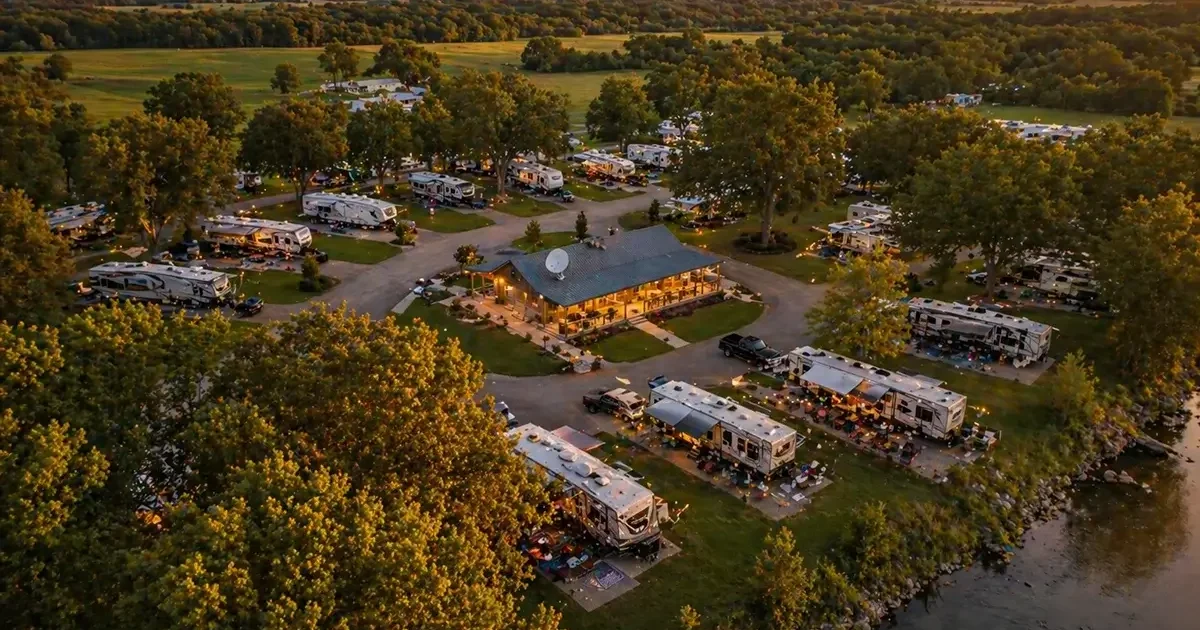
The explosive growth of RV travel and campground tourism since 2020 has created an urgent and unmet need: reliable, fast internet at rural RV parks and campgrounds. Travelers who work remotely expect the connectivity to do their jobs from anywhere. Families expect streaming entertainment. And campground owners who fail to meet these expectations see it directly in their reviews, bookings, and revenue. But rural campground internet is genuinely difficult — the same factors that make rural properties scenic and desirable (remoteness, trees, distance from infrastructure) make providing internet expensive and technically challenging. This comprehensive guide covers every viable rural campground internet solution available in 2026, from Starlink for campgrounds to shared cellular infrastructure, with real-world performance expectations and cost analysis for campground owners and managers.
In This Guide
- Why Rural Campground Internet Matters in 2026
- Unique Challenges of Campground Internet
- Starlink for Campgrounds: Options and Setup
- Cellular Boosters for Campground Coverage
- Distributing Wi-Fi Across Campground Sites
- Bandwidth Management for Multiple Users
- For Guests: Getting Good Internet at Rural Campgrounds
- Cost Analysis for Campground Owners
- Implementation Tips
- FAQs
Why Rural Campground Internet Matters in 2026
The RV industry experienced a massive structural shift beginning in 2020 that has permanently changed the internet expectations of campground guests. Remote work — which was a fringe phenomenon before 2020 — is now a routine reality for millions of Americans, many of whom specifically chose RV travel as a lifestyle enabled by remote work. These “digital nomads” and full-time RVers are not occasional vacationers who can tolerate spotty connectivity for a weekend. They are working professionals who need to make client calls, upload presentations, join video meetings, and maintain reliable internet access as a professional necessity.
Review data from major campground platforms including Campendium, Dyrt, and RVillage consistently shows that internet quality is among the top three factors (alongside hookup reliability and cleanliness) determining guest satisfaction ratings and repeat visit rates. Campgrounds that provide reliable 25+ Mbps Wi-Fi command premium booking rates and maintain stronger occupancy than comparable properties with poor connectivity. A campground rated “poor Wi-Fi” on major platforms loses bookings from the rapidly growing remote worker demographic regardless of how beautiful its setting is.
Unique Challenges of Campground Internet
Providing internet to a rural campground is fundamentally different from providing internet to a rural home or business:
- Many simultaneous users: A 50-site campground at capacity may have 100–200 people simultaneously streaming, gaming, working, and browsing. The aggregate bandwidth demand dwarfs what a single household uses.
- High churn: Users come and go constantly, each expecting instant, reliable connectivity without complex setup. Campground Wi-Fi must work on every device type, every operating system, and accommodate users of all technical skill levels.
- Distributed physical coverage area: A typical rural campground may span 5–50 acres. Getting Wi-Fi signal to a site 1/4 mile from the office requires either distributed access points or a powerful enough base station — both require infrastructure investment.
- Power and shelter at remote sites: Installing outdoor access points requires power and weatherproof enclosures in locations far from existing electrical infrastructure.
- Seasonal usage patterns: Many rural campgrounds are heavily used in summer and essentially empty in winter, creating economics where expensive infrastructure is being amortized over partial-year revenue.
Starlink for Campgrounds: Options and Setup
Starlink has become the most popular backhaul solution for rural campgrounds without access to wired broadband — and for good reason. At 50–120 Mbps, Starlink provides more than enough backhaul bandwidth for a small campground’s total Wi-Fi needs when properly distributed. The options for campground Starlink deployment:
Starlink Business ($250/month) with unlimited priority data: The right tier for campground use. The 1 TB threshold on the Standard plan will be consumed very quickly at a busy campground. Business plan’s unlimited priority allocation ensures consistent performance regardless of how much data guests consume. A single Starlink Business connection can serve as backhaul for up to approximately 30–50 simultaneous moderate users — appropriate for smaller campgrounds of 20–40 sites.
Multiple Starlink dishes for larger campgrounds: For campgrounds with 50+ sites or consistent 90%+ occupancy, two or three Starlink Business connections aggregated through a multi-WAN router (Peplink Balance or Cisco Meraki) provide the combined bandwidth (150–360 Mbps combined) and redundancy appropriate for a professional campground operation. This is also the failover strategy — if one dish goes down, the others maintain service.
Starlink dish placement for campground coverage: Mount the Starlink dish at the highest available point on the property — a rooftop, a water tower, a tall utility pole. The dish needs clear sky access but its exact position relative to campground sites doesn’t matter for satellite reception. The Wi-Fi distribution network (discussed below) handles coverage across the campground.
Cellular Boosters for Campground Guest Mobile Service
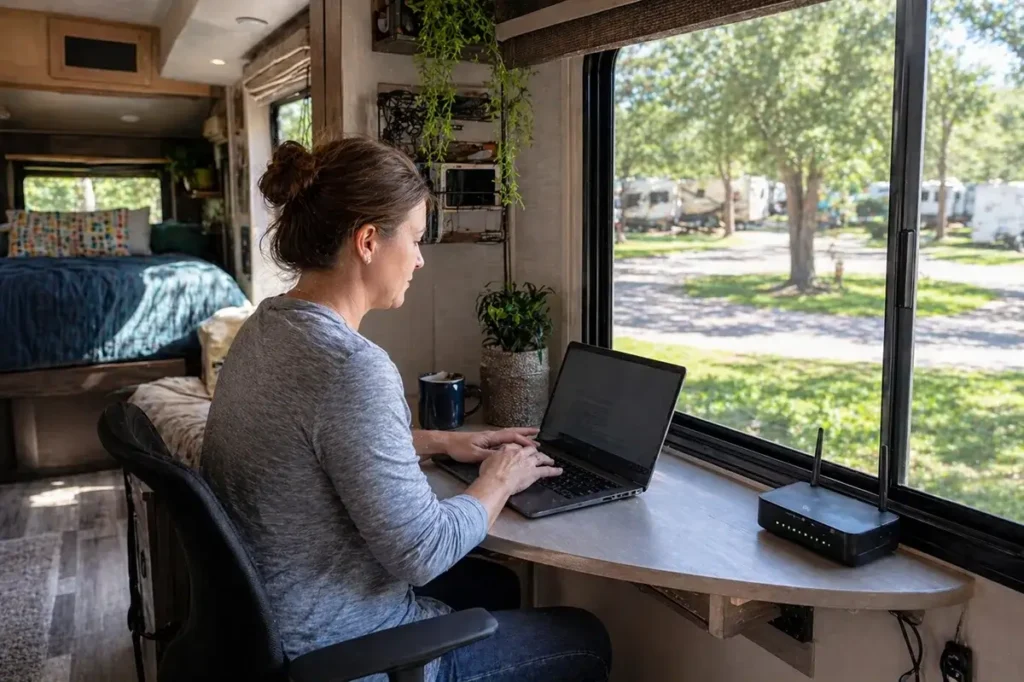
While campground-provided Wi-Fi covers the internet access need, guests also need cellular voice service — for safety, for calls that shouldn’t route over campground Wi-Fi, and for times when the Wi-Fi is congested or down. Rural campgrounds with poor cellular coverage frustrate guests and create safety concerns for emergency calls.
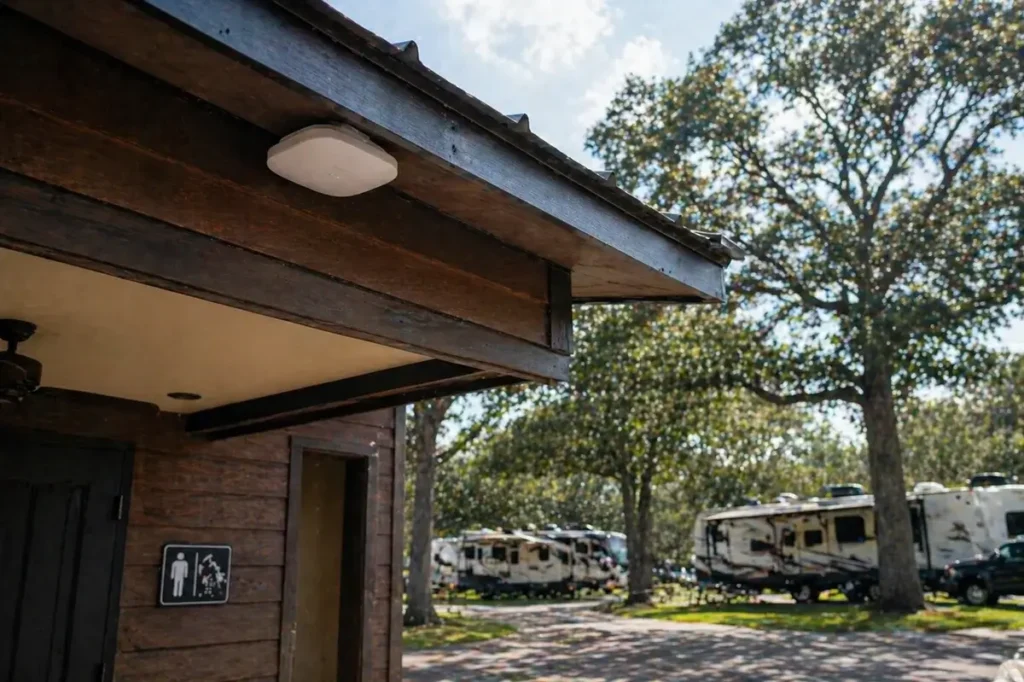
A commercial-grade cellular signal booster — specifically the Wilson Pro 70 Plus ($1,099) or the SureCall Force5 2.0 ($1,500–$2,000) — can dramatically improve cellular voice coverage across a campground property. These commercial boosters support coverage areas up to 25,000–100,000 square feet and operate simultaneously for all major carriers. Install outdoor directional antennas pointed at the nearest towers of the strongest available carriers, run coaxial cable to a central amplifier, and distribute indoor panel antennas across the reception building, restrooms, and laundry facilities where cellular coverage matters most.
Distributing Wi-Fi Across Campground Sites
The Starlink connection or other backhaul provides the internet — but getting that internet to guests across dozens of acres requires a distributed Wi-Fi infrastructure:
Outdoor access point network (best for larger campgrounds): Enterprise-grade outdoor access points from Ubiquiti (UniFi U6 Outdoor), Cambium Networks, or Cisco Meraki mounted on utility poles, trees, or dedicated mast poles throughout the campground provide site-level Wi-Fi coverage. Each access point covers approximately 150–300 feet in a campground environment (less than its theoretical range due to RVs and foliage obstructing signal). A 40-site campground typically needs 8–15 outdoor access points to provide consistent coverage. Run direct-burial Cat6 Ethernet cable from a central switch to each access point — outdoor Ethernet over PoE (Power over Ethernet) eliminates the need for separate power at each access point location.
Cost for outdoor access point campground Wi-Fi: UniFi U6 Outdoor access points cost approximately $179–$229 each. A 12-unit deployment for a 40-site campground costs approximately $2,200–$2,750 for hardware. Add $500–$1,000 for network switches, $500–$2,000 for direct-burial cable and installation labor. Total infrastructure investment: approximately $3,200–$5,750 for the distribution hardware, plus the Starlink dish and subscription costs. ROI is typically under 2 years at standard campground booking rates.
Long-range access point for smaller campgrounds: A single high-powered Ubiquiti UniFi AP Outdoor+ or similar long-range access point can provide adequate coverage for campgrounds under 5 acres where all sites are within 300–400 feet of the office building. This is the lowest-cost starting point — a single outdoor AP costs $150–$300 and provides serviceable coverage for small rural campgrounds without requiring distributed infrastructure.
Bandwidth Management for Multi-User Campground Networks
Without bandwidth management, a small number of guests streaming 4K video or downloading large files will saturate the network for everyone. Professional campground Wi-Fi requires:
- Per-device bandwidth limits: Configure the network to limit each connected device to 5–15 Mbps download and 5 Mbps upload. This is adequate for HD video streaming and video calls while preventing any single device from monopolizing the shared connection. Ubiquiti UniFi and Cisco Meraki both support per-device rate limiting in their management interfaces.
- Guest network isolation: Guest Wi-Fi should be configured to prevent devices from seeing or communicating with each other on the network — a security practice that also prevents bandwidth-heavy device-to-device transfers.
- QoS prioritization: Configure the network to prioritize video call traffic (using DSCP markings) over bulk file downloads and streaming — this ensures remote workers have the responsive connection needed for professional calls even during periods of high network load.
- Hotspot-style login portal: A captive portal (login page that guests see when first connecting) allows the campground to present Wi-Fi terms of use, collect email addresses for marketing, and display usage policies. UniFi provides a built-in hotspot system; third-party solutions like Tanaza or Cucumber Tony integrate with most hardware.
For Campground Guests: Getting Good Internet at Rural Campgrounds
Rural campground Wi-Fi varies enormously in quality. Practical strategies for guests who need reliable connectivity:
- Bring your own Starlink with Roam plan. The most reliable rural campground internet is your own Starlink — deploy the dish when you arrive, connect your own router, and have guaranteed performance independent of the campground’s infrastructure. This is increasingly common among full-time RVers and remote workers.
- Request a site near the main building. Campground Wi-Fi is always strongest near the office or recreation hall where the router is located. Request a site in that zone when booking.
- Check campground Wi-Fi ratings on Campendium or Dyrt before booking. Both platforms include user-reported cellular signal strength and Wi-Fi quality for thousands of campgrounds, giving realistic pre-arrival expectations.
- Use a cellular booster in your RV. A vehicle-mounted weBoost Drive Reach ($500) or SureCall Fusion2Go ($300) boosts cellular signal inside your RV, improving both mobile cellular voice service and hotspot data performance when campground Wi-Fi is inadequate.
Frequently Asked Questions
How much internet does a rural campground need?
A rough calculation: each active campsite needs 5–10 Mbps of available backhaul bandwidth to support typical guest usage (video streaming, video calls, general browsing). For a 40-site campground at 75% occupancy with peak evening usage, plan for 150–300 Mbps of total backhaul capacity. Two Starlink Business connections (2 × 70–100 Mbps = 140–200 Mbps combined) adequately serves most campgrounds of this size during typical usage patterns.
Can I share a residential Starlink connection with campground guests?
Technically possible but not recommended. Starlink’s residential Terms of Service prohibit reselling or sharing service as a commercial Wi-Fi hotspot. The Business plan is the appropriate product for commercial campground use. Additionally, residential Starlink’s 1 TB priority data threshold will be rapidly consumed by a campground’s aggregate guest usage — the Business plan’s unlimited priority allocation is operationally necessary for consistent campground performance.
What is the best cellular booster for a rural campground?
For campground-wide cellular improvement, the Wilson Pro 70 Plus (formerly Wilson Electronics) is the leading commercial-grade booster for this application. It supports up to 25,000 sq ft of indoor coverage, all US carriers simultaneously, and can be expanded with additional indoor antennas for larger coverage areas. For outdoor campsite coverage, the system requires directional outdoor Yagi antennas on a tall mast plus the Pro 70 Plus amplifier in a weatherproof enclosure.
What is the best outdoor Wi-Fi access point for a rural campground?
The Ubiquiti UniFi U6 Outdoor is the most popular choice for rural campground outdoor Wi-Fi deployments. At $179–$229, it delivers enterprise-grade Wi-Fi 6 performance in a fully weatherproof (IP67) enclosure designed for permanent outdoor installation. It connects via a single PoE Ethernet cable (eliminating the need for separate power at each access point location) and integrates with Ubiquiti’s UniFi Network software for centralized management of all access points, bandwidth limits, and guest network settings. For campgrounds managing 5+ access points, the UniFi Controller interface provides the visibility needed to identify which access points are overloaded, which sites have poor signal coverage, and how total bandwidth consumption is distributed across the property.
How do I prevent guests from downloading large files and slowing down the campground Wi-Fi for everyone?
Configure per-device download speed limits in your access point management software. In UniFi, this is done through the Guest Portal settings where you can set a maximum download rate per client. Setting this to 8–10 Mbps per device prevents any single user from consuming excessive bandwidth while still allowing smooth HD streaming and video calls. Additionally, configure traffic shaping to deprioritize bulk file transfer protocols (FTP, BitTorrent, large HTTP downloads) relative to streaming and video call traffic — ensuring that one guest downloading a game update doesn’t degrade video call quality for remote workers at neighboring sites.

Leave a Reply