
Mississippi has the most severe rural broadband gap of any state in the continental United States. As the nation’s most rural state by percentage of rural population, and one of its poorest, Mississippi faces a compounding connectivity crisis where geographic isolation, economic barriers, and historical infrastructure underinvestment intersect. According to the FCC’s broadband data, Mississippi consistently ranks last or near-last in every broadband access metric — from percentage of rural locations with service to broadband adoption rates among existing rural households. Yet 2026 is a year of meaningful change for rural Mississippi: Starlink’s coverage is universal, federal BEAD investment in the state is substantial, and several electric cooperatives have launched ambitious fiber programs that are beginning to transform connectivity in communities that have waited decades for adequate internet. This complete guide covers every rural internet option available in Mississippi today.
In This Guide
- Mississippi Rural Broadband: The Full Picture
- Internet Options by Mississippi Region
- Starlink in Mississippi
- Cellular Options in Rural Mississippi
- Mississippi Electric Cooperatives and Fiber
- Mississippi State Broadband Programs
- BEAD Program: Mississippi’s Investment
- The Mississippi Delta: A Special Focus
- Practical Tips for Rural Mississippi Residents
- Frequently Asked Questions
Mississippi Rural Broadband: The Full Picture
Mississippi’s broadband crisis is both severe and deeply rooted. The state has the highest percentage of rural population of any US state, the second-lowest median household income, and decades of limited private telecommunications investment in rural communities. The result is a connectivity gap that is not merely inconvenient but constitutes a genuine barrier to economic participation, educational access, healthcare delivery, and quality of life for hundreds of thousands of Mississippi residents.
According to the FCC National Broadband Map, Mississippi has more unserved rural addresses as a percentage of its total rural address count than any other state. Counties including Jefferson, Humphreys, Issaquena, Sharkey, Quitman, and Sunflower — all in the Mississippi Delta region — have broadband access deficits that represent some of the most severe connectivity gaps anywhere in the United States. The state’s African American rural population, concentrated in Delta and southwest Mississippi counties, has been disproportionately affected by the connectivity gap — a pattern that reflects broader historical patterns of infrastructure investment inequality.
The economic consequences are compounding. Rural Mississippi communities cannot attract remote workers, retain young adults who need internet access for careers, or support the agricultural technology adoption that makes farming operations competitive. Small businesses in rural Mississippi communities cannot operate the online-dependent business models that drive growth in connected rural areas. Telehealth — which could dramatically improve healthcare access for rural Mississippians far from specialist providers — is functionally inaccessible for households on legacy satellite internet’s 600 ms latency connections.
Internet Options by Mississippi Region
North Mississippi / DeSoto and Marshall Counties (Memphis Orbit)
The rural counties immediately adjacent to Memphis have better connectivity than the rest of rural Mississippi, driven by the metro’s infrastructure influence. DeSoto County has significant cable and fiber penetration in its suburban-rural communities. Marshall, Benton, and Alcorn counties in far north Mississippi have telephone cooperative DSL, some WISP coverage, and improving cellular options. T-Mobile Home Internet is more available in north Mississippi than elsewhere in the state due to better tower density from Memphis metro coverage. Starlink performs excellently throughout north Mississippi’s gently rolling terrain.
Northeast Mississippi (Lee, Pontotoc, Prentiss, Tishomingo Counties)
Northeast Mississippi around Tupelo has better connectivity than much of the state. Comcast serves Tupelo and some surrounding areas; North Mississippi Electric Power Association and several telephone cooperatives provide DSL in rural communities. The Natchez Trace corridor has better connectivity than interior rural roads. Starlink covers the entire northeast region with good performance in the lower-density rural cells.
Central Mississippi Piney Woods (Smith, Jasper, Clarke, Wayne Counties)
Central Mississippi’s pine forest region has limited fixed broadband penetration. Legacy telephone DSL exists in some communities at marginal speeds. Southern Pine Electric Power Association and its affiliated cooperatives have been among Mississippi’s most active in pursuing broadband deployment. Starlink performs well throughout the Piney Woods region with minimal obstruction concerns in the open pine landscape.
Southwest Mississippi (Jefferson, Claiborne, Copiah, Lincoln Counties)
Southwest Mississippi contains some of the state’s most severely underserved rural communities. Jefferson County — one of the most impoverished counties in the United States — has minimal broadband infrastructure. These communities are specifically prioritized in Mississippi’s BEAD implementation due to their combination of high unserved status and concentrated disadvantage. Starlink is the primary viable broadband option for most southwest Mississippi rural properties today.
The Mississippi Delta: A Special Focus
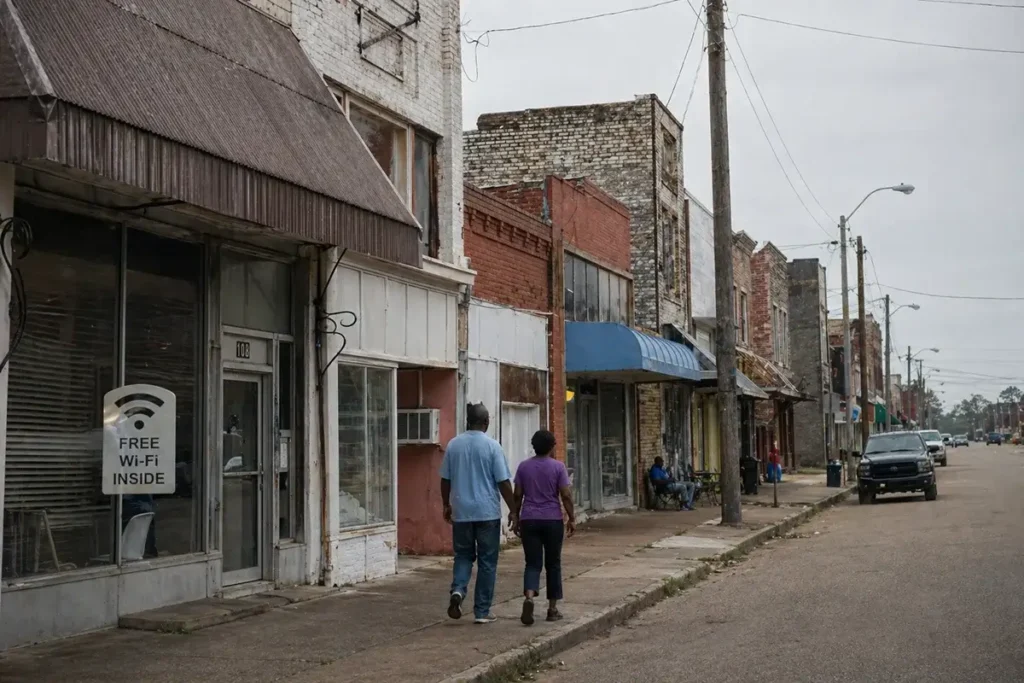
The Mississippi Delta — the alluvial plain between the Yazoo and Mississippi Rivers, encompassing counties like Bolivar, Sunflower, Leflore, Humphreys, Issaquena, Sharkey, Washington, and Warren — deserves specific attention as the most severely broadband-deficient region in the continental United States.
The Delta’s flat terrain is ideal for Starlink installation — the most open, unobstructed sky views imaginable. There is virtually no location in the Delta where a Starlink dish would have meaningful obstruction. Performance in Delta coverage cells is frequently among the strongest in Mississippi due to low user density — 100–140 Mbps speeds are commonly reported by Delta Starlink users, ironically among the fastest rural Starlink performance in the state.
The barrier to Starlink adoption in the Delta is economic, not geographic. The $349 hardware cost and $120/month service fee represent significant percentages of household income in counties where median household incomes are among the lowest in the nation. Bridging this affordability gap requires the subsidy programs discussed in the next section and the infrastructure investment of BEAD-funded deployments that will eventually provide lower-cost broadband options.
Several organizations are actively working on Delta connectivity. The Appalachian Regional Commission extends some programs to Delta communities through the Delta Regional Authority. The USDA’s Rural Partners Network has specifically designated the Mississippi Delta as a focus region. And Mississippi Power’s affiliated cooperatives in the Delta are pursuing BEAD funding for fiber deployment in previously unserved Delta communities.
Mississippi Electric Cooperatives and Fiber
Mississippi has 25 electric power associations (EPAs) — the Mississippi equivalent of electric membership cooperatives — serving rural members across the state. Several are leading rural broadband deployment:
- 4-County Electric Power Association: Serving members in Calhoun, Chickasaw, Grenada, and Webster counties with expanding fiber broadband using USDA ReConnect funding.
- Singing River Electric Power Association: Serving coastal Mississippi members in George, Greene, Jackson, and Wayne counties with broadband expansion.
- Southern Pine Electric Power Association: Among the most active Mississippi EPAs in rural broadband, serving members in Smith, Jasper, Clarke, and Wayne counties with fiber deployment plans.
- Delta Electric Power Association: Serving Delta region members in Bolivar, Sunflower, and Leflore counties with broadband planning — critically important given the Delta’s severe access gap.
Healthcare Access and Rural Mississippi Connectivity
Mississippi has some of the worst rural health outcomes in the United States — high rates of chronic disease, limited specialist access, and healthcare deserts where the nearest hospital is 60+ miles away. Telehealth has been identified by the Mississippi State Department of Health and rural health advocacy organizations as one of the most promising tools for improving rural health outcomes in the state — but only if the underlying connectivity supports it.
A rural Mississippi patient on HughesNet or Viasat attempting a telehealth appointment with a Jackson-based specialist experiences the same 600 ms latency degradation that makes telehealth video calls feel like a difficult international call — counterproductive to the therapeutic relationship and clinically inadequate for assessment purposes. The switch to Starlink ($120/month) transforms this same patient’s telehealth experience into a natural-feeling video conversation indistinguishable from an in-person office visit.
For low-income Mississippi rural households where the $120/month Starlink cost is a barrier, the FCC Lifeline Program ($9.25/month discount), Mississippi’s Medicaid program (which covers telehealth for qualifying patients), and HRSA rural health grant programs that sometimes include patient connectivity support are all relevant resources. Contact the Mississippi Primary Health Care Association or your local Federally Qualified Health Center for assistance navigating connectivity-for-telehealth programs in your community.
Education and Connectivity in Rural Mississippi
Mississippi’s rural school districts face connectivity-related educational equity challenges as severe as any in the country. The Mississippi Department of Education has documented that rural students in high-poverty districts — concentrated in the Delta, southwest Mississippi, and the Piney Woods — have significantly lower rates of home broadband access than students in urban areas, directly correlating with documented achievement gaps in digital skills and online learning participation.
The E-Rate program provides Mississippi’s rural schools with subsidized high-speed broadband, and many Mississippi rural schools now have 100 Mbps+ connectivity within the school building. The gap between excellent school connectivity and inadequate home connectivity is the defining broadband equity challenge for rural Mississippi students — a child who participates fully in online learning during school hours but cannot access online homework, digital textbooks, or virtual tutoring from home is experiencing a measurable educational disadvantage.
Mississippi’s BEAD implementation includes a specific digital equity component targeting the student homework gap, with provisions requiring BEAD-funded ISPs to offer affordable plans for qualifying low-income households. This component will eventually provide lower-cost broadband options for rural Mississippi families — but the implementation timeline means that students waiting for BEAD fiber will wait 3–5 years. For rural Mississippi families whose children need adequate connectivity for school today, Starlink with FCC Lifeline discount ($110.75/month after discount for qualifying households) is the most immediate solution available.
Mississippi State Broadband Programs
The Mississippi Department of Finance and Administration (DFA) administers Mississippi’s broadband programs and BEAD implementation. Mississippi received approximately $1.22 billion in BEAD Program federal funding — one of the largest per-capita allocations nationally, reflecting the depth and breadth of the state’s broadband deficit.
Mississippi’s BEAD implementation plan specifically prioritizes the state’s most underserved communities — the Delta counties, southwest Mississippi, and the Piney Woods region — for first-round infrastructure funding. The state has worked to ensure that the geographic and economic distribution of BEAD funding addresses the compounding disadvantage faced by rural communities that are simultaneously unserved by broadband, economically distressed, and historically underinvested.
Practical Tips for Rural Mississippi Residents
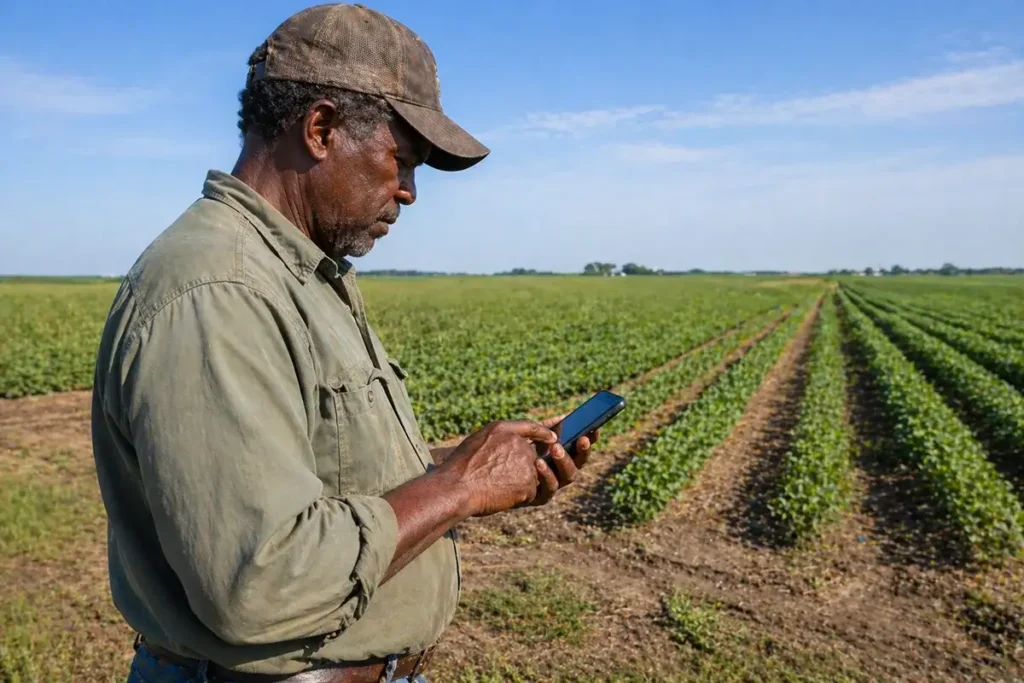
- Starlink is the best immediately available option for most of rural Mississippi. The flat Delta and coastal plain terrain makes installation effortless, and sparse rural coverage cells deliver consistently excellent performance. If cost is a barrier, check FCC Lifeline eligibility for a $9.25/month service discount.
- Contact your electric power association about broadband. Mississippi’s EPAs are increasingly deploying fiber with federal funding. Even if your EPA doesn’t yet offer broadband service, expressing member demand directly influences deployment priority decisions.
- Delta residents: Check whether a local community anchor institution — library, health clinic, community college — offers public broadband access. Many rural Mississippi libraries have been prioritized for E-Rate broadband upgrades specifically to provide community internet access where home broadband is unavailable or unaffordable.
- Challenge FCC broadband map inaccuracies. Mississippi has significant DSL overclaiming on the FCC map. Legacy telephone company DSL rated at 25 Mbps on paper may deliver 1–3 Mbps in reality on long copper runs. Challenging inaccurate coverage at broadbandmap.fcc.gov directly increases your county’s BEAD funding eligibility.
Frequently Asked Questions
What is the best internet for the Mississippi Delta in 2026?
Starlink satellite is the best available broadband for virtually all Delta rural properties in 2026. The Delta’s flat terrain makes it one of the easiest Starlink installation environments in the country, and the low user density in Delta coverage cells delivers consistently strong performance. Cost assistance through the FCC Lifeline program can reduce service costs for qualifying low-income Delta households. BEAD-funded fiber deployments from Delta Electric Power Association and other entities are expected to bring lower-cost wired alternatives beginning 2027–2029.
Is there any free internet for low-income rural Mississippi households?
Free home broadband is not widely available. The FCC Lifeline Program provides a $9.25/month discount for qualifying low-income households. Many Mississippi counties have E-Rate funded public library broadband that provides free community internet access. Some community organizations and schools have implemented community Wi-Fi networks serving nearby residential areas. Contact your county’s community action agency for current local assistance programs.
When will BEAD-funded broadband reach rural Mississippi?
Mississippi’s BEAD implementation is targeting the most severely unserved communities first. Early BEAD-funded deployments in priority counties are expected to begin construction in late 2026 or early 2027, with service delivery extending through 2029–2031 for the most remote rural communities. In the interim — which may be 3–5 years for the most remote addresses — Starlink provides the only viable broadband-class connection available today.


Leave a Reply