
Tennessee is a state of geographic contrasts that create wildly different rural internet experiences depending on which part of the state you call home. The Great Smoky Mountains and Cumberland Plateau in the east present terrain-related connectivity challenges comparable to West Virginia’s Appalachian communities. Middle Tennessee’s rolling farmland around Nashville’s outer counties has better infrastructure due to metro spillover. West Tennessee’s flat agricultural delta and river country resembles the connectivity challenges of rural Mississippi and Arkansas. In 2026, Tennessee rural residents have more options than ever before — but those options vary significantly by region, terrain, and proximity to infrastructure. This comprehensive guide covers every rural internet option across Tennessee’s diverse landscape.
In This Guide
- Tennessee Rural Broadband Overview
- Internet Options by Tennessee Region
- Starlink in Tennessee
- Cellular Options Across Rural Tennessee
- Tennessee WISPs and Telephone Cooperatives
- TVA and Tennessee Electric Cooperatives
- Tennessee State Broadband Programs
- BEAD Program Investment in Tennessee
- Practical Tips for Rural Tennessee Residents
- Frequently Asked Questions
Tennessee Rural Broadband Overview
Tennessee has approximately 1.8 million rural residents spread across 95 counties — a population that is disproportionately dependent on adequate broadband for healthcare access, agricultural business operations, education, and economic participation. According to the FCC National Broadband Map, Tennessee has significant concentrations of unserved addresses particularly in its eastern mountain counties and rural western agricultural counties.
The state’s connectivity landscape is shaped by three distinct geographic zones. East Tennessee’s Appalachian mountain communities share the terrain challenges of neighboring Virginia and North Carolina — steep-sided valleys, hollows with limited sky access, and communities historically dependent on legacy telephone cooperative DSL. Middle Tennessee’s agricultural and rural communities closer to Nashville benefit from better cellular infrastructure driven by the metro’s growth. West Tennessee’s flat river bottom farming communities lack the terrain obstacles of the east but have suffered from decades of limited private ISP investment.
Tennessee has a unique institutional advantage for rural broadband: the Tennessee Valley Authority (TVA) and its network of 153 local power distributors — primarily rural electric cooperatives — that serve the majority of the state’s territory. These utilities have existing infrastructure, right-of-way agreements, and trusted community relationships that make them natural broadband deployment partners. Several Tennessee electric cooperatives have launched active fiber broadband programs, and TVA has been a consistent advocate for rural connectivity investment in its service territory.
Internet Options by Tennessee Region
East Tennessee — Smoky Mountains and Ridge-and-Valley (Knox, Sevier, Blount, Cocke, Carter Counties)
East Tennessee’s mountain and valley communities have a complex connectivity landscape. Communities in the Knoxville metro orbit have reasonable broadband access through cable and fiber providers serving the urban core’s rural fringe. Communities deeper into the Smokies and the parallel ridges of the Valley and Ridge province face more serious challenges. Sevier County’s tourism infrastructure has driven commercial broadband investment along the Pigeon Forge-Gatlinburg corridor, but rural residential communities a few miles off the main tourist routes may have only DSL or satellite. Starlink performs well for most ridge and upper-slope properties but requires sky obstruction assessment for hollow-bottom locations typical of Appalachian settlement patterns.
Cumberland Plateau (Cumberland, Fentress, Overton, Pickett, Scott Counties)
The Cumberland Plateau — the broad, forested upland that separates East and Middle Tennessee — contains some of the state’s most isolated rural communities. Scott County consistently ranks among the least broadband-connected counties in Tennessee. The plateau’s flat tabletop terrain actually facilitates Starlink installation better than the steep ridge-and-valley country to the east and west. But fixed wireless tower coverage on the plateau has historically been limited. Several rural telephone cooperatives serve parts of the plateau with DSL at varying quality levels. Volunteer Electric Cooperative has been among the most active TVA distributors pursuing fiber broadband in this region.
Middle Tennessee — Nashville Rural Fringe (Williamson, Rutherford, Wilson, Smith, Macon Counties)
The rural counties surrounding Nashville have seen dramatic population growth and infrastructure investment driven by the metro’s expansion. Williamson and Rutherford counties’ rural areas have relatively good broadband options including some cable and fiber coverage reaching rural communities. Farther from the metro core — Smith, Macon, Trousdale, and Clay counties — rural connectivity drops significantly. T-Mobile Home Internet eligibility is better in Middle Tennessee’s Nashville orbit than elsewhere in the state. Starlink performs excellently across Middle Tennessee’s gently rolling landscape.
West Tennessee — Delta and River Bottom (Dyer, Lake, Obion, Haywood, Tipton Counties)
West Tennessee’s agricultural counties — cotton, soybeans, corn, and the remnants of the state’s soybean processing industry — have flat terrain ideal for fixed wireless tower coverage but have historically suffered from limited ISP investment. Haywood County has been documented as among the least broadband-connected counties in Tennessee. The region’s proximity to Memphis provides cellular coverage along the I-40 and US-70 corridors but leaves interior agricultural communities with limited options. Starlink’s flat terrain advantage is most pronounced in West Tennessee, where virtually any property has excellent northern sky clearance with no mast required.
TVA and Tennessee Electric Cooperatives
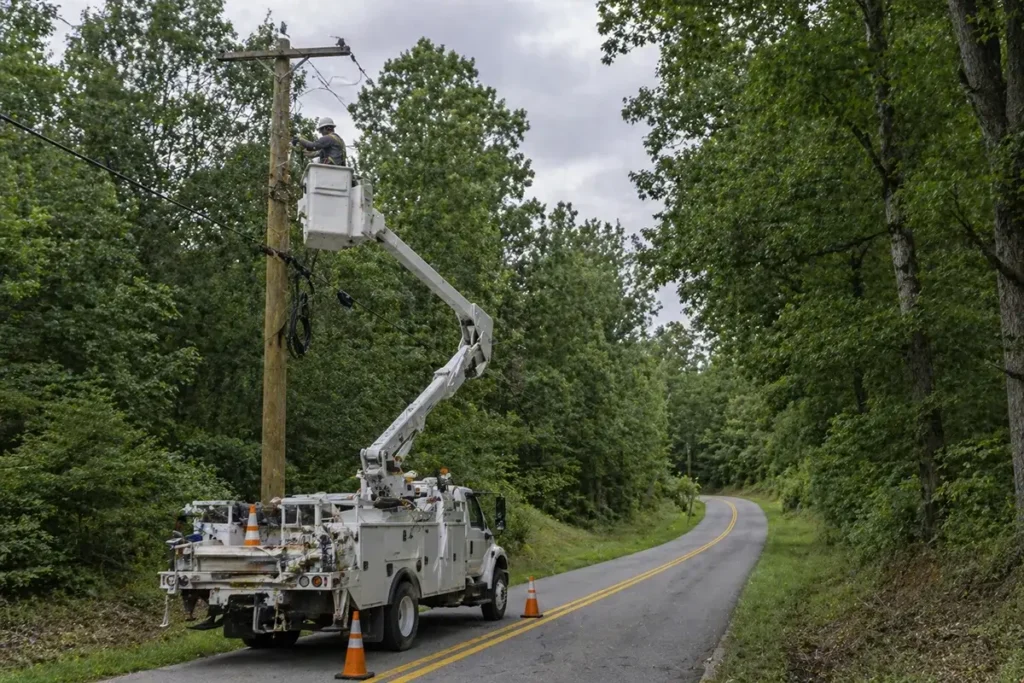
The Tennessee Valley Authority’s network of local power distributors is one of Tennessee’s most significant rural broadband assets. Several TVA distributor cooperatives have launched or are planning substantial fiber broadband programs:
- Volunteer Electric Cooperative: Serving portions of the Cumberland Plateau, Volunteer Electric has been one of Tennessee’s most aggressive electric cooperative broadband deployers, building fiber to rural members in Anderson, Campbell, Claiborne, Fentress, and Scott counties using USDA ReConnect funding.
- Holston Electric Cooperative: Serving northeast Tennessee including parts of Hawkins, Sullivan, and Washington counties with expanding fiber services.
- Duck River Electric Membership Corporation: Serving Middle Tennessee rural members in Bedford, Coffee, Franklin, Giles, Lawrence, Lincoln, Marshall, and Moore counties with broadband expansion plans.
- Pickwick Electric Cooperative: Serving rural Hardin and McNairy counties in far West Tennessee.
If you are a Tennessee electric cooperative member, contact your cooperative directly about broadband plans — TVA has encouraged all its distributors to evaluate broadband deployment, and programs not yet publicly announced may be in planning stages.
Tennessee State Broadband Programs
The Tennessee Department of Economic and Community Development (TNECD) administers Tennessee’s broadband programs through its Office of Rural and Community Connectivity. Tennessee received approximately $843 million in BEAD Program federal funding. The state’s BEAD implementation prioritizes the unserved locations in the eastern mountain counties and western agricultural counties identified by the FCC broadband map as lacking any fixed broadband service.
Tennessee’s broadband program has also been supported by state-level grant funding through the Tennessee Emergency Broadband Fund established during the pandemic, which provided early-stage rural broadband infrastructure grants before BEAD funds became available. Several of these early-funded projects are now in service, bringing first-ever broadband to previously unserved Tennessee rural communities.
Cellular Options for Rural Tennessee in 2026
Cellular home internet and hotspot options vary significantly across Tennessee’s geographic regions. Understanding which carrier performs best in your specific county can save both money and frustration.
Verizon in rural Tennessee: Verizon maintains the strongest rural Tennessee cellular network, particularly in Middle and West Tennessee. Verizon’s 700 MHz Band 13 provides long-range LTE coverage in the agricultural flatlands of West Tennessee and the broader valleys of Middle Tennessee. For rural Tennessee residents considering a cellular hotspot or Verizon Home Internet, check eligibility — Verizon’s rural coverage depth often surprises residents who assumed they were out of range.
AT&T FirstNet in East Tennessee: AT&T’s FirstNet rural expansion has been particularly significant in East Tennessee’s mountain counties, where emergency responder coverage requirements have driven infrastructure investment in hollows and valleys previously without any AT&T service. Rural residents in Cocke, Carter, and Unicoi counties have seen improved AT&T coverage through FirstNet tower deployments that weren’t commercially justifiable before the federal mandate.
T-Mobile in Tennessee: T-Mobile’s 600 MHz Band 71 low-band 5G coverage blankets most of Tennessee’s rural landscape, but Home Internet eligibility is more limited than mobile phone coverage. The Nashville and Memphis metro fringes have the best T-Mobile Home Internet availability. Check your specific address at T-Mobile’s website — availability has expanded significantly in 2025–2026 across Middle Tennessee’s rural communities.
Tennessee’s Connectivity Future: 2026–2030
Tennessee’s rural broadband trajectory is more optimistic than it has been at any prior point. The combination of $843 million in BEAD funding, active electric cooperative fiber programs, and continued Starlink coverage creates a roadmap where the vast majority of rural Tennessee households will have multiple broadband options by 2030 — a situation that would have seemed impossible as recently as 2020.
For rural Tennesseans making connectivity decisions today, the practical guidance is: don’t wait for future infrastructure if you need broadband now. Starlink provides broadband-quality internet today at any rural Tennessee property with adequate sky access. The BEAD-funded fiber that will eventually reach your community is an improvement to build toward, not a reason to defer adequate connectivity in the interim.
Track Tennessee broadband deployment progress through the TNECD broadband office and your local electric cooperative’s communications. When fiber becomes available in your area, the transition from Starlink to fiber is straightforward — the home network infrastructure (router, switches, wired drops) remains the same; only the WAN connection changes.
Practical Tips for Rural Tennessee Residents
- East Tennessee mountain residents: Run the Starlink app’s sky scanner from your property before ordering. Tennessee’s Ridge-and-Valley and Smoky Mountain terrain creates more sky obstruction challenges than Middle or West Tennessee. A 15–25 foot mast resolves most partial obstruction situations.
- Contact your electric cooperative. With multiple Tennessee cooperatives actively deploying fiber using USDA ReConnect and BEAD funds, your cooperative may have broadband service planned for your area within the next 1–2 years. Being a vocal member who requests service influences cooperative leadership’s deployment priority.
- West Tennessee residents: Your flat terrain makes Starlink installation effortless and performs excellently. Check T-Mobile Home Internet availability first at $50/month — Memphis-market T-Mobile coverage extends more deeply into West Tennessee than in the mountainous east.
- File FCC broadband map challenges. Tennessee has documented ISP overclaiming, particularly from legacy telephone companies reporting DSL coverage at theoretical rather than actual delivered speeds. Challenging inaccurate coverage at broadbandmap.fcc.gov improves your county’s BEAD eligibility.

Frequently Asked Questions
What is the best internet for rural east Tennessee?
For most rural east Tennessee properties, the priority order is: (1) check local WISP or telephone cooperative DSL/fiber availability — several east TN co-ops have active fiber programs; (2) check T-Mobile Home Internet availability; (3) Starlink satellite as the universal fallback option that works at virtually any property with adequate sky clearance. Properties in the deep Smokies or Cumberland Plateau without DSL or WISP options should proceed directly to Starlink.
Is Starlink available in the Great Smoky Mountains area of Tennessee?
Yes, statewide. Sevier, Blount, and Cocke county rural properties with adequate northern sky views achieve excellent Starlink performance. The Smokies’ forested ridges and north-facing hollow aspects create obstruction challenges for some valley-bottom properties — always use the Starlink app’s obstruction scanner before ordering at any mountain property.
When will fiber internet reach rural Tennessee?
Timeline varies significantly by county and cooperative. Electric cooperative fiber projects in Scott, Fentress, and Campbell counties are in active construction phases with service expected by 2026–2027. BEAD-funded projects across the state are in planning and procurement stages, with construction beginning 2026–2027 and service delivery extending through 2028–2030 for the most remote communities.
What is the cheapest rural internet option in Tennessee in 2026?
T-Mobile Home Internet at $50/month is the cheapest rural broadband option where available in Tennessee. Check eligibility at your address first — coverage is best in Middle Tennessee near Nashville and in larger East Tennessee communities. Where T-Mobile is unavailable, Verizon Home Internet at $25/month (with qualifying Verizon wireless plan) is the next lowest-cost option. For properties without cellular home internet eligibility, Starlink at $120/month is the most cost-effective broadband solution that provides consistent performance. HughesNet and Viasat entry plans start lower but their data cap limitations and high latency make them inadequate for households with modern internet needs.
Does Tennessee have rural broadband programs for low-income households?
Tennessee participates in the federal FCC Lifeline Program providing a $9.25/month discount on internet service for qualifying low-income households — applicable to Starlink and cellular providers. Several Tennessee electric cooperatives include affordability provisions in their fiber broadband programs for low-income member households. Contact your local cooperative or the Tennessee Department of Economic and Community Development’s broadband office for current state-level assistance programs. BEAD Program implementation in Tennessee will include digital equity components requiring subsidized plans for qualifying households in funded service areas.



Leave a Reply