Kentucky’s rural broadband crisis is one of the most well-documented and deeply rooted in the nation. A state where 42% of residents live in rural areas — and where the Eastern Kentucky coalfields represent some of the most persistently poverty-stricken and infrastructure-deficient communities in America — Kentucky has consistently ranked near the bottom of national broadband access rankings. Yet 2026 represents a genuine inflection point for rural Kentucky connectivity. Starlink’s coverage transforms what’s possible for any property with a sky view. The KY BEAD Program implementation is actively funding infrastructure. And organizations from the Appalachian Regional Commission to the federal Economic Development Administration are treating rural Kentucky broadband as economic development infrastructure. This comprehensive guide covers every rural internet option available in Kentucky in 2026, with region-specific analysis and realistic timelines for improvement.
In This Guide
- Kentucky Rural Broadband Overview
- Eastern Kentucky: The Hardest Cases
- Internet Options by Kentucky Region
- Starlink in Kentucky
- Kentucky WISPs and Telephone Cooperatives
- Kentucky State Broadband Programs
- Appalachian Regional Commission and EDA Investment
- Connectivity and Economic Transition in Coal Country
- Practical Tips for Rural Kentucky Residents
- FAQs
Kentucky Rural Broadband Overview
Kentucky’s geography creates a perfect storm of rural connectivity challenges. The Appalachian Mountains in the east create the same terrain-related infrastructure barriers seen in West Virginia. The state’s agricultural counties in the Bluegrass, Pennyroyal, and Western Coalfields regions have lower population densities that deter commercial ISP investment. And decades of economic decline in the eastern coalfields have left communities without the economic vitality that typically drives private infrastructure investment.
According to FCC broadband coverage data, Kentucky has among the highest percentages of rural addresses lacking access to 100/20 Mbps broadband of any state east of the Mississippi. Counties in eastern Kentucky — Breathitt, Knott, Letcher, Perry, Floyd, Martin, and Pike counties among others — have broadband access deficits comparable to the worst-served rural counties in the nation, despite being located in the eastern United States rather than the vast expanses of western states.
The stakes of broadband connectivity in eastern Kentucky are particularly high because connectivity is widely understood as a prerequisite for the region’s economic diversification beyond coal. Remote work opportunities, tech sector growth, e-commerce, and digital entrepreneurship all require reliable broadband. For a region where coal employment has declined by more than 70% since 2008 and alternative economic opportunities have been severely limited, broadband access is not merely a quality-of-life amenity — it is economic lifeline infrastructure.
Eastern Kentucky: The Hardest Cases
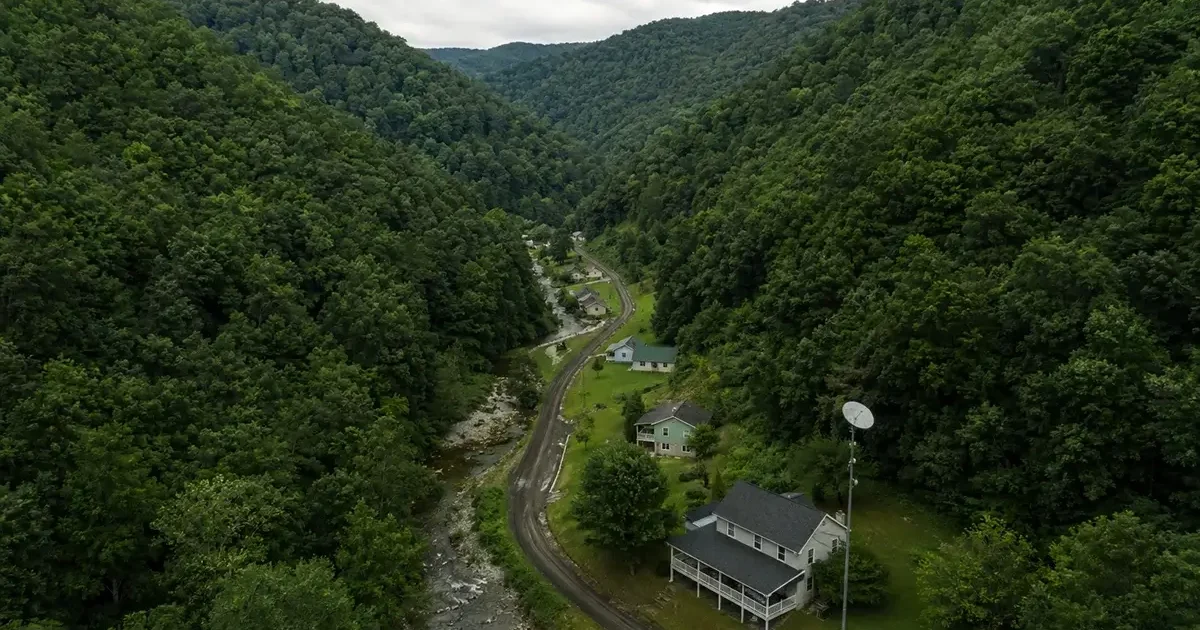
Eastern Kentucky’s connectivity challenge deserves specific attention because it represents one of the most complex rural broadband problems in the country. The combination of steep-sided Appalachian hollows (called “hollers” locally), coal roads that serve as the only access to many communities, legacy telecommunications underinvestment, and deep poverty creates a situation where standard market-based connectivity solutions have consistently failed.
The geography is the primary obstacle. Eastern Kentucky’s ridges and hollows create extreme signal challenges for all wireless technologies. A cell tower on a ridgeline may cover ridge-top properties and the upper slopes but cannot reach the communities at the bottom of the hollow below. A hollow-bottom community may have ridge walls on three sides that block satellite sky views except through a narrow opening — potentially limiting even Starlink’s viability without significant mast installation height.
Fiber-optic cable is the long-term solution for eastern Kentucky’s most remote communities — it is immune to terrain-based signal challenges. But the cost of burying fiber in eastern Kentucky’s rugged terrain is among the highest per-mile costs of any rural US geography. Without substantial government subsidy through BEAD, ReConnect, and ARC funding, private ISPs cannot economically justify deployment in the region’s most isolated communities.
Internet Options by Kentucky Region
Eastern Kentucky Coalfields (Pike, Floyd, Johnson, Magoffin, Breathitt, Knott, Letcher Counties)
Eastern Kentucky’s coal country counties have the state’s most severe broadband gaps and the most challenging terrain. Starlink is available statewide but ridge-top and open-area properties have the best performance while hollow-bottom sites need evaluation. Legacy telephone companies (Windstream, AT&T successor entities, and rural telephone cooperatives) provide DSL at varying quality levels — from marginally adequate near switching infrastructure to completely inadequate 1–2 Mbps service many miles from the equipment. Cellular coverage varies significantly by carrier: AT&T FirstNet has been building rural Kentucky coverage using federal emergency responder network investment. T-Mobile Home Internet eligibility is very limited in deep eastern Kentucky. Verizon has the strongest overall rural Kentucky cellular network.
Central Kentucky / Bluegrass Region (Bourbon, Clark, Casey, Adair, Taylor Counties)
Central Kentucky outside the Lexington metro has better connectivity than eastern Kentucky but still significant rural gaps in the agricultural and smaller town communities. Horse country counties like Bourbon, Scott, and Woodford near Lexington have some broadband access from the metro’s infrastructure outreach, but rural communities farther from major centers depend on telephone cooperative DSL, some WISPs, and increasingly Starlink. T-Mobile Home Internet availability is better in central Kentucky than in the mountains.
Western Kentucky (Muhlenberg, Ohio, Butler, Logan, Todd Counties)
Western Kentucky’s gently rolling terrain between the Pennyroyal Plateau and the Ohio River is more infrastructure-friendly than eastern Kentucky but still has significant rural broadband gaps. Several rural telephone cooperatives operate in this region, and electric cooperative broadband initiatives have made progress. The flat-to-rolling terrain is excellent for Starlink installation — no terrain obstruction concerns in most of this region. T-Mobile’s rural western Kentucky coverage is generally better than in eastern Kentucky.
Appalachian Transition Zone (Rowan, Menifee, Morgan, Wolfe, Powell Counties)
The transition counties between the Bluegrass and the eastern coalfields — sometimes called the “Knobs” region — have terrain challenges without the extreme remoteness of the deep coalfields. Several WISPs serve specific corridors in this region. Starlink performs well across most of this landscape given adequate installation site selection. This region has been a focus of SOAR (Shaping Our Appalachian Region) broadband initiatives alongside the broader eastern Kentucky focus.

Purchase Region (McCracken, Graves, Marshall, Calloway Counties)
The far western Purchase region of Kentucky — the state’s westernmost counties between Tennessee River and the Mississippi — has relatively better connectivity than eastern Kentucky, with some cable provider service in larger communities and reasonable DSL in smaller towns. Rural agricultural areas between towns still have gaps. Starlink serves this region well with open terrain similar to western Tennessee and Missouri. T-Mobile Home Internet availability is better here than elsewhere in rural Kentucky.
Starlink in Kentucky
Starlink is available statewide in Kentucky with no waitlist. Performance varies by location:
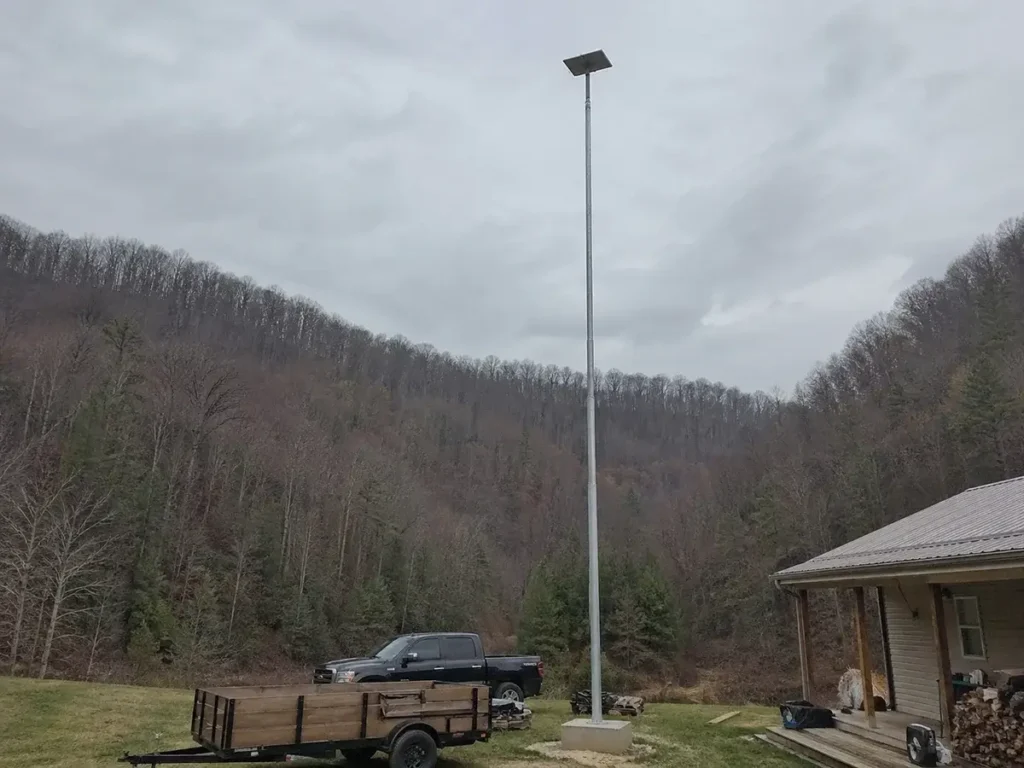
- Eastern Kentucky: Good performance for ridge and slope properties with clear sky views. Hollow-bottom properties — particularly those in narrow north-south oriented hollows with high ridges blocking the north — need sky obstruction assessment before ordering. The Starlink app’s AR scanner is essential pre-purchase due diligence for any eastern Kentucky property. A 20–40 foot mast resolves most partial obstruction issues.
- Central and Western Kentucky: Excellent Starlink conditions — rolling terrain provides clear sky views, coverage cells are relatively uncongested in rural areas, and installation is straightforward. Users in these regions report 80–130 Mbps median download speeds.
- Seasonal considerations: Kentucky’s deciduous forests change significantly between winter (bare trees) and summer (full foliage). A Starlink installation that works perfectly in January may develop obstruction issues in July as nearby trees leaf out. Use the app to scan in summer if possible before committing to an installation location. Consider whether clearing a few branches would improve the year-round sky view.
Kentucky WISPs and Telephone Cooperatives
Kentucky has a network of rural telephone cooperatives that serve specific geographic areas with DSL, and in some cases, newer broadband technologies:
- Peoples Rural Telephone Cooperative (PRTC): Serving eastern Kentucky communities including parts of Morgan, Wolfe, and Breathitt counties with telephone and broadband services.
- Mountain Rural Telephone Cooperative: One of the more progressive eastern Kentucky co-ops, serving parts of Lawrence, Johnson, and neighboring counties with expanding fiber services using ReConnect funding.
- South Central Rural Telephone Cooperative: Serving south-central Kentucky communities with telephone and DSL services, expanding to fiber in some areas.
- Barbourville Utility Commission: Knox County-based utility with broadband service expansion.
- Various WISPs: Multiple small fixed wireless providers operate in Kentucky’s more accessible rural areas. Contact your county extension office for local provider information.
Kentucky State Broadband Programs
Kentucky has established the Kentucky Office of Broadband Development (KOBD) under the Kentucky Cabinet for Economic Development to coordinate state broadband investment and BEAD Program implementation. Kentucky received approximately $1.04 billion in BEAD Program federal funding — a substantial allocation reflecting the depth of the state’s broadband access deficit.
Kentucky’s BEAD implementation plan specifically addresses eastern Kentucky as a priority, with the recognition that connecting these communities is both an economic development imperative and a matter of rural equity. KOBD has worked with the Appalachian Regional Commission, Eastern Kentucky PRIDE, and local community development organizations to ensure BEAD planning reflects on-the-ground community needs in the coalfields.
Appalachian Regional Commission Investment
The Appalachian Regional Commission (ARC) has been one of the most active federal partners in eastern Kentucky broadband, investing in both infrastructure projects and digital inclusion programs across the 13-state Appalachian region. ARC’s POWER (Partnerships for Opportunity and Workforce and Economic Revitalization) initiative has funded broadband infrastructure in Kentucky coal-impacted counties as a core economic diversification strategy.
ARC’s position — unique among federal agencies — is that broadband connectivity and economic opportunity in Appalachia are inseparable. A community that cannot reliably connect to remote work platforms, e-commerce, telemedicine, and digital education cannot participate in the economic activities that are replacing coal employment. ARC funding for rural Kentucky broadband infrastructure operates alongside BEAD, ReConnect, and state programs to create layered investment in the region’s most underserved communities.
Practical Tips for Rural Kentucky Residents
- For eastern Kentucky hollow properties, do the Starlink sky scan before ordering. Use the app from your highest available ground point — a nearby knoll, a roof peak, or an elevated yard area. If you see more than 10% obstruction, a 20–40 foot mast is almost certainly worth the investment for the improved performance it delivers.
- Contact your telephone cooperative about fiber plans. Kentucky’s rural telephone co-ops are among the most active in the state for BEAD-funded fiber deployment. If you are a co-op telephone customer, contact your cooperative directly to ask about fiber broadband timelines for your specific road or area.
- Eastern Kentucky residents should check SOAR and ARC programs. SOAR (Shaping Our Appalachian Region) and the Appalachian Regional Commission coordinate broadband and economic development resources for eastern Kentucky communities. SOAR’s website and ARC’s broadband resources page provide current program information and funding maps.
- Use Verizon for backup cellular in eastern Kentucky. Verizon FirstNet has invested heavily in rural eastern Kentucky coverage specifically for emergency responder communications — a network that incidentally provides the strongest civilian 4G LTE coverage in many eastern Kentucky hollows where no other carrier reaches. A weBoost Home Complete booster with an outdoor Yagi antenna pointed at the nearest Verizon tower dramatically improves backup cellular performance in this region.
Frequently Asked Questions
Does Starlink work in eastern Kentucky hollows?
It depends on the specific property and hollow orientation. Properties in wide valleys or on slopes with a view of the northern sky typically work well. Properties at the bottom of narrow north-south hollows with high ridges blocking the north may have significant obstruction challenges that require a tall mast or may not be solvable. The definitive answer comes from running the Starlink app’s sky scanner from your specific property. Many eastern Kentucky users have successfully installed Starlink on masts of 20–40 feet that clear their hollow’s ridge obstruction — the investment is often worthwhile for the broadband access it provides.
When will fiber internet reach my rural eastern Kentucky property?
Kentucky’s BEAD Program implementation is targeting eastern Kentucky as a priority, but realistic timelines for the most remote hollow communities are 2027–2030 at earliest. Mountain Rural Telephone Cooperative’s active ReConnect-funded fiber projects in parts of Johnson, Lawrence, and neighboring counties are the most immediately progressing fiber deployments in the region. Contact your local telephone cooperative or the Kentucky Office of Broadband Development for deployment status specific to your county.
Is there any free or subsidized internet for rural Kentucky low-income households?
The FCC Lifeline Program provides a $9.25/month discount on internet service for qualifying low-income households regardless of provider. Several Kentucky rural internet providers participate in Lifeline. Additionally, Kentucky’s BEAD implementation plan includes digital equity components that may result in subsidized service programs for low-income rural households in areas receiving BEAD-funded infrastructure. Contact the Kentucky Office of Broadband Development or your local community action agency for current program availability.




Leave a Reply