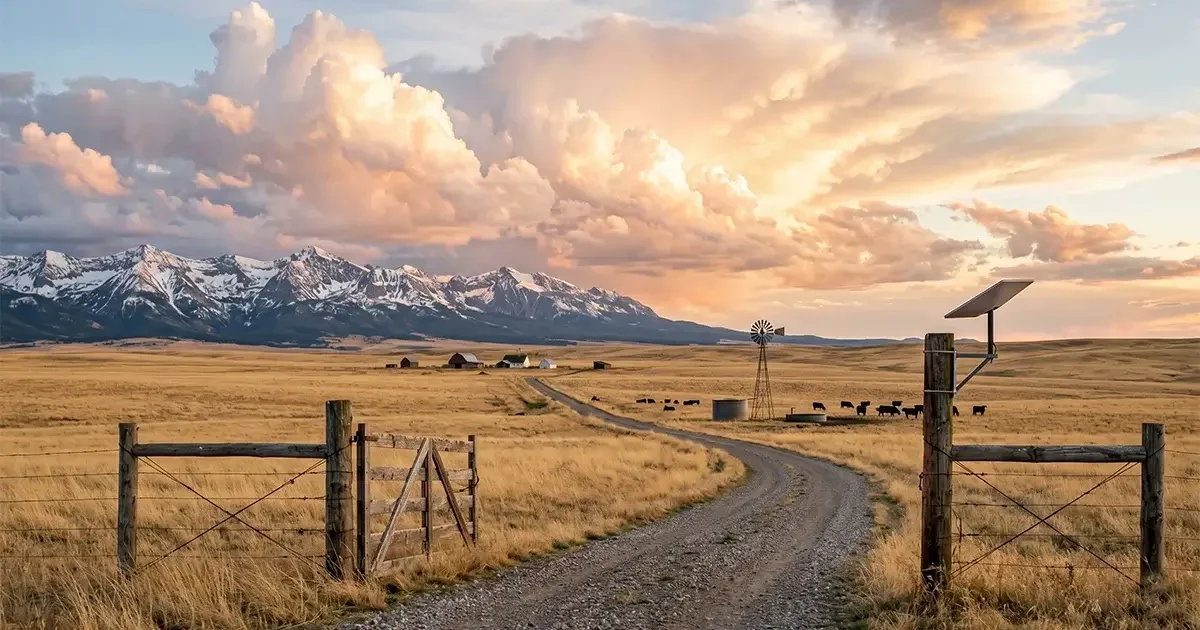
Montana is a state of superlatives when it comes to rural internet challenges: the fourth-largest state by land area, one of the lowest population densities in the continental United States, vast stretches of mountain ranges and high plains with minimal telecommunications infrastructure, and communities separated by dozens of miles of open range with no cell towers in sight. Getting reliable broadband in rural Montana has historically required either extreme patience or expensive and unsatisfying compromise solutions. In 2026, that situation is genuinely changing — Starlink’s universal coverage, expanding T-Mobile rural 5G, and significant federal investment in Montana broadband infrastructure have created more options than rural Montanans have ever had. This complete guide covers every internet option available for rural Montana residents in 2026, with regional breakdowns and state-specific guidance.
In This Guide
- Montana Rural Internet Overview
- Starlink in Montana: Performance and Considerations
- Best Internet by Montana Region
- T-Mobile Home Internet in Rural Montana
- Montana WISPs and Regional Providers
- Connectivity on Montana’s Tribal Lands
- Montana State Broadband Programs
- Federal Investment in Montana Broadband
- Internet for Montana Ranching Operations
- Practical Tips for Rural Montana Residents
- FAQs
Montana Rural Internet Overview
Montana presents an extreme version of the rural connectivity challenge. With approximately 1.1 million residents spread across 147,040 square miles — an average population density of about 7.4 people per square mile — Montana’s communications infrastructure economics are among the most challenging of any state. The same Beaverhead County that is larger than some eastern US states has a population of roughly 9,000 people. Building fiber to every rural Montana household would cost tens of thousands of dollars per connection in the most remote areas.
According to the FCC National Broadband Map, Montana has some of the highest percentages of unserved and underserved addresses of any state. Entire counties in eastern and central Montana — the oil, wheat, and cattle country beyond the Rocky Mountain Front — have cellular coverage from only one or two carriers at modest signal strength, and fixed broadband infrastructure is essentially nonexistent outside of county seat towns.
The arrival of Starlink has been genuinely transformative for rural Montana in a way that is difficult to overstate. Before Starlink, the realistic internet options for a ranch 50 miles from the nearest town were: HughesNet geostationary satellite (slow, high-latency, data-capped), a cellular hotspot that might work marginally well on a good day, or driving to the library in town. Today, Starlink provides the same 70–130 Mbps low-latency broadband to a remote Beaverhead County ranch as it does to a suburban home in Billings.
Starlink in Montana: Performance and Considerations
Starlink performs exceptionally well across most of Montana for several reasons unique to the state’s characteristics:
- Low cell congestion: Montana’s sparse population means that rural Starlink coverage cells serve fewer simultaneous users than cells in denser states. Peak-hour congestion that can slow Starlink speeds in populated rural areas is much less common in Montana. Users in eastern and central Montana routinely report 100–150 Mbps download speeds even during peak evening hours.
- Open sky views: Montana’s high plains and valley ranches typically have excellent northern sky clearance — the direction Starlink satellites primarily orbit from a Montana perspective. Rocky Mountain Front properties on the eastern slope of the Rockies generally have unobstructed views of the northern sky even with mountains to the west.
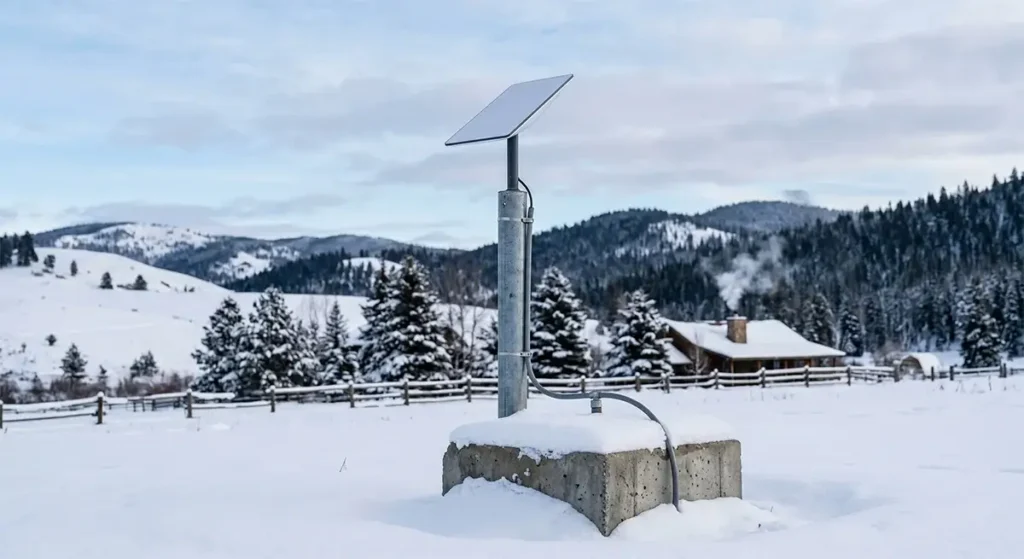
- Cold weather considerations: Montana winters are among the harshest in the continental US. Starlink dishes include a heater designed to melt snow accumulation, but extreme cold snaps (-20°F and below) and particularly heavy snowfall can challenge the heater’s capacity. Northern Montana users report occasional snow-related outages of minutes to an hour during the most severe winter storms. Mounting the dish at an angle that allows snow to shed more readily (rather than flat), or using a commercial dome cover while maintaining sky view, helps manage this.
- Mountain valley properties: In mountain valleys — particularly north-south oriented valleys common in the Rocky Mountain ranges — properties may have ridge obstruction to the north that limits Starlink sky view. Use the Starlink app’s sky scanner from your specific property location to assess. Many valley properties find that a 20–40 foot mast provides the sky clearance needed to clear ridge obstructions.
Best Internet Options by Montana Region
Missoula and Western Montana
Western Montana — Missoula, Hamilton, Polson, and surrounding areas — has the best rural broadband infrastructure in the state due to higher population density and proximity to the west coast fiber network backbone. Several WISPs serve the Bitterroot Valley and Flathead Valley corridors. T-Mobile’s rural 5G coverage is more available here than in eastern Montana. Rural properties in the Rattlesnake, Swan Valley, and Seeley-Swan Valley areas use Starlink as their primary option where WISP coverage doesn’t reach.
Billings and Eastern Montana
Eastern Montana — Billings and the surrounding Yellowstone River corridor, Glendive, Miles City, and the surrounding high plains — has dramatically limited fixed broadband options outside of the towns themselves. Cellular coverage from AT&T and Verizon extends along major highway corridors but has significant gaps in the agricultural land between towns. Starlink serves as the primary broadband solution for the vast majority of rural eastern Montana properties. The flat, open terrain of the eastern plains provides excellent Starlink sky views and minimal obstruction issues.
Great Falls and Central Montana
The Rocky Mountain Front and central Montana — Great Falls, Lewistown, and the agricultural communities between them — have a mix of telephone cooperative DSL, some WISP coverage on specific corridors, and Starlink as the backbone connectivity solution for truly rural properties. The Montana Telephone Association member companies serve some rural corridors with DSL; speeds vary widely based on distance from switching equipment.
Bozeman and Southwest Montana
The Bozeman corridor and surrounding areas have seen dramatic population growth from the technology industry and remote worker migration, which has driven infrastructure investment. Rural properties within 30–40 miles of Bozeman may have WISP options. The Paradise Valley, Madison Valley, and Gallatin Valley rural communities increasingly have Starlink as their connectivity backbone, and T-Mobile coverage is more consistent in this region than in eastern or central Montana. For ranches and rural properties in this region, Starlink is often supplemented with T-Mobile cellular backup.
Glacier Country (Flathead Valley, Glacier Park Area)
The Flathead Valley — Kalispell, Whitefish, Columbia Falls — has relatively better broadband infrastructure than most of Montana, partly driven by tourism industry demand and partly by the valley’s population concentration. Rural properties in the Glacier Park area and mountain communities use Starlink widely. The western-facing mountain terrain can create northern sky obstruction challenges for valley-bottom properties near steeper ridgelines.
T-Mobile Home Internet in Rural Montana
T-Mobile Home Internet availability in rural Montana is significantly more limited than in lower-density rural states, reflecting Montana’s exceptionally sparse tower network. T-Mobile has deployed 600 MHz low-band 5G along major highway corridors — US-2, US-93, US-191, I-90, I-15 — but rural addresses more than 5–10 miles from these corridors frequently show no T-Mobile Home Internet eligibility even where mobile coverage maps indicate signal.
Check your specific address at T-Mobile’s website. If eligible, T-Mobile Home Internet at $50/month is an excellent value and worth testing before investing in Starlink hardware. Rural Montana T-Mobile users on eligible addresses report speeds of 20–60 Mbps on 4G LTE and 40–100 Mbps on 5G Extended, which is adequate for most household and remote work needs.
For rural Montana properties outside T-Mobile’s available service areas — which is the majority of the state’s land area — Starlink is the primary recommendation without a viable T-Mobile alternative.
Montana WISPs and Regional ISPs
- 3 Rivers Communication: A rural telephone cooperative serving Northeastern Montana (Daniels, Roosevelt, Sheridan, and Valley counties) with fiber and DSL services. One of the more progressive Montana co-ops in rural broadband deployment.
- Triangle Telephone Cooperative: Serving north-central Montana (Havre area and surrounding communities) with broadband services through the legacy telephone network.
- Blackfoot Communications: Regional telecommunications provider serving western Montana with fiber, DSL, and expanding fixed wireless services. One of the more competitive providers in the Missoula-Helena corridor.
- Various small WISPs: Multiple small fixed wireless ISPs operate in specific Montana corridors and valleys — typically 1–3 county coverage areas. The best way to find these is through county extension office contacts and local community Facebook groups, as they often don’t have strong web presence.
Connectivity on Montana’s Tribal Lands
Montana has seven federally recognized Native American nations, many occupying large reservation lands with some of the most severe broadband access gaps in the state. The Crow Reservation, Northern Cheyenne Reservation, Fort Peck Reservation, and others have historically had minimal broadband infrastructure despite large land areas and significant populations.
Federal investment specifically targeting tribal broadband has accelerated under the Infrastructure Act and BEAD Program, with tribal entities eligible to apply directly for ReConnect and BEAD funding. Several Montana tribal nations have active broadband deployment projects underway. Tribal members on reservation lands are eligible for the same Starlink service as any rural US resident, and the satellite coverage and performance characteristics are the same as for non-tribal rural areas.
Montana State Broadband Programs
The Montana Department of Commerce coordinates state broadband planning and manages Montana’s BEAD Program implementation. Montana received approximately $632 million in BEAD Program funding — one of the highest per-capita allocations of any state, reflecting the severity of its broadband gap. The Montana BEAD implementation plan prioritizes the state’s most severely unserved rural and tribal areas first, with a stated preference for fiber-optic infrastructure where terrain allows.
Montana has also maintained a state-level broadband mapping challenge process that has successfully identified and corrected numerous cases where ISPs overclaimed rural Montana coverage in FCC databases. These corrections increased Montana’s BEAD-eligible unserved count and accordingly its funding allocation. Rural Montanans who believe their address is incorrectly mapped as served should visit the FCC National Broadband Map to file a coverage challenge.
Internet for Montana Ranching Operations
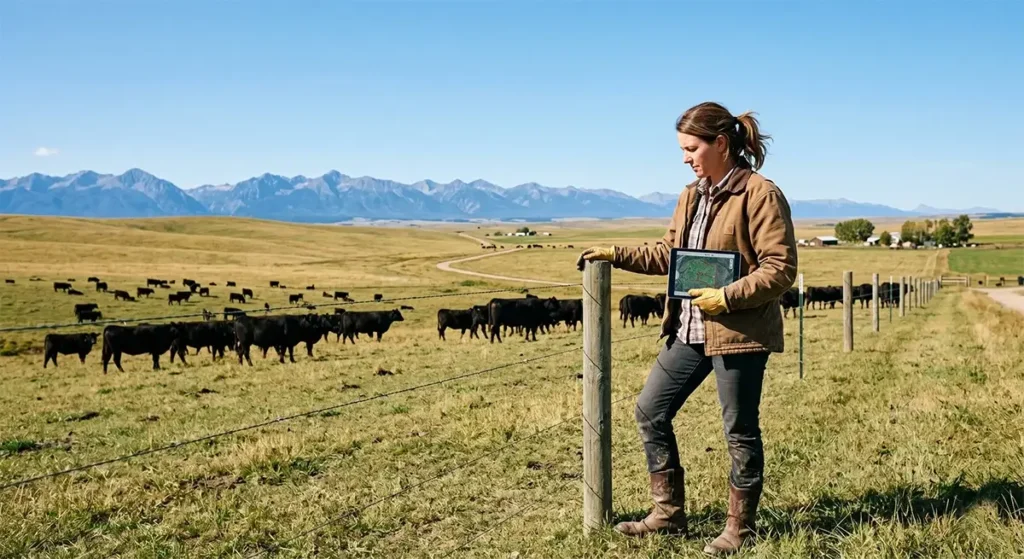
Ranching in Montana has a specific set of internet requirements that urban-oriented internet guides rarely address. Montana ranchers in 2026 are increasingly reliant on connectivity for:
- Cattle tracking and remote monitoring: GPS ear tags, remote camera systems monitoring calving operations and pastures, automated water tank level sensors, and remote gate controllers all require connectivity to transmit data to ranch management platforms.
- Grazing management apps: Digital grazing rotation software, satellite imagery subscriptions for pasture condition monitoring, and USDA Farm Service Agency online portals for conservation compliance all require reliable broadband.
- Commodity market access: Cattle, wheat, and hay price monitoring, basis tracking, and online auction platforms have become standard tools for competitive Montana ranch operations.
- Remote vehicle and equipment telematics: Modern tractors, combines, and even ATVs increasingly transmit operational data to dealer and ranch management systems requiring connectivity.
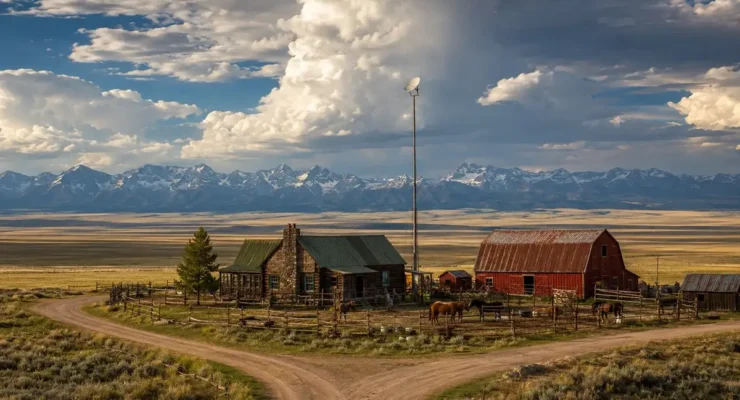
For Montana ranching operations, Starlink Standard or Business is the recommended primary connectivity. For large ranches with multiple headquarters buildings and outbuildings miles apart, multiple Starlink dishes at different locations is a practical and cost-effective solution. For remote line camps or pasture locations needing only IoT sensor data rather than full broadband, LoRaWAN technology provides ultra-low-power, long-range connectivity for sensor data that can be aggregated at a central Starlink-connected gateway.
Practical Tips for Rural Montana Residents
- Invest in a quality Starlink mast for winter stability. Montana wind and snow loads are extreme. A lightweight pole mount may be adequate in milder climates, but rural Montana properties benefit from a heavy-gauge galvanized steel mast anchored with a concrete base — both for stability in high winds and for positioning the dish high enough to clear any surrounding terrain features.
- Plan your internet cable for extreme cold. Standard Ethernet cable can become brittle in extreme cold. For outdoor cable runs in Montana’s climate, use cable rated for direct burial and cold weather installation. The Starlink proprietary cable is rated for its designed operating range, but any extension cable running outdoors should be rated for -40°F.
- Keep the dish snow-free during major storms. While the Starlink dish heater handles normal Montana snowfall, extreme events in the Rockies and high plains can overwhelm it. During multi-day snowstorms, periodic gentle clearing of heavy accumulation from the dish (using a soft broom — never a scraper) can prevent extended outages.
- Check your co-op’s broadband plans. Montana’s rural electric cooperatives have been among the most active in pursuing broadband funding and deployment. If you’re a co-op member and haven’t recently asked your cooperative about broadband service or plans, do so — the answer may have changed meaningfully in the past year.
Frequently Asked Questions
Is Starlink available on remote Montana ranches with no roads?
Yes. Starlink is available anywhere in Montana with a clear sky view. Road access to the property is not required for service — you simply need power for the dish and router, which off-grid properties provide via solar. Many extremely remote Montana properties that cannot be served by any ground-based technology are successfully using Starlink as their primary connectivity solution.
How does Starlink perform in Montana winters?
Generally well. The Starlink dish heater manages normal Montana snowfall reliably. During the most severe winter storms (blizzard conditions, heavy wet snow), brief outages of minutes to an hour are occasionally reported. Mounting the dish at an angle promotes snow shedding. Montana users report that Starlink is significantly more reliable through winter weather than the HughesNet or Viasat systems they previously used.
What is the best internet option for a Montana ranch without cellular service?
Starlink satellite is the best and often only viable broadband option for Montana ranches outside cellular coverage. It delivers 70–130 Mbps with 20–60 ms latency — sufficient for all ranch management applications, remote work, and family household needs. For emergency voice communication independent of internet, a Garmin inReach or SPOT satellite communicator provides critical backup communication capability.
When will fiber internet reach rural eastern Montana?
Realistic timelines for BEAD-funded fiber in eastern Montana’s most remote areas are 2028–2032 at earliest. The combination of extreme distances, low population density, and challenging construction economics makes fiber deployment in places like Beaverhead, Carter, Powder River, and Fallon counties an enormous logistical and financial undertaking. In the interim, Starlink provides broadband-class service that covers the connectivity gap indefinitely. For properties within range of a Montana telephone cooperative, contact the co-op directly for their infrastructure upgrade timeline.


Leave a Reply