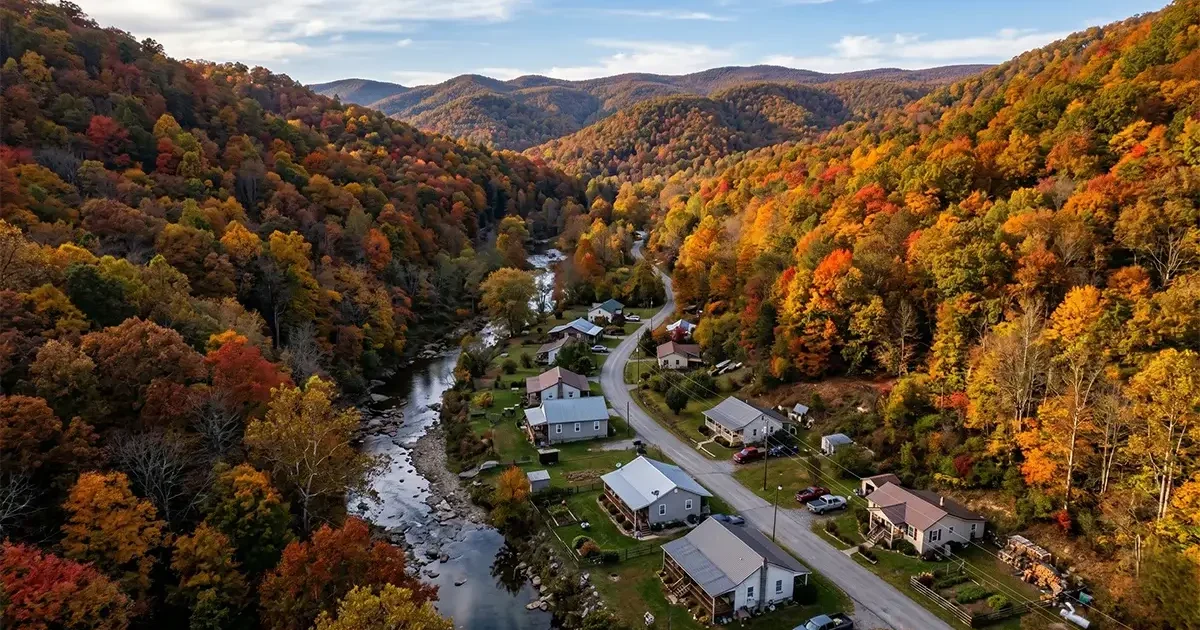
West Virginia has one of the most severe rural broadband gaps of any state in America. With 97% of its land area classified as rural, a predominantly mountainous terrain that creates natural barriers to infrastructure deployment, and a historically limited telecommunications investment history, West Virginia consistently ranks among the bottom five states for rural broadband access. But 2026 is shaping up to be a pivotal year for connectivity in the Mountain State: a combination of Starlink’s universal satellite coverage, unprecedented federal broadband investment through the BEAD Program, and several active state-level initiatives are beginning to change the landscape. This comprehensive guide covers every rural internet option available in West Virginia in 2026, regional performance realities, state-specific programs, and what residents can realistically expect in the years ahead.
In This Guide
- The West Virginia Broadband Crisis
- How Mountain Terrain Creates Connectivity Barriers
- Starlink in West Virginia
- Internet Options by Region
- Cellular and Mobile Internet in WV
- Local and Regional ISPs
- West Virginia State Broadband Programs
- BEAD Program: What WV Gets and When
- USDA ReConnect Projects in West Virginia
- Practical Tips for WV Rural Residents
- FAQs
The West Virginia Broadband Crisis
West Virginia’s broadband access statistics are sobering. According to the FCC National Broadband Map, a substantial portion of West Virginia addresses lack access to fixed broadband at 25/3 Mbps — the previous minimum standard — and an even larger share lack access at the current 100/20 Mbps standard. The state’s broadband gap is not merely rural — it affects entire counties, not just scattered remote properties. McDowell County, Mingo County, Logan County, and many others in the southern coalfields have some of the lowest broadband access rates of any counties in the nation.
The causes are structural and interconnected. West Virginia’s terrain — the Appalachian Mountains, with deeply folded ridges and hollows that create line-of-sight barriers for every wireless technology — makes infrastructure deployment expensive and challenging. The state’s population decline over recent decades has reduced the economic incentive for commercial ISPs to invest in coverage. And legacy telephone infrastructure in many areas was never upgraded beyond copper DSL capable of delivering only 1–5 Mbps — speeds that become effectively unusable for modern internet applications.
The economic consequences compound over time. Remote workers cannot reliably relocate to rural WV without adequate connectivity. Students in remote hollows cannot access online coursework equivalent to urban peers. Farmers cannot use precision agriculture tools. Healthcare providers cannot extend telemedicine services to rural patients. The broadband gap in West Virginia is not just an inconvenience — it is an economic development barrier with measurable effects on the state’s growth trajectory.
How Mountain Terrain Creates Connectivity Barriers
West Virginia’s topography is the single largest obstacle to rural connectivity. The state is among the most rugged east of the Rocky Mountains, with:
- Deep hollows: Many WV communities are located at the bottom of narrow creek hollows with steep ridges on both sides. A fixed wireless tower on a ridgetop may cover the ridgeline properties but cannot reach into the hollow below due to the terrain blocking the signal path. Communities at the bottom of a hollow may be completely invisible to any ridge-mounted tower.
- Limited tower placement options: Cell towers and fixed wireless infrastructure require accessible land, power, and line-of-sight to coverage areas. In densely folded mountain terrain, the number of practical tower placement sites that cover meaningful populations is limited.
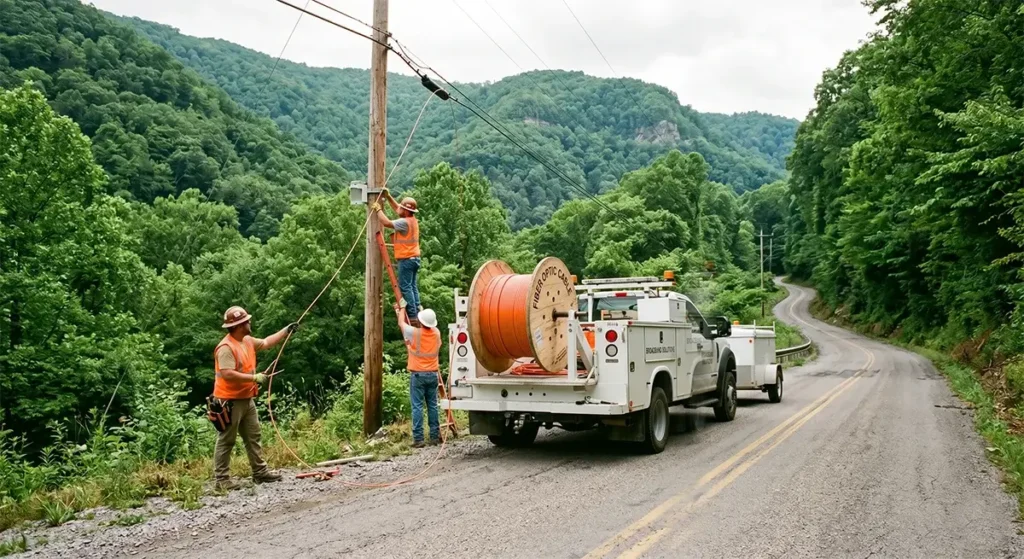
- Fiber construction costs: Trenching fiber-optic cable through mountainous terrain is substantially more expensive per mile than in flat terrain. The combination of difficult terrain, low population density, and mountainous construction conditions makes West Virginia one of the most expensive states per-household to bring fiber broadband to.
- Sky obstruction for satellite: West Virginia’s mountains and valley-oriented home sites create more sky obstruction challenges for satellite internet (including Starlink) than flat rural states. Properties situated at the bottom of narrow hollows with high ridges blocking the northern sky may have insufficient Starlink sky clearance even from a tall mast.
Starlink in West Virginia: What Works and What Doesn’t
Starlink represents the most transformative single development in West Virginia rural connectivity in decades. Available statewide with no waitlist, Starlink bypasses the terrain challenge that defeats fixed wireless and cellular providers — a satellite signal from orbit can reach any property with a clear enough sky view, regardless of the ridges and hollows that block ground-based signals.
Performance across WV Starlink users has generally been strong. With fewer users per coverage cell than in denser states, rural WV Starlink cells are often less congested, and median speeds of 80–130 Mbps are commonly reported across the state during normal hours. WV’s position in the eastern US mid-latitude band puts it in a well-covered zone of Starlink’s satellite constellation.
The sky obstruction challenge is real and location-specific. Properties on ridge tops, ridgelines, south-facing slopes, or in wide valleys generally have excellent Starlink sky clearance. Properties at the bottom of narrow north-south oriented hollows with high ridges to the north (where Starlink satellites predominantly orbit from a WV perspective) may face obstruction challenges. The definitive check is always the Starlink app’s augmented reality sky scanner — use it at your property before ordering. A 20–30 foot mast can clear most obstruction issues for properties that have partial rather than complete sky blocks.
Internet Options by West Virginia Region
Eastern Panhandle (Jefferson, Berkeley, Morgan Counties)
The Eastern Panhandle, bordering Maryland and Virginia, has significantly better connectivity than the rest of WV due to its proximity to the Washington-Baltimore metro area and its relatively flat valley terrain along the Potomac River corridor. Competitive fixed wireless providers serve parts of this region, some DSL infrastructure exists, and cellular coverage from all major carriers is more reliable here than in the state’s interior. Starlink is available and performs well across this region.
Northern WV (Monongalia, Marion, Harrison Counties)
The area around Morgantown (home of West Virginia University) has relatively better broadband infrastructure. Outside the Morgantown metro, rural Harrison, Marion, and Upshur counties have significant gaps. Several local WISPs operate in this region with fixed wireless coverage on specific corridors. Starlink serves the entire region reliably. Some rural telephone cooperative service exists along county road corridors.
Central WV (Kanawha, Nicholas, Webster Counties)
Outside the Charleston metro area, central WV rural communities face significant connectivity challenges. The dense terrain of Nicholas and Webster counties contains some of the most isolated communities in the eastern US. Starlink performs well on properties with adequate sky clearance. The Elk River valley corridor has some fixed wireless options. Cellular coverage from Verizon is the most reliable carrier for rural voice in this region, with T-Mobile significantly less consistent.
Southern Coalfields (McDowell, Mingo, Logan, Wyoming Counties)
Southern WV’s former coal country contains the state’s most severe broadband deserts. County seats have some service, but rural hollow communities — often accessible only by narrow winding state routes — have minimal coverage from any technology. Satellite internet (Starlink and legacy GEO) is functionally the only viable option for many of these communities. Terrain obstruction is most severe in this region, and some hollow-bottom properties may require significant mast height to achieve Starlink sky clearance. The BEAD Program has specifically prioritized this region for infrastructure investment.
Eastern Mountains (Pocahontas, Randolph, Pendleton Counties)
The high mountain counties of eastern WV — including the Snowshoe Mountain and Seneca Rocks areas — have interesting connectivity dynamics. Some tourist-oriented communities have commercial-grade broadband to support hospitality businesses. Rural agricultural and forest properties face the same terrain challenges as southern WV. Starlink covers this region well in most ridgeline and valley locations. Some USDA ReConnect-funded fixed wireless projects have targeted this region specifically.
Cellular Internet in Rural West Virginia
West Virginia is one of the most challenging states for cellular coverage reliability. The mountainous terrain creates deep shadow zones where cellular signals cannot penetrate. Key facts about rural WV cellular coverage:
- Verizon has the strongest rural WV coverage among national carriers, having invested in maintaining the densest rural tower network in the state. In many rural WV areas, Verizon is the only carrier with any service at all.
- T-Mobile’s rural WV coverage is significantly weaker than its coverage maps suggest. The 600 MHz low-band 5G that T-Mobile advertises for rural reach does not penetrate deep hollows effectively, and many rural WV addresses are mapped as covered but deliver no usable signal from inside hollow-bottom homes. T-Mobile Home Internet is available at relatively few rural WV addresses compared to flat-terrain rural states.
- AT&T’s rural WV presence is moderate — better than T-Mobile in many areas but less comprehensive than Verizon. FirstNet (AT&T’s emergency responder network) has improved rural WV AT&T coverage in some counties.
- A quality cell signal booster (weBoost Home Complete or SureCall Fusion5X) is strongly recommended for any rural WV household using cellular data as a primary or backup connection. The terrain-related signal degradation that cellular carriers experience in WV is exactly what signal boosters are designed to address.
Local and Regional ISPs Serving Rural West Virginia
- Citynet: A West Virginia-based ISP that has been one of the more active fixed wireless providers in the state, with service in multiple WV counties using both licensed wireless spectrum and fiber where feasible.
- Glenville State University Broadband Initiative: GSU and Gilmer County have been the site of a notable community broadband initiative using federal funding to bring fiber to previously unserved communities.
- Various Rural Telephone Cooperatives: Some WV telephone cooperatives have upgraded their infrastructure and offer DSL or newer technology broadband. Contact the provider that provides your landline service to ask about broadband options — these cooperatives sometimes serve areas not listed in national databases.
- Frontier Communications: Frontier serves substantial portions of rural WV through legacy telephone infrastructure. Service quality varies significantly — some Frontier-served rural WV areas have fiber upgrades, others have legacy copper DSL delivering only 1–5 Mbps.
West Virginia State Broadband Programs
West Virginia has been investing in broadband infrastructure through several state initiatives:
The West Virginia Broadband Enhancement Council and the West Virginia Development Office coordinate state broadband planning and have been active in challenging inaccurate FCC coverage data — a critical step because the BEAD Program allocates funds based on which locations are mapped as unserved. WV has filed substantial challenges to overclaimed coverage by ISPs in the state, which has increased the number of WV locations eligible for BEAD funding.
The WV DIGIT Act established state-level funding mechanisms specifically for rural broadband infrastructure, complementing federal programs with state matching funds designed to accelerate deployment timelines in the most underserved areas. Contact the WV Development Office at westvirginia.gov for current program details and eligibility information.

BEAD Program Investment in West Virginia
West Virginia received one of the most substantial BEAD Program allocations per capita of any state — over $1.2 billion — reflecting the severity of its broadband gap and the density of unserved locations. West Virginia’s BEAD implementation is being coordinated through the WV Development Office with a specific focus on the state’s most severely underserved southern coalfield counties and hollow communities.
West Virginia has prioritized fiber-first infrastructure where terrain and cost allow, with fixed wireless as a secondary technology for areas where the terrain makes fiber construction prohibitively expensive. BEAD-funded projects in WV are projected to bring broadband to hundreds of thousands of currently unserved addresses between 2025 and 2029, with the most remote communities likely seeing service in the later years of the deployment timeline.
Practical Tips for Rural WV Residents Today
- Don’t wait for BEAD fiber if you need internet now. Government-funded fiber is coming to much of rural WV, but realistic timelines suggest 2027–2030 for most communities. Starlink provides broadband-class service today for $120/month without waiting.
- Challenge the FCC broadband map for your address. If your address is mapped as “served” by a provider that doesn’t actually offer you service, file a challenge at broadbandmap.fcc.gov. WV residents who successfully challenge incorrect coverage claims increase their county’s eligibility for BEAD funding.
- Invest in a Starlink mast if terrain is an issue. WV’s terrain creates more sky obstruction challenges than most states. A 20–30 foot galvanized steel mast anchored in concrete can clear most hollow-bottom obstruction issues and dramatically improve your Starlink experience. TechnoRV and StarMount make purpose-built Starlink mast kits.
- Use Verizon for cellular backup. In rural WV, Verizon’s network is significantly more reliable than T-Mobile or AT&T for backup cellular connectivity. A Verizon prepaid hotspot plan ($40–$50/month for 15–30 GB) provides meaningful emergency backup for Starlink outages.
Frequently Asked Questions
Is Starlink available in all of West Virginia?
Starlink is available statewide in West Virginia with no waitlist. The service works at any location with adequate sky clearance toward the north. Most WV ridge-top, hillside, and open valley properties have sufficient sky clearance. Some narrow, deep hollow properties with ridges blocking the northern sky may need a tall mast installation or may not be suitable candidates for satellite.
What is the best internet option for a rural property in the WV coalfields?
For most rural southern WV properties in McDowell, Mingo, Logan, and Wyoming counties, Starlink satellite is the most practical broadband option available in 2026. Local fixed wireless coverage in this region is very limited, cellular T-Mobile is sparse, and legacy DSL speeds are often below 5 Mbps. Starlink provides 50–130 Mbps with low latency and is available at virtually any property with a usable sky view.
When will fiber reach my rural WV property?
This depends on your specific county and whether it falls within an active BEAD-funded or ReConnect-funded deployment project. Check the USDA ReConnect funded projects map for active WV projects. For BEAD-funded projects, the WV Development Office publishes regular updates on deployment progress. Most optimistically, early BEAD deployments in WV are expected to complete construction by 2026–2027; more remote areas are likely 2028–2030.


Leave a Reply