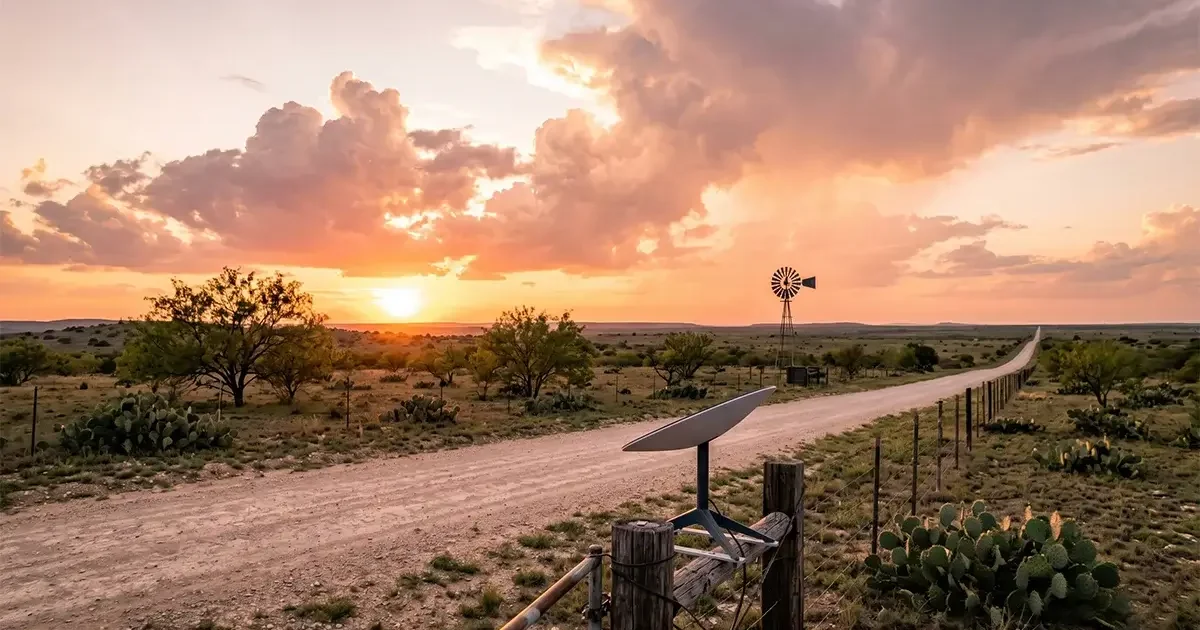
Texas is a state of extremes — extreme size, extreme geography, and extreme rural internet challenges. With the second-largest land area of any US state, a population density that ranges from the dense urban core of Houston and Dallas to vast stretches of West Texas where the nearest neighbor is 10 miles away, Texas presents rural connectivity challenges that are simultaneously some of the most severe and most actively addressed in the country. In this comprehensive guide to rural internet in Texas, we cover the best providers by region, state-specific programs, coverage realities, and what Texas rural residents should expect in 2026.
In This Guide
- Texas Rural Broadband Landscape
- Best Internet by Texas Region
- Starlink in Texas
- T-Mobile Home Internet in Rural Texas
- Notable Local and Regional Providers
- Texas State Broadband Programs
- Federal Funding Coming to Rural Texas
- Provider Comparison for Rural Texas
- Practical Tips for Rural Texas Internet Users
- FAQs
Texas Rural Broadband Landscape in 2026
Texas has approximately 3.7 million rural residents — more than the entire population of many US states. According to data from the FCC National Broadband Map, a significant portion of rural Texas locations still lack access to fixed broadband at 100/20 Mbps, despite the state’s large population and economic activity. This connectivity gap is most severe in West Texas, the Panhandle, deep South Texas, and the Hill Country’s more remote areas.
The state’s geography creates distinct connectivity profiles by region. East Texas — with higher population density, hilly-but-not-extreme terrain, and proximity to major markets — has better legacy infrastructure than most of the state. Central Texas and the Hill Country have pockets of strong coverage near cities but significant gaps in rural inter-county areas. West Texas and the Panhandle are the most challenging: enormous distances between population centers, sparse cell tower coverage, and geography that makes fixed wireless difficult.
The good news: Texas is one of the most active states in pursuing rural broadband expansion. The Texas Broadband Development Office (BDO), created in 2021, coordinates both state and federal broadband investment and has been one of the more effective state broadband offices in the country at moving funding from allocation to actual construction.
Best Internet by Texas Region
East Texas (Piney Woods)
East Texas — including the Pineywoods region, Tyler, Nacogdoches, Lufkin, Longview, and surrounding rural counties — has relatively better rural internet options than most of Texas due to higher population density and historical telephone cooperative infrastructure. Providers including East Texas Telephone Company, Peoples Telephone, and various electric cooperatives that have expanded into broadband serve many rural addresses in this region. Fixed wireless from local WISPs is often available at competitive speeds and pricing. Where WISP or co-op options aren’t available, Starlink has excellent sky views across this relatively flat-to-rolling terrain.
Central Texas / Hill Country
The Hill Country — encompassing Fredericksburg, Kerrville, Marble Falls, Mason County, Bandera County, and surrounding areas — is one of the most actively discussed rural broadband challenges in Texas. The karst limestone terrain creates irregular signal propagation for fixed wireless, and the rugged hills limit line-of-sight coverage from cellular towers. Starlink performs well in most Hill Country locations given the open sky views typical of the region’s hilltop and cedar-cleared pastures. Several local WISPs serve specific corridors, and electric co-op broadband initiatives (including Pedernales Electric Cooperative’s affiliated broadband arm) have been expanding service in the region.
North Texas / Red River Country
North Texas rural areas — from the Red River country south through Wichita Falls and Abilene’s rural surroundings to the outer edges of DFW’s rural exurbs — have a mix of options. Legacy phone co-op DSL remains the only option in some areas, while stronger fixed wireless coverage exists in others. T-Mobile’s rural 5G footprint in this region is expanding, and several addresses that were T-Mobile Home Internet-ineligible 18 months ago are now eligible. Starlink covers this entire region effectively.
West Texas
West Texas — the Trans-Pecos region, Big Bend country, the Permian Basin’s rural edges, and everything west of San Angelo — is ground zero for rural internet challenges in the state. Population densities below 1 person per square mile in some counties, extreme distances from towers, and terrain that makes fixed wireless economically unviable combine to make this one of the most underserved regions in the continental US. Starlink is the primary viable broadband option for most rural West Texas residents. Some areas served by oilfield communications infrastructure have additional options, but residential connectivity remains limited. The Trans-Pecos counties have among the lowest rates of broadband access of any rural region in the United States.
South Texas / Rio Grande Valley Rural Areas
Rural South Texas — the brush country between San Antonio and the Rio Grande, as well as the more rural parts of the Rio Grande Valley outside Edinburg/McAllen — faces both connectivity gaps and economic barriers to adoption. Fixed wireless coverage from regional providers including Rio Networks and various local operators covers some corridors. T-Mobile’s rural network expansion has improved coverage in this region meaningfully since 2023. Starlink is available across this region with generally good sky views in the open brush country terrain.
The Panhandle
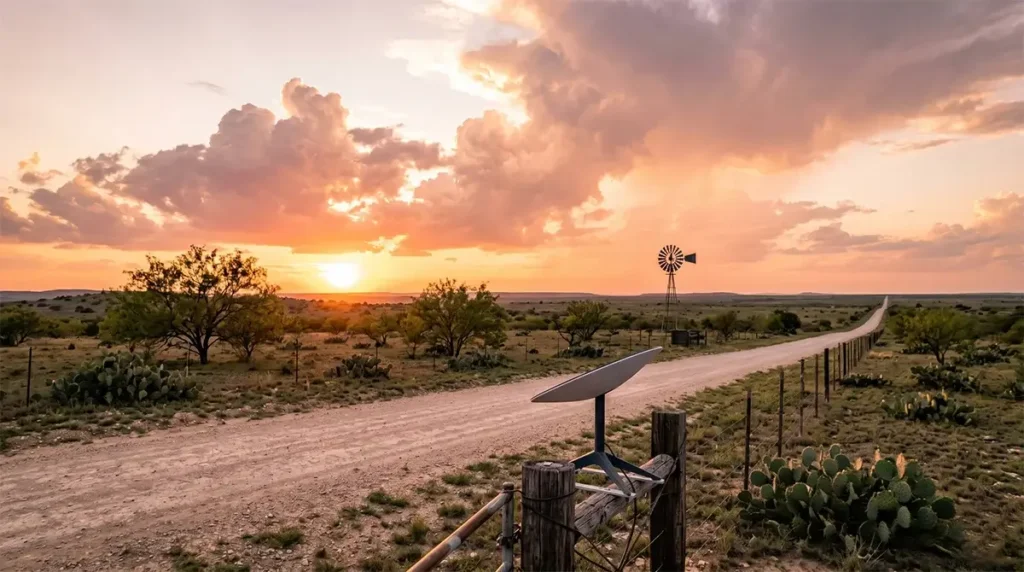
The Texas Panhandle — Amarillo’s surrounding counties, the Canadian River breaks, and the flat-as-a-table agricultural plains extending to the New Mexico border — has historically relied on legacy telephone infrastructure from West Texas-area telephone cooperatives. Several Panhandle co-ops have been actively building out fiber broadband to rural addresses using ReConnect and BEAD funding. Flat terrain is actually an advantage for fixed wireless in the Panhandle, and several WISPs operate in the region with competitive options. Starlink is universally available across this open landscape.
Starlink in Rural Texas
Starlink is available across all of Texas with no waitlist as of 2026. Performance in Texas rural areas has been generally strong, with users reporting median download speeds of 60–120 Mbps and latency of 25–55 ms. Texas is well within Starlink’s coverage cell structure, and the state’s generally open terrain (outside East Texas forest and Hill Country cedar) provides favorable installation conditions with clear sky views from most properties.
Texas-specific Starlink considerations:
- Heat: Texas summer heat — regularly exceeding 100°F — can affect Starlink dish performance. The dish is rated for operation up to 122°F ambient temperature. In West Texas and South Texas where ground temperatures can exceed this threshold during heat waves, dish mounting locations with some afternoon shade protection (while maintaining northern sky view) can help thermal management.
- Thunderstorms: The Texas storm belt brings significant severe weather. Starlink performs through moderate rain with minimal impact. During severe thunderstorms with heavy precipitation and hail, brief outages of 2–10 minutes are possible. The dish is rated for hail up to 1-inch diameter — larger hail events in tornado country may warrant protective measures.
- Great sky views: West Texas in particular offers some of the best Starlink installation conditions in the country — minimal tree cover, flat to gently rolling terrain, and very low radio interference. West Texas users often report above-average Starlink performance as a result.
T-Mobile Home Internet in Rural Texas
T-Mobile has invested significantly in Texas rural coverage using its 600 MHz low-band 5G spectrum, which provides extended range well-suited to Texas’s large geographic distances between towers. Rural Texas T-Mobile Home Internet availability has expanded meaningfully since 2023, with many addresses in North Texas, East Texas, and the Rio Grande Valley corridor now eligible that were not previously.
West Texas and the Panhandle remain more limited for T-Mobile Home Internet due to lower tower density. Check your specific address at T-Mobile’s website — rural availability varies even between neighboring properties depending on terrain and tower proximity.
Notable Local and Regional Providers in Rural Texas
- Peoples Telephone Company: Serving Northeast Texas rural areas including Morris, Titus, and Marion counties with DSL and expanding fiber services.
- East Texas Telephone Company (ETTCO): Historic rural telephone cooperative expanding into fiber broadband for rural Rusk and Panola county residents.
- Pedernales Connect (Hill Country): Broadband affiliate of Pedernales Electric Cooperative serving Hill Country rural members with fixed wireless and expanding fiber.
- West Texas Rural Telephone Cooperative: Serving extremely rural West Texas counties including Presidio, Jeff Davis, and Brewster with legacy DSL and exploring broadband upgrades.
- South Plains Telephone Cooperative: Serving Panhandle rural residents with DSL and fiber expansion using ReConnect funding.
- Various local WISPs: Dozens of small fixed wireless providers operate across Texas regions. The Texas Broadband Development Office maintains a provider database; your county extension office is also a good local source.
Texas State Broadband Programs
Texas has been one of the more proactive states in rural broadband deployment. The Texas Broadband Development Office (BDO), housed within the Texas Department of Agriculture and now under the Governor’s office, coordinates:
- Texas Broadband Pole Replacement Program — funding to replace utility poles to enable broadband infrastructure attachment
- Texas Last Mile Broadband Grant Program — targeted funding for deployment in the most isolated rural Texas locations not covered by federal programs
- BEAD Program state administration — Texas received approximately $3.3 billion in BEAD Program federal funding and is in active planning phases for deployment
The Texas BDO also maintains the Texas Broadband Map, which serves as the state’s version of the FCC’s National Broadband Map and is used to prioritize BEAD deployment. Rural Texans can challenge incorrect coverage data on both maps — this is particularly important in areas like West Texas where some providers have claimed coverage that does not reflect real-world service availability.
Federal Funding Coming to Rural Texas
Texas’s allocation from the BEAD Program represents one of the largest state allocations nationally, reflecting Texas’s combination of large rural population and significant unserved/underserved locations. This funding, combined with ongoing USDA ReConnect awards targeting Texas rural communities, represents a multi-billion-dollar infrastructure investment over the next 5–7 years.
Several Texas-specific USDA ReConnect awards have been made to Texas ISPs including electric cooperatives, telephone co-ops, and regional fiber providers targeting counties in East Texas, North Texas, South Texas, and the Panhandle specifically. Check the USDA ReConnect funded projects map and filter for Texas to see current awards and service area details.

Provider Comparison for Rural Texas 2026
| Provider | Technology | Monthly Cost | Speeds | Best Texas Regions | Availability |
|---|---|---|---|---|---|
| Starlink | LEO Satellite | $120–$250 | 25–220 Mbps | Statewide | Universal |
| T-Mobile Home Internet | 5G/LTE | $50 | 15–200 Mbps | N/Central/E Texas | Address-specific |
| Local WISPs | Fixed Wireless | $40–$90 | 25–100 Mbps | E/N/Central Texas | Very limited |
| Co-op Fiber/DSL | Fiber/DSL | $50–$120 | 10 Mbps–1 Gbps | E Texas, Panhandle | Very limited |
| HughesNet/Viasat | GEO Satellite | $50–$200 | 15–150 Mbps | Statewide | Universal |
Practical Tips for Rural Texas Internet Users
- Check your T-Mobile eligibility before buying Starlink hardware. T-Mobile Home Internet at $50/month is the better value when available. Save the $349 Starlink hardware cost if T-Mobile works adequately at your address.
- Contact your electric cooperative about broadband plans. Many Texas electric cooperatives are actively building broadband or have plans to do so with BEAD funding. If your co-op isn’t offering broadband yet, make your interest known — co-op broadband projects are often driven by member demand signals.
- Challenge incorrect FCC broadband map data. Texas has significant overclaiming of coverage by ISPs on federal maps. If your address shows as “served” by a provider that actually doesn’t offer you service, file a challenge at broadbandmap.fcc.gov to improve your area’s priority for federal funding.
- Consider a cell signal booster alongside Starlink. Even if your primary internet is Starlink, a signal booster for cellular service ensures your phones and cellular hotspot backup work reliably — important for rural Texas where weather events can disrupt satellite service.
- Plan for summer heat management. If you’re in West or South Texas, consider mounting your Starlink dish where afternoon shade from a structure or tree (not in the northern sky field of view) can reduce heat stress during the hottest months.
Frequently Asked Questions
Is Starlink available in rural West Texas?
Yes. Starlink is available across all of West Texas with no waitlist. For the vast majority of rural West Texas residents — where no other broadband option exists — Starlink is the transformative solution. West Texas’s open terrain and clear skies make for excellent Starlink installation conditions.
What is the best internet provider for rural Texas in 2026?
For most rural Texans without cable or fiber: check T-Mobile Home Internet availability first (best value at $50/month when available), then Starlink for universal coverage. If a local WISP or electric cooperative serves your area, that’s often the best performance per dollar. Avoid HughesNet and Viasat as primary connections for households with video call or remote work needs due to high latency.
Is there state assistance for rural Texas internet costs?
Texas has not historically offered direct household subsidies for rural internet costs beyond what federal programs (the now-discontinued Affordable Connectivity Program) provided. The Texas BDO focus is on infrastructure deployment. For low-income households, the FCC Lifeline Program provides a small monthly subsidy for phone/internet service. Watch the Texas BDO website for any new state-level household assistance programs as BEAD implementation progresses.
When will fiber internet reach my rural Texas property?
This depends entirely on your location and whether your county is included in a ReConnect or BEAD-funded fiber deployment project. Check the USDA ReConnect funded projects map and monitor the Texas BDO’s BEAD implementation updates. For most rural Texans, a realistic timeframe for government-funded fiber is 2027–2030 at the earliest. In the interim, Starlink provides broadband-class service today without waiting.



Leave a Reply