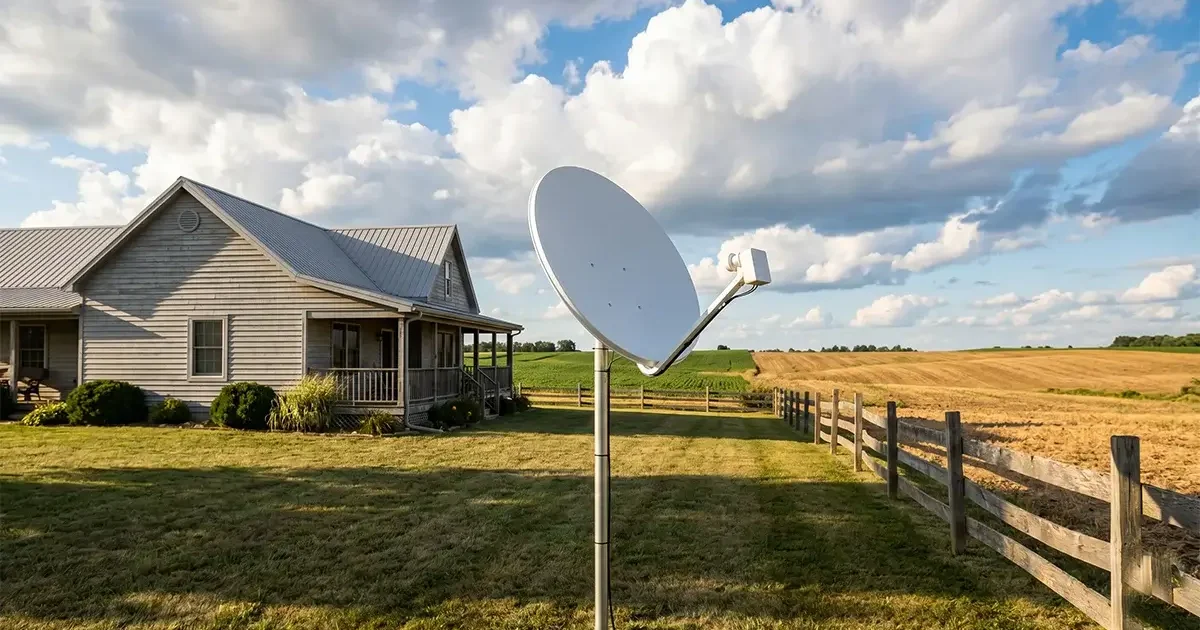
Viasat has been competing in the rural satellite internet market for over a decade, and its newest Viasat 3 satellite has dramatically changed what the service can deliver. But in 2026, with Starlink’s low-Earth orbit network fully deployed and T-Mobile Home Internet expanding aggressively into rural markets, is Viasat still a competitive option — or does it remain a distant second to LEO satellite technology? This comprehensive Viasat review covers real-world performance, pricing, the Viasat 3 upgrade, and an honest assessment of when Viasat makes sense and when it doesn’t.
In This Guide
- About Viasat: Background and Technology
- Viasat 3: What Changed?
- Plans and Pricing in 2026
- Real-World Performance
- Latency Reality
- Data Policies Explained
- Installation and Hardware
- Pros and Cons
- Viasat vs Starlink: Direct Comparison
- Viasat vs HughesNet
- Who Should Choose Viasat?
- FAQs
About Viasat: Background and Technology
Viasat, Inc. is headquartered in Carlsbad, California, and has been in the satellite communications business since 1986. The company operates across three primary satellite platforms — ViaSat-1 (2011), ViaSat-2 (2017), and the newer ViaSat-3 constellation — offering residential, commercial, and government satellite services. In the residential rural internet market, Viasat is the second-largest provider after Starlink by subscriber count, serving customers across the continental United States, Alaska, and several international markets.
Like HughesNet, Viasat’s core residential service uses geostationary (GEO) satellites at approximately 35,786 km altitude. This means the same fundamental latency constraints apply to Viasat as to any GEO satellite provider. However, Viasat has historically differentiated itself from HughesNet by offering higher speed tiers and more flexible data policies, and the launch of Viasat 3 has dramatically expanded the service’s capacity and potential speeds.
Viasat 3: What Changed?
The ViaSat-3 satellite, launched in April 2023, was designed to be the most powerful commercial communications satellite ever built — though it experienced a partial antenna deployment issue that limited its actual capacity to roughly one-third of its designed throughput. Despite this setback, Viasat 3’s operational capacity still significantly exceeds the older ViaSat-2 satellite and has allowed Viasat to offer meaningfully higher speed tiers in most US markets.
Key improvements that Viasat 3 enables over the previous generation:
- Download speed ceilings increased from 25–50 Mbps to 100–150 Mbps on top-tier plans in many regions
- Improved beam efficiency allowing better throughput during peak hours
- More flexible data allocation supporting the “Unlimited” plan branding
- Enhanced mobility capabilities supporting Viasat’s aviation and maritime services
The practical impact for rural residential customers is most visible in the faster plan tiers — users who upgrade to the higher Viasat plans in Viasat 3 coverage areas report real-world speeds of 50–100 Mbps during off-peak hours, a genuine improvement over the previous generation’s ceiling. Peak-hour performance remains constrained by network congestion as more customers share the satellite’s capacity.
Viasat Plans and Pricing in 2026
Viasat’s pricing structure is more complex than competitors and varies significantly by region depending on which satellite serves your area and current promotional pricing. The plans below represent typical 2026 offerings in Viasat 3 coverage markets:
| Plan Tier | Monthly Price | Download Speed | Data Policy | Contract |
|---|---|---|---|---|
| Unlimited Bronze 25 | $70/mo | Up to 25 Mbps | Unlimited (deprioritized after threshold) | 24 months |
| Unlimited Silver 50 | $100/mo | Up to 50 Mbps | Unlimited (deprioritized after threshold) | 24 months |
| Unlimited Gold 100 | $150/mo | Up to 100 Mbps | Unlimited (deprioritized after threshold) | 24 months |
| Unlimited Platinum 150 | $200+/mo | Up to 150 Mbps | Unlimited priority | 24 months |
Viasat’s “Unlimited” plans are an important distinction from HughesNet’s hard data caps. Rather than cutting speed to 1–3 Mbps after a hard limit, Viasat deprioritizes your connection during congested periods once you exceed your plan’s “Liberty” threshold. In practice, deprioritized Viasat speeds during congested evenings can fall to 5–15 Mbps on the lower plans — frustrating but less severe than HughesNet’s near-total throttling.
Equipment is typically leased at $13–$15/month, similar to HughesNet. Early termination fees of up to $500 apply to customers who cancel within the 24-month contract term. Installation is performed by a certified Viasat technician and is typically included in the setup cost.

Real-World Performance
Viasat’s real-world performance in 2026 shows improvement compared to the ViaSat-2 era, particularly for customers on higher-tier plans in Viasat 3 coverage areas. Based on aggregated performance data and user reports:
| Plan Tier | Typical Off-Peak Download | Typical Peak-Hour Download | Upload | Latency |
|---|---|---|---|---|
| Bronze 25 | 18–28 Mbps | 10–20 Mbps | 3–5 Mbps | 620–700 ms |
| Silver 50 | 35–55 Mbps | 20–40 Mbps | 4–8 Mbps | 610–680 ms |
| Gold 100 | 65–100 Mbps | 40–70 Mbps | 5–12 Mbps | 600–660 ms |
| Platinum 150 | 90–150 Mbps | 60–100 Mbps | 8–15 Mbps | 600–650 ms |
The speed improvements on higher-tier plans are real and meaningful for bandwidth-intensive applications like 4K streaming and large file downloads. However, the latency numbers remain firmly in the 600+ ms range across all tiers — an unavoidable consequence of the physics of geostationary satellite communication that no amount of bandwidth expansion changes.
According to Speedtest.net’s Global Fixed Broadband Index, Viasat users in the United States report median download speeds of approximately 35–55 Mbps in 2025–2026, a meaningful improvement over the previous generation’s median of 15–25 Mbps.
Latency Reality: The Immovable Obstacle
The single most important thing to understand about Viasat — the thing that no marketing materials adequately communicate — is that its 600–700 ms latency is not a software problem, a network congestion problem, or something that will improve with future upgrades. It is a consequence of the physical distance between Earth and the satellite, and the speed of light. Viasat will never have Starlink-class latency as long as it uses geostationary satellites.
What this means for specific use cases:
- Zoom and video conferencing: Calls work but conversations feel awkward due to the delay. Participants talk over each other. The experience is functional but noticeably inferior to any low-latency connection.
- Remote desktop: RDP sessions feel sluggish. Keyboard input lags. Complex mouse movements show noticeable hesitation.
- VoIP: Business phone systems using VoIP are essentially unusable at 600+ ms. Natural conversation cadence breaks down entirely.
- Gaming: All real-time multiplayer gaming is unplayable. Turn-based online games with asynchronous play can function.
- Streaming: Pre-buffered video streaming (Netflix, Hulu, Disney+, YouTube) works well since these applications buffer content and do not require real-time low-latency connections. This is where Viasat’s higher bandwidth tiers genuinely shine.
Viasat’s Data Policy: “Unlimited” with Caveats
Viasat markets its plans as “Unlimited,” which is technically accurate but requires explanation. Viasat uses what it calls a “Liberty” policy: each plan has a hidden priority data threshold. Once this threshold is exceeded during a billing month, your connection is subject to “network management,” meaning it will be deprioritized relative to customers who haven’t exceeded their thresholds.
The Liberty thresholds are not prominently disclosed in marketing materials but are available in the service terms. They vary by plan, region, and satellite serving your area. In practice, households that stream HD video regularly or have multiple users will typically hit these thresholds in 2–3 weeks on the lower plans.
The key distinction from HughesNet: Viasat’s “unlimited” deprioritization during congestion typically results in 5–20 Mbps speeds (usable for most applications) rather than HughesNet’s hard throttle to 1–3 Mbps (barely functional). This is a meaningful practical advantage for households that exceed their priority threshold, even though both providers are subject to data management.
Installation and Hardware
Viasat installation is performed by a certified technician, typically within 5–10 business days. The technician installs a dish (approximately 74 cm diameter on current equipment) and configures the indoor modem/router. The installation cost is typically waived or included in promotional offers for new customers but may appear as a separate charge depending on the offer terms.
Viasat’s newer installations for Viasat 3 service use updated modem hardware that supports the higher speed tiers. Existing customers on ViaSat-2 service in areas now covered by Viasat 3 may need a hardware upgrade (new dish and modem) to access the faster plans — check with Viasat customer service for upgrade eligibility at your address.
Viasat Pros and Cons in 2026
Pros
- “Unlimited” data plans — no hard cutoff to near-unusable speeds
- Viasat 3 enables genuinely fast speeds (up to 150 Mbps) on premium plans
- Professional installation nationwide — no DIY required
- Better streaming experience than HughesNet thanks to higher bandwidth ceilings
- Available across the entire continental US with a southern sky view
- Higher upload speeds than HughesNet on comparable plans
Cons
- 600–700 ms latency is unavoidable — makes video calls, VoIP, gaming difficult
- 24-month contract with early termination fees up to $500
- Equipment leasing adds $156–$180/year to true cost
- Top-tier plans cost $150–$200+/month — approaching Starlink Priority pricing
- Viasat 3 antenna deployment issue limits capacity to below original design
- Peak-hour performance degradation when Liberty threshold is exceeded
- “Unlimited” marketing is technically accurate but misleading in practice

Viasat vs Starlink: Direct Comparison
| Factor | Viasat (Gold 100) | Starlink (Standard) |
|---|---|---|
| Monthly Cost | $150 + $13-15 equipment | $120 (no additional fees) |
| Hardware | Leased (never own) | $349 one-time (you own) |
| Download Speed | 40–100 Mbps | 25–100 Mbps |
| Latency | 600–660 ms | 20–60 ms |
| Data | “Unlimited” with deprioritization | 1 TB priority, then deprioritized |
| Video Calls | ⚠️ Possible but laggy | ✅ Works well |
| Gaming | ❌ Unplayable | ✅ Most genres playable |
| Contract | 24 months required | None — cancel anytime |
Viasat vs HughesNet
Between the two legacy satellite providers, Viasat is meaningfully better for most use cases. The “unlimited” data policy prevents the hard throttle to 1–3 Mbps that HughesNet imposes. Higher speed ceilings on Viasat 3 plans deliver better streaming experiences. Upload speeds are higher, which matters for video calling and cloud sync.
The main scenarios where HughesNet may be preferable: if you need the absolute lowest advertised starting price and have genuinely minimal usage that fits within a 15–30 GB monthly cap, or if Viasat 3 coverage hasn’t reached your market and only the older ViaSat-2 service is available (which offers less compelling performance).
Who Should Choose Viasat in 2026?
Viasat is the better of the two legacy satellite options (over HughesNet) for households that:
- Primarily use internet for streaming video and general browsing with no real-time communication requirements
- Are in a Viasat 3 coverage area with access to the faster 100–150 Mbps plans
- Cannot install Starlink due to tree cover or physical constraints
- Prefer professional installation over DIY and are willing to accept a contract for that convenience
For households with remote workers, students in online programs, or anyone who relies on video calls or real-time applications, the 600+ ms latency remains a fundamental obstacle that Viasat’s speed improvements cannot overcome. In those cases, Starlink, T-Mobile Home Internet, or a local fixed wireless provider should be explored first. Check our full guide on all rural internet options and the FCC National Broadband Map to identify what’s available at your specific address.
Frequently Asked Questions
Is Viasat available in my area?
Viasat is available across the continental United States, Alaska, and parts of Hawaii. Coverage is nearly universal for rural areas with a clear view of the southern sky. Check Viasat.com or call their sales line to verify current plan availability at your specific address, as plan tiers vary by which satellite serves your market.
What is Viasat’s “Liberty” policy?
The Liberty policy is Viasat’s network management approach. Each plan has an undisclosed priority data threshold. Once exceeded, your traffic is deprioritized during congested periods. Speeds typically drop to 5–20 Mbps when deprioritized — frustrating but functional — rather than the near-complete throttle seen with HughesNet’s hard data caps.
Can Viasat support a work-from-home setup?
Partially. For jobs that are primarily email, document creation, and asynchronous collaboration (no live video calls, no VPN-intensive applications, no real-time communication tools), Viasat can technically function for remote work. For the majority of knowledge worker roles that involve regular video meetings, Viasat’s 600+ ms latency creates ongoing degraded call quality that most professionals find unacceptable for sustained daily use.




Leave a Reply