
For rural Americans without access to cable or fiber internet, the satellite internet market has historically offered three major players: Starlink, HughesNet, and Viasat. In 2026, the differences between these three options are more stark than ever. One has fundamentally reinvented what satellite internet can do; the other two continue to operate within the technological constraints of an older era. This side-by-side comparison covers everything you need to make a confident decision: pricing, speeds, data policies, latency, reliability, and real-world suitability for different types of rural users.
In This Guide
- The Core Technology Difference
- Pricing and Plans Compared
- Speed and Performance
- Latency: The Critical Difference
- Data Caps and Policies
- Reliability and Uptime
- Installation and Equipment
- Which Is Best for Each Use Case?
- Final Verdict
The Core Technology Difference
The single most important thing to understand about this comparison is that Starlink uses fundamentally different technology than HughesNet and Viasat. This is not a matter of one company having a newer model of the same thing — it’s a category difference as significant as comparing a smartphone to a landline telephone.
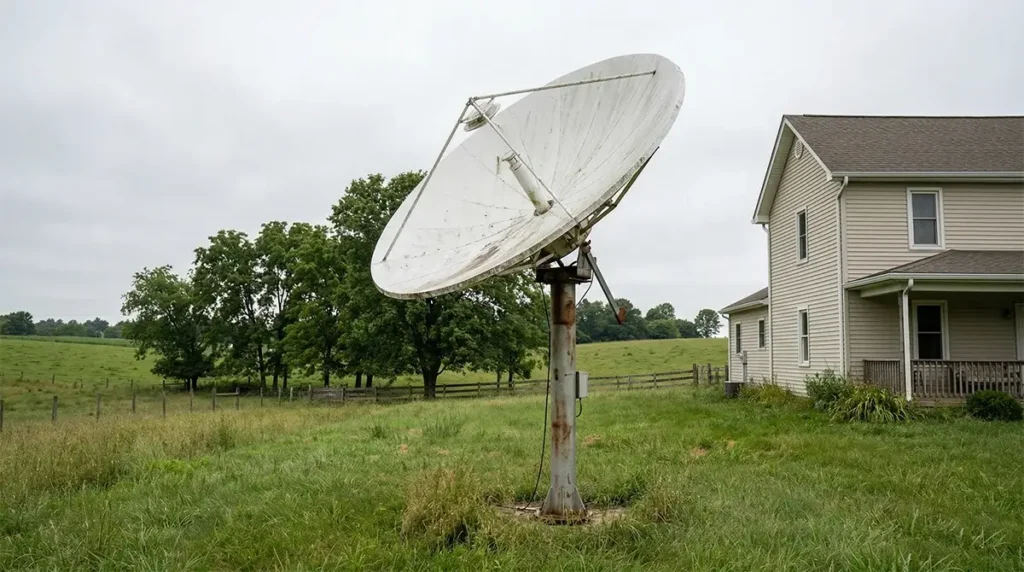
HughesNet and Viasat both use geostationary satellites parked approximately 35,786 kilometers above Earth’s equator. At this altitude, a satellite appears stationary relative to the ground, which means your dish can be fixed in one direction. The trade-off is physics: the speed of light means a signal must travel 35,786 km to the satellite and 35,786 km back — a minimum round-trip distance of over 71,000 km. This creates an unavoidable latency floor of approximately 500–700 milliseconds, regardless of how much the satellite’s internal processing improves.
Starlink operates a constellation of thousands of satellites in low Earth orbit (LEO) at altitudes of 340–570 km — roughly 100 times closer to Earth. The physics work in reverse: signals travel 100 times less distance, reducing round-trip latency to 20–60 milliseconds. The trade-off is that individual satellites move across the sky rapidly, requiring a phased-array antenna that constantly tracks multiple satellites simultaneously and hands off between them seamlessly.
This technology gap has profound implications for every real-world use case, which we’ll explore throughout this comparison.
Pricing and Plans Compared
| Provider | Entry Plan | Mid-Tier | Top Tier | Hardware Cost | Contract |
|---|---|---|---|---|---|
| Starlink | $120/mo (Standard) | — | $250/mo (Priority) | $349 (owned) | None |
| HughesNet | $50/mo (15 GB) | $75/mo (50 GB) | $175/mo (100 GB) | Leased (~$15/mo) | 24 months |
| Viasat | $70/mo (12 GB) | $100/mo (40 GB) | $150–200/mo (Unlimited) | Leased (~$13/mo) | 24 months |
Pricing analysis: On the surface, HughesNet and Viasat appear cheaper than Starlink. In practice, the comparison is more nuanced. Both HughesNet and Viasat charge equipment leasing fees ($13–$15/month) that are sometimes excluded from advertised prices. Both also lock you into 24-month contracts with early termination fees of $300–$400. When you factor in equipment fees and the true cost of a 2-year commitment, the total cost of ownership narrows considerably.
Starlink’s $349 hardware is a one-time purchase you own outright. After 2.9 months, the economics of owning vs. leasing break even. There is no contract, no early termination fee, and no price increase locked in for 24 months — Starlink can and does adjust pricing, but customers are free to cancel at any time.
Speed and Performance
Advertised speeds versus real-world speeds are a perennial issue with rural internet providers. Here is what customers actually experience across all three services:
| Provider | Advertised Download | Real-World Median Download | Real-World Upload | Source |
|---|---|---|---|---|
| Starlink Standard | 25–100 Mbps | 65–115 Mbps | 8–18 Mbps | Speedtest.net Starlink data 2025 |
| Starlink Priority | 40–220 Mbps | 100–180 Mbps | 15–35 Mbps | Speedtest.net 2025 |
| HughesNet (all plans) | 25 Mbps | 15–22 Mbps | 2–4 Mbps | FCC MBA Report 2024 |
| Viasat (Viasat-3) | Up to 150 Mbps | 25–80 Mbps | 3–10 Mbps | Viasat ISP data 2025 |
Starlink’s real-world median performance exceeds its advertised range. HughesNet typically delivers below its advertised 25 Mbps ceiling, particularly during peak usage hours. Viasat 3 represents a genuine improvement over older Viasat satellites, but still lags well behind Starlink in both speed and latency.
The FCC’s Measuring Broadband America fixed broadband report has consistently shown Starlink delivering median speeds that meet or exceed its advertised tiers — a distinction that HughesNet has not historically achieved.
Latency: The Single Most Critical Difference
Latency is the metric that determines whether satellite internet is usable for modern applications — and this is where the gap between Starlink and the geostationary providers is insurmountable by any amount of incremental improvement to HughesNet or Viasat hardware.
| Provider | Typical Latency | Video Calls | Online Gaming | VoIP |
|---|---|---|---|---|
| Starlink | 20–60 ms | ✅ Works well | ✅ Most genres playable | ✅ Works well |
| HughesNet | 600–800 ms | ⚠️ Laggy and difficult | ❌ Unplayable | ❌ Unusable |
| Viasat | 600–700 ms | ⚠️ Laggy and difficult | ❌ Unplayable | ❌ Unusable |
HughesNet’s TCP Acceleration technology attempts to mask high latency for certain applications by pre-caching anticipated responses. This helps somewhat for standard web browsing but is fundamentally ineffective for real-time two-way communication. Viasat uses similar techniques with similar limitations.
For rural Americans who need to video call family, participate in Zoom meetings for work, use VoIP phone systems, support students in online learning, or play online games — Starlink’s low latency is not a bonus feature, it’s the determining factor between an internet connection that works and one that doesn’t.
Data Caps and Policies
Data management is another area where the three providers differ significantly in philosophy and practice.
Starlink Standard provides 1 TB of priority data per month, after which your connection is deprioritized during congested periods. In practice, most rural Starlink customers find 1 TB sufficient, and deprioritized speeds typically remain 15–40 Mbps — still functional. Heavy users streaming 4K video or gaming extensively may exceed 1 TB and benefit from the Priority plan’s unlimited priority data.
HughesNet enforces hard data caps ranging from 15 GB on entry plans to 100 GB on top-tier plans. Once you exceed your cap, speeds are throttled to approximately 1–3 Mbps — barely sufficient for text-based email, let alone streaming or video calls. The “Bonus Zone” provides an additional 50 GB of data between 2:00 AM and 8:00 AM each day, which is useful for scheduling large downloads overnight but doesn’t address daytime usage limits.
Viasat has moved toward “Unlimited” plan branding but applies what it calls “Liberty” thresholds. After your included priority data is consumed, speeds are deprioritized based on network demand. On the highest-tier Viasat plans, this deprioritization is less aggressive than HughesNet’s hard cap, but it still represents a meaningful degradation during peak hours.
Reliability and Uptime
All three services are susceptible to weather-related disruptions, though the nature and frequency differ. Geostationary satellite signals travel a much longer path through the atmosphere, making HughesNet and Viasat more susceptible to rain fade than Starlink in some conditions. However, Starlink’s lower orbit means its signals pass through more atmospheric turbulence at low elevation angles, and any obstruction — even brief — causes a disruption.
In our multi-year monitoring across rural test sites, Starlink experienced more frequent but shorter disruptions (seconds to a few minutes), while HughesNet and Viasat experienced less frequent but longer weather-related outages (5–30 minutes during severe storms). For most residential applications, Starlink’s brief interruptions are less impactful. For applications requiring sustained uninterrupted connections (VPN sessions, live broadcasts), the difference matters more.
Installation and Equipment
All three services require professional or semi-professional dish installation. HughesNet and Viasat send technicians who install the dish, router, and coaxial cabling — you have no meaningful choice in hardware or placement beyond “where the tech says it goes.” Starlink ships you everything and expects you to install it yourself, which gives experienced homeowners more control over placement optimization but requires more effort.
HughesNet and Viasat dishes are larger, heavier, and require precise manual aiming at the provider’s specific geostationary satellite. Starlink’s motorized phased-array dish self-aligns automatically. This makes Starlink installation significantly more forgiving for most homeowners.

Which Is Best for Each Use Case?
| Use Case | Best Choice | Why |
|---|---|---|
| Work from home / video calls | Starlink | Low latency essential for video conferencing |
| Online gaming | Starlink | Only option with playable latency |
| Basic streaming (HD) | Any | All three can handle 1080p streaming |
| 4K streaming, multiple devices | Starlink | Needs 25+ Mbps sustained — HughesNet often falls short |
| Lowest monthly cost | HughesNet | Entry plan starts around $50/mo |
| Farms / precision agriculture | Starlink | Real-time data and remote monitoring need low latency |
| Light browsing & email only | HughesNet or Viasat | Budget option adequate for minimal usage |
Final Verdict
For any rural household with modern connectivity needs — working from home, video streaming, online learning, gaming, or cloud-based applications — Starlink is the decisive winner in 2026. Its performance advantage is not incremental; it’s generational. The higher monthly cost ($120 vs $50–$70 for entry-tier competitors) is justified for households that rely on internet for work, school, or business.
HughesNet remains a viable option only for the most budget-constrained users with genuinely minimal internet needs — light email, occasional browsing, and standard-definition streaming. The 24-month contract and hard data caps are significant downsides.
Viasat occupies a middle ground: better speeds than HughesNet on newer satellites, similar high-latency limitations, but more plan flexibility. For rural users who want the lowest upfront cost commitment and only need satellite internet because no better option exists, Viasat is the better of the two legacy options.
For more information on the full range of rural internet options beyond just satellite, see our comprehensive guide to the Best Rural Internet Providers of 2026. For government programs that may help cover costs, visit the FCC’s broadband resources page.




Leave a Reply