
Rural students face a connectivity gap that has real consequences for their educational outcomes. Access to online learning platforms, video lectures, homework help resources, digital textbooks, and increasingly AI-powered learning tools all require reliable broadband internet. Yet tens of millions of school-age children in rural America still lack the connection quality needed to participate fully in modern education — a digital divide documented by the FCC, the USDA, and the National Center for Education Statistics in report after report. This guide covers the best internet options for rural students in 2026, what speeds and latency requirements different educational applications demand, government assistance programs for qualifying families, and practical strategies for making the most of whatever connection rural students have available.
In This Guide
- The Rural Student Digital Divide
- What Internet Does a Rural Student Actually Need?
- Best Internet Options for Rural Students 2026
- K–12 Online and Hybrid Learning Requirements
- Rural College Students: Unique Challenges
- Homeschooling and Rural Internet
- Government Assistance for Low-Income Rural Families
- School and Library Programs
- Strategies for Managing Slow or Unreliable Connections
- FAQs
The Rural Student Digital Divide in 2026
The term “homework gap” was coined by the FCC to describe the disparity between students with home broadband and those without — and rural students disproportionately fall on the wrong side of that gap. According to the FCC’s Broadband Progress Reports, rural areas account for a dramatically disproportionate share of locations lacking access to 25/3 Mbps service — the FCC’s previous minimum broadband standard, which is itself below what modern educational applications require.
The educational consequences are documented and substantial. Research consistently shows that students without reliable home broadband access score lower on standardized assessments, complete fewer homework assignments involving online resources, have more limited access to AP and advanced coursework (which increasingly uses online platforms), and are less prepared for college-level expectations of technology integration in learning.
The pandemic era made these disparities viscerally visible: when schools shifted to remote learning in 2020, rural students in areas without broadband were suddenly unable to participate in their own education. School districts in rural counties across America distributed cellular hotspots, parked school buses with Wi-Fi near neighborhoods, and in some cases sent teachers to homes with printed packets as substitutes for instruction. This experience accelerated federal investment in rural broadband specifically because the educational cost of the connectivity gap became impossible to ignore.
The good news for 2026: Starlink’s widespread deployment has meaningfully changed the available options for many rural families that were previously without any viable broadband option. But cost, awareness, and technical barriers still prevent many rural families from accessing the solutions that now exist.
What Internet Does a Rural Student Actually Need?
Understanding the specific technical requirements of educational applications helps rural families make smarter decisions about which internet plan to prioritize. Here’s a breakdown by application type:
| Educational Application | Download Speed | Upload Speed | Latency Sensitivity | Notes |
|---|---|---|---|---|
| Video streaming (recorded lectures, YouTube) | 5–25 Mbps | Minimal | Low | HD requires 5 Mbps sustained |
| Live video classes (Zoom, Google Meet) | 3–5 Mbps | 3–5 Mbps | High — under 150ms | Critical: geostationary satellite fails here |
| Google Classroom / Canvas / Blackboard | 3–10 Mbps | 1–5 Mbps | Low | Document/assignment uploads need upload speed |
| Virtual labs and simulations | 5–15 Mbps | 2–5 Mbps | Moderate | Interactive; some latency tolerance |
| AI tutoring tools (Khanmigo, ChatGPT) | 3–10 Mbps | 1–3 Mbps | Low | Text-based; efficient bandwidth use |
| Digital textbooks (PDF/ePub) | 1–5 Mbps | Minimal | None | Download once, read offline |
| Educational gaming platforms | 5–15 Mbps | 3–5 Mbps | Moderate to High | Varies by platform type |
| College application portals | 2–5 Mbps | 2–10 Mbps | Low | Document uploads can be large |
The critical threshold for student internet is 25 Mbps download / 5 Mbps upload with latency under 150 ms. This combination covers every common educational application including live video classes. The upload speed requirement is often underestimated — students submitting video assignments, participating in video calls with cameras on, and uploading documents all require meaningful upload bandwidth that legacy satellite services cannot provide.
The latency requirement below 150 ms is what disqualifies HughesNet (600–800 ms) and Viasat (600–700 ms) as adequate platforms for live video instruction. A student trying to participate in a live Zoom class on geostationary satellite will experience the same delayed, over-each-other conversation dynamic that makes professional video calls frustrating — compounded by the fact that students may be less adept at compensating for the technical awkwardness during graded participation.
Best Internet Options for Rural Students in 2026
1. Starlink — Best for Full Educational Participation
Starlink’s 20–60 ms latency and 50–100+ Mbps download speeds support every K-12 and college educational application including live video classes, virtual labs, and AI tutoring tools. It is the definitive solution for rural students who need full access to modern digital education. At $120/month, it’s a meaningful cost — but compare it to the cost of a student unable to participate fully in honors coursework, college prep resources, or a live hybrid school program.
2. T-Mobile Home Internet — Best Value When Available
At $50/month, T-Mobile Home Internet with adequate rural coverage delivers the speeds and latency required for full educational participation. Check availability carefully and test actual performance during school hours (not just evenings). Some rural towers experience daytime congestion that can affect peak-period video call quality.
3. Local Fixed Wireless WISP — Best If Available
A local fixed wireless provider offering 25+ Mbps with low latency is often the best value for rural families — typically $40–$80/month. Ask your school district’s technology coordinator whether they know of local WISP coverage in your area, as school tech departments often maintain relationships with local providers.
4. Cellular Hotspot + Signal Booster — Minimum Viable
For families where cost is the primary constraint, a boosted cellular hotspot connection can provide the minimum bandwidth needed for basic educational access. A weBoost Home Complete booster ($649 one-time) combined with an unlimited data hotspot plan ($50–$80/month) can deliver 15–40 Mbps with low latency in areas with cellular coverage — adequate for most educational applications except the highest-bandwidth streaming.

K–12 Online and Hybrid Learning Requirements
The shift to hybrid and partially online K–12 instruction has become permanent in many rural school districts. Rural schools have adopted online curriculum delivery for several compelling reasons: staffing challenges (rural districts struggle to recruit teachers for specialized subjects like AP Chemistry, AP Calculus, foreign languages, and special education), the ability to offer broader course catalogs through virtual course providers, and the efficiency of digital homework submission and tracking systems.
Common K–12 digital platforms that rural students now routinely use include Google Workspace for Education (Docs, Slides, Classroom), Khan Academy, IXL Math, Newsela, Edpuzzle, Flipgrid, and video-conferencing tools like Zoom and Google Meet. State virtual schools — including Florida Virtual School (FLVS), Virtual Virginia, Texas Virtual School Network, and many others — provide full online courses accessible to rural students who cannot access specialized coursework locally.
For rural students enrolled in any program involving live synchronous video instruction, the internet requirements are firm: latency under 150 ms is non-negotiable for a usable experience. HughesNet and Viasat simply cannot provide this, regardless of their download speed tiers.
Rural College Students: Unique Connectivity Challenges
Rural college students face a particularly acute version of the connectivity problem: they may attend college in a connected campus environment but return home for summers, holidays, and winter breaks to rural properties where their college coursework — increasingly online even for in-person students — is difficult or impossible to complete at the level expected.
A student who participates normally in coursework during the academic semester but falls behind on online assignments and projects during a month-long winter break at a rural family property without broadband is experiencing a real educational equity issue that their urban peers do not face. Practical solutions include:
- Starlink service paused during the academic year and reactivated for breaks — though the monthly cost still applies unless service is fully cancelled and reinstated
- T-Mobile or Verizon prepaid unlimited hotspot plans during extended home periods — approximately $50–$60/month for genuinely unlimited data
- Community anchor institutions: rural libraries, community colleges, and even many rural businesses now offer public Wi-Fi that students can use for bandwidth-intensive tasks
- Downloading course materials, videos, and readings for offline access before returning home — most LMS (Learning Management Systems) support offline content access for enrolled students
Homeschooling and Rural Internet
Rural areas have historically had higher rates of homeschooling than national averages — partly by choice and partly because small rural schools offer limited advanced coursework options. The internet has transformed rural homeschooling by making high-quality, structured curriculum available to any family with a broadband connection.
The most popular online homeschool programs used by rural families include Khan Academy (free), Connections Academy, Time4Learning, Sonlight, and various state-funded virtual public schools. Live co-op classes through platforms like Outschool connect rural homeschooled students with instructors and peers for live, interactive instruction in subjects that parents may not feel equipped to teach — advanced math, foreign languages, music, debate, and test prep.
Families homeschooling multiple students simultaneously should plan for concurrent bandwidth needs: two students in separate live video classes simultaneously need approximately 10 Mbps upload and 10 Mbps download just for those calls, plus additional capacity for other household internet use. A Starlink Standard connection or solid T-Mobile Home Internet connection handles this comfortably; most geostationary satellite options do not.
Government Assistance for Low-Income Rural Families
Internet access cost is a significant barrier for rural families who want to provide students with adequate connectivity. Several programs exist to help:
FCC Lifeline Program: Provides a monthly discount of $9.25 on internet (or phone) service for qualifying households at or below 135% of the federal poverty line. While the discount is modest, it applies to satellite and fixed internet services. More information at the FCC Lifeline Program page.
State Programs: Several states have established broadband affordability programs using American Rescue Plan and BEAD Program funding. These vary significantly by state — some offer direct subsidies to qualifying households for internet service costs, others fund ISP deployments with affordability provisions built in. Check your state broadband office website for current programs.
School District Hotspot Lending: Following pandemic-era programs, many rural school districts have maintained hotspot lending programs for students without adequate home connectivity. Contact your district’s technology coordinator to ask about device and connectivity lending programs.
E-Rate for Libraries and Schools: The FCC’s E-Rate program funds broadband connectivity for schools and libraries at discounted rates, with rural and high-poverty schools receiving the deepest discounts. While this doesn’t directly subsidize home connections, it ensures that rural public schools and public libraries have high-quality internet that students can access during and after school hours.
Practical Strategies for Managing Slow or Unreliable Connections
For rural students whose connectivity situation cannot be immediately improved, these strategies help maximize educational access with limited bandwidth:
- Download everything you can during off-peak hours. Most educational video platforms allow downloaded viewing. On a Sunday afternoon, download the week’s video lectures, recorded class sessions, and digital readings while bandwidth is available.
- Schedule live classes during your fastest connection window. Rural internet, whether cellular or satellite, is typically fastest in the early morning (5–9 AM) before other household members are online and before the local cell tower or satellite cell fills with users. If you have scheduling flexibility, early-morning live classes use bandwidth more efficiently.
- Reduce video quality in live sessions. In Zoom and Google Meet, manually setting your outgoing video to 360p or disabling your camera entirely reduces upload requirements by 70–90%, making participation more reliable on limited connections.
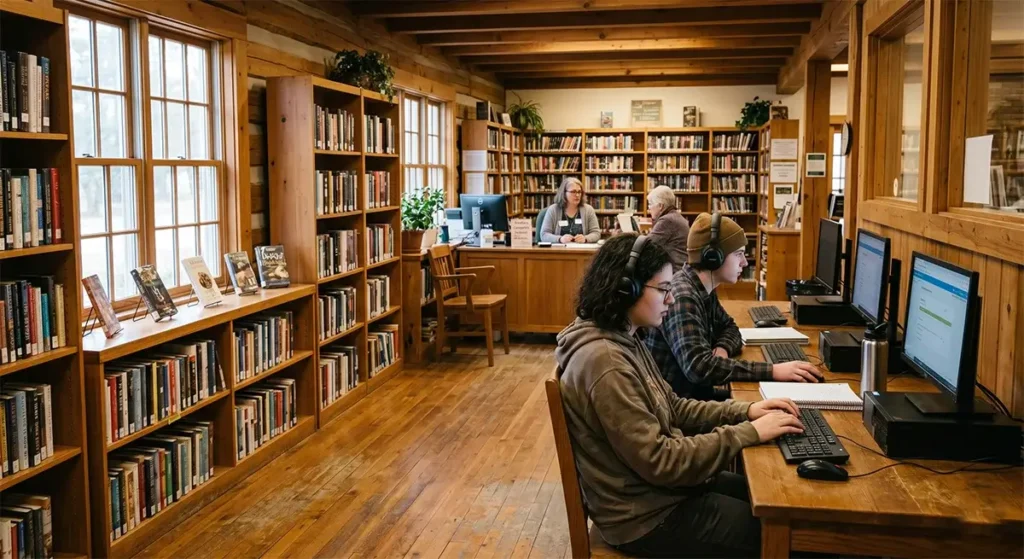
- Use the public library strategically. For bandwidth-intensive tasks — uploading large projects, taking proctored online exams, participating in lag-sensitive live activities — the rural public library’s broadband connection is a legitimate resource. Most rural public libraries now have reliable broadband (E-Rate funded) and study areas suitable for focused academic work.
- Invest in a cellular booster before replacing your internet plan. If cellular coverage exists near your property, a signal booster may improve your hotspot speeds enough to handle educational needs at a fraction of the cost of a new internet service.
Frequently Asked Questions
Can rural students take AP classes online with Starlink?
Yes. Starlink provides more than sufficient speed and low enough latency for all College Board AP coursework, AP classroom resources, and any online learning platform. Students in areas served by Starlink should have no technical barriers to accessing the full range of AP, IB, and dual-enrollment online courses.
Is there free internet available for rural students?
Free home broadband is not widely available, but the Lifeline Program provides discounts, and some state programs offer subsidized connections. More practically accessible are public library broadband connections (free to library card holders), school district hotspot lending programs, and in some communities, nonprofit-operated free Wi-Fi networks focused on student access. Ask your school district technology coordinator what resources are available in your specific community.
Will HughesNet or Viasat work for online school?
For asynchronous online school (recorded lectures, document-based assignments, digital textbooks, and asynchronous discussion boards), HughesNet and Viasat can be functional though constrained by data caps (HughesNet) or performance during peak hours. For any program involving live video instruction (synchronous Zoom or Meet classes), these services’ 600+ ms latency creates a degraded experience that most students and teachers find unacceptably disruptive. If your child’s school program involves regular live video classes, we strongly recommend pursuing Starlink or a low-latency alternative.



Leave a Reply