
Oklahoma’s rural broadband landscape reflects the state’s complex character: vast open plains in the west where satellite is the most practical solution, rugged Ozark foothills in the northeast with terrain challenges, a dense network of small towns and farming communities across the center, and some of the most severely economically distressed rural counties in the South. Oklahoma ranks consistently near the bottom of national broadband access rankings, with significant portions of its rural population lacking access to service that meets modern speed standards. But 2026 is bringing meaningful change through Starlink’s universal coverage, expanding federal investment, and active state-level broadband initiatives. This complete guide covers rural internet options across all of Oklahoma’s diverse regions.
In This Guide
- Oklahoma Rural Broadband Overview
- Internet Options by Oklahoma Region
- Starlink in Oklahoma
- T-Mobile and Verizon Home Internet in Rural Oklahoma
- Connectivity on Oklahoma Tribal Lands
- Oklahoma WISPs and Regional Providers
- Oklahoma State Broadband Programs
- Internet for Oil and Gas Operations
- Practical Tips for Rural Oklahoma Residents
- FAQs
Oklahoma Rural Broadband Overview
Oklahoma is a state where the rural broadband problem is both severe and economically consequential. With approximately 70% of the state’s land area classified as rural and a population of about 4 million, Oklahoma has hundreds of thousands of rural residents without adequate broadband access. The state’s economy — heavily dependent on agriculture, oil and gas, and increasingly technology and aerospace in the Tulsa and OKC corridors — creates compounding demand for connectivity across both established and emerging rural economic sectors.
According to FCC broadband coverage data, Oklahoma has one of the highest concentrations of unserved rural addresses in the south-central United States. The situation is particularly acute in the state’s southeastern counties (the “Little Dixie” region bordering Arkansas and Texas), the far western Panhandle counties, and the rural areas of the Ouachita Mountains in the southeast.
Oklahoma’s 39 federally recognized Native American nations — the highest tribal nation count of any US state — add a critical dimension to the rural broadband challenge. Oklahoma’s tribal lands, which span much of the eastern half of the state following the Supreme Court’s 2020 McGirt decision, include many of the state’s most broadband-deficient communities. Federal funding programs for tribal broadband have been active in Oklahoma, but the scale of need substantially exceeds current funding levels.
Internet Options by Oklahoma Region
Oklahoma City Metro Rural Fringe (Logan, Lincoln, Cleveland, McClain Counties)
The rural counties immediately surrounding the OKC metro have better connectivity than most of rural Oklahoma due to proximity to urban infrastructure. T-Mobile Home Internet is available at more rural addresses in this zone than anywhere else in the state. Several WISPs operate in the OKC metro fringe. Starlink is available with excellent performance across this mostly flat terrain. Rural communities in Canadian, Grady, and Garvin counties are seeing BEAD-funded infrastructure expansion beginning in 2026.
Northwest Oklahoma (Woodward, Major, Alfalfa, Woods Counties)
Northwest Oklahoma’s sweeping wheat plains and oil-producing counties have minimal fixed broadband infrastructure outside of small towns. The flat terrain is ideal for Starlink installation — virtually no obstruction concerns — and the low coverage cell density delivers consistently excellent Starlink performance. T-Mobile’s 4G LTE coverage exists along major highway corridors but Home Internet eligibility in truly rural addresses is limited. Cellular signal boosters dramatically improve the usability of whatever cellular signal exists in this region’s remote areas.
Northeast Oklahoma / Green Country (Tulsa Rural, Wagoner, Cherokee, Delaware Counties)
The rolling hills and Ozark foothills of northeast Oklahoma — the “Green Country” — have terrain that creates coverage challenges for fixed wireless while generally providing adequate sky views for Starlink. Several WISPs serve specific communities in this region. The Cherokee, Creek, and Osage Nations’ tribal territories span much of this region, and tribal broadband investments have improved connectivity in some communities. Starlink performs well across most of the Green Country landscape. T-Mobile Home Internet eligibility is moderate, somewhat better than the state average due to this region’s higher population density.
Southeast Oklahoma / Little Dixie (LeFlore, Latimer, Pushmataha, McCurtain Counties)
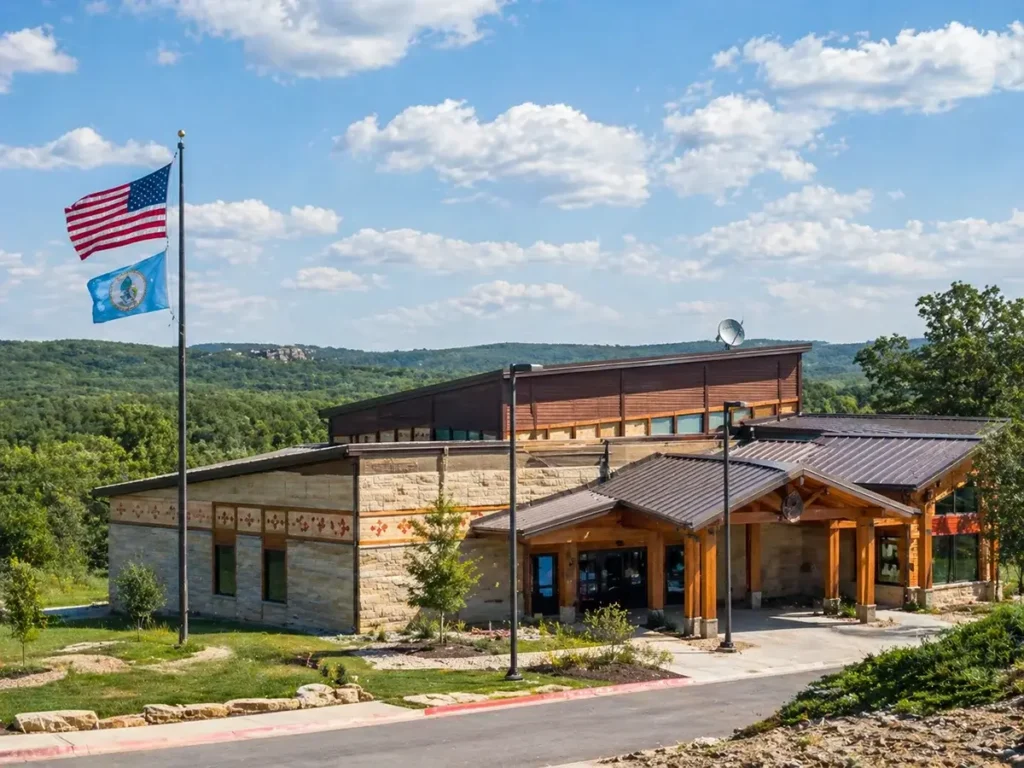
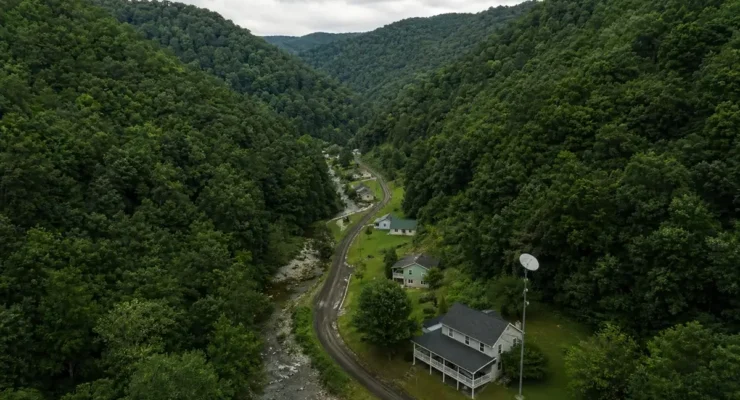
Southeast Oklahoma’s forested mountain and valley communities represent the state’s most severe broadband gap. The Ouachita Mountains and Kiamichi River country combine remote geography, limited economic investment, and difficult terrain. Many communities in LeFlore, Latimer, and McCurtain counties have no viable fixed broadband option other than legacy satellite. Starlink is available and often performs well for ridge and hillside properties — the Ouachita terrain provides adequate sky views from most elevated locations. Deep valley and creek-bottom properties may have northern sky obstruction requiring mast installation. The Choctaw Nation has been the most active tribal broadband investor in this region.
The Panhandle (Texas, Beaver, Cimarron Counties)
Oklahoma’s Panhandle — three counties stretching 200 miles west from the main body of the state — is among the most isolated rural territory in the continental United States. Cimarron County, the westernmost county, has some of the lowest population density and worst broadband access statistics of any county east of the Rocky Mountains. The flat, open terrain is ideal for Starlink — the sky views are essentially unrestricted in all directions. Cellular coverage is limited to Verizon in most of the Panhandle, with T-Mobile and AT&T coverage sparse and unreliable in the most remote areas. For Panhandle residents, Starlink is often the first time they’ve had access to broadband-class internet.
Central Oklahoma / Frontier Country (Garfield, Grant, Kay, Osage Counties)
The agricultural heartland of central Oklahoma has a mix of telephone cooperative DSL, some WISP coverage in specific corridors, and growing Starlink adoption. This region’s flat to gently rolling terrain is favorable for both fixed wireless tower coverage and Starlink installation. Several rural telephone cooperatives — Pioneer Telephone Cooperative and Northwest Rural Electric Cooperative affiliates — provide DSL and in some areas fiber service to their member communities.
Connectivity on Oklahoma Tribal Lands
Oklahoma’s unique status as home to 39 federally recognized tribal nations means that tribal broadband programs are a critical component of the state’s rural connectivity landscape. Key tribal broadband initiatives include:
- Cherokee Nation Broadband: The Cherokee Nation has been one of the most aggressive tribal broadband investors in the country, deploying fiber-optic infrastructure to Cherokee communities across a 14-county jurisdiction in northeastern Oklahoma using a combination of tribal funds, USDA ReConnect grants, and BEAD Program allocations.
- Choctaw Nation Connectivity: The Choctaw Nation has deployed fixed wireless and is expanding fiber in rural Choctaw Nation communities in southeastern Oklahoma — some of the state’s most persistently underserved areas.
- Muscogee Nation and Other Tribal Investments: Multiple smaller tribal nations have pursued broadband infrastructure using FCC E-Rate, USDA ReConnect, and NTIA tribal broadband funds. The McGirt decision’s affirmation of tribal sovereignty over much of eastern Oklahoma has accelerated tribal-led infrastructure investment in areas where state and commercial ISP investment was insufficient.
Tribal members living within tribal jurisdictions should contact their nation’s administration to inquire about tribal broadband programs, as these are often not widely advertised through commercial channels.
Internet for Oil and Gas Operations in Rural Oklahoma
Oklahoma’s oil and gas industry has a unique and urgent set of rural connectivity needs distinct from agricultural or residential uses. Remote well sites, compressor stations, pipeline monitoring equipment, and field operations offices all require reliable connectivity for SCADA (Supervisory Control and Data Acquisition) systems, equipment telematics, regulatory compliance reporting, and worker safety communications.
For rural Oklahoma oil and gas field operations, Starlink Business has become an increasingly common connectivity solution for field offices and manned facilities. For remote unmanned infrastructure (pipeline monitoring stations, remote wellhead sensors), cellular IoT solutions using AT&T or Verizon M2M (machine-to-machine) SIM plans provide the low-bandwidth but high-reliability connectivity needed for sensor data transmission. For the most remote Panhandle or southwest Oklahoma operations with no cellular coverage, Iridium and Globalstar satellite IoT services provide global coverage with low-bandwidth data transmission for critical SCADA data.
Oklahoma State Broadband Programs
Oklahoma’s state broadband coordination is handled through the Oklahoma Broadband Office, established under the Oklahoma Department of Libraries in 2021 and now operating under the Office of Management and Enterprise Services (OMES). The Oklahoma Broadband Office is administering the state’s $1.17 billion BEAD Program allocation with specific attention to the state’s tribal broadband needs, rural agricultural communities, and the southeastern counties with the most severe access deficits.
Oklahoma has also maintained active participation in the USDA ReConnect Program, with numerous Oklahoma-based ISPs — including rural telephone cooperatives and regional WISPs — receiving ReConnect funding for rural broadband infrastructure across the state. The ReConnect funded projects map shows multiple active Oklahoma projects in various stages of construction and deployment.
Practical Tips for Rural Oklahoma Residents
- Starlink is your best option in most of rural Oklahoma today. The flat-to-rolling terrain of most of Oklahoma provides excellent Starlink installation conditions. The sparse coverage cells in western and central Oklahoma deliver consistently fast speeds. Order and install without delay if you need broadband now.
- Contact your tribal nation if you live within a tribal jurisdiction. Oklahoma’s tribal broadband programs are some of the most active in the country. Even if commercial ISPs don’t serve your area, your nation may have an active broadband program or be deploying one with BEAD funding.
- Invest in a Verizon signal booster for rural cellular backup. Verizon has the strongest rural Oklahoma cellular network. A weBoost Home Complete booster dramatically improves Verizon signal in rural homes, providing better backup connectivity for Starlink outages than AT&T or T-Mobile in most rural Oklahoma areas.
- File FCC broadband map challenges for your address. Oklahoma has documented cases of ISP coverage overclaiming in rural areas. If a provider on your FCC map listing doesn’t actually serve you, file a challenge at broadbandmap.fcc.gov to improve your area’s BEAD eligibility.

Frequently Asked Questions
What is the best internet option for rural western Oklahoma in 2026?
Starlink is the best and often the only viable broadband option for most of rural western and Panhandle Oklahoma. The terrain is ideal for installation, performance in low-density western Oklahoma cells is consistently strong, and T-Mobile or Verizon Home Internet eligibility is limited outside of highway corridors. Install Starlink, invest in a Verizon backup hotspot, and you’ll have the most reliable connectivity available in the region.
Is there internet available for the Oklahoma Panhandle?
Starlink is available throughout the Oklahoma Panhandle with no waitlist. The open terrain and minimal competition for satellite coverage cells makes Panhandle Starlink performance frequently excellent — some of the best in the state. Cellular connectivity from Verizon is available in towns and along US-270/US-64 but is limited in the truly rural areas between towns. For Panhandle residents who have never had broadband, Starlink is a transformative option that is available and performant right now.
How is the Cherokee Nation improving internet in northeastern Oklahoma?
The Cherokee Nation has deployed and continues to expand a fiber-optic broadband network across its 14-county jurisdiction in northeastern Oklahoma. The network is built on a combination of USDA ReConnect grants, NTIA tribal broadband funding, and tribal capital investment. Cherokee Nation members and community residents in the jurisdiction should contact the Cherokee Nation’s tribal utility operations or broadband services department for information on service availability at specific addresses and enrollment procedures.



Leave a Reply