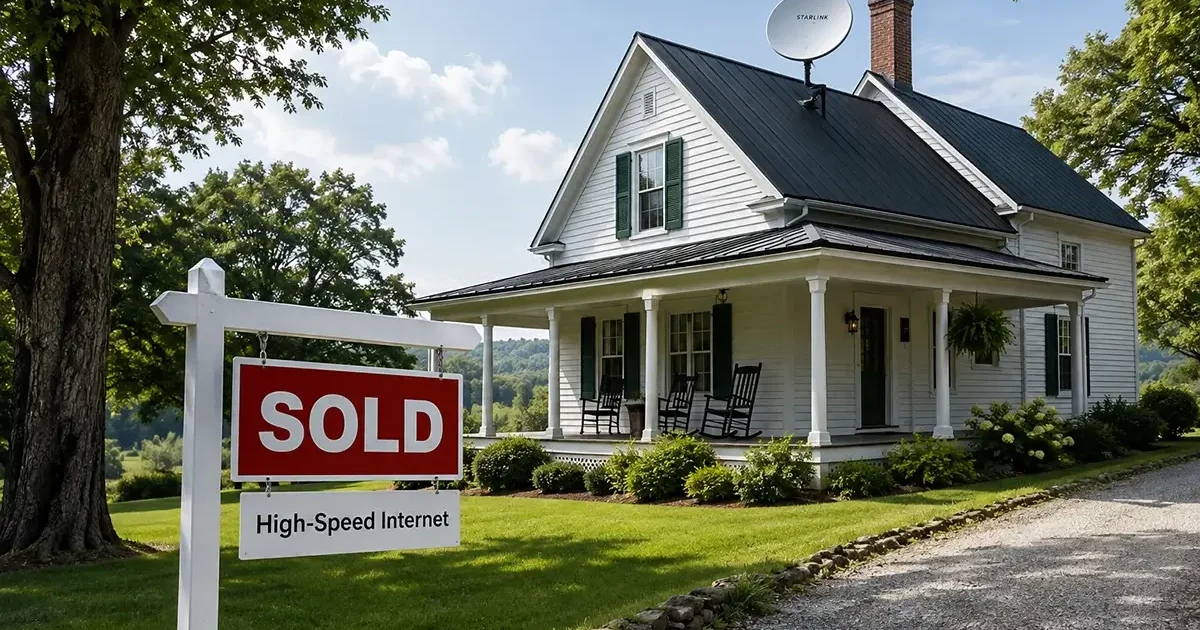
Does rural broadband actually affect property values? The answer — increasingly well-documented by real estate researchers, appraisers, and property economists — is yes, significantly. Adequate internet connectivity has emerged as a genuine real estate value driver in rural markets, and the absence of broadband has become a measurable discount factor for properties without it. This comprehensive guide covers what rural property buyers, sellers, investors, and landowners need to know about how internet connectivity affects rural real estate values in 2026, including documented research on the value premium, practical implications for buyers and sellers, and how to evaluate connectivity as part of any rural property decision.
In This Guide
- Does Rural Broadband Affect Property Values?
- What the Research Shows
- The Remote Work Effect on Rural Real Estate
- Documenting the Value Premium
- Rural Property Buyer’s Internet Evaluation Guide
- Seller’s Guide: Maximizing Value Through Connectivity
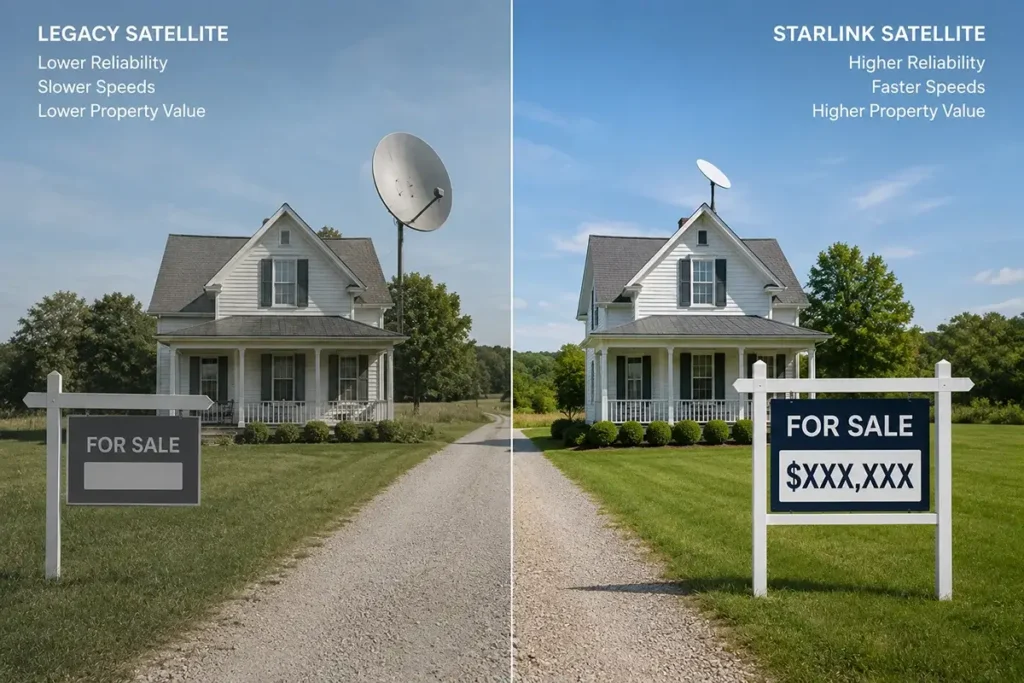
- What Starlink Means for Rural Property Values
- Rural Property Investment and Broadband
- How to Properly Evaluate Property Connectivity
- Frequently Asked Questions
Does Rural Broadband Affect Property Values?
The intuitive case for broadband affecting rural property values has always been straightforward: a property where you can work remotely, access telehealth, run a business, and participate in the digital economy is more functional and therefore more valuable than an identical property without these capabilities. For most of broadband’s history, however, the broadband gap in rural areas was so widespread that the value differential was difficult to isolate — almost all rural properties lacked adequate internet, so buyers couldn’t easily compare like-for-like properties with and without broadband.
The post-2020 period changed this dramatically. Remote work created massive new demand for rural properties with broadband from urban buyers willing to pay premium prices to access rural lifestyle while maintaining career connectivity. Simultaneously, Starlink’s 2021–2022 commercial deployment created a new class of previously unconnected rural properties — ones that suddenly had broadband-quality internet for the first time. This natural experiment — rural properties with and without Starlink, before and after Starlink’s availability — has provided researchers with new data for measuring broadband’s actual effect on rural property values.

What the Research Shows
Academic research on rural broadband and property values has accelerated since 2020 and produced increasingly clear findings:
A widely-cited study from the University of New Hampshire (published in 2021) found that rural New Hampshire properties with fiber broadband access sold at a premium of approximately 3% compared to comparable properties without fiber. In absolute dollar terms on the typical rural New Hampshire property, this represents $8,000–$15,000 of value attributable to broadband access.
Research from the USDA Economic Research Service examining rural broadband adoption across multiple states found that communities with broadband access experienced higher property value growth rates than comparable communities without broadband access — a community-level premium in addition to the individual property premium from direct access. The USDA’s research has specifically linked rural broadband investment to measurable rural economic development outcomes including property value appreciation, population stability, and new business formation.
A 2022 Lincoln Institute of Land Policy study on rural broadband and property values found premiums ranging from 2–7% for rural residential properties with high-speed broadband access compared to comparable properties without access, with higher premiums in markets where remote work demand from urban buyers was stronger. The study specifically noted that the premium was higher in scenic rural markets (mountains, lakes, coastal areas) where remote worker demand was most concentrated. According to the USDA Economic Research Service rural broadband research, the relationship between broadband access and rural economic outcomes including property values is consistently documented across multiple study methodologies and geographic contexts.
The Remote Work Effect on Rural Real Estate
Remote work has been the most powerful market force changing rural property values in the post-2020 period. Urban professionals with the ability to work from anywhere have discovered that rural living — with dramatically lower housing costs, space, nature access, and quality of life — is accessible and desirable if broadband connectivity is available. This demand has created a measurable bifurcation in rural property markets:
Rural properties with broadband: High demand from remote workers, investors, and people seeking rural lifestyle. In many scenic rural markets, these properties have seen 20–40% price appreciation driven by remote worker demand since 2020 — a premium that would not have materialized without adequate internet connectivity enabling the remote work lifestyle.
Rural properties without broadband: Lower demand from the expanding remote worker buyer pool, who exclude these properties at the search stage. These properties compete only for buyers who either don’t need internet (a shrinking buyer pool) or are willing to accept connectivity limitations — typically at a meaningful discount to comparable connected properties.
The remote work effect is most pronounced in scenic rural markets within driving distance of major metro areas — Vermont, the Catskills, the Appalachians, the Ozarks, the Rocky Mountain foothills — where urban buyers are willing to pay premium prices for rural lifestyle with broadband connectivity. In these markets, the difference between “has Starlink” and “no internet available” in a listing can be the difference between receiving multiple offers and sitting on the market for months.
Documenting the Value Premium: What Buyers Are Actually Paying
The broadband value premium in rural real estate manifests in several documented ways:
List price difference: Rural real estate listings in competitive markets now commonly advertise broadband availability as a featured amenity — “Starlink compatible,” “Fiber available,” or “High-speed internet” in listing headlines. These properties typically list at higher prices than comparable properties without broadband mentions in markets where remote worker demand is active.
Days on market difference: Properties with documented broadband connectivity sell significantly faster than comparable properties without internet in markets where remote worker buyers are active. A rural Vermont property with fiber broadband may sell within days of listing; a comparable property with “no reliable internet” may sit on the market for months despite lower pricing.
Offer count difference: In competitive rural markets, broadband-connected properties frequently generate multiple offers while non-connected comparable properties may generate few or none. The competitive offer dynamic drives prices above list for connected properties while non-connected properties negotiate below list.
Appraiser consideration: Rural real estate appraisers are increasingly incorporating broadband access as a value factor in comparable sales analyses. When a comparable sale includes broadband and the subject property lacks it (or vice versa), appraisers make adjustments — typically $3,000–$15,000 per comparable adjustment depending on the market and property type.
Rural Property Buyer’s Internet Evaluation Guide
For buyers considering a rural property purchase, internet connectivity evaluation should be part of the due diligence process as standard as water quality testing and septic inspection. Steps to evaluate connectivity before making an offer:
- Run the Starlink sky obstruction scan from the property. Download the Starlink app, go to the property, and run the sky obstruction AR scanner from the intended satellite dish location (typically the highest accessible point on the property or the roof of the main structure). This 5-minute assessment definitively shows whether Starlink is viable at the specific property location. A result showing less than 5% obstruction means excellent Starlink conditions; more than 15% obstruction indicates mast installation may be needed; more than 30% obstruction suggests Starlink may not be viable from ground-level positions.
- Check FCC broadband map for all providers at the property address. Visit broadbandmap.fcc.gov and enter the property address to see all providers officially reported as serving the address, including fixed wireless, telephone company DSL, and cable coverage.
- Inquire about local WISPs. Ask the seller, neighbors, or the local real estate agent about local wireless internet providers serving the area. WISP availability isn’t always captured in the FCC map.
- Test the seller’s actual connection if they have one. If the seller currently has internet service at the property, ask to run a speed test during the property showing. This documents actual performance, not just advertised speeds.
- Include connectivity conditions in the purchase agreement if needed. For properties where connectivity is critical to your intended use, consider making the offer contingent on confirming viable broadband — either through Starlink viability demonstration or through transferring the seller’s existing WISP service to the buyer.
Seller’s Guide: Maximizing Rural Property Value Through Connectivity
For rural property sellers, investing in broadband infrastructure before listing can provide one of the highest ROI improvements available — particularly in markets with active remote worker buyer demand.
Installing Starlink before listing: A $349 hardware investment in Starlink, with a month of verified service at $120, can add $5,000–$15,000 to the property’s value in markets where broadband is a competitive differentiator. This represents a return of 10x–30x on the connectivity investment. More importantly, it opens the property to the large remote worker buyer pool that simply won’t consider properties without verified broadband.
Marketing connectivity prominently: Rural property listings should lead with connectivity information when it’s a strength. “High-speed Starlink satellite internet” or “Verified 85 Mbps broadband at this property” in the listing description and headline communicates to remote worker buyers that this property meets their non-negotiable requirement — before they spend time visiting a property that doesn’t.
Documenting the connection: Provide buyers with speed test screenshots from multiple time periods showing the actual performance of the connection. Buyers who’ve been burned by rural properties with “internet available” that turned out to be 2 Mbps satellite appreciate documented evidence of actual performance.
What Starlink Has Done for Previously Unconnected Rural Properties
Starlink’s arrival has effectively created broadband access for millions of rural US properties that previously had no viable option — and in doing so, has unlocked value in those properties that previously couldn’t be accessed. For rural property owners who have had Starlink since 2021–2022, the effect has been measurable:
Properties that previously could only attract buyers willing to accept connectivity limitations now compete for the full range of rural property buyers including remote workers, telehealth-dependent retirees, and families with school-age children who need online education access. This expanded buyer pool — all other property characteristics being equal — supports higher prices and faster sales that translate to real money for rural property sellers.
For rural communities broadly, Starlink has contributed to population stability and in some cases population growth in communities that were losing residents due to the perception that rural living required sacrificing connectivity. Stable or growing population supports property values at the community level beyond the individual property effect.
Frequently Asked Questions
How much does broadband add to rural property value?
Research consistently documents a 2–7% rural property value premium attributable to broadband access, with the premium being highest in scenic rural markets with active remote worker demand. On a $300,000 rural property, this represents $6,000–$21,000 of value attributable to broadband access. The premium varies significantly by market — in competitive Catskills, Vermont, or mountain West rural markets with strong remote worker demand, the effective premium from having verified broadband versus no internet may be even larger than these averages suggest.
Should I install Starlink before selling my rural property?
In most rural markets with any remote worker buyer demand — which includes most scenic and exurban rural areas within 3 hours of a major metro — yes. The $349 hardware investment plus one month of verified service has a typical ROI of 10x–30x in value added to the listing price, plus meaningfully reduces time-on-market by opening the property to the remote worker buyer pool. Consult with a rural real estate agent familiar with your specific market to confirm whether the remote worker demand in your area justifies this investment before listing.
Do rural appraisers account for Starlink availability in property valuations?
Increasingly yes. Rural appraisers in markets where broadband is a documented value factor are making positive adjustments for comparable sales that have broadband versus subject properties without it, and vice versa. The practice is not yet uniform — appraisers in markets where broadband has not historically been a differentiating factor may not yet fully account for it. As Starlink adoption has made broadband access more common in rural areas, the absence of broadband (or the presence of only legacy slow satellite) is becoming a more clearly identifiable negative adjustment factor in rural appraisals.


Leave a Reply