
Maine has one of the most unique rural broadband challenges in the northeastern United States — a vast, forested, and sparsely populated state that is simultaneously New England’s largest state by area and one of its most rural by population distribution. Maine’s 35,380 square miles of dense boreal and mixed hardwood forests, rocky coastline, working waterfront communities, potato farming regions in Aroostook County, and the vast Unorganized Territories that cover nearly half the state’s area create a rural connectivity landscape as diverse as the state’s natural character. In 2026, Maine’s aggressive state broadband investment, telephone cooperative fiber programs, and Starlink’s coverage are creating meaningful rural connectivity improvement — though the most remote communities still face significant challenges. This complete guide covers rural internet options across Maine’s distinct regions.
In This Guide
- Maine Rural Broadband Overview
- Best Internet by Maine Region
- Starlink in Maine
- Maine Telephone Cooperatives
- Maine State Broadband Programs
- Maine’s Unorganized Territories: The Ultimate Rural Frontier
- Aroostook County: The County
- Maine Coast and Island Connectivity
- Practical Tips for Rural Maine Residents
- Frequently Asked Questions
Maine Rural Broadband Overview
Maine is New England’s largest state by area but has a population of only approximately 1.4 million people — making it one of the most rural states in the northeastern United States by population density. The state’s rural broadband challenge is driven by the combination of dense forest cover that creates sky obstruction for wireless technologies, rocky terrain that makes buried infrastructure expensive, extreme winter weather that challenges both installation and equipment, and a dispersed population that creates high per-household costs for any fixed infrastructure deployment.
According to the FCC National Broadband Map, Maine has one of the highest percentages of unserved rural addresses of any northeastern state, with particular concentration in Aroostook County (the largest county east of the Mississippi by area), Washington County, Somerset County, and the vast Unorganized Territories that cover approximately 10.5 million acres in northern Maine where there is essentially no private land settlement and no infrastructure of any kind.
Maine has been one of the most active northeastern states in rural broadband investment. The Maine Connectivity Authority (MCA), established in 2021, has been specifically tasked with achieving universal broadband access for Maine residents — a mandate that reflects the state’s recognition that rural broadband is essential infrastructure for Maine’s economic development, healthcare access, and quality of life.
Best Internet by Maine Region
Southern Maine / Greater Portland Orbit (York, Cumberland, Sagadahoc Counties)
Southern Maine has the state’s best rural connectivity, driven by proximity to Portland — Maine’s largest city and a significant technology and creative economy hub. Rural communities within 30–45 miles of Portland have some cable and fiber coverage extending from the metropolitan area. Communities along I-95, Route 1, and US-302 have better options than more remote communities. T-Mobile Home Internet availability is better in southern Maine than in the more remote northern regions. Several southern Maine telephone companies have expanded broadband in rural communities.
Midcoast Maine (Knox, Waldo, Lincoln Counties)
Maine’s midcoast — the scenic peninsula and island communities between Portland and Acadia — has moderate connectivity in coastal communities with significant gaps in inland rural areas away from US-1. The unique geography of many midcoast communities — on peninsulas with limited infrastructure routing options — creates connectivity challenges similar to island communities even for road-connected properties. Several midcoast telephone companies serve specific communities. Starlink’s open coastal sky access (often with ocean visibility to the south) provides excellent installation conditions from most midcoast properties.
Downeast Maine (Washington County)
Washington County — the easternmost US county, bordering Canada’s New Brunswick province — has some of Maine’s most severe rural broadband gaps outside of the Unorganized Territories. Calais, Machias, and Eastport have limited commercial broadband; the vast rural stretches of blueberry barrens, forests, and coastal communities between them have essentially no fixed broadband infrastructure. Washington County has the lowest per-capita income of any Maine county and has been specifically prioritized in state and federal broadband investment programs.
Northern Maine / Aroostook County
Aroostook County — “The County” as Mainers call it — covers 6,829 square miles, making it larger than Connecticut and Rhode Island combined. Its potato and grain farming communities, the small cities of Presque Isle and Caribou, and the vast forested territory approaching the Canadian border have connectivity situations that vary from moderate in the agricultural corridor to essentially nonexistent in the most remote forested areas. See the dedicated Aroostook section below.
Maine State Broadband Programs
Maine’s Maine Connectivity Authority (MCA) is the state’s dedicated broadband agency with a mandate for universal broadband access. Maine received approximately $272 million in BEAD Program federal funding, which the MCA is implementing alongside its own state funds and prior ConnectMaine Authority grants. Maine has been one of the most proactive states in rural broadband investment — the MCA was specifically established to coordinate and accelerate deployment in a state where the geographic and economic challenges would otherwise be prohibitive for commercial-only approaches.
Maine has also benefited from the USDA ReConnect Program across multiple funding rounds, with several Maine telephone companies and cooperatives receiving ReConnect grants for fiber deployment in previously unserved communities. For current project maps, funded ISP information, and Maine Connectivity Authority programs.
Maine’s Unorganized Territories: The Ultimate Rural Frontier
Maine’s Unorganized Territories (UTs) — approximately 10.5 million acres of mostly forested land in northern and western Maine with no local municipal government — are home to approximately 9,000 year-round residents plus a much larger seasonal population of camp and cabin owners, timber workers, and outdoor recreation visitors. The UT is administered directly by the Maine Land Use Planning Commission rather than any local municipal government, creating unique governance and infrastructure challenges.
For UT residents and camp owners, Starlink is the only viable broadband option — there is no telephone company DSL, no cable, and in most cases no cellular coverage in the vast interior UT. The dense boreal forest (primarily spruce-fir with some hardwood) creates sky obstruction challenges for properties deep in the forest — properties on open water (which are common in the UT’s lake country) typically have excellent sky access over the water, while forest-interior properties may need significant mast installation to clear the surrounding canopy.
Aroostook County: Maine’s Agricultural Giant
Aroostook County’s potato and grain farming economy — one of the largest potato-producing regions in the United States — requires broadband connectivity for precision agriculture, commodity market access, and the agricultural business operations of what are often large-scale commercial farming enterprises. The county’s agricultural communities along the Route 1 and Route 11 corridors have moderate telephone company connectivity; the vast rural stretches beyond these corridors depend on Starlink.
The flat and gently rolling terrain of Aroostook’s potato country — essentially identical geography to New Brunswick’s potato-growing region across the nearby Canadian border — provides excellent Starlink installation conditions with no sky obstruction concerns from most farmstead locations. Performance in Aroostook’s extremely low-density coverage cells (among the least populated territory in the eastern United States) is frequently excellent — users report 95–130 Mbps download speeds in the most remote northern Aroostook locations.
Maine Coast and Island Connectivity
Maine’s iconic island communities — Monhegan, Vinalhaven, North Haven, Deer Isle, Isle au Haut, and others — have specific connectivity challenges driven by their water-access-only or limited ferry access character. The same open ocean geography that makes Maine’s island communities so spectacularly beautiful provides essentially unrestricted southern sky access for Starlink, making satellite installation conditions ideal for island properties.
The salt air and marine environment of Maine’s coast and islands requires the same marine-grade installation attention as Hawaii’s islands — dielectric grease on all outdoor connections, marine-grade mounting hardware, and annual inspection for corrosion. Maine’s harsh winter conditions — ice storms, heavy snow, and temperatures well below zero — add additional installation requirements beyond the salt air considerations of warmer coastal states.
Practical Tips for Rural Maine Residents
- Unorganized Territory residents and camp owners: Starlink is your only viable broadband option. Open lake-shore positions provide excellent sky access; dense forest properties need careful sky scanner assessment and may need significant mast installation to clear the boreal canopy.
- Maine winter considerations: Heavy snow and ice accumulation on Starlink dishes is more common in Maine than in most US states. The built-in heater handles typical snowfall but heavy wet snow during nor’easters can occasionally require brief clearing. Mount with an angle that promotes snow shedding. Extreme cold (Maine’s interior can reach -30°F in harsh winters) requires the same precautions as northern Midwest and northern New England states.
- Island and coastal residents: Marine-grade hardware for all outdoor components. Excellent sky access in most cases. Check the Maine Connectivity Authority for current broadband programs serving your specific coastal or island community.
Frequently Asked Questions
What is the best internet for Aroostook County Maine?
For rural Aroostook County agricultural communities beyond telephone company DSL coverage, Starlink is the recommended immediately available broadband. The flat potato-growing terrain delivers excellent sky access and consistently strong performance in Aroostook’s very low-density coverage cells. Check the Maine Connectivity Authority for BEAD-funded project timelines for your specific community — Aroostook is a MCA priority deployment zone and fiber infrastructure is actively being planned for many previously unserved communities.

Does Starlink work in Maine’s Unorganized Territory?
Yes. Starlink is available throughout Maine including in the Unorganized Territory with no waitlist. The open lake-shore positions common in the UT’s lake country provide excellent sky access. Dense boreal forest interior properties may have significant sky obstruction — use the Starlink app scanner from your property before ordering. The UT’s extremely low coverage cell density delivers some of the fastest rural Starlink performance in the northeastern United States for properties with adequate sky clearance.
Maine’s Fishing and Maritime Industry Connectivity
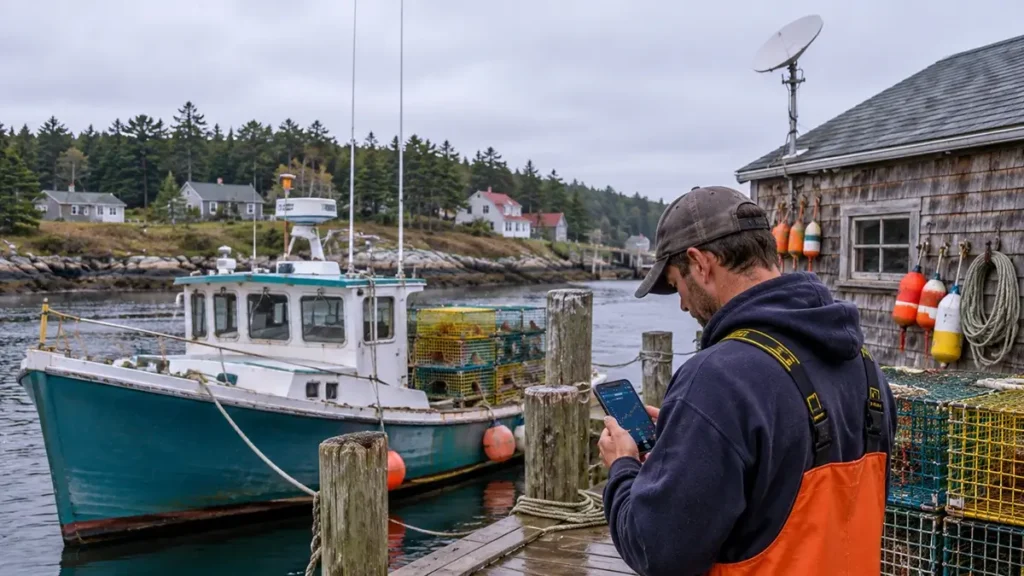
Maine’s commercial fishing industry — lobstering, groundfishing, scalloping, and aquaculture — is the economic backbone of dozens of coastal communities from Kittery to Eastport. The connectivity needs of Maine’s fishing industry are unique: lobstermen need tide and weather data, market pricing for lobster, and communication with shoreside operations. Aquaculture operations monitoring water quality, sea temperature, and stock health require broadband for real-time sensor data access. Fish dealers and processors need connectivity for business operations, regulatory compliance reporting, and market access.
Starlink has been adopted across Maine’s working waterfront, both at shore-side facilities and — increasingly — on commercial fishing vessels through Starlink’s maritime options. For shore-side fishing businesses and aquaculture operations, Starlink provides reliable broadband where telephone company DSL has been marginal and cable never reached. The open ocean exposure of most Maine working waterfront locations provides essentially unrestricted southern sky access for Starlink installation — ideal conditions for the salt-air environment that requires marine-grade hardware and annual corrosion inspection.
Maine Tourism and Rural Connectivity
Maine’s tourism economy — outdoor recreation, wilderness camping, skiing, and the iconic Maine coastal experience — creates significant demand for connectivity in locations that are inherently scenic and often remote. Wilderness outfitters, backcountry lodges, and remote sporting camps serve guests who increasingly expect Wi-Fi despite their remote locations. Starlink has transformed what these businesses can offer their guests: a remote fly-fishing lodge in the Unorganized Territory that previously had only satellite phone communication can now offer guests genuine broadband Wi-Fi using a single Starlink dish and a mesh router extending coverage through the lodge buildings.
For Maine tourism and hospitality businesses, Starlink Business ($250/month) with commercial Terms of Service is the appropriate plan when providing Wi-Fi to paying guests — the unlimited priority data ensures consistent guest Wi-Fi performance regardless of how much data guests consume during their stay. Contact the Maine Connectivity Authority about any broadband business support programs that may be available for tourism businesses investing in connectivity infrastructure in rural Maine communities.
What is the best internet option for a seasonal cabin in Maine’s Unorganized Territory?
For seasonal cabins in Maine’s Unorganized Territory — typically used May through October for fishing, hunting, and recreation — Starlink Roam with the service pausing feature is the most cost-effective approach. Order Starlink before your first season visit, set up at the cabin (the open lake-shore position most UT cabins enjoy provides excellent sky access), and pause service during the November–April off-season. Five months of active service at $150/month costs $750/year — reasonable for reliable broadband at a remote location that previously had only satellite phone or no connectivity at all. Keep the dish and router at the cabin year-round (they’re weatherproof and cold-rated) and simply reactivate service when you arrive for each season.



Leave a Reply