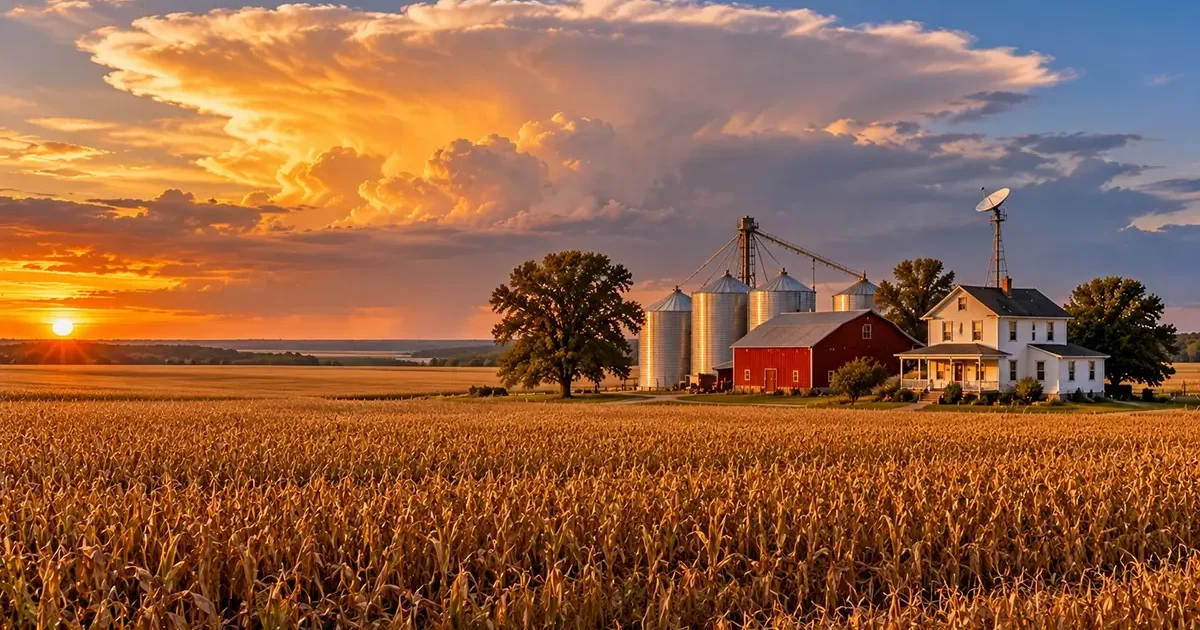
Illinois is a state where the rural broadband story is overshadowed by Chicago’s global profile — yet outside the Chicago metropolitan area, downstate Illinois has millions of rural residents in agricultural communities, small towns, and river corridor communities with connectivity situations that range from adequate near mid-size cities to severely limited in the most rural stretches of the Illinois plains, the Shawnee Hills of the south, and the river bottom communities along the Illinois, Wabash, and Mississippi rivers. As America’s third-largest agricultural state by revenue and a major manufacturing and logistics hub, Illinois has an acute economic need for rural broadband that policymakers and electric cooperatives are increasingly addressing in 2026. This complete guide covers rural internet options across Illinois’s distinct regions.
In This Guide
- Illinois Rural Broadband Overview
- Best Internet by Illinois Region
- Starlink in Illinois
- Illinois Electric Cooperatives and Broadband
- Illinois State Broadband Programs
- Southern Illinois: The Shawnee Hills and River Corridor
- Illinois Agriculture and Precision Farming
- Remote Work and Rural Illinois
- Practical Tips for Rural Illinois Residents
- Frequently Asked Questions
Illinois Rural Broadband Overview
Illinois covers 57,914 square miles with approximately 12.8 million residents — but the distribution is extreme. The Chicago metropolitan area contains roughly 60% of the state’s population, leaving the remaining 40% distributed across the vast agricultural plains of central and southern Illinois. The state’s rural broadband challenge is driven by the commercial ISP economics of serving dispersed agricultural communities across vast flat terrain where population density is low enough that market-driven deployment rarely pencils out without government subsidy.
According to the FCC National Broadband Map, Illinois has significant concentrations of unserved rural addresses in its southern counties (Hardin, Pope, Massac, Pulaski, Alexander), river corridor communities along the Mississippi and Illinois rivers, and agricultural counties in west-central Illinois away from the I-74 and I-55 corridors. Illinois’s rural broadband gap is real — the state ranks in the bottom half of US states for rural broadband access despite its overall economic strength.
Illinois has approximately 25 rural electric cooperatives serving members across the state’s rural territory, and several have been among the Midwest’s more active in broadband deployment. The state’s robust agricultural economy — Illinois is consistently among the top 3 US states for corn and soybean production — creates specific rural broadband demand from farm operations that cannot wait for commercial ISP investment timelines.
Best Internet by Illinois Region
Central Illinois Agricultural Plain (McLean, Livingston, Ford, Iroquois Counties)
Central Illinois’s flat agricultural plain — some of the world’s most productive farmland — has moderate connectivity with significant gaps in agricultural communities away from the Bloomington-Normal, Champaign-Urbana, and Kankakee metro corridors. Several central Illinois telephone companies and electric cooperatives serve rural communities with DSL and expanding broadband. T-Mobile Home Internet eligibility is better in the more densely populated central Illinois agricultural communities than in the more remote southern counties. The perfectly flat terrain makes Starlink installation effortless with no sky obstruction concerns.

Western Illinois / Spoon River Country (McDonough, Fulton, Schuyler, Brown Counties)
Western Illinois’s agricultural and river corridor communities between the Illinois River and the Mississippi — Macomb, Canton, and the surrounding rural communities — have significant broadband gaps in agricultural areas away from US-136 and US-67 corridors. Several western Illinois electric cooperatives have active broadband programs. The gently rolling western Illinois landscape makes Starlink installation straightforward.
Southern Illinois / Shawnee Hills (Hardin, Pope, Massac, Saline, Gallatin Counties)
Southern Illinois’s Shawnee National Forest country — the rugged Shawnee Hills and the Ohio and Mississippi river corridor communities — has some of the state’s most severe rural broadband gaps. Hardin County is Illinois’s least populated county and one of its least connected, accessible primarily via Route 1 along the Ohio River. The forested Shawnee Hills terrain creates sky obstruction considerations for Starlink similar to rural Appalachian communities. See the dedicated section below.
Northwest Illinois / Galena and Jo Daviess County
Northwest Illinois’s scenic lead mining country — Jo Daviess County’s rolling hills and the historic Galena area — has moderate connectivity driven by tourism and the Chicago metro’s recreational land use in the region. Communities along US-20 and in the Galena-Elizabeth corridor have better connectivity than the more remote agricultural communities in the surrounding counties. The region’s rolling terrain is generally favorable for Starlink installation.
Illinois Electric Cooperatives and Broadband
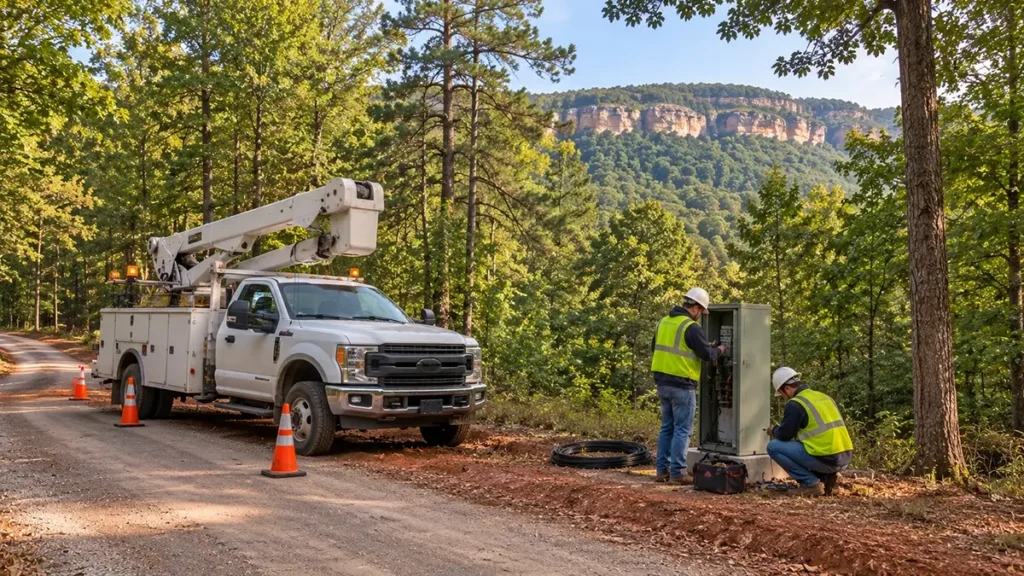
Illinois’s rural electric cooperatives have been among the Midwest’s more active in broadband deployment:
- Egyptian Electric Cooperative Association: Serving members in southern Illinois’s most underserved communities — Johnson, Massac, Pope, and Hardin counties — with active broadband programs using BEAD and ReConnect funding.
- Corn Belt Energy Cooperative: Serving members in central Illinois with expanding broadband programs.
- Southwestern Electric Cooperative: Serving members in southwestern Illinois with broadband development.
- Shelby Electric Cooperative: Serving members in Shelby County and surrounding areas with active broadband deployment.
- Menard Electric Cooperative: Serving members in Menard County (near Springfield) with broadband programs.
Illinois State Broadband Programs
Illinois’s broadband programs are coordinated through the Illinois Department of Commerce and Economic Opportunity (DCEO). Illinois received approximately $1.08 billion in BEAD Program federal funding — one of the larger Midwestern allocations, reflecting the scale of the state’s rural broadband gap across its extensive rural territory. Illinois’s BEAD implementation specifically prioritizes southern Illinois’s underserved communities, river corridor communities, and agricultural areas with the highest concentrations of unserved addresses.
Illinois has also operated the Illinois Rural Internet Access Fund and the Illinois Broadband Lab, providing state-level resources and coordination for rural broadband deployment that complements federal BEAD investment. For current project maps and funded ISP information, contact the Illinois DCEO broadband team or visit the Illinois broadband program website.
Southern Illinois: The Shawnee Hills and River Corridor
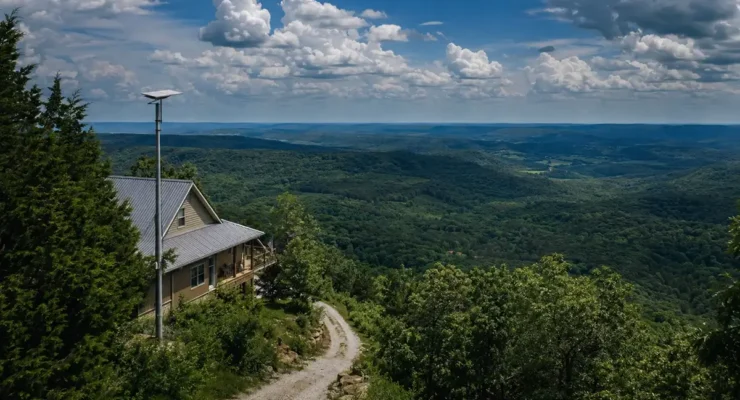
Southern Illinois’s Shawnee National Forest country is one of the most geographically distinctive and least-connected rural territories in the Midwest. The Shawnee Hills — a ridge of sandstone bluffs, forested hollows, and scenic river corridors that runs east-west across the bottom of the state — creates connectivity challenges comparable to Appalachian terrain rather than the flat Illinois agricultural plain that most people associate with the state. Communities in the Garden of the Gods wilderness area, the Cave-in-Rock ferry community on the Ohio River, and the small towns of Golconda and Elizabethtown have connectivity situations more comparable to rural Kentucky or West Virginia than to the Illinois heartland.
For southern Illinois Shawnee Hills communities, the sky obstruction assessment is important for Starlink — forested ridge-and-hollow terrain creates the same installation considerations as any Appalachian rural community. Ridge-top and south-facing slope properties typically have excellent sky access; hollow-bottom properties may need mast installation. Egyptian Electric Cooperative Association’s active BEAD-funded broadband programs represent the most significant infrastructure investment in some of these communities in decades.
The Ohio River corridor communities of southern Illinois — including Metropolis (the “Superman City”), Golconda, and Cave-in-Rock — have limited connectivity options driven by the difficulty of routing any infrastructure along the river’s often-flooded floodplain. Starlink is the most viable broadband option for most Ohio River corridor rural properties, and the generally open river views provide good sky access from most riverfront properties.
Illinois Agriculture and Precision Farming
Illinois is consistently the #2 or #3 US state for corn and soybean production — an agricultural powerhouse whose farm operations are among the most technology-intensive in the world. Precision agriculture adoption in Illinois is high relative to national averages, and broadband connectivity is the enabling infrastructure for the GPS guidance, variable rate application, yield monitoring, and farm management platforms that Illinois’s competitive commodity production demands.
The University of Illinois Extension has documented the precision agriculture productivity benefits for Illinois farm operations with broadband access, and several Illinois Farm Bureau county organizations have advocated for rural broadband as a farm competitiveness issue. For Illinois agricultural operations without adequate telephone company or cooperative fiber coverage, Starlink Priority ($250/month) is the recommended configuration — the flat Illinois terrain delivers consistently excellent performance and the unlimited priority data accommodates the peak planting and harvest season data demands that corn and soybean operations generate.
Practical Tips for Rural Illinois Residents
- Southern Illinois Shawnee Hills residents: Use the Starlink app scanner before ordering for any hollow or forested property. Contact Egyptian Electric Cooperative about current BEAD-funded broadband programs — the cooperative is one of the state’s most active in reaching the state’s most underserved communities.
- Central and western Illinois agricultural residents: Check your electric cooperative’s current broadband availability — Illinois cooperatives have been increasing their programs significantly with BEAD funding. T-Mobile Home Internet is worth checking for the more populated agricultural communities along major corridors.
- River corridor properties (Illinois, Mississippi, Ohio rivers): River proximity may affect Starlink installation if nearby bluffs or levee systems create sky obstruction. Check the sky scanner before ordering. The open river views from many riverside properties actually provide excellent western sky access that compensates for any eastern obstruction.
Frequently Asked Questions
What is the best internet for rural southern Illinois?
For rural southern Illinois’s Shawnee Hills communities, Starlink is the best available broadband — with sky obstruction assessment essential for hollow and forested properties. Contact Egyptian Electric Cooperative about BEAD-funded broadband programs that may serve your area. For the most remote communities in Hardin and Pope counties, Starlink is typically the only viable broadband option and delivers good performance in the low-density coverage cells of this remote region.
Is Starlink available throughout Illinois?
Yes. Starlink is available statewide in Illinois with no waitlist. Performance across the flat agricultural plain of central and northern Illinois is consistently excellent — commonly 90–115 Mbps in low-density rural coverage cells. Southern Illinois’s forested terrain requires sky obstruction assessment for some property locations. Contact your electric cooperative for fiber alternatives before ordering satellite — Illinois cooperatives have expanded broadband significantly with BEAD funding in 2025–2026.
Telehealth and Rural Illinois Healthcare Access
Rural Illinois’s healthcare access challenge — particularly pronounced in the southern Shawnee Hills counties and the more remote agricultural communities far from Illinois’s mid-size city hospital systems — is being meaningfully addressed by telehealth that Starlink and cooperative fiber broadband enables. Illinois has expanded telehealth reimbursement under Medicaid and private insurance to make remote physician consultations and specialist access available to rural Illinoisans who previously faced 60–90 minute drives to the nearest appropriate specialist.
For rural Illinois residents on HughesNet or Viasat legacy satellite service, the 600 ms latency makes telehealth video consultations functionally inadequate. Switching to Starlink transforms telehealth from a theoretically available resource to a practically useful healthcare tool for rural Illinois families in communities far from hospital systems. Egyptian Electric Cooperative’s fiber programs in southern Illinois specifically address the intersection of healthcare access and connectivity in communities where both are historically limited.
Rural Illinois Homeschooling and Online Education
Illinois’s rural homeschooling community — which has grown substantially since 2020 as families have discovered the flexibility of home-based education combined with online curriculum platforms — depends on broadband connectivity for the wide range of online educational resources that modern homeschooling draws upon. Illinois is a homeschool-friendly state with minimal regulatory requirements, and the combination of affordable rural land and homeschool flexibility has made rural Illinois an attractive destination for educational families seeking space and rural lifestyle.
For rural Illinois homeschooling families, Starlink’s 20–60 ms latency enables real-time interactive video tutoring, live online class participation, and collaborative learning platforms that the legacy satellite’s 600 ms latency makes practically impossible. Starlink Standard ($120/month) is the recommended connectivity platform for rural Illinois homeschooling families without cooperative fiber or adequate telephone DSL coverage at their specific address.
What telephone cooperative or company serves my rural Illinois address?
Illinois has numerous rural telephone companies and cooperatives serving specific geographic areas. The most reliable way to identify your provider is to check your existing telephone or DSL bill — the provider name appears on every bill. If you have no existing telephone service, ask neighbors about local providers or contact your county extension office. The Illinois Commerce Commission maintains records of telecommunications providers by service area that can help identify the company serving your specific rural address. Several rural Illinois telephone companies have expanded fiber broadband significantly with BEAD funding — checking with the specific provider for your area gives the most current information about fiber availability timelines.


Leave a Reply