
South Carolina’s rural broadband landscape reflects the state’s complex history and economic geography. The Upstate region around Greenville and Spartanburg has seen significant economic growth and improving infrastructure. The Midlands connecting Columbia to the coast has a mix of adequately connected and severely underserved communities. The Lowcountry coastal plain — South Carolina’s historic agricultural heartland — encompasses some of the most persistently underserved rural communities in the Southeast, where the connectivity gap overlaps with deep historical inequality in a pattern familiar from neighboring Georgia’s coastal plain counties. In 2026, South Carolina’s rural residents have more options than ever before — Starlink’s universal availability, expanding electric cooperative fiber programs, and BEAD Program investment are all moving the needle on a problem that has been building for decades. This complete guide covers every rural internet option across South Carolina’s distinct regions.
In This Guide
- South Carolina Rural Broadband Overview
- Best Internet by South Carolina Region
- Starlink in South Carolina
- Cellular Home Internet in Rural SC
- South Carolina Electric Cooperatives
- South Carolina State Broadband Programs
- The Lowcountry: Connectivity and History
- The Pee Dee Region: Agricultural Connectivity
- Practical Tips for Rural SC Residents
- Frequently Asked Questions
South Carolina Rural Broadband Overview
South Carolina has approximately 1.5 million rural residents — about 29% of the state’s population — distributed across a coastal plain, piedmont, and mountain geography that creates distinct connectivity challenges in each zone. The state’s rural broadband gap is both geographic and demographic: the communities with the worst broadband access are disproportionately the rural communities with the highest concentrations of African American residents, reflecting historical patterns of infrastructure inequity dating back decades.
According to the FCC National Broadband Map, South Carolina has significant concentrations of unserved addresses in the Pee Dee agricultural counties (Williamsburg, Clarendon, Lee, Marlboro), the coastal plain counties south and west of Columbia (Allendale, Bamberg, Barnwell, Hampton, Jasper), and the rural portions of the state’s interior. Allendale County has some of the worst broadband access statistics of any county in the Southeast.
South Carolina’s electric cooperative sector — 20 cooperatives serving rural members across the state — has become the primary vehicle for rural broadband deployment, with several cooperatives building fiber to members using USDA ReConnect and BEAD Program funding. This cooperative-led approach is particularly significant in South Carolina’s rural coastal plain, where commercial ISP investment has historically been most absent.
Best Internet by South Carolina Region
South Carolina Upstate (Oconee, Pickens, Greenville, Spartanburg Counties)
The Upstate region benefits from its proximity to the Greenville-Spartanburg metropolitan corridor and the BMW Manufacturing presence that has driven significant infrastructure investment. Rural communities in Oconee, Pickens, and Cherokee counties — the Blue Ridge foothills zone — have telephone cooperative DSL, some WISP coverage in specific corridors, and Starlink for more remote properties. Blue Ridge Electric Cooperative serves members in this region with broadband programs. T-Mobile Home Internet availability is moderate in the Upstate’s more densely populated rural fringe.
Midlands (Newberry, Fairfield, Chester, Lancaster, Kershaw Counties)
The Midlands counties between Columbia and the Upstate have mixed connectivity — adequate in communities along I-20, I-26, and US-1 corridors, but with significant gaps in interior agricultural communities. Several Midlands telephone companies provide DSL at varying quality levels. Palmetto Electric Cooperative and Newberry Electric Cooperative have broadband programs serving portions of their member territory. Starlink serves the entire Midlands region effectively with the flat-to-rolling terrain providing generally good sky access.
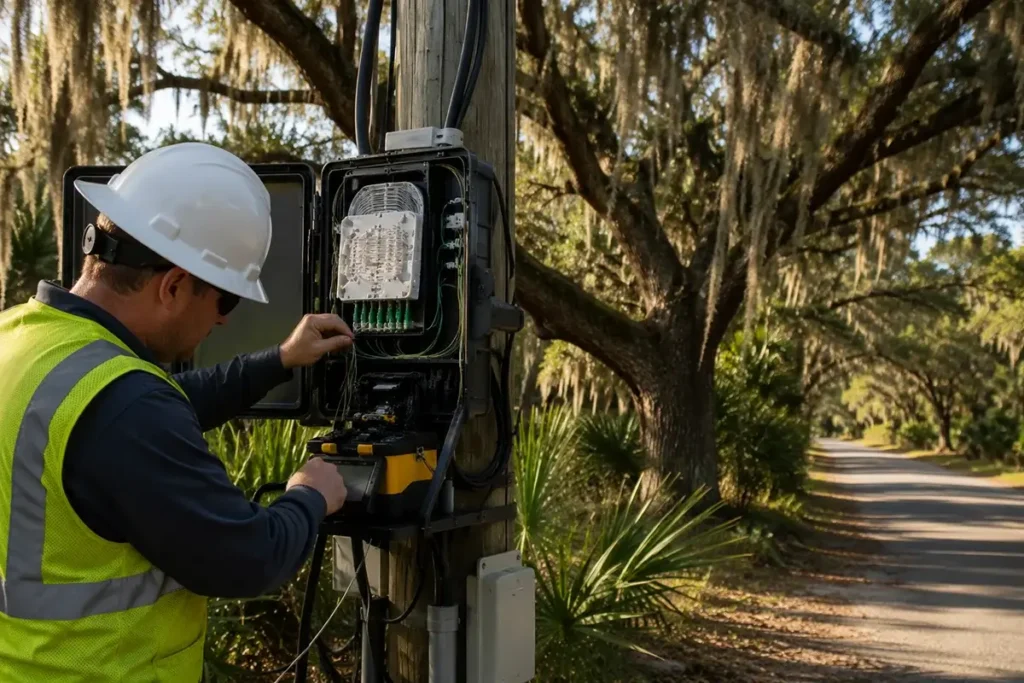
Pee Dee Region (Florence, Darlington, Marlboro, Chesterfield, Williamsburg, Dillon Counties)
The Pee Dee is South Carolina’s agricultural heartland — tobacco, cotton, and livestock country that has some of the state’s most severe broadband access deficits. Williamsburg County in particular has limited broadband options outside its county seat of Kingstree. Horry County’s rural communities away from Myrtle Beach have better options than interior Pee Dee counties due to the beach corridor’s infrastructure spillover. Several Pee Dee electric cooperatives are pursuing fiber with BEAD funding. The flat agricultural terrain of the Pee Dee makes Starlink installation effortless with excellent performance in uncongested rural coverage cells.
Lowcountry (Allendale, Bamberg, Barnwell, Hampton, Jasper, Colleton Counties)
South Carolina’s rural Lowcountry — the agricultural and timberland counties of the coastal plain southwest of Columbia toward Savannah — has some of the worst broadband access statistics in the Southeast. Allendale County’s rural broadband deficit is well-documented and severe. Jasper County’s rural communities face similar challenges. The flat, open terrain of the Lowcountry coastal plain makes Starlink installation straightforward — one of the few technologies that can reach these communities without physical infrastructure investment. Several Lowcountry electric cooperatives are the most active rural broadband deployers in this region.
South Carolina Electric Cooperatives and Broadband
South Carolina’s 20 electric cooperatives are the primary rural broadband deployment vehicles in the state’s most underserved communities:
- Blue Ridge Electric Cooperative: Serving Upstate members in Oconee, Pickens, and Greenville counties with active fiber broadband — one of SC’s most advanced cooperative broadband programs.
- Palmetto Electric Cooperative: Serving Lowcountry members in Beaufort, Jasper, and Hampton counties with active broadband deployment.
- Lynches River Electric Cooperative: Serving Pee Dee members in Lancaster and Chesterfield counties with broadband programs.
- Horry Electric Cooperative: One of SC’s largest cooperatives, serving Horry and Georgetown counties with extensive broadband deployment including rural areas beyond the Myrtle Beach commercial corridor.
- Santee Electric Cooperative: Serving Williamsburg and surrounding counties with broadband development using BEAD and ReConnect funding.
- Tri-County Electric Cooperative: Serving rural members in several Lowcountry counties with broadband expansion plans.
South Carolina State Broadband Programs
South Carolina’s broadband programs are coordinated by the South Carolina Broadband Office within the Office of Regulatory Staff (ORS). South Carolina received approximately $601 million in BEAD Program federal funding. The state’s BEAD implementation specifically prioritizes Allendale County, the rural Pee Dee, and the rural Lowcountry in its first-priority deployment cohort.
South Carolina has also maintained the South Carolina Rural Broadband Initiative, a state-funded program that has provided supplemental investment in rural broadband infrastructure, particularly targeting the state’s most economically distressed rural counties. Several Lowcountry and Pee Dee electric cooperatives have received state funding through this initiative. Contact the South Carolina Broadband Office for current funded project maps and deployment status information relevant to your county.
The Lowcountry: Connectivity and History
South Carolina’s rural Lowcountry has a unique historical context that makes its connectivity gap particularly significant. The Sea Islands and coastal plain communities of Hampton, Jasper, Colleton, and Beaufort counties include some of the most culturally significant African American communities in the nation — Gullah Geechee communities whose descendants of enslaved Africans have maintained distinct language, culture, and community identity for generations. These communities, on barrier islands and coastal mainland, have faced infrastructure underinvestment across multiple generations.
The Gullah Geechee Cultural Heritage Corridor — a federally designated area covering rural coastal communities in South Carolina, Georgia, Florida, and North Carolina — has been specifically identified by NTIA, USDA, and state broadband offices as requiring targeted broadband investment. Several USDA ReConnect grants have been directed to cooperative broadband deployment in Gullah Geechee communities. Palmetto Electric Cooperative’s broadband program specifically serves portions of this corridor.
For Lowcountry rural residents who need broadband today, Starlink is the most immediately accessible option. The flat, open coastal plain provides excellent sky views for installation, and the low user density in rural Lowcountry coverage cells typically delivers strong Starlink performance. Cost assistance through FCC Lifeline ($9.25/month discount) reduces barriers for qualifying low-income households in this economically distressed region.
Practical Tips for Rural South Carolina Residents
- Contact your electric cooperative immediately. South Carolina’s cooperatives are among the most broadband-active in the Southeast. Horry Electric, Blue Ridge Electric, and Palmetto Electric have mature programs; others are deploying with BEAD funding. Even if your cooperative doesn’t offer broadband yet, expressing member demand influences deployment priority.
- Pee Dee and Lowcountry residents: Your flat terrain is ideal for Starlink with no obstruction concerns anywhere in the coastal plain. Check T-Mobile Home Internet eligibility — T-Mobile’s coverage near major US-17, US-278, and I-95 corridors sometimes reaches rural properties that aren’t aware of their eligibility.
- Upstate Blue Ridge members: Blue Ridge Electric’s fiber program is one of the most advanced in the state — check their service map for your address. Coverage has expanded significantly and some previously unserved rural addresses now have fiber available.
- Challenge FCC map inaccuracies. South Carolina has documented AT&T DSL overclaiming in the Lowcountry and Pee Dee. Accurate challenge filings directly improve your county’s BEAD eligibility and ensure investment flows where it’s genuinely needed.
Frequently Asked Questions
What is the best internet for rural Allendale County, SC?
Allendale County, consistently one of the most broadband-deficient counties in the Southeast, has very limited fixed broadband options outside Allendale town limits. Starlink satellite is the most immediately available broadband solution for rural Allendale County properties. The flat terrain makes installation effortless. BEAD-funded rural broadband projects targeting Allendale are in planning stages and expected to deliver wired alternatives beginning 2028–2030. FCC Lifeline Program discounts are available for qualifying low-income Allendale County households.
Is Horry Electric Cooperative’s broadband available in rural Horry County?
Horry Electric Cooperative has been expanding its broadband program throughout its member territory in Horry and Georgetown counties. Service availability varies by road and neighborhood — check Horry Electric’s website for the current service map or contact member services directly. The cooperative’s rural broadband program has expanded significantly with BEAD funding and covers substantially more of its rural member territory than it did 12–18 months ago.
Does South Carolina have state internet assistance for low-income rural households?
The federal FCC Lifeline Program ($9.25/month discount) applies to qualifying SC low-income households. South Carolina does not currently have a state-specific internet subsidy program for individuals beyond federal programs, though BEAD implementation requirements include affordability provisions for funded ISPs. Contact your county’s community action agency and SC’s Office of Regulatory Staff broadband program for current assistance program availability.
South Carolina Agriculture and Broadband
South Carolina’s agricultural economy — ranked among the nation’s top producers of peaches, tobacco, soybeans, broilers, and forestry products — depends increasingly on broadband connectivity for precision agriculture, commodity market access, and business operations. The Pee Dee region’s row crop farms, the Midlands’ poultry operations, and the Lowcountry’s specialty crop producers all face connectivity needs that legacy telephone DSL cannot meet.
For South Carolina farm operations without access to cooperative fiber or cable, Starlink Business ($250/month) provides the most reliable broadband solution. The flat coastal plain terrain in the Pee Dee and Lowcountry makes installation effortless, and the low user density in rural coverage cells delivers consistently excellent Starlink performance in these regions. For upstate Piedmont farms within range of expanding electric cooperative fiber programs, fiber broadband delivers the symmetric upload speeds that make drone imagery upload, John Deere Operations Center sync, and agricultural cloud platforms work at full capability.
The USDA Rural Development South Carolina state office administers several programs relevant to agricultural broadband connectivity — including ReConnect grants and Community Facilities grants that have funded rural broadband infrastructure in SC communities. Visit the USDA Rural Development South Carolina office website for current program information relevant to SC agricultural producers and rural communities.

South Carolina Broadband: Looking to 2030
South Carolina’s broadband trajectory is meaningfully improving. The combination of $490 million in BEAD Program funding, active electric cooperative deployments at Berkeley, Horry, Black River, and PeeDee cooperatives, and Starlink’s universal coverage creates a genuine path toward near-universal rural broadband access by 2030. The state’s BEAD implementation is tracking toward first-round construction beginning 2026–2027 in the highest-priority unserved communities, with continued deployment through 2029–2031 for the most remote addresses. Rural SC residents who need broadband today should not wait for infrastructure — Starlink provides the connectivity needed for remote work, telehealth, education, and farm operations right now, while infrastructure development proceeds toward the more affordable wired options that will eventually serve these communities.
Can I get internet on Hilton Head Island or other SC islands?
Yes. Starlink is available throughout South Carolina’s coastal islands including Hilton Head, Kiawah, Fripp, Edisto, Pawleys Island, and others. The flat coastal terrain and open sky provide excellent Starlink conditions. Hargray Communications serves portions of the coastal area including Hilton Head and Bluffton with cable broadband — check Hargray availability for your specific island address as it may offer competitive pricing for coastal residents. Salt air environment requires corrosion-protected mounting hardware and periodic inspection of outdoor connections for all island installations.
What is the best internet for farming in rural Orangeburg County SC?
For rural Orangeburg County farm operations, check Mid-Carolina Electric Cooperative and your specific telephone provider for current broadband availability first. If neither offers adequate speeds at your address, Starlink Standard ($120/month) is the recommended immediate solution. The flat Midlands terrain makes installation straightforward, and the sparse rural coverage cells in Orangeburg County typically deliver 80–120 Mbps download speeds — well adequate for all precision agriculture and farm business applications. Long-term, Orangeburg County is within the priority zone for BEAD-funded deployment; check South Carolina’s BEAD project maps for upcoming infrastructure timelines at your specific address.
How do I know which South Carolina electric cooperative serves my property?
The Electric Cooperatives of South Carolina website at ecsc.org includes a cooperative locator that identifies which of the state’s 20 cooperatives serves your specific county or address. Alternatively, check your electric bill — the name of your electric provider is listed on every bill. If your electricity is provided by one of South Carolina’s cooperatives rather than Dominion Energy or Duke Energy, contact that cooperative’s member services department about broadband availability and upcoming deployment plans.
Digital Equity and Rural SC Communities
South Carolina’s rural broadband gap has a significant racial equity dimension that state and federal programs are specifically addressing in 2026. The Pee Dee region and Black Belt-adjacent counties of Williamsburg, Georgetown, and Horry contain substantial African American rural communities where broadband access rates lag dramatically behind white rural communities in the same state. This disparity reflects historical patterns of infrastructure investment that systematically bypassed Black rural communities — patterns that digital equity advocates and federal broadband programs are now explicitly working to reverse through priority investment in communities that have been most underserved.
BEAD Program digital equity requirements mandate that funded ISPs offer affordable service plans for low-income households in their service areas — a provision specifically designed to address the adoption gap that would prevent economically disadvantaged rural SC households from benefiting from new infrastructure even when it reaches their communities. South Carolina’s BEAD implementation plan includes digital equity outreach components partnering with community organizations, churches, historically Black colleges and universities (including South Carolina State University, Claflin University, and Benedict College), and county extension offices in the most underserved communities to drive adoption alongside infrastructure deployment.
For rural South Carolinians in communities where broadband has historically been absent, the combination of new infrastructure investment and digital equity programs represents a genuine opportunity for connectivity that improves educational outcomes, healthcare access, and economic opportunity in ways that compound over time. Organizations including the South Carolina Broadband Partnership and county-level digital literacy programs provide training and support for rural SC residents new to broadband adoption.
Remote Work and Rural SC Economic Development
South Carolina’s rural communities — from the Upstate textile mill towns to the Pee Dee’s agricultural communities — have experienced significant economic disruption over the past two decades through manufacturing offshoring and agricultural consolidation. Remote work represents a meaningful economic development pathway for rural SC communities with broadband connectivity, enabling residents to access employment opportunities without relocating to Charlotte, Columbia, or Charleston. A rural Marlboro County resident with Starlink connectivity can work remotely for an employer anywhere in the country while living in a community where housing costs, property taxes, and cost of living are dramatically lower than metro alternatives. South Carolina’s rural economic development organizations including the South Carolina Rural Infrastructure Authority and the Rural Electric Cooperatives’ economic development programs have identified broadband connectivity as the most critical prerequisite infrastructure for rural SC economic diversification and remote work adoption.




Leave a Reply