
South Dakota is a state where the rural broadband challenge is shaped by some of the most extreme geographic and demographic conditions in the continental United States. The fourth-least densely populated state in the nation, South Dakota spans from the rich agricultural plains of the east through the Missouri River Breaks to the rugged Badlands, the Black Hills, and the vast expanse of the western short-grass prairie — a landscape where some counties cover thousands of square miles with populations in the hundreds. The state’s nine Sioux tribal nations, whose reservation lands span roughly one-third of South Dakota’s territory, face connectivity challenges that combine geographic isolation with the historical infrastructure underinvestment that has affected tribal lands across the country. In 2026, Starlink provides the most immediate and universal rural broadband solution across this vast state, while BEAD Program investment and tribal broadband initiatives are beginning to build the infrastructure foundation that these communities deserve. This complete guide covers rural internet options across all of South Dakota’s distinct regions.
In This Guide
- South Dakota Rural Broadband Overview
- Best Internet by South Dakota Region
- Starlink in South Dakota
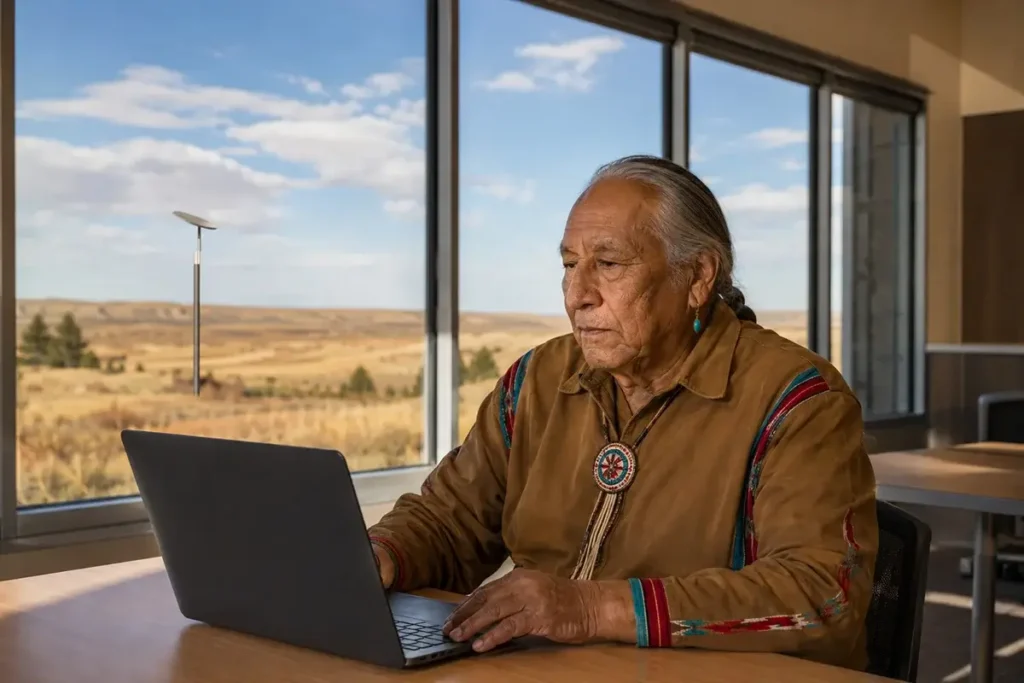
- Connectivity on South Dakota Tribal Lands
- Cellular Coverage in Rural South Dakota
- South Dakota Telephone Cooperatives
- South Dakota State Broadband Programs
- Ranching and Agriculture Connectivity
- Practical Tips for Rural SD Residents
- Frequently Asked Questions
South Dakota Rural Broadband Overview
South Dakota presents one of the most extreme rural broadband challenges in the continental United States — not because of difficult terrain (much of the state’s eastern half is flat agricultural plain), but because of the economics of providing service to an extremely sparse population across enormous geographic areas. The state’s 900,000 residents are spread across 77,116 square miles — making South Dakota nearly the size of Missouri with less than one-sixth the population.
According to the FCC National Broadband Map, South Dakota has some of the highest percentages of unserved rural addresses of any state in the northern plains region. The unserved addresses are concentrated in the state’s western half — particularly in Haakon, Ziebach, Dewey, Corson, Perkins, and Harding counties — and on the tribal reservation lands that cover much of the state’s central and western territory.
The state has a network of approximately 17 rural telephone cooperatives that serve specific geographic areas with telephone and increasingly broadband service. These cooperatives, combined with electric cooperatives and the state’s significant rural satellite internet user base, form the patchwork of rural connectivity that South Dakota’s rural residents navigate in 2026.
Best Internet by South Dakota Region
East River Agricultural Plain (Minnehaha, Brookings, Kingsbury, Hamlin, Clark Counties)
East River — the eastern agricultural half of South Dakota between the Minnesota border and the Missouri River — has better connectivity than the state’s western half, driven by the agriculture-dense economy and proximity to Sioux Falls (the state’s largest city) and Brookings (home to South Dakota State University). Several east river telephone cooperatives serve rural communities with DSL and in some cases fiber. T-Mobile Home Internet availability is better in east river than in the western plains. The flat Red River-adjacent terrain is ideal for Starlink installation with essentially unrestricted sky access.
Missouri River Corridor (Hughes, Sully, Hyde, Hand, Jerauld Counties)
The Missouri River corridor communities between Pierre (the state capital) and the east river agricultural plain have moderate connectivity — better than the far west but with significant gaps in rural communities far from Pierre, Chamberlain, and the river-road corridors. Several telephone cooperatives serve portions of this region. Starlink performs well throughout the rolling Missouri Breaks terrain.
West River Ranching Country (Haakon, Meade, Butte, Perkins, Harding Counties)
West River South Dakota — the vast short-grass prairie west of the Missouri River — is one of the most sparsely populated rural territories in the continental United States. Harding County, the state’s northwest corner, covers 2,678 square miles with a population of approximately 1,200 people — fewer than 0.5 people per square mile. Telephone service is primarily from rural telephone cooperatives including WEB Telephone Cooperative and Black Hills Telephone; broadband capabilities at these distances from switching equipment are minimal. Starlink is the only viable broadband option for the vast majority of west river ranch operations and rural residences, and the flat-to-rolling prairie terrain provides essentially unrestricted sky access. Performance in these extremely low-density coverage cells is among the fastest rural Starlink performance in the country — users regularly report 110–150 Mbps download speeds.
Black Hills Region (Pennington, Custer, Lawrence, Meade Counties)
The Black Hills region — home to Mount Rushmore, Custer State Park, and the Sturgis Motorcycle Rally corridor — has better connectivity than most of west river South Dakota, driven by the tourism economy and the presence of Rapid City (the state’s second-largest city). Communities along US-16, US-385, and SD-79 corridors have some cable and fiber coverage from smaller regional providers. Rural properties in the Hills’ forested terrain have sky obstruction considerations for Starlink — the ponderosa pine forest and ridged terrain can create obstruction from some property positions. The Starlink app scanner is important due diligence for any Black Hills forested property.
Connectivity on South Dakota Tribal Lands
South Dakota’s nine Sioux tribal nations — Cheyenne River Sioux, Crow Creek Sioux, Flandreau Santee Sioux, Lower Brule Sioux, Oglala Sioux (Pine Ridge), Rosebud Sioux, Sisseton Wahpeton Oyate, Standing Rock Sioux, and Yankton Sioux — occupy reservation lands that collectively cover roughly one-third of South Dakota’s territory. These reservations include some of the most economically distressed and broadband-deficient communities in the United States.
Pine Ridge Reservation (Oglala Sioux) — the nation’s second-largest reservation by area and home to approximately 40,000 members — has been specifically identified in federal broadband equity frameworks as one of the most severely connectivity-deficient communities in the country. Shannon County (now Oglala Lakota County), which covers the core of Pine Ridge Reservation, has consistently ranked among the poorest counties and least broadband-connected counties in the United States.
Cheyenne River Sioux Tribal Utility Authority and several other tribal utilities have pursued broadband deployment using tribal economic development resources and federal tribal broadband funding through NTIA and USDA. The NTIA’s tribal broadband programs have specifically prioritized South Dakota tribal nations given the severity of connectivity gaps on reservation lands. Tribal members on South Dakota reservation lands should contact their tribal government’s utility or economic development office about tribal broadband programs before ordering individual satellite service.
South Dakota Telephone Cooperatives
South Dakota’s rural telephone cooperatives serve specific geographic areas with telephone and increasingly broadband service:
- WEB Telephone Cooperative: Serving far northwest South Dakota in Perkins, Corson, and Harding counties — covering some of the most remote ranch country in the Great Plains.
- Venture Communications Cooperative: Serving members across central South Dakota with telephone and broadband services.
- Brookings Municipal Utilities: Serving the Brookings area with fiber broadband.
- West River Telecommunications Cooperative: Serving members in the Missouri Breaks country of west-central South Dakota.
- SDN Communications: A cooperative-owned network serving communities across South Dakota with expanding broadband programs.
South Dakota State Broadband Programs
South Dakota’s broadband programs are coordinated through the Bureau of Information and Telecommunications (BIT) under the Governor’s Office. South Dakota received approximately $358 million in BEAD Program federal funding — a significant allocation relative to the state’s population that reflects the depth of the rural broadband gap across west river’s vast territory and tribal lands.
South Dakota’s BEAD implementation specifically addresses tribal lands as the state’s highest-priority connectivity challenge. The state is working with tribal governments — each of which has sovereign authority over broadband policy on its reservation — to develop deployment models that respect tribal self-determination while facilitating the federal investment that can bring connectivity to these profoundly underserved communities.
Ranching and Agriculture Connectivity in South Dakota
South Dakota’s agricultural economy — beef cattle, corn, soybeans, winter wheat, and sunflowers — depends on connectivity for commodity market access, livestock management, precision agriculture, and increasingly for the remote monitoring of vast ranch operations spread across terrain that no single operator can physically inspect daily. A west river cattle operation covering 20,000+ acres needs remote monitoring capability that only satellite connectivity can provide across the entire operation area.
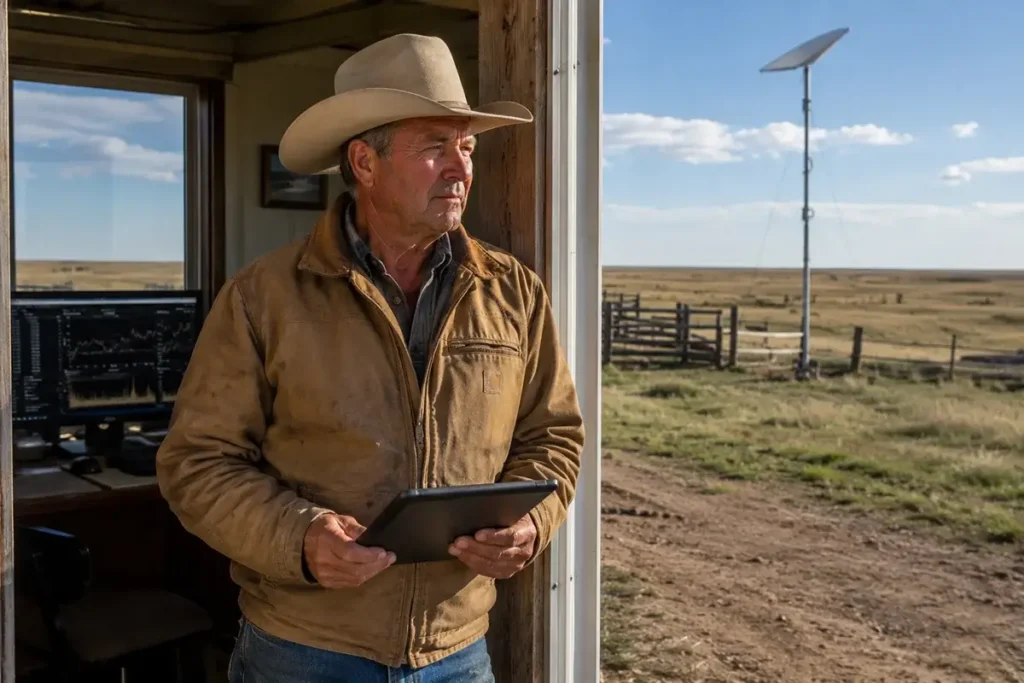
Starlink has been transformative for west river South Dakota ranch operations. The ability to check grain market prices in real time, conduct video calls with commodity buyers, manage USDA program applications, and monitor remote water tanks and livestock locations through connected sensors — all capabilities that require broadband — was simply impossible for most west river ranch operations before Starlink’s arrival. Ranch operations in Harding, Perkins, and Corson counties routinely report that Starlink has fundamentally changed how they operate and manage their ranches. Combined with LoRaWAN sensor networks for remote property monitoring (see our LoRaWAN guide), Starlink enables a comprehensive connected ranch management platform that was unimaginable a decade ago.
Practical Tips for Rural South Dakota Residents
- West river ranch operations: Order Starlink without delay — the flat prairie terrain makes installation effortless and performance in west river’s ultra-low-density coverage cells is frequently among the fastest in the country. Invest in Starlink Priority ($250/month) for ranch business operations that require consistent upload performance for data-intensive applications.
- Black Hills forested properties: Run the Starlink app obstruction scanner before ordering. Ponderosa pine forest creates more sky obstruction than the prairie; properties in open meadows or south-facing slopes typically have better sky access than those deep in the pine canopy.
- Tribal members: Contact your tribal government about tribal broadband programs before ordering individual Starlink service — group purchasing arrangements or tribal broadband programs may offer better value or more appropriate connectivity solutions for tribal member households.
- South Dakota winter: West river South Dakota experiences some of the most severe winter weather in the continental US — blizzards with wind chills reaching -60°F. Starlink handles these conditions at its rated operating range; however, at temperatures approaching -40°C, monitor dish performance and ensure the router is in a heated space. The dish heater handles snow accumulation but extreme cold-soaking of the dish exterior electronics at the very bottom of the operating temperature range can occasionally affect performance.
Frequently Asked Questions
What is the best internet for a west river South Dakota ranch?
Starlink Priority ($250/month) is the recommended broadband solution for west river South Dakota ranch operations. The flat prairie terrain makes installation effortless, and performance in the ultra-low-density coverage cells of west river consistently exceeds the national rural average — often 110–150 Mbps download with 20–40 Mbps upload. Add a Verizon cellular backup connection for redundancy during the rare Starlink weather events or equipment issues that occur. This dual-connection setup at approximately $300/month provides broadband reliability appropriate for a commercial ranch operation.
Is there any internet available on Pine Ridge Reservation?
Starlink is available statewide in South Dakota including throughout Pine Ridge Reservation. The open prairie terrain of the reservation provides excellent Starlink installation conditions. The barrier is primarily economic — the $349 hardware and $120/month service cost represents a significant percentage of household income for many Pine Ridge families. The Oglala Sioux Tribe has pursued tribal broadband programs using federal funding to address both infrastructure and affordability barriers for tribal member households. Contact the Oglala Sioux Tribe’s utility authority about current tribal broadband program availability for tribal members.
When will South Dakota’s tribal reservations get broadband infrastructure?
South Dakota’s BEAD implementation is prioritizing tribal reservation lands as the state’s highest-urgency deployment zone. However, given the complexity of tribal sovereignty, the scale of the infrastructure gap, and the construction challenges in remote west river terrain, realistic timelines for wired broadband infrastructure reaching the most remote reservation communities range from 2027–2032. In the interim, Starlink and tribal broadband satellite programs provide the most immediately accessible connectivity for reservation communities.
South Dakota Tourism and Connectivity
South Dakota’s tourism economy — the second-largest sector after agriculture — generates significant rural internet demand from the communities serving visitors to Mount Rushmore, Custer State Park, the Badlands, the Needles Highway, and the annual Sturgis Motorcycle Rally (which draws 500,000+ visitors to the small western South Dakota community each August). Tourism businesses including motels, restaurants, campgrounds, and attraction operations need connectivity for booking platforms, payment processing, social media marketing, and guest Wi-Fi — needs that Starlink has addressed for many rural tourism operations previously unable to get adequate broadband.
The Sturgis Motorcycle Rally’s temporary internet demand — thousands of additional users in a small geographic area for one week each August — creates unique coverage cell congestion that affects Starlink performance in the Sturgis, Deadwood, and Black Hills coverage cells during rally week. Rural businesses and residences in the Black Hills corridor that rely on Starlink should be aware of this annual peak-demand period and plan accordingly, using cellular backup connections for the most critical business operations during Rally week when satellite performance may be degraded by the surge in concurrent users.
South Dakota Broadband: The Path Forward
South Dakota’s broadband trajectory is positive but the scale of the challenge — particularly on tribal reservation lands — means the path to near-universal connectivity will extend well beyond this decade for the most remote communities. The combination of Starlink’s immediate availability for any property with sky access, telephone cooperative fiber deployment using BEAD funding in specific communities, and tribal broadband programs serving reservation lands creates a layered approach that will progressively close the gap.
For rural South Dakota residents making connectivity decisions today, the practical guidance is clear: don’t wait for infrastructure that may be years away in the most remote areas. Starlink provides broadband-quality connectivity today at any South Dakota property with sky access, and for west river ranch properties where performance in ultra-low-density coverage cells frequently exceeds 120 Mbps, the service quality often rivals what urban fiber users experience. Check the South Dakota Department of Commerce broadband office for current BEAD project maps and timelines for your specific county as a reference for understanding when wired alternatives may reach your area.



Leave a Reply