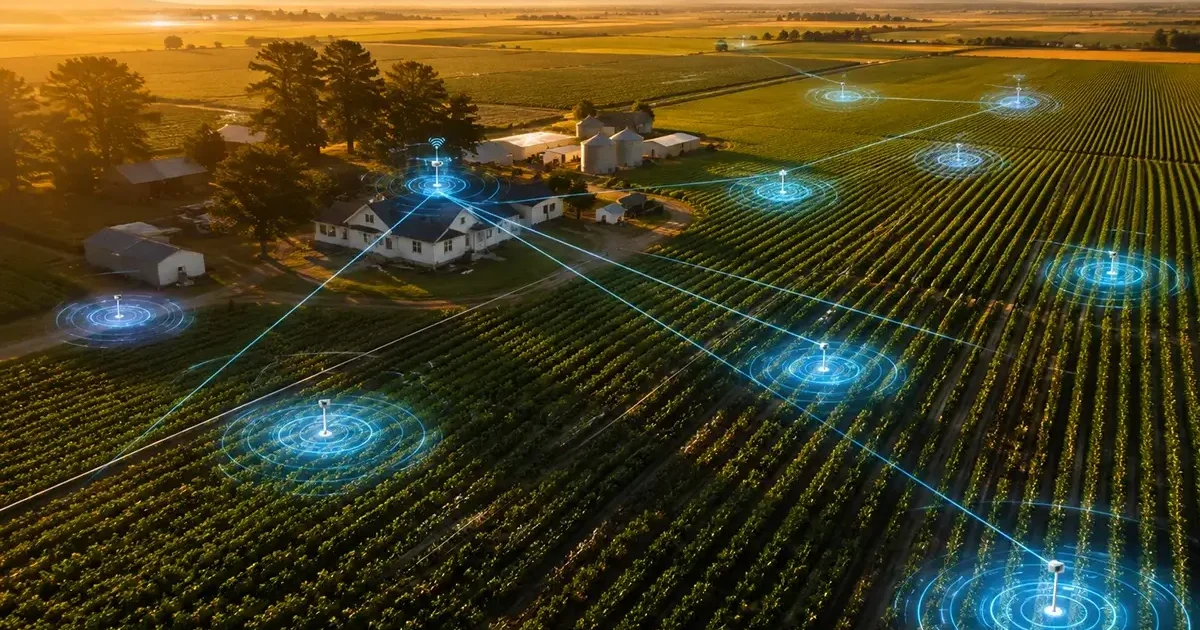
Most rural internet discussions focus on delivering broadband to the farmhouse, the home office, or the main living area. But across the fields, pastures, timberland, and agricultural infrastructure of rural properties, a different kind of connectivity problem is emerging — one that broadband alone cannot solve. How do you monitor a soil moisture sensor a mile from the farmhouse? How do you track cattle across a 500-acre pasture? How do you detect a water leak in a remote irrigation head without driving to check it? The answer in 2026 is often not Starlink or LTE — it’s LoRaWAN, the long-range, low-power radio technology that is becoming the backbone of agricultural and rural IoT (Internet of Things) infrastructure. This comprehensive guide explains LoRaWAN technology, its applications on rural properties, and how to build a practical LoRaWAN network that connects sensors across your entire property.
In This Guide
- What Is LoRaWAN? Rural IoT Explained
- How LoRaWAN Works
- LoRaWAN vs Cellular IoT vs Wi-Fi for Rural Use
- Rural and Agricultural LoRaWAN Applications
- Building Your Own Rural LoRaWAN Network
- LoRaWAN Hardware for Rural Properties
- Data Platforms and Integration
- Realistic Range Expectations
- Cost Analysis: LoRaWAN vs Cellular IoT
- Getting Started with Rural LoRaWAN
- Frequently Asked Questions
What Is LoRaWAN? Rural IoT Explained
LoRaWAN stands for Long Range Wide Area Network — a wireless communication technology specifically designed for connecting low-power sensors and devices over very long distances with minimal energy consumption. It is not a replacement for broadband internet. Instead, LoRaWAN excels at the specific task that rural properties increasingly need: reliably transmitting small amounts of data (a soil moisture reading, a gate open/close event, a water tank level) from remote sensors across large areas to a central collection point, using sensors that can run on a single battery for years.
LoRa (the radio technology underlying LoRaWAN) was developed by Semtech and uses unlicensed radio spectrum in the 915 MHz band in North America. A LoRaWAN network consists of three components:
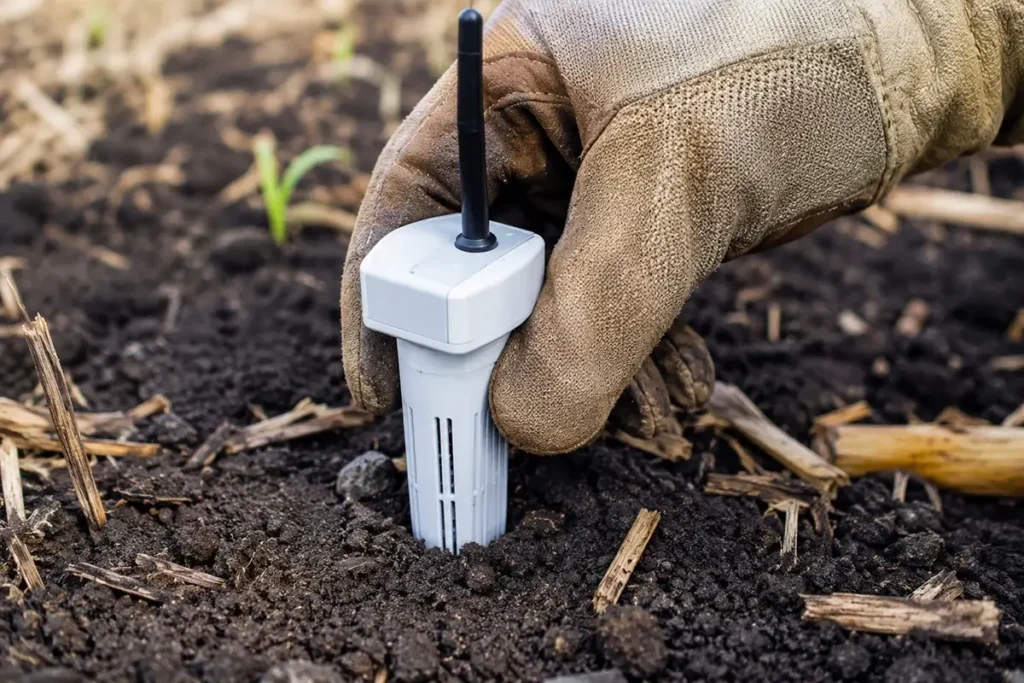
- End devices (sensors/nodes): Battery-powered devices with sensors that transmit small data packets over the LoRaWAN radio link. Examples: soil moisture probes, water tank level sensors, gate monitors, cattle GPS tags, weather stations.
- Gateway: A receiver unit installed at a central location (farmhouse roof, grain elevator, hilltop) that receives transmissions from all end devices within range and forwards the data to the internet via your existing broadband connection (Starlink, cellular, or wired).
- Network server and application platform: Cloud software that receives data from gateways, stores it, and makes it available through dashboards, mobile apps, and integration with farm management software.
How LoRaWAN Works: The Technical Essentials
LoRaWAN’s key technical characteristics make it uniquely suited for rural agricultural applications:
Long range: LoRaWAN signals travel 5–15 km in open rural terrain — significantly farther than Wi-Fi (100–300 meters) or Bluetooth (10–100 meters). In flat agricultural land, a single gateway on a 30-foot pole or rooftop can cover an entire section (1 square mile) with multiple sensors. In rolling terrain, multiple strategically placed gateways can cover hundreds of acres.
Low power consumption: LoRaWAN end devices (sensors) typically use very small amounts of power, with batteries lasting 2–10 years depending on transmission frequency. A soil moisture sensor transmitting one reading per hour runs for years on two AA batteries. This eliminates the need for power infrastructure at sensor locations — a critical advantage for remote rural property monitoring where running power to every sensor location is impractical.
Low data rate: LoRaWAN is specifically designed for small data packets — sensor readings, alerts, status updates — not for streaming video or file transfers. Typical LoRaWAN packets are 50–200 bytes. This limitation is precisely what enables the long range and low power — physics dictates that slower data rates travel farther with less energy.
License-free spectrum: LoRaWAN operates in the unlicensed 915 MHz ISM band in North America, meaning no spectrum license is required to build and operate a private LoRaWAN network on your own property. This is analogous to Wi-Fi — you can set up your own network without regulatory approval.
Star topology: Unlike Wi-Fi mesh networks where devices connect through each other in chains, LoRaWAN uses a star topology — all sensors communicate directly to gateways, not through each other. This simplifies network management and means adding or removing one sensor doesn’t affect others.
LoRaWAN vs Cellular IoT vs Wi-Fi for Rural Use
| Technology | Range | Battery Life | Data Rate | Cost per Sensor/Month | Best Rural Use Case |
|---|---|---|---|---|---|
| LoRaWAN (private) | 5–15 km | 2–10 years | Very low | $0 (own infrastructure) | Remote sensors, large property coverage |
| LTE-M / NB-IoT (cellular) | Cell tower range | 6 months – 5 years | Low | $2–$10/device/mo | GPS tracking, mobile assets, nationwide coverage |
| Wi-Fi | 100–300 m | Hours to days | High | $0 (existing network) | Indoor sensors, devices near the farmhouse |
| Zigbee/Z-Wave | 10–100 m | Months – years | Low | $0 (own hub) | Smart home devices, indoor automation |
| Satellite IoT (Iridium, Orbcomm) | Global | Months | Very low | $5–$50/device/mo | Truly remote beyond cellular coverage |
LoRaWAN’s position in this landscape is clear: it is the ideal technology for monitoring static or slow-moving assets distributed across a large rural property when cellular coverage is unavailable, unreliable, or too expensive at scale. The zero ongoing per-device cost is particularly compelling for farms that need to monitor dozens or hundreds of sensors — deploying 50 cellular IoT sensors at $5/month each costs $250/month indefinitely, while 50 LoRaWAN sensors after initial hardware cost have essentially zero ongoing infrastructure cost.
Rural and Agricultural LoRaWAN Applications
Soil and Water Monitoring
Soil moisture monitoring is one of the most economically valuable LoRaWAN applications for agricultural properties. Wireless soil moisture probes deployed at multiple depths across field zones transmit readings hourly to a central gateway. Farm management software integrates these readings with weather data and crop models to optimize irrigation scheduling — typically reducing irrigation water use by 15–30% while maintaining or improving yield. For farms where water is both costly and limited (western US irrigation operations, drought-prone southeastern fields), the ROI on soil moisture monitoring systems is typically under two growing seasons.
Irrigation system monitoring extends this concept to infrastructure: flow sensors on irrigation pipes, pressure sensors at sprinkler heads, and water meter sensors transmit operational data that detects leaks, blockages, and inefficiencies without requiring manual inspection of remote irrigation infrastructure.
Livestock Monitoring
LoRaWAN-based livestock monitoring systems track cattle, sheep, and other livestock across large pastures using GPS-equipped ear tags or collar devices that transmit location data hourly. Systems from manufacturers including Halter (New Zealand-origin, now US-deployed), SolaniX, and several domestic providers allow ranchers to know precisely where each animal is, detect fence breaches when cattle leave expected zones, identify animals that aren’t moving (potential illness or injury indicator), and track grazing rotation patterns for pasture management optimization.
The economics are compelling for large operations: a rancher who currently spends hours each week physically checking pasture locations can redirect that time to higher-value operations. The ability to detect a fence breach immediately (rather than discovering it when neighbors call about cattle on their crops) prevents both animal loss and liability costs.
Weather and Environmental Monitoring
Micro-climate monitoring using LoRaWAN weather stations distributed across a property provides data granularity that regional weather services cannot match. On hilly terrain, temperature inversions can create 10°F differences between valley bottom and ridge top that are invisible to a single weather station. For frost-sensitive crops (vineyards, orchards, high-value vegetables), monitoring these micro-climate differences enables targeted frost protection that saves crops while avoiding wasteful blanket frost protection measures.
Infrastructure and Asset Monitoring
Rural infrastructure monitoring applications include: grain bin temperature and moisture sensors (detecting spoilage conditions before they become crop loss events), water tank level sensors (alerting when livestock water drops below threshold in remote pastures), gate open/close sensors (security and livestock management), pump run-time monitors (detecting pump failures at remote irrigation stations), and generator fuel level sensors (preventing unexpected fuel shortages at remote equipment).
Timber and Wildfire Applications
For timber property owners, LoRaWAN enables distributed fire risk monitoring — temperature, humidity, and smoke sensors across a timber tract can detect early fire risk conditions or actual fire starts far faster than periodic human inspection. In regions with significant wildfire risk, early detection systems connected via LoRaWAN to Starlink-connected gateways can provide timely alerts that enable rapid response.
Building Your Own Rural LoRaWAN Network
A private LoRaWAN network for a rural property is surprisingly accessible to build — the hardware ecosystem has matured significantly, and the software platforms have become increasingly user-friendly. A basic functional setup:
- Deploy a LoRaWAN gateway: A gateway receives transmissions from all your sensors and forwards data to a cloud platform via your existing internet connection (Starlink, cellular, or wired). Gateways connect to your router via Ethernet or Wi-Fi and then to the internet normally. Mount the gateway at the highest accessible point on your property for maximum coverage range — a farmhouse rooftop, a grain elevator, or a dedicated pole installation.
- Select and deploy end devices (sensors): Choose sensors appropriate for your specific monitoring needs. Many commercial agricultural sensor systems come pre-configured for LoRaWAN. For custom applications, development boards from RAK Wireless, Dragino, and TTGO allow building custom sensors around specific measurement needs.
- Configure a network server: The network server manages communications between gateways and devices. Options include hosted cloud platforms (The Things Network — free for private use, The Things Industries — paid enterprise tier, Chirpstack — open source self-hosted) and fully hosted solutions from agricultural IoT platform providers.
- Integrate with your farm management platform: Most agricultural software (Granular, Climate FieldView, FarmLogs) accepts sensor data through API integrations. Alternatively, platforms like Node-RED or Datacake provide visual dashboards and alerting without requiring programming skills.
LoRaWAN Hardware for Rural Properties
Gateways (the critical first purchase):
- RAK Wireless RAK7268 (~$200): The most popular indoor/outdoor gateway for private rural LoRaWAN networks. 8-channel gateway, Ethernet/Wi-Fi backhaul, weatherproof enclosure option. Excellent documentation and active community support.
- Dragino LPS8N (~$150): Solid budget option for indoor installation with outdoor antenna. Good starting point for farmhouse-mounted gateway applications.
- Helium Network hotspot (varies): Helium is a decentralized LoRaWAN network where gateway owners earn cryptocurrency for providing coverage. Helium gateway coverage in rural areas is sparse, but deploying a Helium gateway provides both your own LoRaWAN coverage AND earns token rewards. Check Helium network coverage maps for your area.
Soil and water sensors:
- Dragino LSE01 soil moisture/temperature sensor (~$35/unit)
- Seeed Studio SenseCAP soil sensors (~$100–$150, commercial grade)
- Milesight EM500 environmental sensor series (~$80–$200)
GPS livestock trackers:
- Abeeway Smart Badge / Compact Tracker (~$100–$150/unit)
- Digital Matter Yabby3 (~$120/unit, IP68 rated for livestock use)
Cost Analysis: Private LoRaWAN vs Cellular IoT
| Setup | Hardware Cost | Monthly Cost | 5-Year Total (20 sensors) |
|---|---|---|---|
| Private LoRaWAN (20 sensors, 1 gateway) | $200 (GW) + $1,500 (sensors) | $0 | $1,700 |
| Cellular IoT (NB-IoT, 20 sensors) | $2,000 (sensors) | $100 ($5/device × 20) | $8,000 |
| Commercial agricultural IoT platform | $5,000–$15,000 | $200–$500 | $17,000–$45,000 |
The economic advantage of private LoRaWAN networks at scale is compelling. The per-device cost difference between private LoRaWAN and cellular IoT is negligible for 5 sensors but becomes very significant at 20, 50, or 100 sensors across a large agricultural operation. According to agricultural technology research compiled by the USDA National Agricultural Statistics Service, adoption of precision monitoring technologies that reduce input costs is increasingly correlated with farm profitability, making the infrastructure investment in rural IoT connectivity a farm business decision rather than merely a technology curiosity.
Getting Started: A Practical Roadmap
For rural property owners new to LoRaWAN, the recommended starting path:
- Month 1: Deploy a single RAK7268 gateway at your farmhouse or highest accessible building. Connect to your Starlink or existing internet connection. Join The Things Network (free) as your network server. Verify the gateway is online and receiving signal.
- Month 2: Deploy 2–3 sensors in the use case with the highest value for your property (soil moisture in your most critical field, water tank in your most remote pasture, gate monitor on your main cattle gate). Validate data transmission and alerts.
- Month 3+: Evaluate range coverage from your gateway. Add a second gateway if needed for distant areas of the property. Expand sensor count to cover additional monitoring needs as confidence in the system builds.

Frequently Asked Questions
Do I need Starlink to use LoRaWAN on my rural property?
No. LoRaWAN requires an internet connection to forward sensor data to cloud platforms, but any internet connection works — Starlink, cellular hotspot, fixed wireless, or wired broadband. The LoRaWAN gateway uses minimal bandwidth (typically under 1 Mbps even at full capacity with dozens of sensors) and is compatible with any internet source. You can even run LoRaWAN with a cellular router as the gateway internet backhaul if that’s your primary rural connectivity solution.
How far does LoRaWAN actually reach on a flat farm?
In flat, open agricultural terrain with the gateway elevated 30+ feet on a rooftop or pole, LoRaWAN typically achieves reliable sensor communication at 5–10 km radius. On exceptionally flat terrain (Great Plains, Mississippi Delta) with an elevated gateway, ranges of 10–20 km have been documented. In rolling terrain, expect 2–5 km per gateway with coverage patterns shaped by the local landscape. The Dragino gateway calculator and The Things Network coverage estimation tools can help predict coverage for your specific terrain before hardware purchase.
Can LoRaWAN track my cattle’s location in real time?
LoRaWAN GPS trackers transmit location updates at configurable intervals — most agricultural applications update hourly (sufficient for grazing management) or every 15 minutes (sufficient for detecting fence breaches quickly). True real-time continuous tracking (every few seconds) is not practical with LoRaWAN due to duty cycle limitations of the 915 MHz radio spectrum. For real-time continuous tracking needs, cellular IoT or satellite IoT is required. For practical livestock management — knowing where your cattle are and detecting problems — hourly LoRaWAN GPS tracking is entirely adequate and orders of magnitude more cost-effective than cellular alternatives at scale.
Is LoRaWAN difficult to set up for someone without a technical background?
Entry-level LoRaWAN setup has become considerably more accessible in 2025–2026 as gateway manufacturers have invested in plug-and-play configuration. A RAK7268 gateway with standard firmware can be configured through a web browser in approximately 30 minutes using video tutorials available from the manufacturer. The more complex aspects — configuring application servers, integrating with farm management software, and writing custom sensor decoder code — do require more technical comfort. Many agricultural technology consultants and precision ag service providers now offer LoRaWAN deployment services for farmers who want the benefits without the DIY technical work. County extension offices in some states have also developed LoRaWAN agricultural resources as part of precision agriculture programs.

Leave a Reply