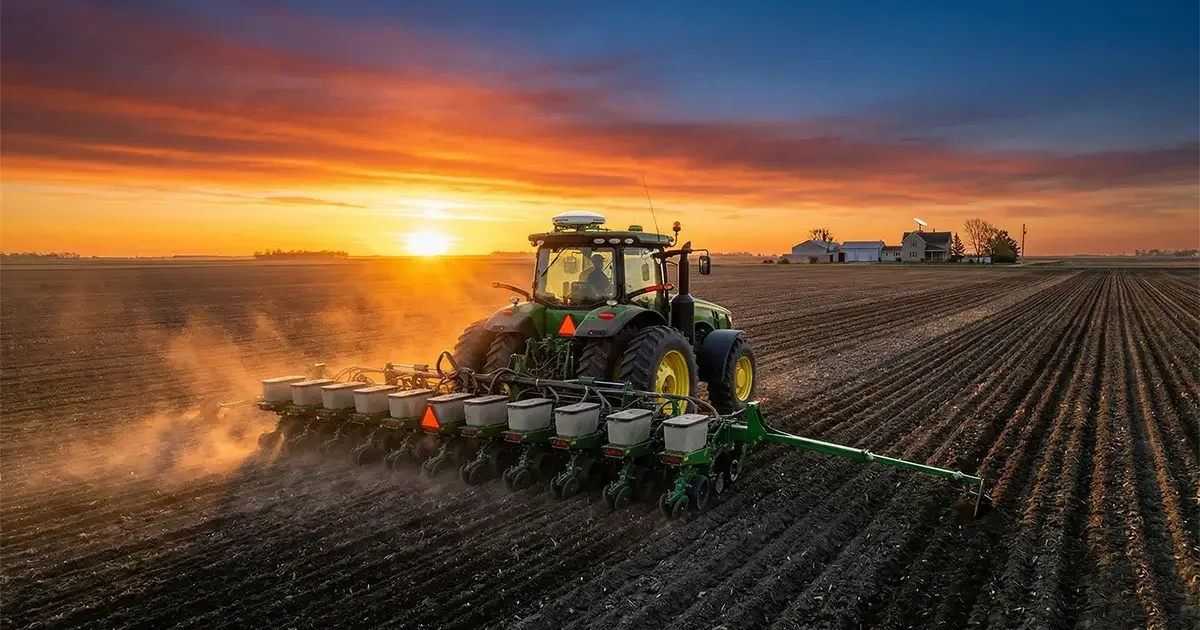
Modern farming is data-driven, and that data needs to move. Whether you’re running GPS-guided tractors, monitoring soil moisture sensors across 500 acres, tracking livestock with remote cameras, managing irrigation systems from your phone, or simply running the business side of a farming operation — reliable internet connectivity is no longer optional for competitive agricultural operations in 2026. This guide covers the best internet options for farms and agricultural properties, specific use cases and bandwidth requirements, and how to build a connectivity infrastructure that works across the unique challenges of farm environments.
In This Guide
- Why Internet Connectivity Matters for Modern Farms
- Unique Connectivity Challenges on Farms
- Bandwidth Requirements by Use Case
- Best Internet Options for Farms in 2026
- Starlink for Agriculture: A Deep Dive
- Extending Coverage Across Large Properties
- Backup Connectivity for Business Continuity
- Government Programs for Farm Connectivity
- FAQs
Why Internet Connectivity Matters for Modern Farms
The economic stakes of farm connectivity have never been higher. Precision agriculture — using data, sensors, GPS, and automation to optimize crop yields and reduce input costs — is now mainstream in competitive farming operations. Equipment manufacturers like John Deere, Case IH, and AGCO have built connectivity into their product lines as a standard feature, not an add-on. A combine harvester that cannot send its operational data back to a farm management platform, or a GPS-guided planter that loses its correction signal mid-field, creates real economic losses.
Beyond field operations, the business side of farming has migrated online as comprehensively as any other industry. Grain market monitoring, futures trading, USDA reporting, agricultural lending platforms, crop insurance filing, equipment telematics, and supply chain logistics all require reliable internet access. Farms that cannot access these systems reliably are at a competitive disadvantage that compounds over time.
Finally, rural quality of life on farm properties — for farm families, seasonal workers, and farm staff — increasingly depends on internet access for education, healthcare (telemedicine), and basic communications. The connectivity question is simultaneously a business infrastructure issue and a quality-of-life issue.
Unique Connectivity Challenges on Farms
Farm connectivity is harder than home connectivity for several important reasons:
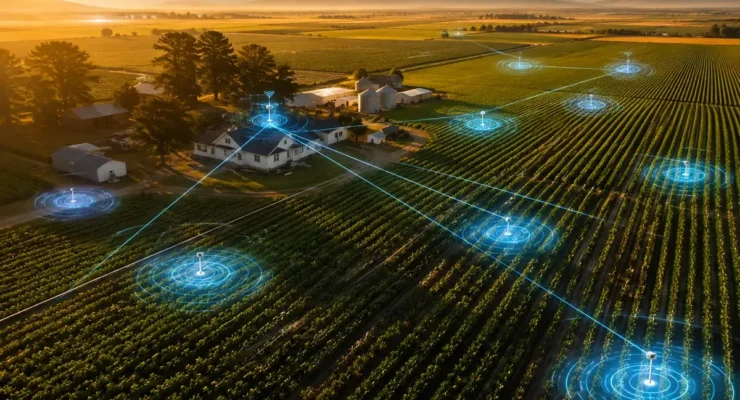
- Physical scale: A farm may span hundreds or thousands of acres. Getting a usable internet signal into a machine shop, equipment barn, grain storage facility, or irrigation pump house a quarter-mile from the farmhouse is a completely different challenge than covering a 2,500 sq ft home.
- Interference: Agricultural operations generate significant RF interference from motors, variable-frequency drives, welding equipment, and large metal structures (grain bins, machine sheds) that can attenuate wireless signals.
- Environmental exposure: Outdoor wireless equipment on farms must withstand extreme temperature swings, dust, humidity, herbicide and pesticide drift, and vibration from nearby heavy equipment — conditions that destroy consumer-grade hardware quickly.
- Mobile connectivity: Tractors, combines, sprayers, and ATVs need connectivity in the field, not just at the farmstead. This requires either cellular coverage in the fields or in-cab satellite connectivity solutions.
- Uptime criticality: During planting and harvest, internet outages are not merely inconvenient — they can halt operations that are time-critical and weather-dependent. Farm operations need backup connectivity planning in a way that residential users do not.
Bandwidth Requirements by Farm Use Case
| Application | Bandwidth Required | Latency Sensitivity | Notes |
|---|---|---|---|
| GPS autosteer / RTK correction | Less than 1 Mbps | Moderate | Small data packets; reliability more important than speed |
| Precision ag platform (Granular, Climate Corp) | 2–5 Mbps | Low | Periodic syncs; not real-time |
| Remote livestock cameras (HD) | 3–8 Mbps per camera | Low | 4K cameras require 15–25 Mbps each |
| IoT sensors (soil, weather, moisture) | Less than 1 Mbps total | Low | Very small data packets; LoRaWAN alternative |
| Video calls (Zoom, FaceTime) | 3–5 Mbps symmetric | High | Requires low latency satellite or fixed wireless |
| Grain market monitoring / trading | 2–5 Mbps | Moderate | Latency matters for live market data |
| Farm management software (cloud) | 5–10 Mbps | Low | Bulk data sync; can be off-peak scheduled |
| Equipment telematics (JD Operations Center) | 2–5 Mbps | Low | Cellular often handles in-field; farmstead connection for sync |
For most farm operations, a connection delivering consistent 25 Mbps download / 5 Mbps upload with under 100 ms latency covers all active farm management tasks simultaneously. Heavier operations (multiple 4K camera streams, regular large file uploads) benefit from 50+ Mbps. Legacy geostationary satellite with its 600–800 ms latency is inadequate for real-time applications regardless of its advertised download speed.
Best Internet Options for Farms in 2026
1. Starlink (Residential or Business): For farms without access to fiber or reliable fixed wireless, Starlink is the transformative option. Speeds of 50–220 Mbps and latency of 20–60 ms cover the full range of farm connectivity applications. The Starlink Business tier ($250/month) provides priority data allocation with SLA commitments better suited to business operations. Multiple Starlink dishes can be deployed at different locations on large farmsteads for comprehensive coverage.
2. Local Fixed Wireless (WISP): When a local WISP serves your area, this is often the best value — $40–$80/month for 25–100+ Mbps with low latency. WISPs have been rapidly expanding rural coverage using CBRS spectrum and 5G fixed wireless technology with USDA ReConnect funding. Check with your county extension office and ask neighboring farms.
3. Fiber to the Farm: Rural fiber is expanding through utility cooperative initiatives, BEAD Program funding, and state broadband programs. If fiber is available or coming to your area, it should be your long-term target — 1 Gbps symmetric connections eliminate all connectivity constraints indefinitely.
4. Cellular (T-Mobile, AT&T, Verizon) + Signal Booster: For farms with cellular coverage, a commercial-grade signal booster setup combined with a 4G/5G router can provide a cost-effective farmstead connection. T-Mobile Home Internet at $50/month is worth evaluating if rural coverage is available at your location.
Starlink for Agriculture: A Practical Deep Dive
Thousands of American farmers have adopted Starlink as their primary farm connectivity solution since its rural rollout, and their feedback has been consistently positive for farm-specific applications. Here’s what the agricultural Starlink experience looks like in practice:
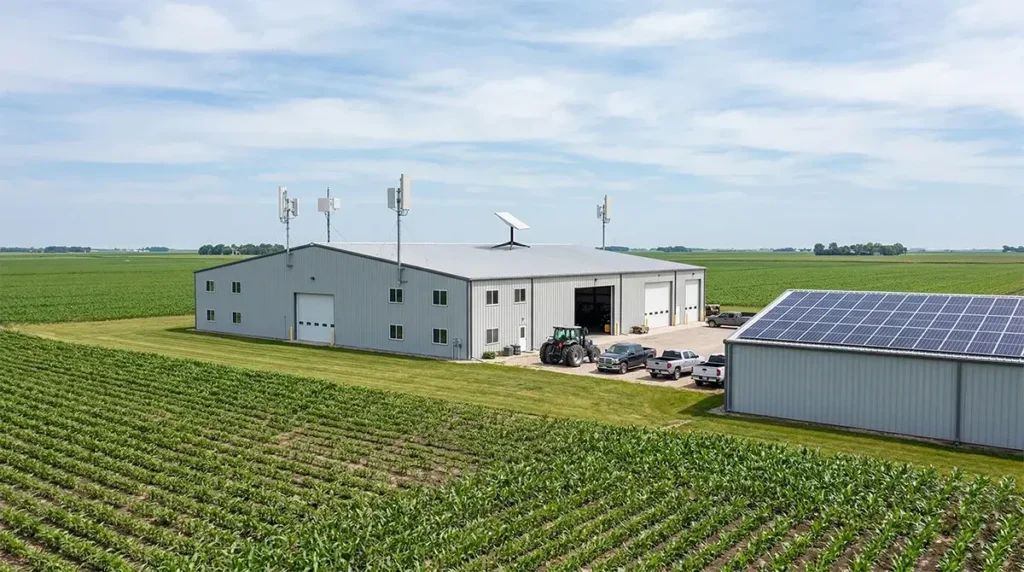
Farmstead installation: Most farm Starlink installations mount the dish on a dedicated tall mast (10–30 feet) in a clear area of the farmyard. This elevated position provides better sky coverage than a rooftop installation and avoids signal obstruction from grain bins, silos, and machine sheds. A quality ground-set steel pipe mount with concrete base is the most weather-resistant option for farm environments.
Extending coverage to outbuildings: Starlink dishes connect to your local network via Ethernet. Extending that network across a farmstead requires outdoor-rated Ethernet cable (direct-burial Cat6 or Cat6A) or a point-to-point Wi-Fi bridge between the farmhouse and outbuildings. Ubiquiti’s outdoor access points (PowerBeam or NanoBeam series) are popular and rugged enough for farm environments.
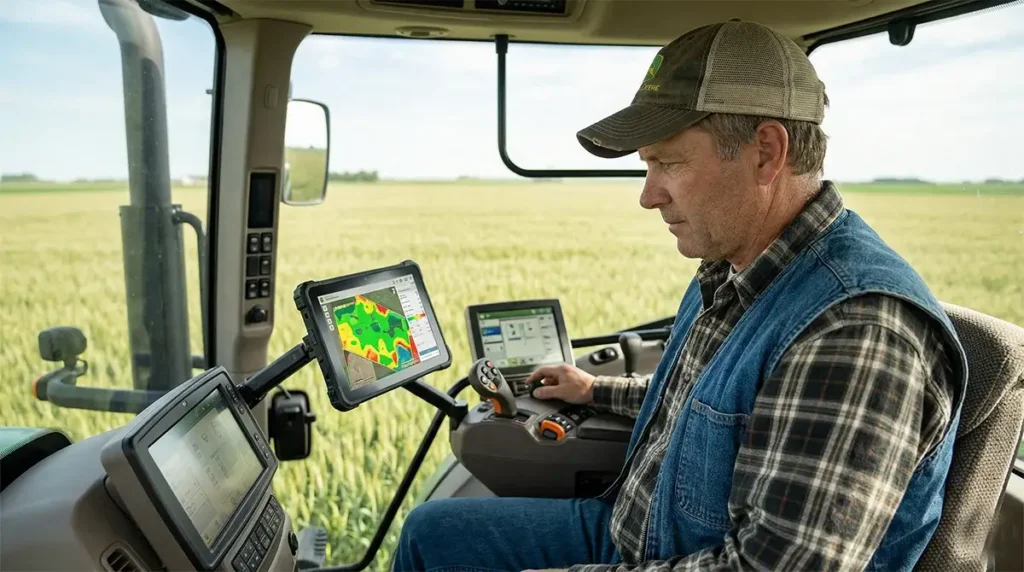
In-field connectivity: For connectivity on moving equipment, in-cab cellular hotspots or the Starlink Roaming plan (designed for vehicles including tractors and combines) provide data connectivity in the field. Many precision agriculture operations run a hybrid: Starlink at the farmstead for heavy data sync, cellular for in-field real-time data.
Uptime considerations: During critical operations like planting and harvest, connectivity outages are costly. Consider running Starlink as primary with a cellular LTE router as automatic failover backup. Multi-WAN routers from Peplink or Cradlepoint handle this failover automatically, switching to the cellular backup the moment Starlink connectivity is interrupted.
Extending Internet Coverage Across Large Farm Properties
Getting internet to the farmhouse is step one. Getting it to the machine shop, equipment shed, grain storage, worker housing, and fields is the harder step. Here are the most practical approaches:
- Direct-burial Ethernet: For outbuildings within 300 feet of the router, outdoor-rated Cat6 direct-burial cable is the most reliable solution. Zero interference, gigabit speeds, works in any weather. Plan trenching as part of any major farm infrastructure project.
- Point-to-point wireless bridges: For outbuildings 300 feet to several miles away, a Ubiquiti PowerBeam or airMAX bridge provides high-bandwidth (150–450 Mbps) connectivity without cable runs. Requires clear or near-clear line of sight.
- Multiple Starlink dishes: For truly large farms or properties with significant obstacles between the main farmstead and work areas, deploying a second Starlink dish at a remote building location is increasingly cost-effective and straightforward to configure.
- LoRaWAN for IoT sensors: For soil sensors, weather stations, gate monitors, and other IoT devices that send small amounts of data, LoRaWAN (Long Range Wide Area Network) technology provides coverage across an entire farm from a single gateway, using minimal power and cost — separate from your main internet connection entirely.
Government Programs Supporting Farm Connectivity
Federal and state investment in rural agricultural connectivity has accelerated dramatically. Key programs include:
The USDA ReConnect Program has invested over $2 billion across multiple funding rounds to bring broadband to rural agricultural areas. Phase 3 and Phase 4 funding rounds prioritized service to agricultural-zoned properties specifically. Contact your USDA Rural Development state office to ask what ReConnect-funded projects are planned for your county.
The USDA’s Agricultural Research Service (ARS) Digital Agriculture Initiative funds research into connectivity technology specifically for precision agriculture applications, including low-orbit satellite integration with farm management platforms.
Most states now have a state broadband office coordinating BEAD Program implementation with agricultural interests represented. Contact your state’s broadband office and your state department of agriculture to make sure farmland connectivity needs are reflected in state broadband planning.
Frequently Asked Questions
Can Starlink handle running a combine’s GPS system?
For stationary farmstead connectivity syncing to GPS correction services, yes. For in-cab real-time RTK correction on a moving combine, a dedicated in-cab cellular data connection is more appropriate than Starlink (which requires a fixed or slow-moving installation). Many farmers run both: Starlink at the farmstead for office and bulk data, cellular for in-field machine connectivity.
How much data does a farm typically use per month?
A typical mixed-operation farm (precision ag software, livestock cameras, business operations, family residential use) typically uses 300–800 GB per month. Farms with multiple HD camera streams, large-scale data uploads, or significant video conferencing usage may exceed 1 TB. Starlink’s 1 TB priority data threshold on the Standard plan covers most farms; large operations benefit from the Priority plan’s unlimited priority data.
Is Starlink suitable for running grain market software and trading platforms?
Yes. Grain market monitoring and most agricultural trading platforms work well on Starlink. For real-time futures trading where milliseconds of latency matter, fiber or cable is theoretically better, but for the practical grain marketing needs of most farm operations, Starlink’s 20–60 ms latency is entirely adequate.

Leave a Reply