
The “best rural internet provider” question doesn’t have a single answer that applies everywhere in the United States — it has dozens of correct answers depending on where you live, what technology is available at your specific address, and what you use the internet for. This comprehensive regional guide organizes the best rural internet options by geographic region across the continental United States, giving you a clear, region-specific starting point for evaluating your options in 2026. Whether you’re in the Deep South, the Great Plains, the Rocky Mountain West, or Appalachia, this guide tells you which providers to check first, which technologies dominate each region, and what regional factors affect your connectivity decisions.
In This Guide
- How to Use This Regional Guide
- Southeast (AL, GA, MS, SC, FL, TN, KY)
- Appalachia (WV, VA, Eastern KY, Eastern TN)
- South Central (TX, OK, AR, LA)
- Midwest Agricultural (IA, MN, WI, MO, IN, OH)
- Great Plains (KS, NE, SD, ND, MT, WY)
- Mountain West (CO, UT, NM, AZ, NV, ID)
- Pacific Northwest (OR, WA)
- Northeast (PA, NY, ME, VT, NH)
- The Universal Rural Option: Starlink
- The 7-Step Rural Internet Decision Framework
How to Use This Regional Guide
This guide organizes rural internet options by region because carrier coverage strength, cooperative broadband availability, and technology penetration vary significantly by geography. Use this guide to identify the providers most worth checking in your specific region — then verify availability at your specific address before purchasing hardware or committing to a plan. For any provider listed, always verify availability at your address since regional patterns don’t guarantee coverage at any individual location. Coverage at your neighbor’s address half a mile away doesn’t guarantee coverage at your address.
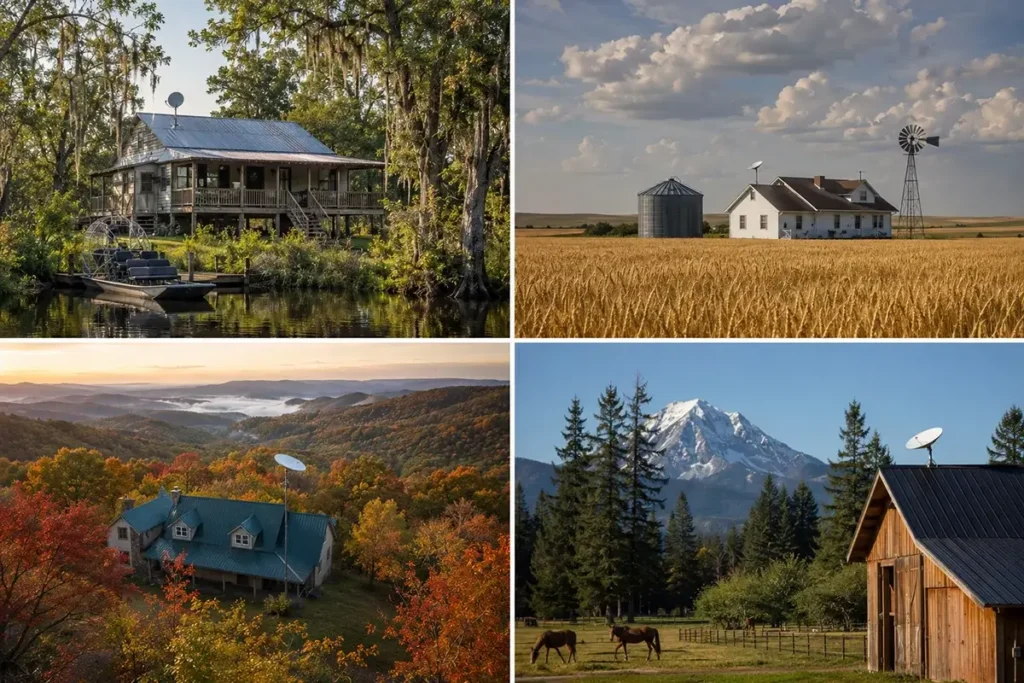
Southeast: AL, GA, MS, SC, FL, TN, KY
Best options in priority order:
- Electric cooperative fiber (where available): The Southeast has some of the most active electric cooperative broadband programs in the nation. Tennessee’s TVA distributor cooperatives, Georgia’s 42 Electric Membership Corporations (EMCs), South Carolina’s 20 cooperatives, and Alabama’s 23 cooperatives all have active or planned fiber programs. This is your first check in the Southeast — cooperative fiber delivers the best performance and value where available.
- T-Mobile Home Internet ($50/month): T-Mobile’s rural Southeast coverage is improving rapidly. Check eligibility at your specific address — the flat terrain of the coastal plain states (MS, AL, GA, SC, FL) supports better T-Mobile coverage than the Appalachian mountain communities of Tennessee and Kentucky.
- Verizon Home Internet ($25/month bundled): Verizon has strong rural Southeast cellular coverage, particularly in non-mountain areas. Existing Verizon wireless customers should check Home Internet eligibility for the significant bundled rate savings.
- Starlink ($120/month): Universal fallback available at any Southeast rural address with sky access. Hurricane-vulnerable coastal communities should follow the storm preparation protocols detailed in our Florida rural internet guide.
Regional note: The Southeast’s electric cooperative broadband programs are expanding rapidly with BEAD funding. Check your cooperative’s current status even if you checked 12 months ago — the deployment pace has accelerated significantly and availability may have changed.
Appalachian Region: WV, VA Mountain, Eastern KY, Eastern TN
Best options in priority order:
- Local telephone cooperative fiber (where available): Appalachian telephone cooperatives — Mountain Rural Telephone (KY), CVEC (VA), several WV cooperatives — have active fiber programs using ReConnect and BEAD funding. Check your cooperative first, and check recently — BEAD-funded deployment has accelerated significantly in 2025–2026.
- Starlink with proper sky assessment ($120/month): Appalachian hollow-bottom properties often need 20–40 foot masts to clear ridge obstructions. Ridge-top and slope properties have excellent conditions. The sky obstruction scanner is non-negotiable before ordering in any Appalachian mountain terrain.
- Verizon cellular home internet: Verizon’s FirstNet investment has improved rural coverage in Appalachian corridors. Check Home Internet eligibility for highway-adjacent properties where adequate cellular signal is available.
South Central: TX, OK, AR, LA
Best options in priority order:
- Electric cooperative fiber (TX, OK, AR): Texas has the most active electric cooperative broadband programs in the South. Oklahoma’s tribal nation broadband programs serve portions of eastern Oklahoma. Arkansas’s Carroll Electric has active Ozarks fiber deployment using BEAD funding.
- T-Mobile Home Internet ($50/month): T-Mobile has strong coverage along major Texas, Oklahoma, and Arkansas corridors — particularly the I-35, I-40, I-20, and US-69 corridors that cross each state.
- Starlink ($120/month): Universal option for any rural South Central property. Excellent performance on Texas’s open plains, the Arkansas Ozarks (from ridge properties), Oklahoma’s Great Plains, and Louisiana’s flat coastal plain.
Midwest Agricultural: IA, MN, WI, MO, IN, OH
Best options in priority order:
- Telephone cooperative fiber: The Midwest has the nation’s most advanced rural telephone cooperative fiber infrastructure. Iowa’s cooperatives, Minnesota’s cooperatives (Paul Bunyan Telephone, Arvig, many others), and Wisconsin’s cooperatives (Nelson Telephone, West Wisconsin Telcom) have built fiber that makes satellite unnecessary for many Midwest agricultural addresses. Check your telephone cooperative first — deployment has accelerated significantly with BEAD funding and availability may have expanded since you last checked.
- T-Mobile Home Internet ($50/month): T-Mobile coverage in the higher-density agricultural Midwest states is better than in the Mountain West. Many Midwest rural addresses qualify for the $50/month flat rate — always check before ordering satellite.
- Starlink ($120/month): The flat Midwest terrain makes Starlink installation effortless and performance excellent. Best option for properties beyond telephone cooperative fiber coverage zones.
Regional note: Missouri’s Ozarks region in the south requires the same sky obstruction assessment as Appalachian terrain. All other Midwest regions have flat to gently rolling terrain with no significant sky obstruction concerns.
Great Plains: KS, NE, SD, ND, MT, WY
Best options in priority order:
- Telephone cooperative fiber (where available): Kansas (Nex-Tech, Pioneer Communications), Nebraska (NCTC, Great Plains Communications), and some Montana cooperatives have fiber programs in specific communities. Check first — gigabit fiber at competitive rates is the superior option where available.
- Starlink Priority ($250/month) for remote commercial operations: The Great Plains’ ultra-low-density Starlink coverage cells deliver some of the fastest rural performance in the country — commonly 110–150+ Mbps. Starlink Priority is specifically recommended for farm and ranch operations with high data demands and commercial operations requiring consistent performance.
- Verizon cellular backup: Verizon has the strongest rural Great Plains cellular network. Pair with Starlink as a backup connection for any commercial operation where connectivity downtime has economic consequences.
Regional note: The Great Plains is where satellite internet’s performance advantage over legacy alternatives is most pronounced. The flat terrain, clear skies, and ultra-low coverage cell density combine to make Starlink performance in this region frequently among the best available rural broadband anywhere in the country.
Mountain West: CO, UT, NM, AZ, NV, ID
Best options in priority order:
- Sky obstruction assessment FIRST — always required: Before ordering any wireless broadband for a Mountain West rural property, run the Starlink app’s sky obstruction scanner from your intended installation location. Mountain West terrain is the most variable of any region for wireless connectivity — this step cannot be skipped for any property in mountain, canyon, or ridge-and-valley terrain.
- Starlink (where sky access is adequate): Open mesa, valley floor, and slope properties throughout the Mountain West have excellent Starlink conditions. Deep canyon and narrow valley properties may be unable to achieve adequate sky access from any ground-level position.
- Electric cooperative fiber (ID, CO, NM, UT): Garkane Energy (UT canyon country), several Colorado cooperatives, and Idaho cooperatives have active broadband programs. Check cooperative availability for your specific address before defaulting to satellite.
Pacific Northwest: OR, WA
Best options in priority order:
- PUD broadband (Washington): Washington’s Public Utility Districts have some of the most advanced rural broadband programs in the West. Check your PUD for current fiber or fixed wireless availability before considering any other option — PUD broadband is typically the best-value rural internet where available.
- US Cellular: US Cellular has notably stronger rural Oregon and Washington coverage than nationally dominant carriers in many Pacific Northwest rural areas. Check US Cellular Home Internet eligibility specifically — it may show availability where T-Mobile and Verizon show weak results.
- Starlink ($120/month): Available statewide with no waitlist. Tree cover in western Oregon and Washington creates sky obstruction challenges — use the app scanner for any heavily forested property. Eastern Oregon and eastern Washington’s open terrain delivers excellent Starlink performance.
Northeast: PA, NY, ME, VT, NH, Rural New England
Best options in priority order:
- Local WISP or telephone cooperative: The Northeast has numerous small telephone cooperatives and fixed wireless ISPs serving specific rural communities. Check local WISP availability first — many rural Northeast communities have WISP options offering lower-cost service than satellite at adequate performance levels.
- T-Mobile or Verizon Home Internet: Population density in even rural Northeast states is higher than the Plains or Mountain West, improving cellular home internet eligibility compared to more sparsely populated regions. Check both carriers.
- Starlink ($120/month): Available throughout the Northeast with no waitlist. Northeast forest cover creates sky obstruction challenges more frequently than open terrain states — use the scanner for any forested rural property.
The Universal Rural Option: Starlink
Across all regions, one option is consistently available when nothing else provides adequate service: Starlink. Any rural address in the continental United States, Hawaii, and Alaska with a clear sky view can order Starlink with no waitlist and receive equipment within days. Performance varies by coverage cell density but is consistently broadband-quality — typically 65–115 Mbps download and 20–60 ms latency.
For the millions of rural Americans who have exhausted every other option and found nothing adequate, Starlink is not a consolation prize — it is a genuine broadband solution that works reliably for all modern internet applications including video calls, gaming, telehealth, homeschooling, and remote work. According to performance data tracked by Speedtest.net’s global broadband intelligence reports, Starlink’s median performance in the United States has consistently placed it among the top-performing fixed broadband services nationally — not just among satellite services, but among all fixed broadband technologies measured across urban and rural markets combined.
The 7-Step Rural Internet Decision Framework
Regardless of your region, follow this decision framework before ordering any rural internet service. This process takes 30–60 minutes and saves you from making an expensive commitment to the wrong service:
- Check FCC broadband map: See what’s officially reported at broadbandmap.fcc.gov — and use the challenge process if listed providers don’t actually serve you at adequate speeds
- Check your electric cooperative: Call or visit your electric cooperative’s website — ask specifically about current broadband availability and upcoming BEAD deployment plans for your road or neighborhood
- Check your telephone cooperative: If your phone service comes from a telephone cooperative, check their broadband offerings — they may have recently deployed fiber or high-quality fixed wireless
- Check T-Mobile Home Internet: Enter your address at t-mobile.com — the $50/month flat rate no-contract service is the best rural internet value if your address qualifies
- Check Verizon Home Internet: If you’re an existing Verizon wireless customer, check the $25/month bundled Home Internet rate eligibility — the lowest-cost rural option available to qualifying customers
- Check local WISPs: Ask your county extension office, neighbors, or the FCC broadband map about fixed wireless providers serving your area — local WISPs are often underrepresented in national databases but may provide excellent performance at lower cost than satellite
- Order Starlink: If none of the above options provide adequate service at your address, order Starlink at starlink.com — available everywhere in the US with no waitlist, no long-term contract, and hardware deliverable within a week
Frequently Asked Questions
Which US state has the best rural internet options overall in 2026?
Iowa and Minnesota have the best rural internet ecosystems of any agricultural states, driven by progressive telephone cooperative networks that have deployed fiber to rural communities years ahead of the national average. In these states, a meaningful percentage of rural farm addresses have access to gigabit fiber from telephone cooperatives — making satellite unnecessary for well-served households. For the continental US overall, Iowa’s combination of cooperative fiber reach, T-Mobile Home Internet availability, and Starlink backup coverage creates the most complete rural broadband option set of any agricultural state in the country.
What region has the worst rural internet options in 2026?
The Mississippi Delta (Mississippi, Arkansas Delta, Louisiana Delta communities), the tribal reservation lands of the northern Great Plains (Pine Ridge, Standing Rock, Cheyenne River), and the deep Appalachian coal country of eastern Kentucky and southern West Virginia consistently have the worst rural internet options of any US regions. These areas combine severe geographic isolation, deep and persistent poverty limiting household ability to afford even technically available services, and historical infrastructure underinvestment that has compounded over generations. In these regions, even Starlink adoption faces affordability barriers that prevent households from accessing connectivity that is technically available to them. Addressing these communities’ connectivity requires both infrastructure investment and significant subsidy programs to bridge the adoption gap for low-income rural households who need broadband but cannot afford current market pricing.
Is it better to get Starlink or wait for BEAD-funded fiber in my area?
For most rural Americans, the answer is: get Starlink now and switch to fiber when it arrives. BEAD Program infrastructure construction in the most rural and most underserved areas is realistically 3–7 years away for many communities — waiting 5 years without adequate broadband to avoid a $349 hardware purchase and $120/month service is not a rational trade-off. Starlink’s no-contract structure means you can switch to cooperative fiber the day it becomes available at your address with no cancellation penalty, no equipment return requirement, and no switching cost beyond the first month’s fiber service. The opportunity cost of inadequate broadband — limited remote work access, constrained telehealth, impaired online education, reduced agricultural productivity — far exceeds the cost of Starlink for the duration until fiber arrives.

Leave a Reply