
Florida’s rural broadband challenge surprises many people — a state associated with beaches, theme parks, and retirees has substantial rural communities with serious internet access deficits. The state’s panhandle counties, central Florida’s agricultural heartland, and the Big Bend region along the Gulf Coast have connectivity situations that rival rural Appalachia or the Great Plains in their severity. Florida’s rural population — approximately 1.5 million people in communities far from the Miami, Tampa, Orlando, and Jacksonville metro corridors — depends on agriculture, timber, and rural industries that increasingly require reliable broadband connectivity. In 2026, Florida’s BEAD Program investment, electric cooperative broadband programs, and Starlink’s universal coverage are creating meaningful improvement. This complete guide covers rural internet options across Florida’s distinct regions.
In This Guide
- Florida Rural Broadband Overview
- Best Internet by Florida Region
- Starlink in Florida
- Florida Electric Cooperatives and Broadband
- Florida State Broadband Programs
- The Florida Panhandle: Rural Connectivity Deep Dive
- Hurricane Resilience and Rural Florida Internet
- Florida Agriculture and Connectivity
- Practical Tips for Rural Florida Residents
- Frequently Asked Questions
Florida Rural Broadband Overview
Florida’s broadband landscape is defined by its metropolitan corridors — the I-4 corridor between Tampa and Orlando, South Florida’s metro, the Jacksonville area, and smaller coastal urban centers all have competitive commercial broadband. Step away from these corridors into the agricultural communities of the Panhandle, the cattle ranches of north-central Florida, the sugar cane and citrus growing regions of south-central Florida, or the fishing and timber communities of the Big Bend Gulf Coast, and the connectivity picture changes dramatically.
According to the FCC National Broadband Map, Florida has significant concentrations of unserved rural addresses in Panhandle counties (Liberty, Calhoun, Gulf, Franklin, Jefferson), the Big Bend area (Madison, Taylor, Dixie, Gilchrist counties), and rural agricultural communities in north-central Florida. Florida’s rural broadband gap is often overlooked in national discussions because the state’s overall urban broadband access is excellent — but the rural communities experiencing digital exclusion are numerous and their connectivity challenges are very real.
Florida has 16 rural electric cooperatives serving members across the state’s rural territory. These cooperatives have been among the Southeast’s more active broadband deployers, with several receiving USDA ReConnect grants and BEAD funding for fiber deployment in previously unserved rural communities.
Best Internet by Florida Region
North Florida / Panhandle Interior (Liberty, Calhoun, Holmes, Washington Counties)
The Florida Panhandle’s interior counties — away from the Gulf Coast resort corridor — have some of Florida’s most severe rural broadband gaps. Liberty County, the least-populated Florida county, has essentially no fixed broadband infrastructure in most of its rural territory. Calhoun, Holmes, and Washington counties have telephone cooperative DSL in some communities and Starlink for rural properties. Gulf Coast Electric Cooperative has active broadband programs for Panhandle members using BEAD funding. The flat to rolling Panhandle terrain makes Starlink installation straightforward.
Big Bend / Gulf Coast Rural (Taylor, Dixie, Gilchrist, Levy, Wakulla Counties)
Florida’s Big Bend region has some of the state’s most dramatic rural character. The coastal fishing communities of Cedar Key, Steinhatchee, and surrounding Gulf communities have limited connectivity options. Inland agricultural and timber communities in Taylor, Dixie, and Gilchrist counties depend on telephone cooperative DSL and Starlink. The flat terrain provides excellent Starlink conditions. Talquin Electric Cooperative serves members in Leon, Liberty, Gadsden, and Wakulla counties with expanding broadband programs.
North-Central Florida (Suwannee, Columbia, Hamilton, Madison Counties)
North-central Florida’s agricultural communities — tobacco, peanuts, timber, and livestock — have moderate connectivity with significant gaps in rural areas away from the I-10 and US-90 corridors. Suwannee Valley Electric Cooperative has been among Florida’s most progressive cooperative broadband programs, deploying fiber to rural members using USDA ReConnect and BEAD funding. T-Mobile Home Internet availability is better along major highway corridors than in the rural interior of these counties.
South-Central Florida / Agricultural Interior (Highlands, Hardee, DeSoto, Okeechobee Counties)
Florida’s agricultural interior — citrus, cattle, and row crops between Tampa and Lake Okeechobee — has significant rural broadband gaps away from commercial corridors. Several electric cooperatives serve portions of this region with broadband expansion plans including Glades Electric Cooperative. The flat to gently rolling terrain makes Starlink installation effortless with excellent sky access from essentially any property location.
Florida Electric Cooperatives and Broadband
- Suwannee Valley Electric Cooperative: Serving members in north-central Florida with active fiber broadband deployment — among Florida’s most progressive cooperative broadband programs, reaching rural members who have never previously had viable broadband options.
- Gulf Coast Electric Cooperative: Serving Panhandle members in Bay, Calhoun, Gulf, Holmes, Jackson, and Washington counties with expanding broadband programs using ReConnect and BEAD funding.
- Talquin Electric Cooperative: Serving members in Leon, Liberty, Gadsden, and Wakulla counties with broadband expansion programs targeted at the Panhandle’s most underserved rural communities.
- Glades Electric Cooperative: Serving members in south-central Florida’s agricultural interior with broadband development using state and federal funding.
- Tri-County Electric Cooperative: Serving members in north Florida with broadband development targeting agricultural communities beyond cable plant coverage areas.
Florida State Broadband Programs
Florida’s broadband programs are coordinated through the Florida Department of Economic Opportunity (DEO). Florida received approximately $868 million in BEAD Program federal funding, which DEO is implementing with specific attention to the Panhandle’s most severely underserved communities, the Big Bend region, and rural north-central Florida counties. Florida has also operated state broadband grant programs using American Rescue Plan funds that accelerated deployment in several rural communities ahead of BEAD construction timelines, particularly in the north-central Florida cooperative territory.
Hurricane Resilience and Rural Florida Internet
Florida’s annual hurricane season creates specific connectivity resilience requirements more demanding than any other rural state. Hurricanes Ian (2022), Idalia (2023), and subsequent major storms demonstrated that terrestrial broadband infrastructure — fiber cables, telephone lines, cable systems, cellular towers — can be severely damaged by direct hurricane strikes, leaving rural communities without connectivity for days to weeks after the storm passes.
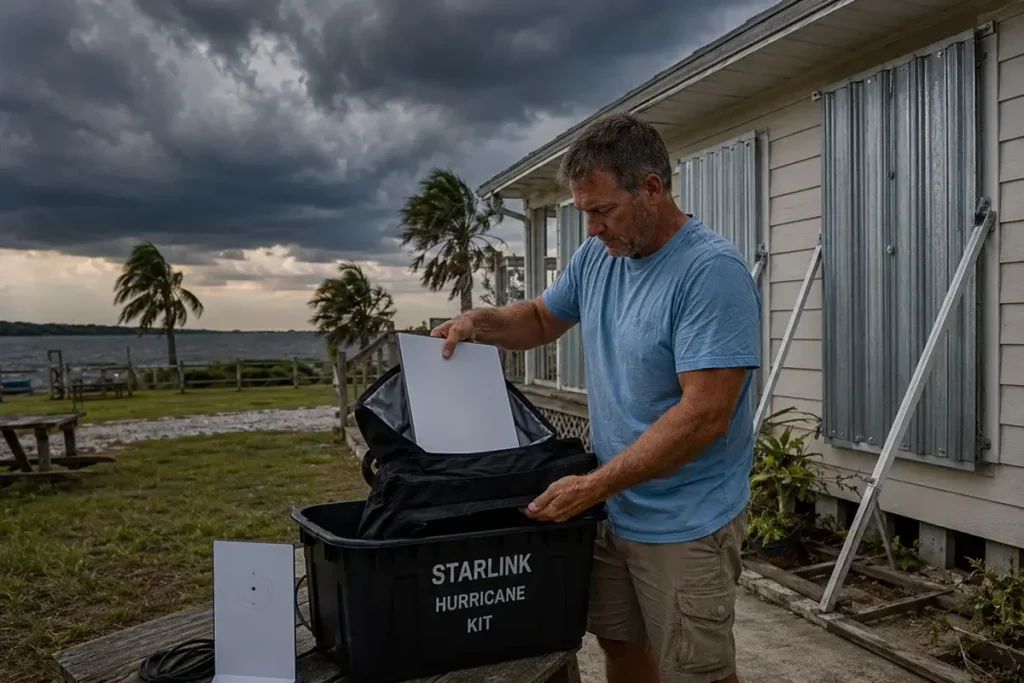
Starlink’s satellite-based connectivity offers meaningful hurricane resilience advantages. The dish must be secured or removed before a direct hurricane impact (rated for 75 mph sustained winds but not for 100–150+ mph major hurricane winds). After the storm passes and power is restored, Starlink typically reconnects within minutes — far faster than the days or weeks required for physical terrestrial infrastructure repair after major hurricane events.
For rural Florida properties in hurricane-vulnerable areas, the recommended configuration is: Starlink as primary internet (fastest post-storm recovery), Verizon cellular backup (strongest Florida rural network), UPS on all internet equipment, and a storm preparation protocol — stow the Starlink dish and router in a protected interior location before any direct hurricane landfall, and reinstall immediately after the storm for rapid connectivity restoration. This protocol has been documented to restore connectivity within 1–2 hours of power restoration in communities where neighbors on terrestrial services waited days.
Florida Agriculture and Connectivity
Florida’s diverse agricultural economy — citrus (recovering from citrus greening disease), cattle, sugar cane, tomatoes, strawberries, and ornamental horticulture — requires broadband connectivity for precision agriculture, commodity market access, and regulatory compliance documentation that modern Florida agricultural operations must maintain for food safety, environmental compliance, and crop insurance purposes.
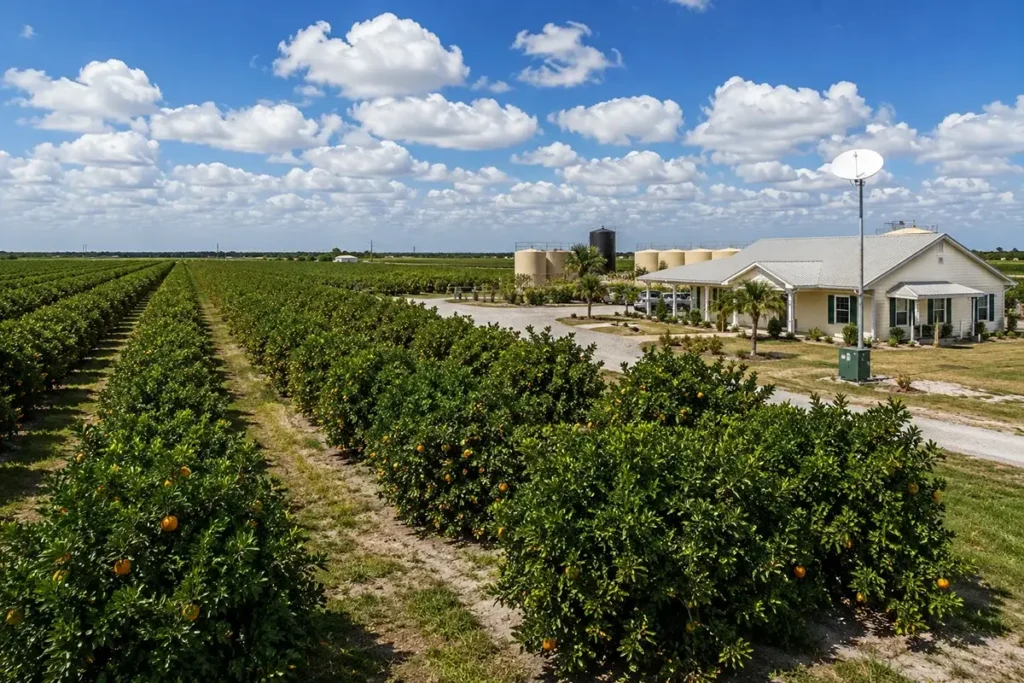
For Florida farm operations without telephone cooperative fiber or cable coverage, Starlink Standard ($120/month) provides the most immediately available broadband. Florida’s flat agricultural terrain — particularly in the cattle country of Highlands, Hardee, and Okeechobee counties and the sugar cane growing areas of Palm Beach County’s western reaches — provides ideal Starlink installation conditions with unrestricted sky access from any open field or farmstead location.
Practical Tips for Rural Florida Residents
- Hurricane preparation (essential for all Florida): Before any direct hurricane threat, stow the Starlink dish and router in a protected interior location. Reinstall after the storm passes and power is restored. Store equipment in a clearly labeled container for quick post-storm setup — this 30-minute pre-storm investment enables same-day connectivity restoration after storm passage.
- Florida salt air and humidity: Florida’s coastal and near-coastal environment accelerates corrosion on outdoor electrical connections. Use dielectric grease on outdoor cable connections, inspect annually, and ensure all cable entry points are thoroughly weatherproofed for Florida’s frequent afternoon thunderstorms and very high annual rainfall totals.
- Contact your electric cooperative first. Suwannee Valley Electric, Gulf Coast Electric, and Talquin Electric have active programs that may serve your area. Cooperative fiber at competitive prices is the better long-term option where available.
Frequently Asked Questions
What is the best internet for rural Panhandle Florida?
For rural Panhandle interior communities in Liberty, Calhoun, and Holmes counties, Starlink is typically the best and often the only viable broadband option. Gulf Coast Electric Cooperative’s active broadband program is expanding to member communities using BEAD funding — check current cooperative service availability for your specific address before ordering satellite. T-Mobile Home Internet availability is limited in the most rural Panhandle interior communities but may be available along US-231 and other major Panhandle highway corridors.
Does Starlink work well in Florida’s heat and humidity?
Yes. Starlink’s Gen 3 dish is rated for operating temperatures up to 50°C (122°F) — exceeding Florida’s highest recorded temperatures. The dish handles Florida’s high humidity well in its standard IP56-rated configuration. The main Florida-specific considerations are: salt air corrosion protection for coastal properties (within 2 miles of saltwater), hurricane storm preparation and post-storm reinstallation protocol, and ensuring cable connections are properly weatherproofed given Florida’s frequent afternoon thunderstorms and very high annual rainfall totals in the state’s interior agricultural regions.
Rural Florida and Remote Work
Florida’s rural communities have seen significant remote worker in-migration driven by the state’s combination of natural beauty, no state income tax, relatively lower rural cost of living compared to coastal Florida metros, and the appeal of Florida’s outdoor lifestyle. The Panhandle’s coastal and near-coastal rural communities, north-central Florida’s horse country and agricultural communities, and the Big Bend region’s scenic river and coastal communities have all attracted remote workers who need rural Florida living with adequate broadband connectivity.
For rural Florida communities developing broadband-enabled economic development strategies, the connectivity investment serves multiple purposes simultaneously: enabling remote work for existing rural residents, attracting new remote worker residents who bring economic activity to rural communities, supporting agricultural operations that need precision agriculture connectivity, and enabling the telehealth services that rural Florida healthcare providers need to deliver care to underserved communities. The Suwannee Valley Electric Cooperative’s active fiber deployment program specifically acknowledges all of these economic development dimensions as drivers for the cooperative’s broadband investment, recognizing that connectivity enables a range of economic opportunities for rural north-central Florida communities that have been economically constrained by inadequate infrastructure for decades.
Education Access in Rural Florida
Florida’s rural school districts — particularly in the Panhandle interior and Big Bend region — face educational challenges where broadband connectivity plays an increasingly important role. The COVID-19 pandemic exposed the homework gap in Florida’s rural communities with particular severity: students in rural Panhandle counties who could not access E-Rate-funded school broadband at home fell significantly behind during remote learning periods, with documented learning loss outcomes that correlated strongly with home internet access.
Florida’s Department of Education has incorporated rural broadband as an educational equity issue in its policy frameworks, recognizing that the educational opportunities available to Florida students should not be determined by whether they happen to live in a metro area or in a rural Liberty County community without home internet. BEAD Program digital equity provisions specifically require that funded ISPs offer affordable plans for qualifying low-income households in their service areas — including families with school-age children in Florida’s most rural communities. Contact your county’s school district and community action agency about current programs providing home internet access or digital literacy support for Florida rural families with school-age children.
Florida’s public libraries receive E-Rate funded broadband and provide free Wi-Fi to the public — a resource for rural Florida families without home broadband for after-school homework completion and access to educational platforms. Several Florida rural counties have specifically extended school campus Wi-Fi to the parking lot to provide homework zone access outside school hours for students whose homes lack internet connectivity. Contact your local school district about current after-hours student Wi-Fi access programs and community hotspot locations near your rural Florida community.




Leave a Reply