
Hawaii’s rural broadband challenge is unlike any other US state’s — shaped by island geography, volcanic terrain, and a tourism economy that has invested heavily in resort corridors while leaving agricultural communities significantly underserved. For farmers growing Kona coffee, macadamia nuts, and tropical fruits; rural communities on Molokai, Lanai, and the Big Island’s remote districts; and ranching operations on Mauna Kea’s slopes — reliable broadband has been elusive for decades. In 2026, Starlink’s universal coverage, Hawaii’s BEAD Program investment, and active state broadband programs are creating meaningful rural connectivity improvement for the first time. This complete guide covers every rural internet option across Hawaii’s islands.
In This Guide
- Hawaii Rural Broadband Overview
- Best Internet by Island
- Starlink in Hawaii: Special Considerations
- Hawaii State Broadband Programs
- Big Island: Hawaii’s Largest Rural Challenge
- Molokai, Lanai, and Rural Maui
- Hawaii Agriculture and Connectivity
- Hawaii Installation Tips
- Practical Tips for Rural Hawaii Residents
- Frequently Asked Questions
Hawaii Rural Broadband Overview
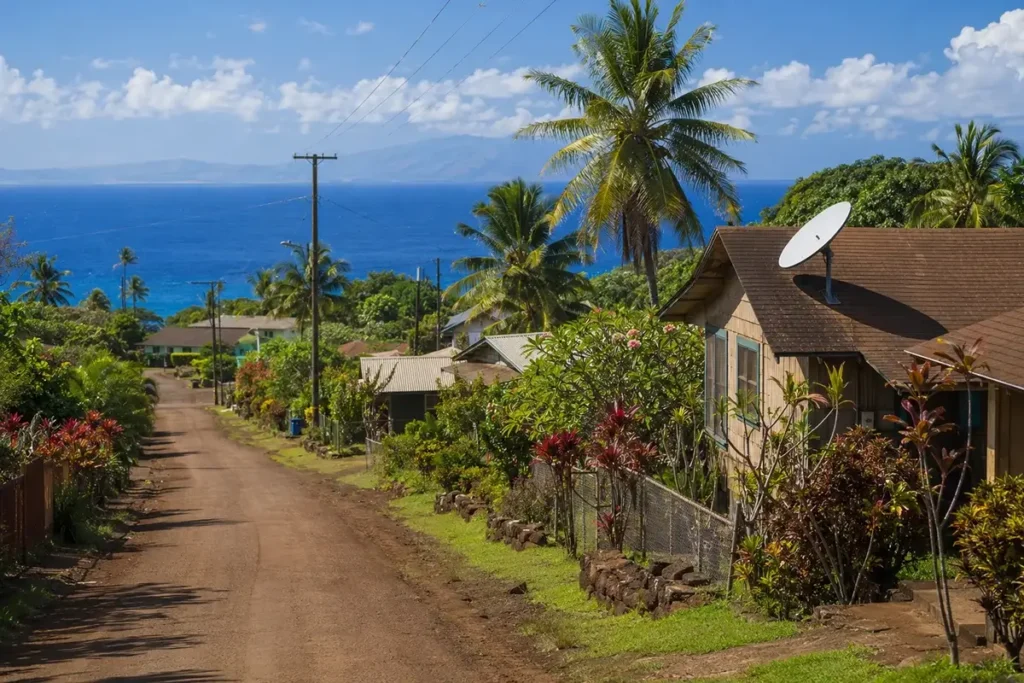
Hawaii’s broadband geography is defined by the tension between tourism-driven infrastructure investment and the needs of rural communities far from resort corridors. Honolulu and Maui’s resort towns have competitive broadband from Spectrum, Hawaiian Telcom, and smaller providers. The agricultural communities of Kona, Kohala, and Puna on the Big Island; rural communities on Molokai and Lanai; and the remote valleys of Kauai’s north shore have connectivity situations bearing no resemblance to what visitors experience in tourist areas.
According to the FCC National Broadband Map, Hawaii has significant concentrations of unserved and underserved addresses on the Big Island (particularly in Puna and Ka’u districts), on Molokai, and in rural portions of Maui, Kauai, and smaller islands. The state’s mountainous volcanic terrain creates the same wireless coverage challenges as Appalachian terrain, with ridges and deep valleys blocking signal paths between communities.
Hawaii is also unique among US states in relying entirely on undersea fiber cable for all internet connectivity. Every byte of Hawaii internet traffic traverses undersea cables to the mainland US — cables historically vulnerable to deep-ocean activity. Several cable cuts have created statewide internet disruptions in Hawaii’s history, adding a resilience dimension to connectivity planning that purely continental states don’t face. This vulnerability makes satellite connectivity not just a convenience but a genuine resilience asset for island communities.
Best Internet by Island
Oahu (Honolulu)
Oahu has the best broadband access of any Hawaiian island — a function of its dense population, state government and military infrastructure, and commercial investment driven by Honolulu’s urban economy. However, even Oahu has rural broadband gaps in North Shore agricultural communities, the Waianae Coast on the west side, and rural Ko’olau mountain valleys. These communities depend on Starlink and WISP coverage where Hawaiian Telcom DSL and Spectrum cable don’t reach.
Maui
Maui’s resort corridor has excellent commercial broadband. The island’s rural communities tell a different story. Hana, on Maui’s remote east end — accessible via the famous winding Road to Hana — has extremely limited connectivity. The agricultural communities of Upcountry Maui (Kula, Makawao, Pukalani) have better connectivity but still face rural broadband gaps in agricultural zones away from main Upcountry roads.
Big Island (Hawaii County)
Hawaii County is the state’s most geographically diverse island and its largest rural broadband challenge. At 4,028 square miles — larger than Connecticut and Rhode Island combined — the Big Island spans active volcanoes and snow-capped peaks, tropical rainforests and lava deserts. The Big Island’s connectivity is described in detail in the dedicated section below.
Kauai
Kauai’s north shore communities near the Na Pali Coast have some of Hawaii’s most limited connectivity in any inhabited area. Road access is single-route and frequently closed by flooding; infrastructure investment on the north shore is accordingly limited. The Waimea Canyon area and Kokee plateau in west Kauai have similar challenges. Kauai’s south and east shores have better connectivity from Lihue’s commercial infrastructure. Starlink serves Kauai statewide with no waitlist.
Starlink in Hawaii: Special Considerations
| Factor | Hawaii-Specific Issue | Required Action |
|---|---|---|
| Salt air corrosion | Marine environment accelerates corrosion far faster than continental US | Marine-grade mounting hardware; dielectric grease on all outdoor connections; annual inspection |
| Trade wind loading | Consistent 15–25 mph NE trade winds; gusts to 40+ mph during Kona storms | Secure mounting hardware rated for sustained wind loads at your specific site |
| Volcanic vog (Big Island) | Sulfur dioxide from Kilauea can accelerate outdoor equipment corrosion | More frequent inspection for properties near active volcanic areas |
| Sky obstruction on volcanic slopes | Steep volcanic ridges can block northern horizon at some slope properties | Use Starlink app sky scanner from exact installation location before ordering |
| Very high rainfall (windward sides) | Some Big Island and Kauai windward areas receive 100–200+ inches annually | Thorough waterproofing of all cable entry points; weatherproof tape on connections |
Hawaii State Broadband Programs
Hawaii’s broadband programs are coordinated through the Hawaii Broadband and Digital Equity Office under the Department of Commerce and Consumer Affairs. Hawaii received approximately $152 million in BEAD Program federal funding. While smaller than many mainland state allocations, per-household construction costs for island broadband deployment are significantly higher due to island logistics, limiting geographic reach of available investment.
Hawaii’s BEAD implementation specifically addresses the Big Island’s rural districts, Molokai, and rural Kauai as the state’s highest-priority unserved communities. The state has worked with the Department of Hawaiian Home Lands (DHHL) — administering approximately 200,000 acres for native Hawaiian homestead communities — on connectivity planning for homestead communities, many located in rural areas with significant broadband deficits. For current program information, visit the Hawaii Broadband Office website.
Big Island: Hawaii’s Largest Rural Broadband Challenge
Hawaii County’s Big Island presents rural broadband challenges combining mainland rural economics (vast distances, sparse population) with island-specific constraints (everything shipped by sea or air, undersea cable vulnerability, active volcanic terrain). The island’s diverse districts have dramatically different connectivity situations:
Puna District: One of the state’s most underserved areas, and the community most severely impacted by the 2018 Kilauea eruption that destroyed over 700 homes and eliminated some existing limited infrastructure. The remaining Puna community — in Hawaiian Beaches, Leilani Estates, and other residential areas — has limited fixed broadband options and depends heavily on Starlink. The volcanic forest terrain creates more sky obstruction challenges than the drier west side.
Ka’u District: The southernmost point in the United States is in Ka’u District. The sparse agricultural and ranching communities of this dry, remote district have essentially no fixed broadband infrastructure beyond marginal DSL in Naalehu. Starlink is the primary broadband option for Ka’u’s ranching operations and rural homesteads.
Kohala and Kona Districts: The Kona coffee belt and the ranching communities of North Kohala have somewhat better connectivity driven by tourism infrastructure investment. Rural agricultural properties above the resort zone depend on Starlink and limited WISP coverage. The Parker Ranch operation in Waimea — one of the largest ranches in the US — requires reliable broadband for extensive cattle operations across Kohala mountain slopes.
Molokai, Lanai, and Rural Maui
Molokai — often called “the friendly isle” — has the highest percentage of native Hawaiian population of any island and one of the most limited infrastructure investments in the state. Residents have historically resisted commercial tourism development, preserving authentic rural character while accepting the infrastructure investment limitations that come with lower commercial activity. Molokai’s connectivity depends primarily on Starlink and limited cellular coverage from the few towers serving the island.
Lanai presents an interesting connectivity bifurcation: the Four Seasons resorts have commercial broadband infrastructure, while the community of Lanai City (the island’s only town) and surrounding agricultural areas have limited options. Starlink serves both the resort community fringe and rural Lanai residents. Both Molokai and Lanai’s island geography — surrounded by open Pacific Ocean — provides essentially unrestricted sky access for Starlink installations from any cleared or open location on either island.
Hawaii Agriculture and Connectivity
Hawaii’s specialty agriculture — Kona coffee, macadamia nuts, tropical fruits, flowers, and cattle — is increasingly technology-dependent in ways that require reliable broadband. Coffee farmers in the Kona belt use weather monitoring, soil moisture sensing, and international buyer platforms. Aquaculture operations on the Big Island monitor water quality continuously. Flower farms access international buyers through online marketplaces. All of these applications require broadband that Starlink now provides universally across the state’s agricultural landscape — often for the first time in the history of these farming communities.
The economic case for rural Hawaii farm broadband is compelling: a Kona coffee farmer who can access specialty coffee auction platforms, participate in online cupping competitions, and market directly to premium buyers through an online presence earns substantially more than one selling through traditional channels. Connectivity that enables premium market access is an economic multiplier for Hawaii’s specialty agricultural community.
Practical Tips for Rural Hawaii Residents
- Use marine-grade hardware for all outdoor components. This is the single most important Hawaii-specific installation difference. Standard continental US mounting hardware corrodes within 2–3 years in Hawaii’s salt air; marine-grade stainless steel hardware lasts the life of the installation.
- Big Island volcanic terrain residents: Run the Starlink app scanner before ordering — volcanic slopes can have significant horizon obstruction depending on orientation and steepness. Properties on ridge tops, south-facing slopes, and open lava fields typically have excellent sky access.
- Molokai and Lanai residents: Starlink is your best and often only viable broadband option. The open Pacific surrounding these islands provides excellent western sky access. Cellular coverage from AT&T and Verizon on neighbor islands can be limited; Starlink provides connectivity independent of cellular tower coverage.
- Kauai north shore residents: Starlink’s small dish footprint is more compatible with north shore environmental constraints than any alternative broadband infrastructure. The open Pacific to the west and south provides good sky access from most north shore properties with minimal coastal development.
Frequently Asked Questions
Does Starlink work in Hawaii?
Yes. Starlink is available throughout Hawaii — all major islands — with no waitlist and generally good performance. Hawaii’s 19–22° latitude is within the Starlink constellation’s full coverage range. Installation considerations specific to Hawaii include salt-air corrosion protection for all outdoor hardware, trade wind mounting security, volcanic terrain sky obstruction assessment for Big Island properties, and thorough waterproofing for high-rainfall windward locations. These Hawaii-specific considerations are important for long-term reliable operation but don’t prevent Starlink from working throughout the state.
What is the best internet for Kona coffee farmers on the Big Island?
For rural Kona coffee belt farms on the Big Island’s west slopes, Starlink Standard ($120/month) is the most universally available and reliably performing broadband option. The Kona coast’s predominantly clear skies and slope orientation toward the open Pacific provide generally good Starlink sky access from most farm properties. Marine-grade hardware and salt-air corrosion protection measures are important for Kona coast installations within the salt air influence zone (generally within 2 miles of the ocean). Check Hawaiian Telcom DSL availability at your specific address as a potentially lower-cost alternative if adequate speeds are available at your farm’s distance from the nearest switching equipment.

When will BEAD funding reach the most rural Big Island communities?
Hawaii’s BEAD Program implementation is targeting the Big Island’s Puna and Ka’u districts, Molokai, and rural Kauai as highest-priority communities. Construction timelines for island-based broadband infrastructure are more complex than mainland projects due to material shipping logistics and island-specific permitting requirements. Realistic service delivery timelines for priority Big Island and Molokai communities range from 2028–2031. Starlink provides immediately available broadband at any Hawaii rural property today regardless of future infrastructure development timelines.
Department of Hawaiian Home Lands (DHHL) Communities
The Department of Hawaiian Home Lands administers approximately 200,000 acres of land across all major Hawaiian islands for the benefit of native Hawaiian beneficiaries. Many DHHL homestead communities are located in rural areas that have historically received minimal broadband infrastructure investment, creating specific connectivity challenges for native Hawaiian homestead residents who may be living on designated land in some of Hawaii’s most beautiful but least-connected areas.
DHHL has been working with the Hawaii Broadband Office and federal BEAD Program administrators to ensure that homestead community broadband needs are specifically addressed in state deployment planning. For native Hawaiian homestead residents, contact DHHL’s Land Development Division about any planned broadband infrastructure programs for your specific homestead community before ordering individual satellite service — coordinated community programs may offer better pricing or more appropriate infrastructure solutions than individual household subscriptions.
Starlink is available at all DHHL homestead communities statewide. The open agricultural and pastoral character of many homestead communities — particularly on the Big Island’s large homestead areas and Molokai’s substantial homestead territory — provides generally good Starlink sky access from most property locations within homestead communities.
Can I get internet in Hawaii without a landline or cable?
Yes. Starlink, T-Mobile and Verizon cellular service, and local WISP coverage all provide internet without requiring a telephone landline or cable TV connection. In many rural Hawaii locations, Starlink is the only available option that provides broadband-quality speeds — and it works completely independently of any telephone or cable infrastructure. The $349 hardware purchase and $120/month service cost are the total requirements for Starlink service at any Hawaii rural address with sky access and power.



Leave a Reply