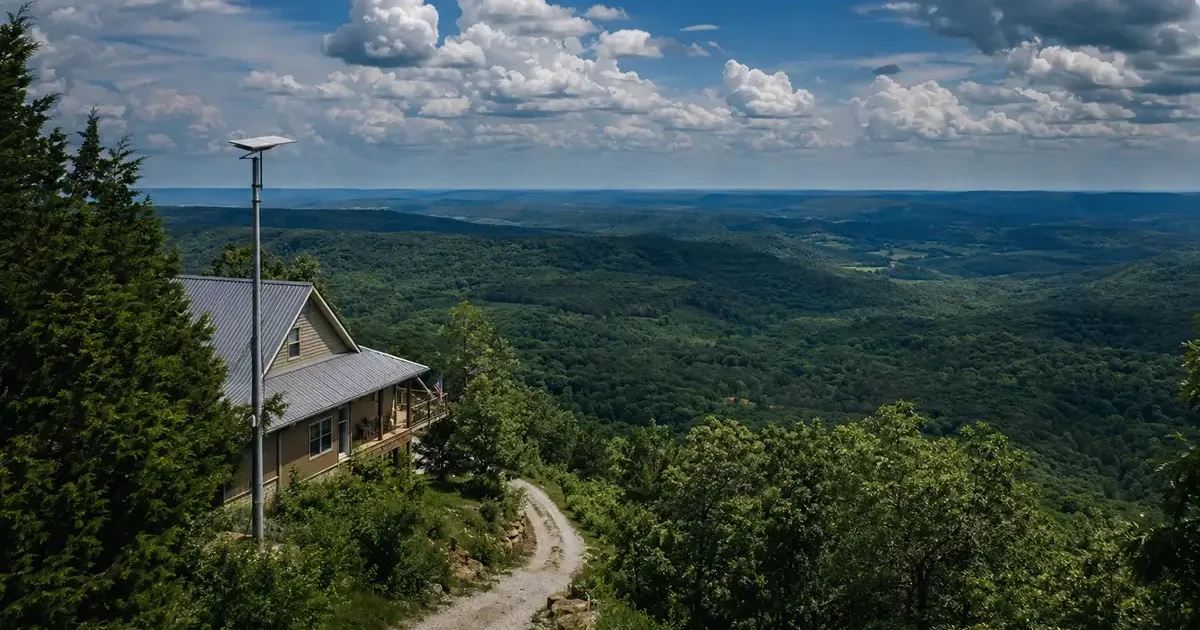
Missouri sits at the geographic center of America’s rural broadband challenge — a heartland state where the Missouri and Mississippi Rivers define productive agricultural corridors flanked by some of the nation’s most persistently disconnected rural communities. The Ozark Plateau in southern Missouri has terrain challenges comparable to neighboring Arkansas and Kentucky. The bootheel — Missouri’s southeastern agricultural appendage — shares the flat-terrain isolation of the Mississippi Delta. And the vast agricultural plains of northern and western Missouri present the economic challenge of very low population density stretching across productive farmland that private ISPs have limited incentive to serve. In 2026, Missouri’s rural internet landscape is changing through electric cooperative broadband programs, expanding Starlink coverage, and significant BEAD Program investment — but the work of connecting every rural Missouri household remains substantial. This comprehensive guide covers every rural internet option across Missouri’s distinct regions.
In This Guide
- Missouri Rural Broadband Overview
- Best Internet by Missouri Region
- Starlink in Missouri
- Cellular Home Internet in Rural Missouri
- Missouri Electric Cooperatives and Broadband
- The Missouri Ozarks: Connectivity in Rugged Country
- Missouri State Broadband Programs
- Missouri Agriculture and Internet Needs
- Practical Tips for Rural Missouri Residents
- Frequently Asked Questions
Missouri Rural Broadband Overview
Missouri’s rural broadband situation reflects the complexity of a state that spans multiple distinct geographic and economic regions. The state has approximately 1.7 million rural residents — about 28% of total population — spread across the Ozark Plateau, the Missouri River valley’s agricultural bottomlands, the northern plains, and the bootheel. These regions have dramatically different terrain, population density, and telecommunications infrastructure histories that produce very different connectivity outcomes.
According to the FCC National Broadband Map, Missouri has significant concentrations of unserved and underserved addresses in the Ozark counties of the south, the rural agricultural counties of the north and northwest, and the bootheel counties along the Mississippi. The state’s electric cooperative network — 43 cooperatives serving rural members — has become increasingly important as a broadband deployment vehicle, with Missouri cooperatives being some of the most active in the Midwest in pursuing broadband infrastructure investment.
Missouri’s position as an agricultural state with the nation’s seventh-largest farm economy creates significant precision agriculture broadband demand that is driving cooperative investment and attracting attention from rural broadband programs targeting agricultural communities. The state’s role as a major pork, beef, and row crop producer means that farm connectivity is simultaneously an economic competitiveness issue and a quality-of-life issue for the families who operate these operations.
Best Internet by Missouri Region
Missouri Ozarks (Ozark, Douglas, Howell, Oregon, Shannon, Reynolds Counties)
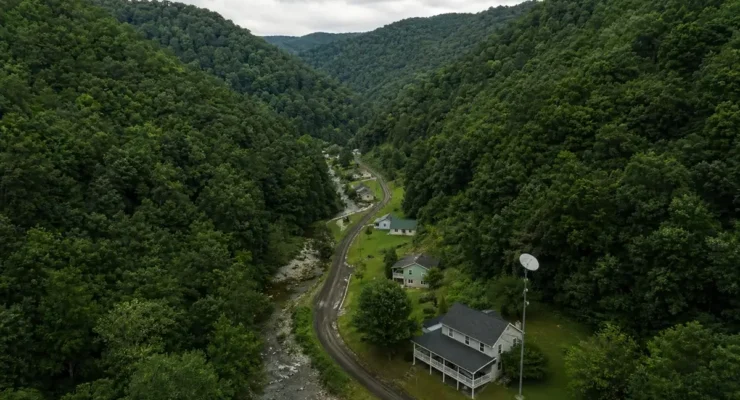
The Missouri Ozarks — the rugged, forested plateau of southern Missouri — presents the state’s most challenging rural broadband terrain. Shannon County, with a population of fewer than 8,000 residents across 1,000 square miles, has some of the worst broadband access statistics of any Missouri county. Communities in the Current River and Eleven Point River drainages, along with the many recreational communities around Table Rock Lake, Bull Shoals Lake, and Truman Lake, have terrain-limited wireless coverage and minimal wired infrastructure. Starlink covers the entire Ozark region — ridge and plateau properties have excellent sky access while deep hollow properties may need mast installation similar to neighboring Arkansas and Kentucky Ozark communities.
Missouri Bootheel (New Madrid, Mississippi, Pemiscot, Dunklin, Stoddard Counties)
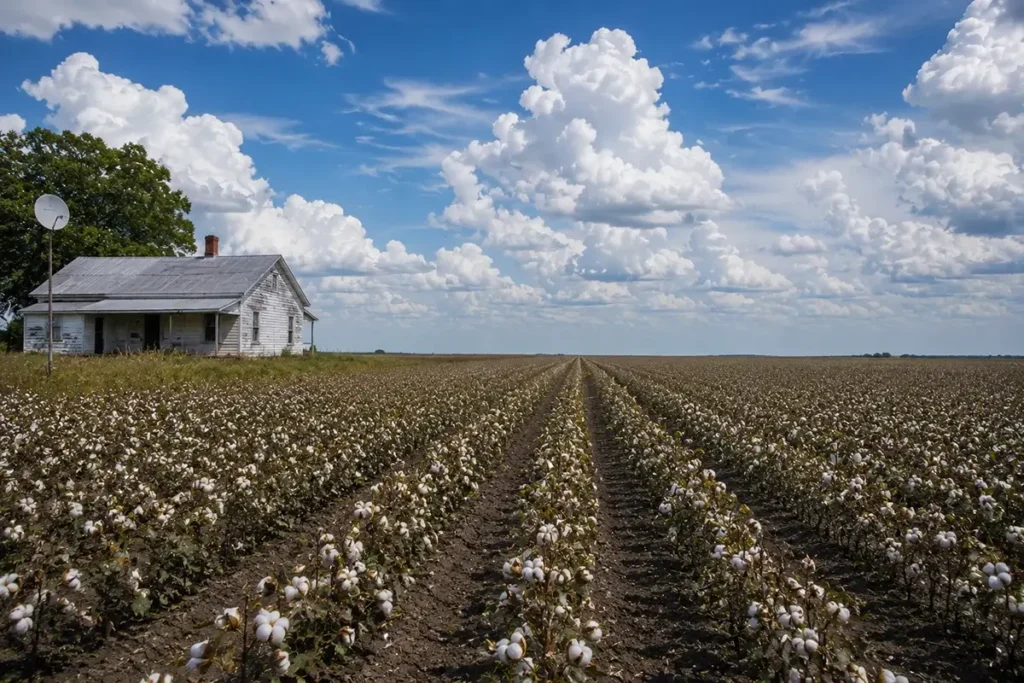
The Missouri Bootheel — the flat agricultural appendage that pushes south between Tennessee and Arkansas along the Mississippi River — is geographically and economically similar to the Mississippi and Arkansas Delta communities. Cotton, soybeans, rice, and corn agriculture defines this region, along with some of Missouri’s highest poverty rates and most severe broadband deficits. The flat terrain is ideal for Starlink installation with no obstruction concerns, and the sparse coverage cells in the bootheel deliver consistently good Starlink performance. Several bootheel electric cooperatives are pursuing fiber deployment with BEAD funding.
Northwest Missouri (Atchison, Holt, Nodaway, Worth, Harrison, Mercer Counties)
Northwest Missouri’s rolling prairie — a highly productive row crop and livestock region that borders Iowa and Kansas — has sparse broadband infrastructure relative to its agricultural productivity. The small county seats have telephone company DSL; rural farmsteads depend on Starlink and cellular hotspots. T-Mobile Home Internet availability is moderate in northwest Missouri along major corridor communities but limited on the most remote farmsteads. The relatively flat terrain of the Missouri plains makes Starlink installation straightforward with minimal obstruction concerns.
Central Missouri (Cooper, Moniteau, Howard, Randolph, Chariton Counties)
Central Missouri’s river bottoms and upland agricultural communities north of Jefferson City and Columbia have moderate broadband options — better than the Ozarks and bootheel but with significant rural gaps between the commercial corridors. Several central Missouri telephone companies provide DSL; Consolidated Communications and Lumen serve portions of this region. T-Mobile Home Internet availability is better in central Missouri than in more remote parts of the state, driven by proximity to the I-70 corridor. Electric cooperative fiber programs from Boone Electric Cooperative and Callaway Electric Cooperative are expanding service in their member territories.
Missouri Electric Cooperatives and Broadband
Missouri’s 43 electric cooperatives collectively serve rural members across the state’s most underserved territory. Several have become significant broadband deployers:
- Boone Electric Cooperative: Serving rural Boone, Callaway, Howard, and Cooper county members with active fiber broadband deployment — one of Missouri’s most progressive cooperative broadband programs.
- Co-Mo Connect (Co-Mo Electric Cooperative): One of Missouri’s broadband success stories — Co-Mo Electric’s broadband subsidiary serves rural members in Moniteau and Morgan counties with fiber broadband achieving speeds up to 1 Gbps. A model for cooperative broadband deployment in Missouri that other cooperatives are following.
- White River Valley Electric Cooperative: Serving Ozark region members in Taney, Ozark, Douglas, and Wright counties with active fiber deployment.
- Southwest Electric Cooperative: Serving southwest Missouri members in McDonald, Barry, and Lawrence counties with broadband programs.
- Associated Electric Cooperative (AECI): Missouri’s generation and transmission cooperative has supported member distribution cooperatives in broadband deployment planning and funding acquisition.
Co-Mo Connect in particular has demonstrated that Missouri electric cooperatives can build and operate world-class rural fiber broadband — the cooperative’s members in rural Moniteau County now have 1 Gbps fiber internet at competitive prices. This success story has influenced other Missouri cooperatives to pursue similar programs.
The Missouri Ozarks: Connectivity in Rugged Country
The Missouri Ozarks present the state’s most acute rural broadband challenge and its most dramatic connectivity success story simultaneously. The challenge: terrain that makes wired infrastructure deployment extremely expensive, communities too small and dispersed for commercial ISP economics, and a legacy of telephone cooperative DSL delivering 1–5 Mbps over long rural copper runs. The success story: Starlink has transformed what’s possible for Ozark communities that previously had no viable broadband option.
The recreational economy of the Missouri Ozarks — tourism, hunting, fishing, float trips on the Current and Jacks Fork rivers, vacation homes around the region’s many lakes — creates connectivity demand from seasonal visitors and second-home owners as much as from permanent residents. This broader base of demand has made some Ozark communities more commercially attractive for broadband investment than their permanent resident population alone would justify.
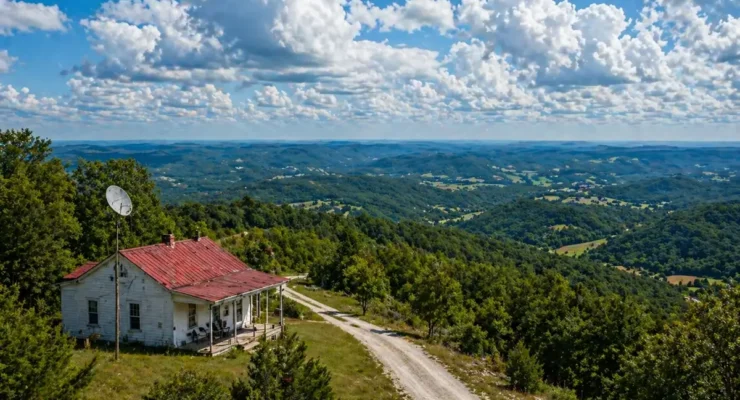
White River Valley Electric Cooperative’s active fiber program in the Ozark region — funded through USDA ReConnect and state programs — is specifically targeting communities that have been without adequate internet for decades. For members within the cooperative’s deployment plan, fiber service is coming within the 2026–2028 timeframe. For Ozark residents outside the cooperative’s service territory or deployment timeline, Starlink remains the recommended immediate solution. The region’s generally open ridge-top terrain provides excellent Starlink sky views for most properties, though deep Current River and Eleven Point River hollows may need mast installation.
Missouri State Broadband Programs
Missouri’s broadband programs are coordinated by the Office of Broadband Development within the Missouri Department of Economic Development. Missouri received approximately $1.74 billion in BEAD Program federal funding — reflecting the state’s large unserved and underserved population spread across its diverse rural geography.
Missouri’s BEAD implementation plan specifically addresses the Ozark region and bootheel as priority deployment zones, recognizing that these areas have the most severe access deficits and the greatest need for government-subsidized infrastructure. The state has worked with its electric cooperative network to position cooperatives as primary BEAD grant recipients, leveraging the cooperatives’ existing member relationships and infrastructure as a deployment advantage.
Missouri also operates the Missouri Broadband Grant Program, a state-funded complement to federal programs that has provided additional investment in rural broadband infrastructure in communities not covered by federal programs or between funding rounds. Contact the Missouri Office of Broadband Development for current program information and funded project status at your specific county location. Additional resources are available through the USDA Rural Development Missouri state office, which administers ReConnect grants for the state.
Missouri Agriculture and Internet Needs
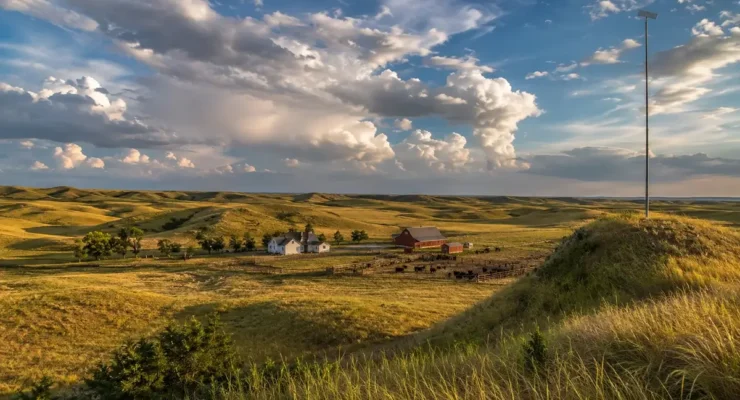
Missouri’s farm economy — a diverse mix of beef cattle, hogs, soybeans, corn, poultry, and specialty crops — increasingly depends on digital connectivity for competitive operation. The state has approximately 95,000 farms averaging about 285 acres each — a mix of large commodity operations and smaller diversified farms that together create a substantial broadband demand base from the agricultural sector.
| Missouri Agricultural Sector | Key Connectivity Applications | Minimum Broadband Needed |
|---|---|---|
| Row crop (corn, soybeans) | Precision planting, drone imagery, USDA reporting | 25 Mbps / 10 Mbps upload |
| Beef cattle ranching | Remote livestock cameras, GPS tracking, market data | 10 Mbps / 5 Mbps upload |
| Hog operations | Barn environmental monitoring, biosecurity cameras, production reporting | 25 Mbps / 10 Mbps upload |
| Poultry contract growing | House monitoring, integrator reporting systems, compliance documentation | 25 Mbps / 10 Mbps upload |
| Agritourism | Online booking, guest Wi-Fi, social media, point of sale | 50 Mbps / 15 Mbps upload |
For Missouri farm operations without access to cooperative fiber or cable, Starlink Business ($250/month) remains the recommended primary broadband solution. The Ozark region’s farm operations — where terrain challenges have historically made DSL service marginal — have been among the most enthusiastic Starlink adopters in Missouri, with farmers reporting transformative improvements in their ability to use precision agriculture software, manage livestock remotely, and access commodity market data in real time.
Practical Tips for Rural Missouri Residents
- Check Co-Mo Connect and other cooperative broadband programs first. Missouri’s most progressive cooperatives have demonstrated that rural cooperative fiber is achievable and excellent. If your cooperative has a broadband program or is planning one, that’s often the best long-term option — contact your cooperative directly.
- Ozark residents: Use the Starlink app sky scanner from your specific property location. The Ozarks’ terrain creates more sky obstruction variability than any other Missouri region. Most ridge and plateau properties have excellent conditions; hollow-bottom properties near major river drainages need assessment before ordering.
- Bootheel residents: Your flat terrain makes Starlink installation as simple as anywhere in the country. Check T-Mobile Home Internet eligibility first — the Bootheel’s agricultural corridor communities sometimes have T-Mobile coverage that’s not reflected in outdated coverage tools. At $50/month, T-Mobile represents significant savings versus Starlink if coverage is adequate.
- File FCC broadband map challenges for inaccurate coverage claims. Missouri has documented telephone company DSL overclaiming in the Ozarks and bootheel. Accurate challenge filings directly improve your county’s BEAD eligibility.
Frequently Asked Questions
What is Co-Mo Connect and is it available in my area?
Co-Mo Connect is the broadband subsidiary of Co-Mo Electric Cooperative, serving rural members in Moniteau and Morgan counties with fiber broadband up to 1 Gbps. It is one of Missouri’s most successful rural cooperative broadband examples. Service is limited to Co-Mo Electric’s membership territory — contact Co-Mo directly at their website to check service availability at your specific address if you’re in Moniteau or Morgan counties.
Does Starlink work well in the Lake of the Ozarks area?
Yes. The Lake of the Ozarks area — centered in Morgan, Camden, Miller, and Benton counties — has Starlink available with generally good performance. The lake region’s mix of ridge properties and water-adjacent sites provides variable sky clearance — properties on the lake’s many peninsulas and ridge-top locations typically have excellent northern sky access. Vacation and second-home properties at the lake have been significant Starlink adopters given the area’s historically inadequate DSL service. White River Valley Electric Cooperative’s fiber program is also expanding toward the lake region from the south, potentially providing a competitive wired alternative within the next several years.
When will rural Missouri get better broadband options?
Missouri’s BEAD implementation is expected to fund construction of rural broadband infrastructure with service beginning in priority communities by 2027–2028. The Ozark region and bootheel communities in the first-priority unserved cohort will receive service earliest; more remote areas and secondary priority communities will follow through 2030–2031. Missouri’s electric cooperative sector is moving faster than the BEAD timeline in many areas — Co-Mo Connect and White River Valley Electric are actively building now. In the interim, Starlink provides broadband-quality connectivity at any Missouri rural property today.
Rural Tourism and Connectivity in Missouri
Missouri’s Ozarks region is one of the Midwest’s premier recreation destinations — float trips on crystal-clear rivers like the Current, the Eleven Point, and the Jacks Fork; fishing, hunting, and hiking in the Mark Twain National Forest; historic communities with distinctive Ozark cultural heritage; and a growing agritourism sector including wineries, orchards, and farm stays. Rural tourism businesses depend on connectivity for online booking platforms, social media marketing, guest Wi-Fi, and business operations in ways that legacy satellite and telephone DSL cannot adequately support.
Starlink has been transformative for Ozark tourism businesses — float trip outfitters, vacation cabin rental operators, bed-and-breakfast establishments, and rural event venues have used Starlink to establish the online presence and booking capability that is essential for competing in the modern tourism market. A rural cabin rental without Wi-Fi or with HughesNet’s slow performance loses bookings to comparable properties with adequate internet — a genuine business consequence that Starlink has addressed for hundreds of Ozark tourism operators.
For rural Missouri tourism businesses, the recommended connectivity configuration mirrors the vacation rental setup covered in our vacation home internet guide — Starlink Business as primary with cellular backup, remote management capability, and appropriate guest network separation. The investment in reliable internet infrastructure pays for itself in improved online reviews, reduced booking inquiries about Wi-Fi quality, and the ability to maintain consistent online presence and booking system operation regardless of staff location.
What is the best internet option for rural Missouri in 2026?
The evaluation order for rural Missouri: (1) check your electric cooperative — Co-Mo Electric, Ozark Electric, and Central Missouri Electric have active fiber programs that may serve your area; (2) check T-Mobile Home Internet eligibility — available at more Missouri addresses than in the Ozarks, particularly in northern and central Missouri’s flatter terrain; (3) Starlink as the universal fallback that works at any rural Missouri property with sky clearance. For Missouri Ozarks properties specifically, Starlink is typically the only viable broadband option available today in most of the region’s rural territory.
Is Starlink worth it in Missouri compared to HughesNet?
Yes, unambiguously. For any rural Missouri household currently on HughesNet or Viasat, switching to Starlink is the most impactful internet upgrade available. The performance difference is transformative: Starlink’s 65–115 Mbps download and 20–60 ms latency versus HughesNet’s 25 Mbps download and 600 ms latency enables video calls that actually feel natural, gaming that works for the first time, telehealth appointments without conversation lag, and work-from-home applications that function professionally. The $120/month Starlink Standard cost versus HughesNet’s $50–$70/month entry pricing is a real cost difference, but the quality-of-life improvement justifies the additional monthly expense for most rural Missouri households with meaningful internet usage.

Leave a Reply