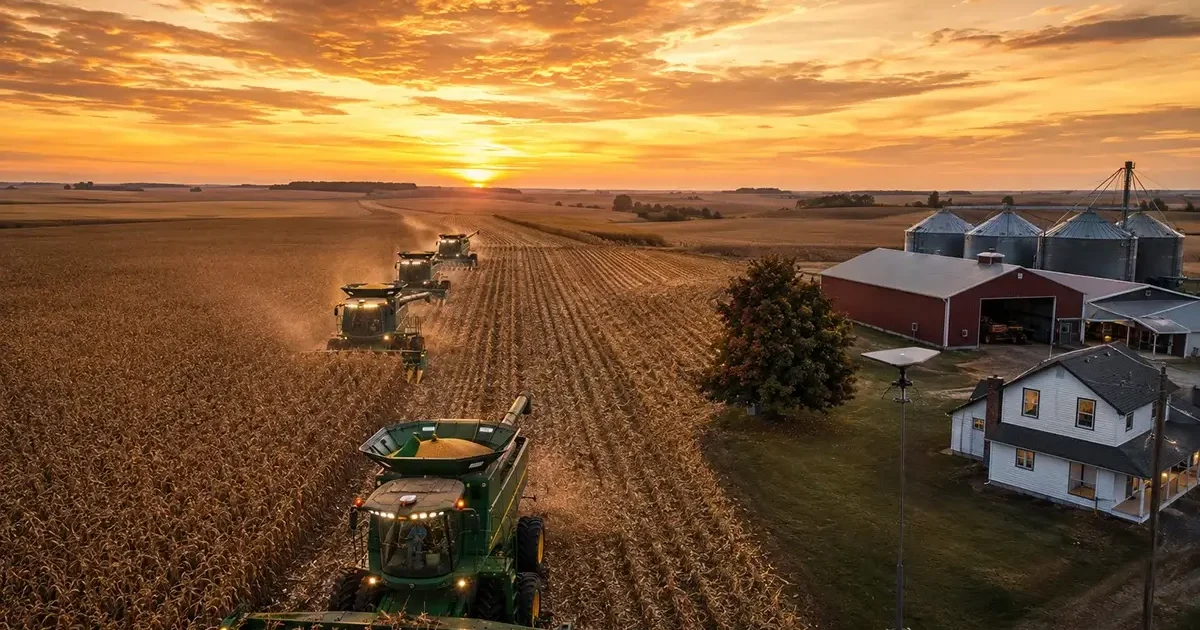
No sector of rural America has been more transformed by Starlink than modern farming. The transition from marginal telephone DSL or geostationary satellite — which made farm office internet barely functional — to Starlink’s broadband-quality connectivity has unlocked an entire ecosystem of precision agriculture technology that was previously impractical or impossible for rural farm operations. This comprehensive guide is written specifically for farmers, farm managers, and agricultural business owners who need to understand exactly how to deploy, configure, and maximize Starlink for farm use in 2026 — including which plan and hardware is right for different farm scales, how to extend coverage across farm buildings, how to integrate Starlink with precision agriculture systems, and what to expect from Starlink in field and remote monitoring applications.
In This Guide
- Why Modern Farms Require Broadband
- Which Starlink Plan for Farms?
- Farm Installation Considerations
- Extending Network Coverage Across Farm Buildings
- Starlink and Precision Agriculture Integration
- Field Connectivity: In-Cab and Mobile Solutions
- Grain Bin and Storage Monitoring
- Livestock Operations and Starlink
- Farm Business Continuity and Backup
- Complete Farm Connectivity Cost Analysis
- Frequently Asked Questions
Why Modern Farms Require Broadband in 2026
The digitization of agriculture has accelerated dramatically in the past five years. What was once a technology-forward niche practice — GPS guidance, variable rate application, yield mapping — is now baseline competitive farming in most US crop production regions. Farms that cannot access the data platforms, cloud services, and connected equipment systems that define modern precision agriculture operate at a measurable productivity and profitability disadvantage compared to connected competitors.
The broadband requirements of modern farm operations span every functional area:
| Farm Application | Bandwidth Needed | Upload Critical? | Latency Sensitive? |
|---|---|---|---|
| John Deere Operations Center data sync | 5–25 Mbps | Yes (field data upload) | No |
| Climate FieldView / Granular farm management | 5–15 Mbps | Yes (imagery upload) | No |
| Drone imagery upload (post-flight) | 25+ Mbps upload | Critical | No |
| RTK GPS correction signals | Under 1 Mbps | No | Moderate |
| Grain bin monitoring (temperature, moisture) | Under 1 Mbps | No | No |
| Livestock monitoring cameras | 3–8 Mbps per camera | No | No |
| Commodity market platforms (DTN, CME) | 3–5 Mbps | No | Moderate |
| Farm business accounting (QuickBooks, AgriEdge) | 3–10 Mbps | Moderate | No |
| Equipment telematics (John Deere, AGCO, CNH) | 1–3 Mbps | Moderate | No |
| Video calls with agronomists, bankers, buyers | 3–5 Mbps each direction | Critical | Critical (under 150ms) |
| USDA portal management (FSA, NRCS, RMA) | 5–10 Mbps | Moderate | No |
| Remote farm security monitoring | 3–8 Mbps per camera | No | No |
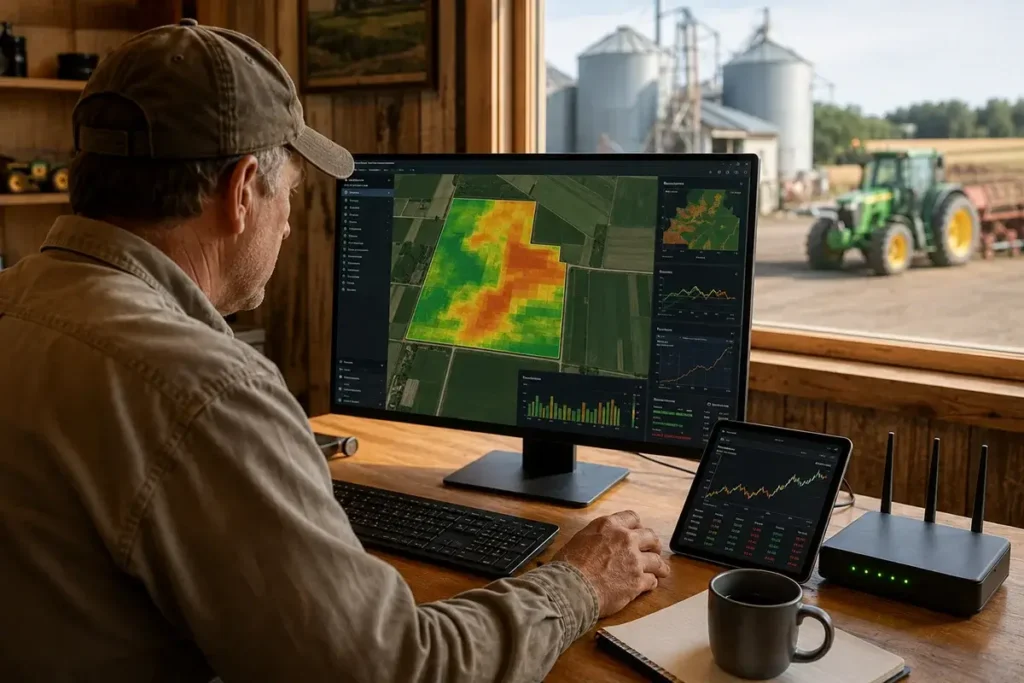
The aggregate bandwidth requirement of a modern farm office running several of these applications simultaneously — drone imagery upload alongside a video call with a crop consultant, while the operations center syncs and a grain bin monitoring dashboard refreshes — easily exceeds 50–100 Mbps during peak farm operations periods. Legacy satellite or telephone DSL connections that cap at 10–25 Mbps with marginal upload simply cannot support this workload. Starlink’s typical rural performance of 65–115 Mbps download and 10–25 Mbps upload (Standard plan) accommodates most farm office workloads, with Starlink Priority’s 15–35 Mbps upload substantially improving the drone imagery upload bottleneck that is the most common Starlink limitation on large drone-using farm operations.
Which Starlink Plan Is Right for Your Farm?
| Farm Scale | Recommended Plan | Monthly Cost | Key Benefit |
|---|---|---|---|
| Small farm / single operator, light tech use | Starlink Standard | $120/mo | Adequate for office and basic monitoring |
| Mid-size operation, drone use, multiple users | Starlink Standard (monitor data) | $120/mo | Monitor 1 TB threshold; upgrade if needed |
| Large operation, multiple employees, heavy data | Starlink Priority | $250/mo | Unlimited priority, 15–35 Mbps upload |
| Multi-site farm, commercial livestock operation | Multiple Starlink dishes | $120–$250/mo each | Dedicated connection per major site |
| Farm business needing SLA and support | Starlink Business | $250/mo | Business terms, priority support |
For most mid-size crop farms (500–5,000 acres) with a primary farm office building, a shop, and several remote structures, the Starlink Priority plan at $250/month provides the most operationally reliable solution. The unlimited priority data eliminates the data management overhead that the Standard plan’s 1 TB threshold creates during high-volume periods — particularly planting and harvest, when operations center data sync, machinery telematics, and security camera uploads are all at their seasonal peak simultaneously.
For very large operations with multiple separate farm sites — operations where the main farm headquarters is five or more miles from major secondary facilities — deploying separate Starlink dishes at each major site provides the most reliable connectivity for each facility rather than attempting to bridge a single connection across long distances. At $250/month per site for Priority service, two-site coverage costs $500/month — still substantially less than the per-month cost of a dedicated T1 line that large farms previously relied on for reliable connectivity.
Farm Installation Considerations
Farm installations differ from residential Starlink setups in several important ways that require specific planning:
Height requirements near grain handling: Farms with grain elevators, tall bin complexes, or high equipment storage buildings near the intended dish location need extra height on the mounting mast to achieve sky clearance above these structures. The Starlink app’s sky scanner must be run from the exact intended dish height — not from ground level — to correctly assess whether clearance above nearby grain bins is achieved.
Dust and agricultural chemical exposure: Farms generate significant dust during planting, harvesting, and tillage operations, and regularly use aerial and ground application of herbicides, fungicides, and fertilizers that can coat outdoor equipment. Mount the Starlink dish away from areas of heavy dust generation (downwind of grain handling) and ensure cable entry points are well-sealed to prevent dust infiltration into the farmhouse or shop. The dish is IP56 rated and handles agricultural environments well, but the cable and connectors at the router end are more vulnerable — use dielectric grease on outdoor connector joints and weatherproof tape on any exposed connections.
Lightning protection on agricultural masts: Farm buildings and structures on flat agricultural land are disproportionate lightning targets. A Starlink dish mounted on a tall galvanized steel mast in an open farm setting is a potential lightning path. Install a proper grounding system — 8-foot ground rod driven adjacent to the mast base, #6 copper grounding wire from the mast to the ground rod, and a surge protector on the router’s power input. Starlink’s router has some built-in surge protection, but a dedicated power surge protector or UPS with surge capability adds meaningful protection for the electronics.
Multiple building cable routing: Farm operations often need network connectivity in the shop, grain office, scale house, and equipment sheds in addition to the main farmhouse. Rather than running the Starlink cable long distances to remote buildings (the maximum supported length is 150 feet), the most practical approach is: install the Starlink dish optimally for sky access, connect it to a central router in the main farmhouse or farm office, and then extend the network to remote buildings via outdoor-rated Cat6 direct burial cable (for distances under 300 feet) or wireless point-to-point bridges (for buildings beyond 300 feet).
Extending Network Coverage Across Farm Buildings
One of the most common farm connectivity challenges is getting reliable internet to multiple buildings spread across a farmstead. A single Starlink dish cannot directly serve buildings 500 feet or 1,500 feet away. The strategies for extending coverage depend on the distances involved:
Direct burial Cat6 Ethernet (distances under 300 feet): Direct burial outdoor-rated Cat6 cable, trenched 12–18 inches underground, provides the most reliable network extension to nearby outbuildings. PoE switches at each building provide both network connectivity and power for Wi-Fi access points, security cameras, and other networked devices at the remote location. At approximately $0.15–0.25 per foot for direct burial Cat6, extending the network 200 feet to a shop or equipment building costs $30–$50 in cable plus labor for trenching. One-time cost, zero ongoing expense, completely reliable once installed.
Wireless point-to-point bridges (distances 300 feet to 3 miles): For farm buildings too far for Ethernet cable runs, wireless point-to-point bridges — pairs of outdoor directional wireless units mounted with line-of-sight between two buildings — carry the network signal between locations wirelessly. Ubiquiti’s airMax series and PowerBeam units are the most popular farm network bridge equipment, delivering 150–450 Mbps wireless backhaul at distances up to 30 km with clear line of sight. Cost per link: $150–$400 for the hardware pair. Installation requires both buildings to have power and clear line of sight — no trees, hills, or buildings blocking the path between the two units.
Separate Starlink dish at remote buildings (distances beyond line-of-sight): For major farm facilities beyond wireless bridge range or with obstructed line of sight, a second Starlink dish dedicated to that facility is the most practical solution. This is particularly relevant for farms with facilities in separate hollows, behind hills, or more than a mile from the main farmstead. At $120–$250/month for an additional dish, this approach provides the highest performance and lowest latency for the remote facility but has the highest ongoing cost.
Starlink and Precision Agriculture Integration
The precision agriculture platforms that modern farms depend on have all been designed to work over broadband internet connections — a connectivity standard that Starlink now meets reliably in rural areas for the first time. Specific integration notes for major platforms:
John Deere Operations Center: The Operations Center syncs field data, machine telemetry, and agronomic records between in-cab displays and the cloud management platform via Starlink at the farmstead. Large farms with dozens of connected machines generating continuous telematics data benefit most from Starlink Priority’s unlimited priority data, as machine telematics data streams continuously during operation seasons and can consume meaningful data volume. Post-season data analysis and report generation through the Operations Center web interface requires consistent 10+ Mbps broadband — well within Starlink’s capability.
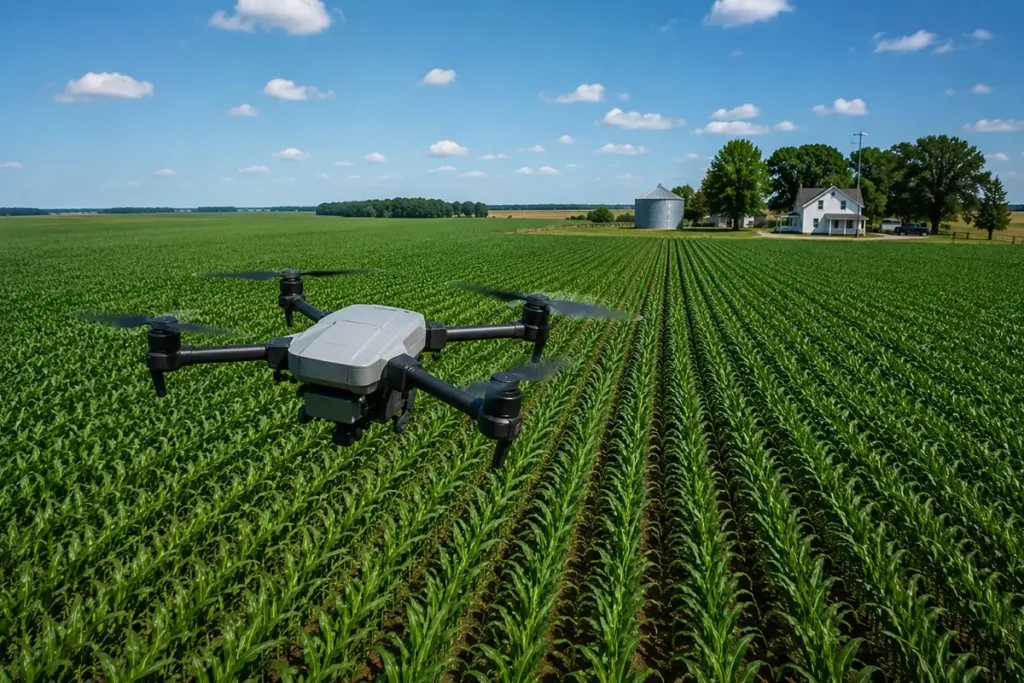
Climate FieldView: FieldView’s field-level imagery and agronomic data platform requires broadband for scouting uploads, field health imagery processing, and report sharing with agronomists. FieldView’s mobile app can cache data for offline use in the field but requires broadband sync when returning to the farmstead. Starlink’s upload speed is the critical factor — FieldView imagery files can be 50–500 MB per flight, and uploading a full season’s worth of drone imagery from a large operation requires sustained upload bandwidth that HughesNet’s 3 Mbps upload could not support but Starlink’s 10–25+ Mbps handles effectively.
RTK GPS correction services (TerraStar, Swift Navigation, CORS networks): Most RTK correction services use minimal bandwidth — under 500 Kbps — but require consistent low-latency delivery for real-time correction signals. Starlink’s 20–60 ms latency supports RTK correction delivery adequately, though dedicated RTK services delivered via cellular modem remain the most reliable in-field solution since Starlink requires the dish at the farmstead rather than in the field with the equipment.
The USDA National Agricultural Statistics Service tracks technology adoption across US farm operations. According to USDA NASS agricultural surveys, broadband adoption among US farms correlates strongly with precision technology adoption rates — farms with adequate broadband use GPS guidance, yield monitors, variable rate technology, and remote monitoring at dramatically higher rates than farms without broadband, translating to measurable input cost reduction and yield improvement advantages.
Grain Bin and Storage Monitoring on Starlink
Grain bin temperature and moisture monitoring is one of the highest-ROI remote monitoring applications for farm Starlink connections. Modern grain bin monitoring systems — from providers including Shivvers, GSI, Sukup, and IntelliFarm — use wireless sensors inside bins to continuously monitor grain temperature and moisture, alerting farm managers when conditions suggest potential spoilage development before it becomes a costly problem.
These monitoring systems connect via the farm’s Starlink network to cloud dashboards accessible from smartphones and computers. The bandwidth requirement is minimal — a complete bin monitoring system with a dozen sensor nodes typically uses less than 1 GB per month for data transmission. The operational value is substantial: a single spoiled bin of corn on a large farm can represent $50,000–$200,000 in crop loss that remote monitoring and early intervention can prevent.
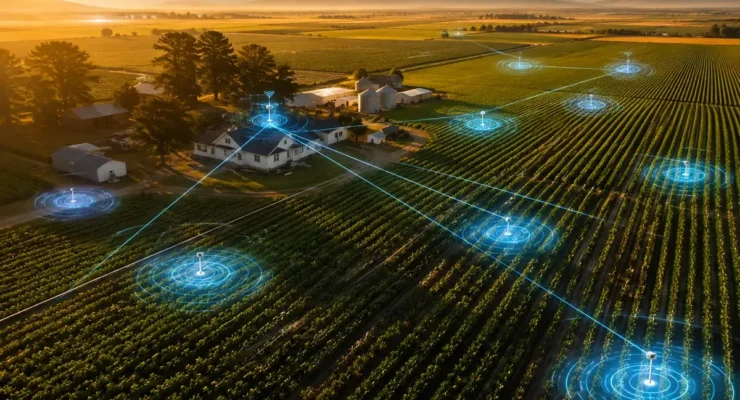
Setup requires a Wi-Fi-connected base station inside or adjacent to the bin complex, within Wi-Fi range of the farm’s Starlink-connected network. For bin complexes more than 300 feet from the main farm building, either extend the Starlink network to the bin complex via direct burial Ethernet or wireless bridge, or use a cellular-connected monitoring system that operates independently of the farm’s Starlink network using a dedicated M2M SIM card.
Farm Business Continuity and Internet Backup
For farm operations where internet connectivity directly affects operational capability — grain marketing decisions requiring real-time commodity price access, precision application systems that require connectivity for prescription maps, and livestock monitoring systems where connectivity gaps create blind spots — a backup internet connection provides the operational continuity that a single-connection setup cannot guarantee.
The recommended farm backup configuration: Starlink Priority as primary (best performance, unlimited data), plus a Verizon business cellular data plan as backup. A Peplink Balance 20X router ($500) supports both connections simultaneously with automatic failover — if Starlink drops for any reason (weather event, power fluctuation, equipment issue), all farm network traffic automatically routes through the Verizon cellular backup within seconds. The combined monthly cost ($250 Starlink + $40–$60 cellular backup) is justified for operations where connectivity downtime has real economic consequences.
Complete Farm Connectivity Cost Analysis
| Farm Type | Recommended Setup | Hardware (one-time) | Monthly Cost | Annual Cost |
|---|---|---|---|---|
| Small family farm, single building | Starlink Standard + router | $349 | $120 | $1,440 |
| Mid-size farm, 2–3 buildings | Starlink Priority + bridge to outbuilding | $600 | $250 | $3,000 |
| Large crop operation, drone use | Starlink Priority + cellular backup | $900 | $300 | $3,600 |
| Multi-site large operation | 2× Starlink Priority + dual-WAN router | $1,200 | $500 | $6,000 |
| Commercial livestock operation | Starlink Business + monitoring network | $1,500 | $350 | $4,200 |
Comparing these costs against the precision agriculture ROI is instructive. A mid-size crop farm that adopts broadband-enabled precision agriculture tools — variable rate application, drone scouting, yield monitoring with real-time analytics — typically achieves input cost savings of $10–$30 per acre according to agricultural extension research. On a 2,000-acre operation, that’s $20,000–$60,000 in annual input savings. The $3,000/year Starlink Priority cost represents less than one month’s worth of the precision agriculture savings it enables — one of the highest ROI technology investments available to modern farm operations.
Frequently Asked Questions
Can I use Starlink in the field while operating farm equipment?
No — the standard Starlink residential and business dishes are designed for stationary use and will not operate while mounted on moving farm equipment. For in-field connectivity (RTK correction signals, in-cab telematics, precision agriculture display updates), cellular data from the major carriers via the equipment’s built-in cellular modem or an in-cab hotspot device remains the most practical solution. Starlink provides the farmstead broadband backbone; cellular provides the mobile field connectivity that complements it.
How does Starlink handle the high data usage during planting and harvest?
Planting and harvest seasons are the highest internet demand periods on farm operations — operations center sync peaks, drone imagery uploads are at maximum frequency, and additional employees using the network simultaneously. Standard plan users should monitor their monthly data usage closely during these periods and consider temporarily upgrading to Priority plan for the duration of peak season if they consistently approach the 1 TB threshold. Priority plan’s unlimited data eliminates this management overhead entirely, making it the recommended plan for operations with heavy seasonal data demand.
Is Starlink reliable enough for time-sensitive commodity trading and marketing?
Yes, for the vast majority of commodity marketing activities. Starlink’s connection is stable and fast enough for commodity trading platforms, DTN market data services, and grain elevator portal access. For operations that execute high-frequency trades where sub-second execution matters (rare in physical commodity trading, more relevant in futures trading), Starlink’s 25–50 ms latency versus fiber’s 2–5 ms creates a theoretical disadvantage — but for typical grain marketing decisions made on a minutes-to-hours timescale, Starlink’s latency is completely adequate and the connectivity it provides is transformational compared to the no-broadband alternative most rural farms faced previously.
Can my farm’s Starlink connection support multiple simultaneous video calls?
Yes. Starlink’s bandwidth supports multiple simultaneous HD video calls. Each HD video call (Zoom, Teams, Google Meet) requires approximately 3–5 Mbps each direction. With 20–35 Mbps upload on Starlink Priority, a farm office can support 4–6 simultaneous outgoing HD video streams — adequate for most farm business scenarios. Network QoS configuration on your router to prioritize video call traffic over background data sync operations ensures call quality remains consistent even when other farm network activities are occurring simultaneously.

Leave a Reply