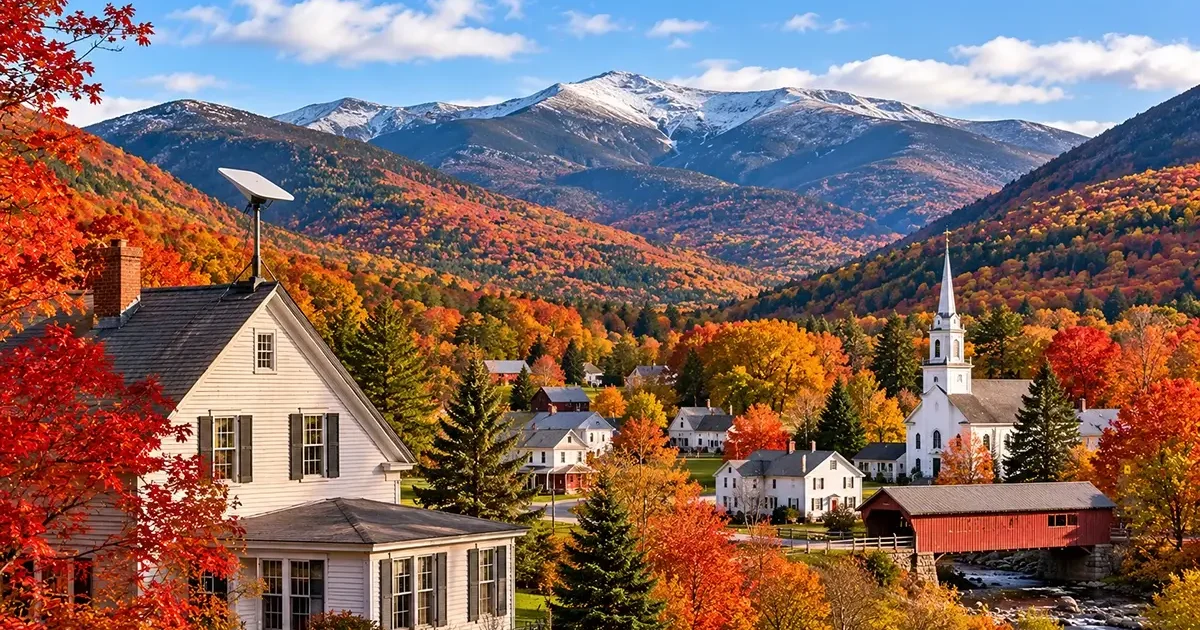
New Hampshire’s rural broadband challenge reflects the state’s distinctive character — a small, independent-minded state that ranks among the most rural in New England while maintaining one of the region’s strongest economies. The Granite State’s 9,349 square miles encompass the White Mountains’ rugged alpine terrain, the Lakes Region’s seasonal recreational communities, the Connecticut River valley’s agricultural and manufacturing corridor, and the remote North Country communities approaching the Canadian border. New Hampshire has been an active investor in rural broadband through multiple state programs, and its telephone cooperatives have been among New England’s most progressive in fiber deployment. In 2026, the state’s rural broadband situation is one of meaningful progress with persistent gaps in the most remote communities. This complete guide covers rural internet options across New Hampshire’s distinct regions.
In This Guide
- New Hampshire Rural Broadband Overview
- Best Internet by New Hampshire Region
- Starlink in New Hampshire
- New Hampshire Telephone Cooperatives
- New Hampshire State Broadband Programs
- White Mountains: Connectivity in Alpine Terrain
- North Country: New Hampshire’s Remote Communities
- Lakes Region Connectivity
- Practical Tips for Rural NH Residents
- Frequently Asked Questions
New Hampshire Rural Broadband Overview
New Hampshire has approximately 800,000 rural residents in communities ranging from the exurban communities of Rockingham and Hillsborough counties within commuting range of Boston to the remote North Country communities of Coos County near the Canadian border. The state’s geography — compact but extremely varied, from seacoast to alpine summits — creates a connectivity challenge where terrain rather than pure distance is the dominant factor in infrastructure economics.
According to the FCC National Broadband Map, New Hampshire has significant concentrations of unserved rural addresses in Coos County (the state’s northernmost and least populated county), the White Mountains communities of Carroll and Grafton counties, and rural agricultural towns throughout the western Connecticut River valley. New Hampshire’s overall broadband situation is better than the most rural states — the Boston metro’s infrastructure influence reaches further north than in any other New England state — but meaningful rural gaps remain in the state’s most remote communities.
New Hampshire’s telephone cooperatives have been among the most progressive in New England for broadband deployment. Several have completed full fiber transitions that make their service territories among the best-connected rural areas in the region.
Best Internet by New Hampshire Region
Southern New Hampshire (Hillsborough, Rockingham, Merrimack Counties)
Southern New Hampshire has the state’s best rural connectivity, driven by proximity to Manchester, Nashua, and the Boston metro’s northern suburbs. Communities along I-93, I-89, and Route 101 corridors have cable and some fiber coverage. T-Mobile Home Internet availability is better in southern New Hampshire’s more densely populated communities than in the remote north. Rural communities in southern New Hampshire are typically within adequate range of multiple commercial broadband options.

Monadnock Region / Southwest New Hampshire (Cheshire, Sullivan Counties)
Southwest New Hampshire’s Monadnock region — the scenic area around Mount Monadnock and the Connecticut River valley border with Vermont — has moderate connectivity. Communities along Route 9, Route 12, and the Connecticut River corridor have telephone company DSL and some cable coverage. Rural hill towns throughout Cheshire and Sullivan counties depend on telephone cooperative DSL and Starlink. The rolling terrain creates variable Starlink conditions — hilltop and ridge properties typically have excellent sky access.
Lakes Region (Belknap, Carroll Counties)
New Hampshire’s Lakes Region — Winnipesaukee, Sunapee, and surrounding lakes — has connectivity driven by the significant tourism and second-home economy. Lake community main areas have cable and some fiber coverage; rural properties away from the main lake communities and road corridors depend on Starlink and WISP coverage. The Lakes Region’s large seasonal cabin population creates demand for Starlink Roam with pausing capability similar to Minnesota’s lake country.
White Mountains and North Country (Grafton, Carroll, Coos Counties)
The White Mountains and Coos County’s remote communities have the state’s most limited broadband options. The White Mountains’ dramatic terrain — including New Hampshire’s iconic Presidential Range with several 6,000-foot summits — creates sky obstruction challenges in the narrow valley communities between the ranges. The North Country’s communities along the Connecticut River from Lancaster to Pittsburg have very limited telephone company DSL. See the dedicated sections below.
New Hampshire Telephone Cooperatives and Companies
New Hampshire has several rural telephone companies that have been progressive in broadband deployment:
- NH Electric Cooperative (NHEC): New Hampshire’s electric cooperative has been exploring broadband programs for its member communities and is among the more active New England electric cooperatives in this space.
- TDS Telecom / Granite State Telephone: Serving several rural New Hampshire communities with DSL and expanding fiber programs.
- Consolidated Communications: Serving portions of New Hampshire with fiber broadband expansion.
- MetroCast / Sertex: Serving specific New Hampshire communities with cable and expanding fiber programs.
New Hampshire State Broadband Programs
New Hampshire’s broadband programs are coordinated through the New Hampshire Office of Strategic Initiatives (OSI)‘s broadband team. New Hampshire received approximately $202 million in BEAD Program federal funding — a meaningful allocation for the state’s rural territory. New Hampshire’s BEAD implementation focuses on Coos County, the White Mountains communities, and rural western New Hampshire towns with the highest concentrations of unserved addresses.
New Hampshire has also operated the NH Broadband Mapping and Planning program and has participated in multiple USDA ReConnect grant rounds, with several New Hampshire ISPs receiving ReConnect funding for rural fiber deployment. For current program information and project maps, contact the New Hampshire Office of Strategic Initiatives broadband team.
White Mountains: Connectivity in Alpine Terrain
The White Mountains communities — Lincoln, Conway, Jackson, Gorham, and the surrounding resort and hiking communities — have investment-driven broadband in the resort core areas, with significant gaps in the surrounding rural communities and smaller towns. The Presidential Range’s narrow valleys create some of the most challenging Starlink sky obstruction conditions in the northeastern United States — narrow east-west valleys with 5,000+ foot mountain walls on both sides can completely block the northern sky that Starlink requires.
For White Mountains properties, the Starlink sky obstruction scanner is absolutely essential before ordering — this is as critical as in Colorado’s mountain communities or Utah’s canyon country. Properties on the flanks of the mountains with south-facing orientation typically have adequate sky access; properties in the narrow valley bottoms between mountain ranges (such as the Pemigewasset River valley north of Lincoln, or the Androscoggin Valley near Gorham) may find the northern sky blocked by adjacent mountain walls from any ground-level position.
North Country: New Hampshire’s Remote Communities
Coos County — New Hampshire’s northernmost county and the state’s largest by area — has some of the state’s most remote and least-connected communities. The town of Pittsburg, at the Canadian border, covers 291 square miles and has a year-round population of approximately 900 people. The Connecticut Lakes communities near the border, accessible by a single road through Canadian Pacific railroad-owned timber land (with a toll gate), have essentially no fixed broadband infrastructure.
For North Country residents, Starlink is the primary broadband solution. The open agricultural and forest landscape of the Connecticut River upper valley provides generally good Starlink sky access, though dense forest properties need sky scanner assessment. Performance in Coos County’s extremely low-density coverage cells is consistently excellent — commonly 100–130 Mbps in the most remote areas where very few users share the satellite capacity.
New Hampshire Lakes Region Connectivity
The Lakes Region’s large seasonal cabin and second-home economy creates specific connectivity demand patterns. Year-round Lakes Region residents need consistent broadband for the full calendar year; seasonal cabin owners need connectivity primarily during the May–October season. Starlink Roam with service pausing during the November–April off-season is the most cost-effective approach for seasonal New Hampshire cabin use.
The Lakes Region’s open water views — particularly from lake-facing properties on Winnipesaukee, Squam, Sunapee, and the many smaller New Hampshire lakes — provide excellent southern sky access for Starlink installation. These properties’ Starlink sky conditions are among the best in the state, with the lake view providing unrestricted access to the southern satellite paths that matter most for northern latitude installations.
Practical Tips for Rural New Hampshire Residents
- White Mountains valley residents: The sky obstruction scanner is non-negotiable before ordering Starlink. Some narrow mountain valley properties cannot achieve adequate sky clearance from any ground-level position — research this thoroughly before making a connectivity decision for any property in the Presidential Range or Franconia Notch corridor.
- North Country residents: Starlink delivers excellent performance in Coos County’s very low-density coverage cells. Order without hesitation for any open terrain property. Dense boreal forest properties in the far north need sky scanner assessment.
- Lakes Region seasonal cabin owners: Starlink Roam with seasonal pausing is the most cost-effective approach. The open lake-facing sky access makes installation conditions excellent for most lakefront properties.
Frequently Asked Questions
What is the best internet for the White Mountains region of New Hampshire?
For White Mountains resort communities (Lincoln, Conway), commercial cable and some fiber is available. For rural communities in the mountain valleys — Jackson, Jefferson, Franconia, Sugar Hill — Starlink is typically the best available option, with sky obstruction assessment essential before ordering for any property in a narrow mountain valley. Contact your telephone company for current DSL or fiber availability at your specific address before ordering satellite.
Is Starlink available in northern Coos County near the Canadian border?
Yes. Starlink is available throughout New Hampshire including in the northernmost Coos County communities near the Canadian border. The service works up to and including the Canadian border and is available at any address with sky access on the US side. Performance in the very remote northern Coos communities is frequently among the state’s best — the low coverage cell density delivers consistently fast speeds for the few users in this sparsely populated territory.
New Hampshire Agriculture and Rural Economy
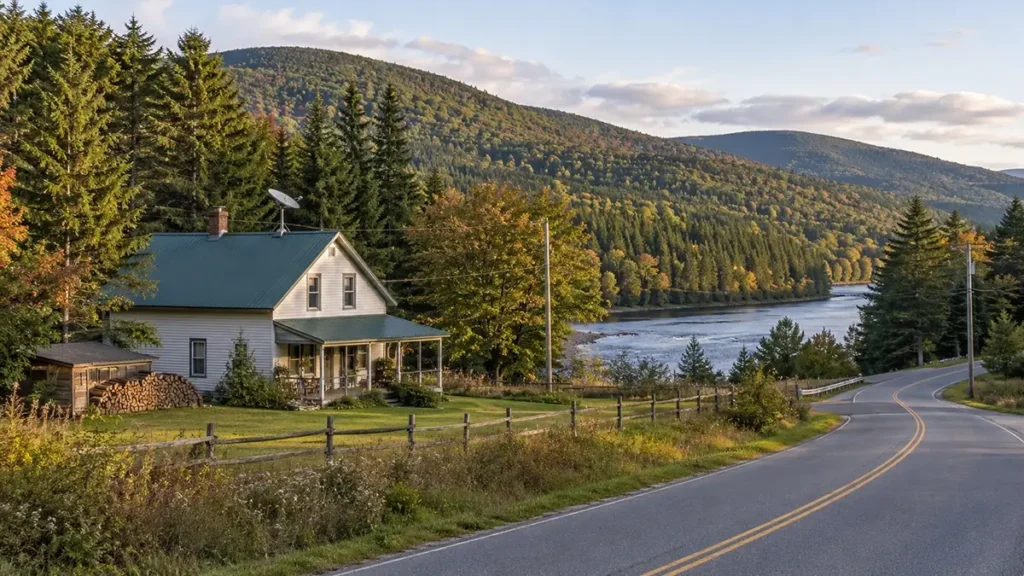
New Hampshire’s agricultural economy — smaller in scale than neighboring Vermont’s but equally important to the state’s rural character — includes dairy farming, apple orchards, maple syrup production, vegetables, and increasingly specialty crops that serve the Boston and Manchester metro areas’ premium food markets. New Hampshire’s farm-to-table economy requires broadband for direct marketing to consumers through CSA programs, farmers market online ordering systems, and the social media presence that modern specialty food producers use to build customer relationships across the region.
For New Hampshire agricultural operations, broadband enables the market access and operational management that small-scale specialty farming requires to be economically competitive. A Monadnock region apple orchard that operates a pick-your-own business and direct online sales program needs reliable connectivity for the customer communication and payment processing that these direct marketing approaches require. Starlink Standard ($120/month) provides the broadband these agricultural operations need where telephone company DSL has been inadequate and cooperative fiber hasn’t yet reached.
New Hampshire’s Second-Home Economy and Connectivity
New Hampshire’s significant second-home population — particularly in the Lakes Region, the White Mountains, and the Seacoast — creates a large seasonal broadband demand that differs from year-round residential demand in important ways. Second-home owners who use their properties for 2–6 months annually benefit most from Starlink Roam’s pausable service, which allows monthly costs to be concentrated in the active-use months rather than paid year-round. For properties used during the summer Lake Winnipesaukee season (May–September), Starlink Roam used for 5 months at $150/month costs $750/year versus $1,440/year for year-round Standard service — a meaningful savings for occasional-use seasonal properties.
New Hampshire’s ski chalet and White Mountains cabin community has similar seasonal dynamics — winter season (December–March) and foliage season (September–October) are the primary use periods, with spring and early summer seeing minimal use. Tailoring Starlink service to the actual use season through the Roam plan’s pause capability is the most cost-effective approach for the substantial New Hampshire seasonal cabin owner population.
Does T-Mobile Home Internet work in rural New Hampshire?
T-Mobile Home Internet availability in rural New Hampshire varies significantly by location. Southern New Hampshire communities along I-93, I-89, and Route 3 have better T-Mobile coverage than the more remote North Country and White Mountains communities. The Monadnock region and Lakes Region have moderate T-Mobile availability. For remote Coos County communities, T-Mobile Home Internet is often unavailable — Starlink is the primary option. Check T-Mobile’s eligibility checker at your specific address before ordering. In communities where both T-Mobile and Starlink are available, T-Mobile’s $50/month rate represents a meaningful $70/month savings over Starlink — check eligibility first before defaulting to the higher-cost satellite option.



Leave a Reply