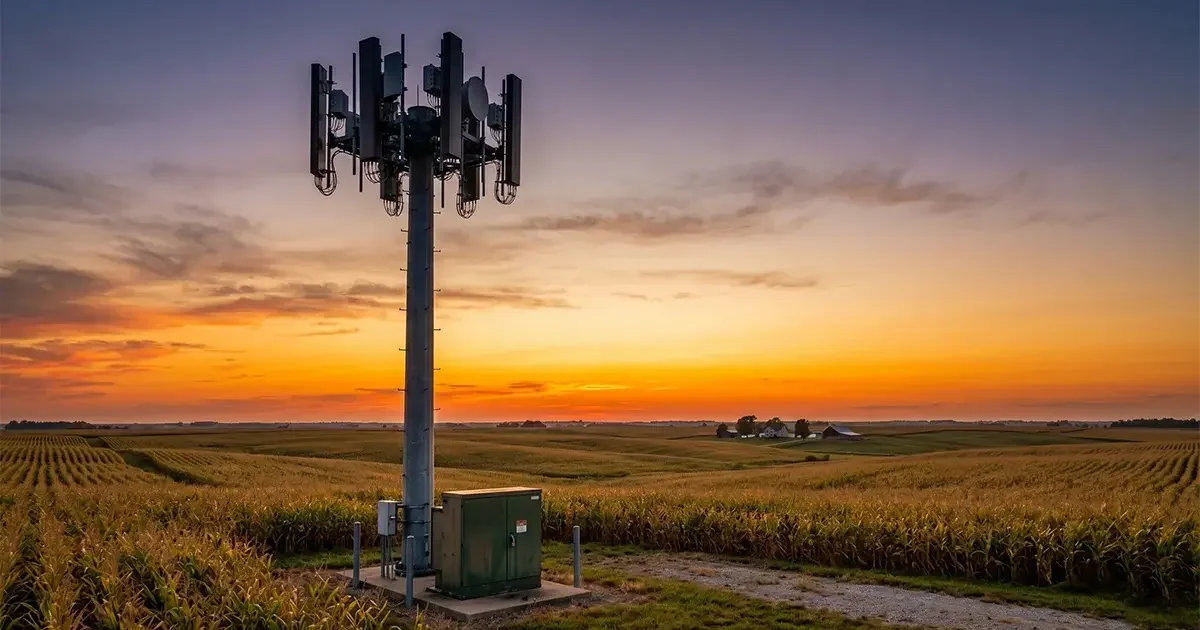
If you live in a rural area, you may have heard neighbors talking about “fixed wireless” internet — or seen a small antenna mounted on nearby rooftops pointing at a tower in the distance. Fixed wireless internet is one of the most underrated options in rural connectivity, and in areas where it’s available, it frequently offers the best combination of speed, latency, price, and reliability of any rural broadband option. This comprehensive guide explains how fixed wireless internet works, what performance you can realistically expect, how to find providers in your area, and how it compares to satellite and cellular alternatives.
In This Guide
- What Is Fixed Wireless Internet?
- How Fixed Wireless Works: Technical Explained
- Performance: Speeds, Latency, and Reliability
- Fixed Wireless vs Satellite Internet
- Fixed Wireless vs Cellular Home Internet
- How to Find Fixed Wireless Providers in Your Area
- What to Expect from Installation
- New Technology Driving Rural Fixed Wireless in 2026
- Limitations to Know Before You Sign Up
- FAQs
What Is Fixed Wireless Internet?
Fixed wireless internet delivers broadband to homes and businesses via radio signals transmitted between a tower and a receiver installed on the customer’s property. Unlike mobile cellular internet (where your device connects while moving), fixed wireless receivers are permanently installed at one location — hence “fixed.” Unlike satellite internet, the entire signal path stays within the Earth’s atmosphere, with no round trip to a satellite thousands of miles away.
The providers who deploy fixed wireless for rural use are called Wireless Internet Service Providers — WISPs — and they range from small single-county operations to multi-state regional ISPs. Rural electric cooperatives have also become significant players in fixed wireless rural broadband, leveraging their existing infrastructure and member relationships to deploy internet service to communities that commercial providers have passed over.
Fixed wireless is not to be confused with cellular home internet (T-Mobile Home Internet, Verizon Home Internet), which uses carrier cellular towers intended for mobile phone service. Fixed wireless uses dedicated broadband infrastructure built specifically for high-capacity stationary connections, typically using licensed or unlicensed spectrum that is not shared with mobile phone traffic.
How Fixed Wireless Works: Technical Overview
A fixed wireless network consists of three components:
1. The Tower/Access Point: A fixed wireless ISP installs antenna equipment on a tower, hilltop, water tower, grain elevator, or other elevated structure. This equipment — called a Base Station or Access Point — transmits the internet signal outward in multiple directions (sector antennas covering 60–120 degree arcs) or in a specific direction (highly directional backhaul equipment). The base station is connected to the broader internet via fiber or a high-capacity wireless backhaul link.
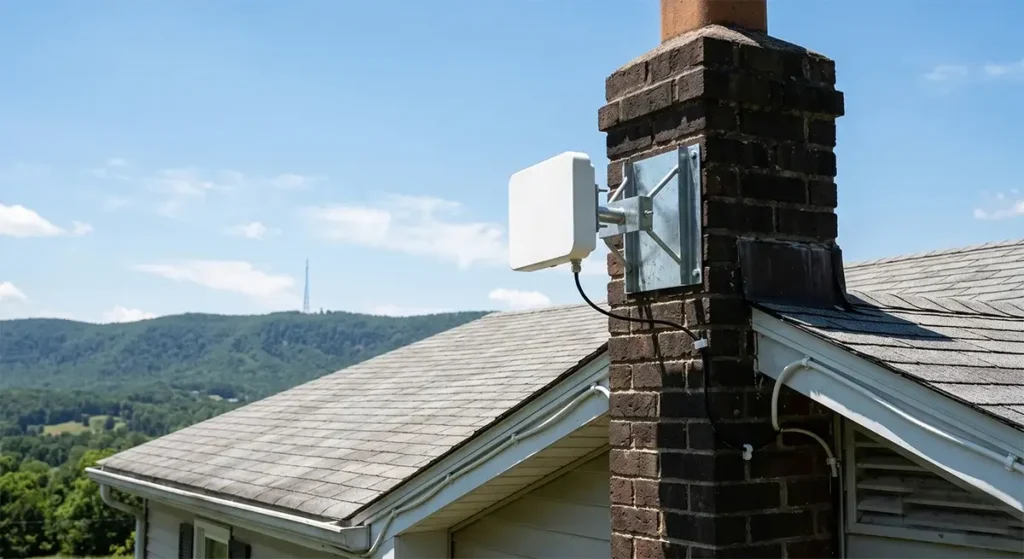
2. The Customer Premise Equipment (CPE): A small receiving antenna is installed on your home or business’s roof, wall, or chimney by a WISP technician. This outdoor unit must have line-of-sight (or near-line-of-sight) to the tower. A cable runs from the outdoor unit to an indoor router/modem that distributes the internet to your home network.
3. The Connection Path: Radio signals travel from the base station to your CPE in the licensed microwave or millimeter-wave frequencies the WISP uses. Popular frequency bands for rural fixed wireless include 3.65 GHz (CBRS), 5.8 GHz (unlicensed), 6 GHz, 11 GHz, and the newly available mid-band spectrum being utilized by next-generation deployments.
The critical requirement for fixed wireless is line-of-sight between the tower and the customer’s receiving antenna. Dense vegetation, buildings, terrain features (hills, ridges), or other obstructions in the direct path between your property and the WISP’s tower will degrade or block the signal. Modern fixed wireless equipment has improved significantly in its ability to handle partial obstructions (called “near-line-of-sight” NLOS capability), but strong performance still generally requires a relatively clear signal path.
Fixed Wireless Performance: What to Expect
| Technology Generation | Download Speed | Upload Speed | Latency | Distance Range |
|---|---|---|---|---|
| Legacy fixed wireless (802.11n era) | 5–25 Mbps | 2–10 Mbps | 15–40 ms | 3–10 miles |
| Modern 802.11ac/ax WISP | 25–250 Mbps | 10–50 Mbps | 10–30 ms | 5–25 miles |
| CBRS (Citizens Broadband Radio Service) | 50–500 Mbps | 20–100 Mbps | 8–25 ms | 5–15 miles |
| Fixed 5G (Verizon, T-Mobile LTE Advanced) | 25–400 Mbps | 10–100 Mbps | 10–40 ms | 2–15 miles |
| mmWave Fixed Wireless (urban edge) | 100 Mbps–1 Gbps | 50–500 Mbps | 3–10 ms | 0.5–2 miles |
The most important distinction between fixed wireless and satellite internet is latency. Fixed wireless latency of 10–40 ms is comparable to cable internet and dramatically better than geostationary satellite’s 600–800 ms. This makes fixed wireless fully capable for video calls, VoIP, gaming, remote desktop, and all real-time internet applications — the applications that make satellite service feel inadequate.
According to FCC Measuring Broadband America data, fixed wireless providers serving rural areas deliver median speeds that meet or exceed the FCC’s 25/3 Mbps broadband standard in the vast majority of measured locations, with a significant portion meeting the newer 100/20 Mbps standard as WISP technology continues to modernize.
Fixed Wireless vs Satellite Internet
| Factor | Fixed Wireless (WISP) | Starlink | HughesNet/Viasat |
|---|---|---|---|
| Monthly Cost | $40–$100 | $120–$250 | $65–$200 |
| Download Speed | 25–500 Mbps | 25–220 Mbps | 15–150 Mbps |
| Latency | 10–40 ms | 20–60 ms | 600–800 ms |
| Data Caps | Often unlimited | 1 TB priority | 15–200 GB |
| Weather Impact | Low (some rain fade) | Low (brief precipitation events) | Moderate rain fade |
| Coverage | Limited — tower-dependent | Universal | Universal |
| Line of Sight Required | Yes (or near-LOS) | No (clear sky required) | No (southern sky) |
| Contract | Varies (often month-to-month) | None | 24 months |
Fixed wireless beats every satellite option on both price and latency when it’s available. The challenge is availability: fixed wireless requires you to be within range of a tower with line-of-sight clearance, while satellite is available anywhere with a clear sky. For the millions of rural Americans within range of a quality WISP, fixed wireless is the superior choice. For those outside WISP range, Starlink fills the gap.
How to Find Fixed Wireless Providers in Your Area
Finding WISPs is harder than it should be, because small fixed wireless providers rarely have large marketing budgets or national search engine visibility. Here are the most effective methods for finding WISP coverage at your address:
- FCC National Broadband Map: Visit broadbandmap.fcc.gov and enter your address. Under “Available Providers,” filter by “Fixed Wireless” to see all ISPs that have self-reported fixed wireless coverage at your location. Note that the map overestimates coverage significantly in some areas — use it as a starting point and verify directly with providers.
- Ask neighbors and local businesses: The most reliable information about what WISP coverage actually works in your area comes from other rural residents who have tried it. Post in local Facebook groups, ask at the county extension office, or inquire at your local hardware store. Rural connectivity is a community-level problem, and community members typically have the most accurate local knowledge.
- Search “[county name] wireless internet provider”: Many WISPs have minimal web presence and don’t show up in national ISP comparison databases. A county-level Google search often surfaces local providers that national databases miss entirely.
- Contact your electric cooperative: Rural electric cooperatives are increasingly deploying broadband alongside their electric service. Even if your cooperative’s website doesn’t mention broadband, call and ask — many co-ops have broadband programs in planning or early deployment that aren’t prominently advertised yet.
- WISPA member directory: The Wireless Internet Service Providers Association (WISPA) maintains a searchable database of member providers. Not all WISPs are WISPA members, but it’s a useful starting search point for finding legitimate rural providers.
What to Expect from Fixed Wireless Installation
Fixed wireless installation is performed by a WISP technician and typically takes 2–4 hours. Here’s what the process involves:
- Pre-installation survey: The WISP will either do an in-person site survey or ask you to provide photos of your property and line-of-sight toward their nearest tower. This determines whether your property can receive service and which antenna type and mounting location will work best.
- Outdoor antenna mounting: The technician installs a small receiving antenna (CPE) on your roof, chimney, or an exterior wall — wherever the best sight line to the tower exists. The antenna is typically a compact unit (6–12 inches diameter) and much less visually obtrusive than a satellite dish.
- Cable run: A weatherproof Ethernet or coaxial cable runs from the outdoor antenna into your home, typically through a drilled entry point sealed with waterproof compound.
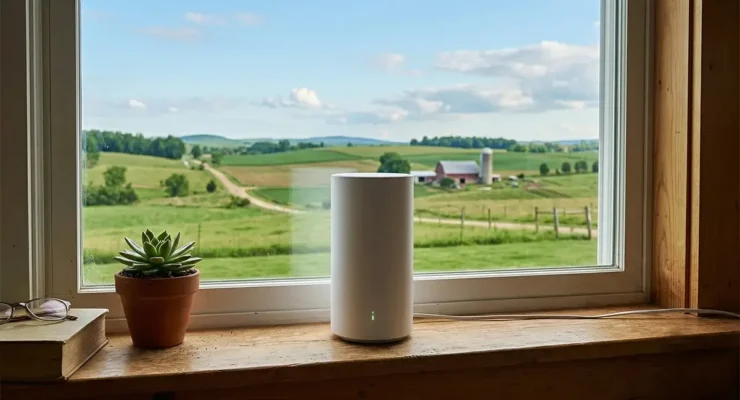
- Indoor modem/router: The technician connects the cable to a modem or router provided by the WISP, configures your Wi-Fi network, and tests performance to confirm the connection meets the plan’s specifications.
- Performance verification: A professional WISP installation should end with a speed test confirming that your connection is performing within the expected range for your plan tier and distance from the tower.
New Technology Driving Rural Fixed Wireless in 2026
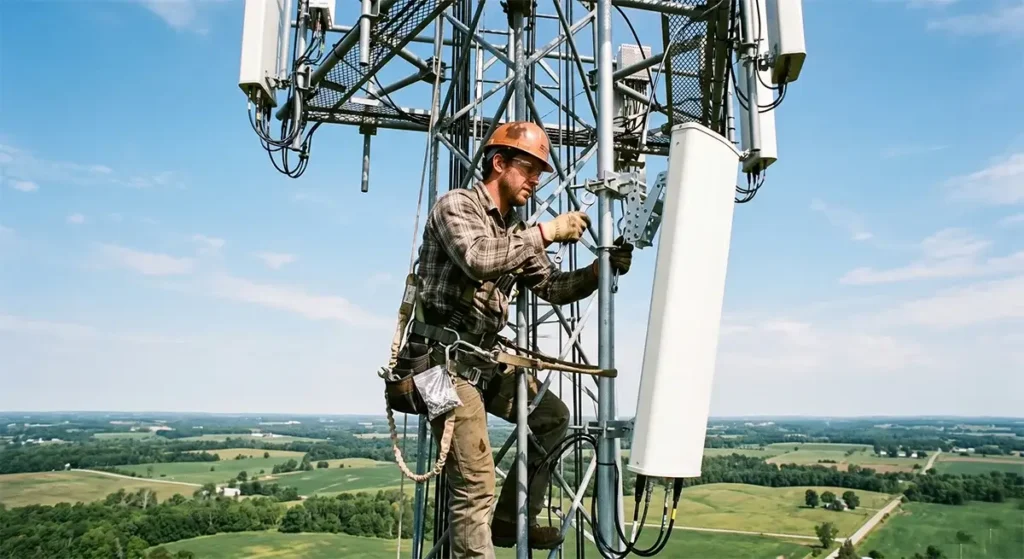
Fixed wireless technology is advancing rapidly, and 2026 rural WISPs are dramatically more capable than the early rural wireless ISPs of the 2010s. Key technology developments driving performance improvements:
CBRS (Citizens Broadband Radio Service): The 3.5 GHz CBRS band, made available by the FCC in 2020, has become a game-changer for rural WISPs. CBRS provides licensed spectrum access that avoids interference from other users, enabling WISPs to deploy more reliable, higher-capacity networks. Many CBRS-based fixed wireless deployments deliver 100–500 Mbps to rural customers at costs competitive with cable.
Massive MIMO and Beamforming: Modern fixed wireless equipment (from Cambium, Ericsson, Nokia, and others) uses massive MIMO (multiple input, multiple output) antenna arrays with beamforming to dramatically increase spectral efficiency. These technologies allow a single tower to serve more customers simultaneously at higher speeds than earlier equipment.
BEAD-funded expansion: The NTIA’s $42.45 billion BEAD Program is funding thousands of fixed wireless deployments in rural areas that previously had no coverage. WISPs that receive BEAD grants are building new towers and deploying modern equipment in areas they couldn’t economically serve before. Rural fixed wireless coverage is expanding meaningfully in 2025–2028 across the country as BEAD deployments come online.
Fixed Wireless Limitations to Know
- Line-of-sight is required. No amount of signal processing overcomes a ridge, hillside, or dense forest blocking the direct path between your property and the tower. Before committing to fixed wireless service, have the provider verify actual signal quality at your location — not just map-based coverage estimates.
- Distance from tower matters. Performance decreases with distance. Customers on the edge of a WISP’s coverage area (10–25 miles from tower) will experience meaningfully lower speeds than customers 3–5 miles from the tower. Ask the provider for the expected performance at your specific distance.
- Capacity limitations on older networks: Some rural WISPs are small operations with limited backhaul capacity. A WISP serving 200 rural customers through a single 1 Gbps backhaul fiber connection may deliver excellent speeds in the morning but struggle during peak evening hours when all customers are online. Ask prospective providers about their backhaul capacity and current subscriber base size.
- WISP quality varies enormously: Unlike major national ISPs with standardized service delivery, WISP quality varies enormously by operator. Some are highly professional operations with SLA commitments, 24/7 support, and modern equipment. Others are small operations where the owner personally handles all support calls and maintenance. Ask local neighbors for their experience with any WISP before signing up.
Frequently Asked Questions
How do I know if I have line of sight to a fixed wireless tower?
The most reliable way is to ask the WISP to perform a site survey. Alternatively, use a LiDAR-based line-of-sight tool (several free web-based tools exist using USGS elevation data — search “radio line of sight calculator”) to check whether there are terrain obstacles between your property coordinates and the tower’s known location. Trees are harder to assess without a physical site survey.
Can fixed wireless handle working from home?
Yes — fixed wireless is one of the best rural internet technologies for remote work. Its low latency (10–40 ms) makes video calls, VPN, and real-time cloud applications work smoothly, and its higher upload speeds (relative to satellite) are ideal for sending files, screen sharing, and video conference camera use. Most modern fixed wireless plans also come without data caps, eliminating the throttling concern that affects HughesNet users.
What is the difference between fixed wireless and cellular home internet?
Fixed wireless uses dedicated broadband infrastructure built by WISPs specifically for stationary connections, typically using spectrum not shared with mobile phones. Cellular home internet (T-Mobile, Verizon) uses the same towers and spectrum that power mobile phones. Both technologies deliver internet via radio signals, but dedicated fixed wireless systems are typically engineered for higher per-customer capacity and more consistent performance at rural distances than shared mobile networks.



Leave a Reply