
When most rural Americans think about home internet options, Verizon often doesn’t come to mind — yet Verizon Home Internet has been quietly expanding its rural footprint using the company’s extensive 4G LTE and 5G network. At $25–$60 per month for existing Verizon wireless customers, with no data caps and no annual contract, Verizon Home Internet offers pricing that competes directly with T-Mobile’s rural offering. But the critical question for rural users is the same as it is for T-Mobile: is it actually available at your specific rural address, and what does real-world performance look like in areas far from urban centers? This comprehensive Verizon Home Internet review covers everything rural residents need to evaluate whether Verizon is a viable option for their property in 2026.
In This Guide
- What Is Verizon Home Internet?
- Pricing and Plans
- The Verizon Gateway Device
- Real-World Rural Performance
- Rural Availability: The Core Question
- Verizon vs T-Mobile Home Internet for Rural
- Verizon vs Starlink
- Pros and Cons
- Who Should Try Verizon Home Internet?
- Frequently Asked Questions
What Is Verizon Home Internet?
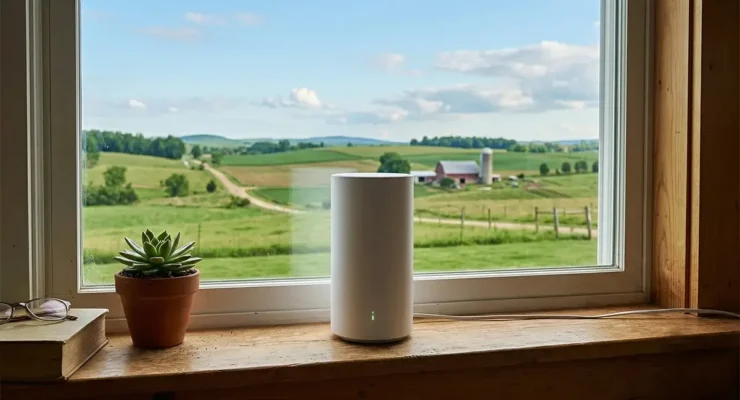
Verizon Home Internet (branded as “Verizon 5G Home Internet” or “Verizon LTE Home Internet” depending on the technology available at your address) is a fixed wireless access (FWA) home broadband service delivered through Verizon’s cellular network infrastructure. Like T-Mobile Home Internet, it uses a plug-in gateway device rather than an outdoor dish or professional installation — you receive a gateway device in the mail, plug it into a power outlet, and connect to it via Wi-Fi or Ethernet.
Verizon offers two distinct technology tiers under the Home Internet umbrella, and understanding which one serves your rural address is essential to setting realistic performance expectations:
5G Home Internet: Available in areas covered by Verizon’s mmWave or mid-band 5G Ultra Wideband (UW) network. Delivers the fastest home internet speeds — potentially 300–1,000 Mbps — but is almost entirely limited to dense urban and suburban areas. Rural residents will almost never have access to this tier.
LTE Home Internet: Available in areas with Verizon’s 4G LTE network coverage but without 5G UW. This is the relevant tier for most rural Verizon Home Internet customers. Uses the same LTE network that powers Verizon cell phones in rural areas. Delivers 25–50 Mbps download speeds in typical rural conditions — adequate for most household uses, though well below Starlink’s performance ceiling.
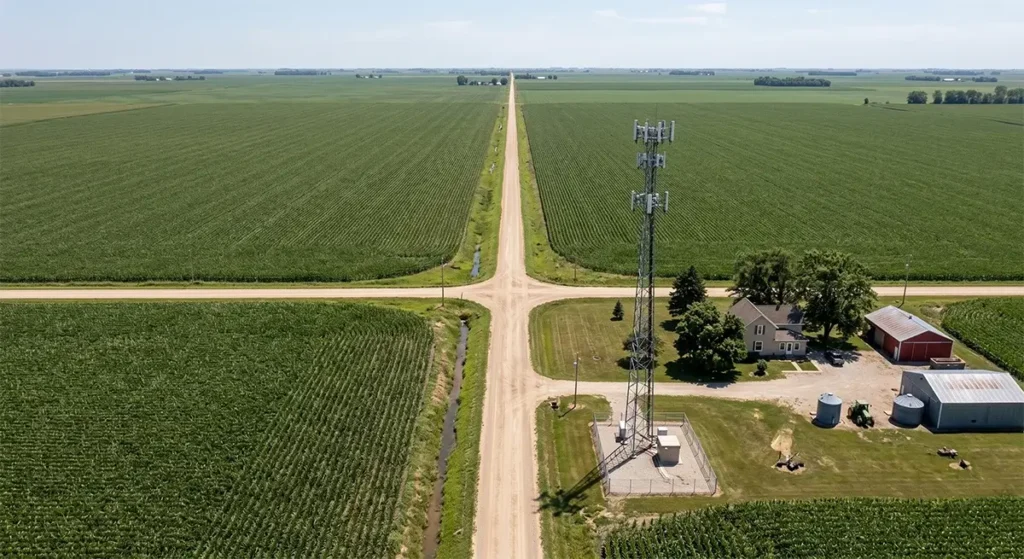
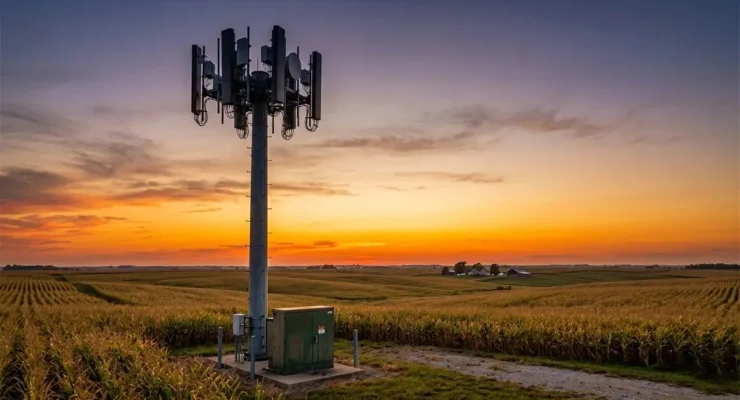
Verizon’s rural Home Internet expansion strategy deliberately targets areas where Verizon’s LTE network already has strong coverage — giving the carrier a unique advantage in rural markets where its network has historically outperformed T-Mobile and AT&T in terms of rural penetration depth. Verizon has invested more aggressively in rural tower coverage than any other major US carrier over the past decade, and that investment pays dividends for rural Home Internet eligibility.
Pricing and Plans
Verizon Home Internet pricing has a notable feature that distinguishes it from T-Mobile: the price is substantially lower for existing Verizon wireless customers, creating a significant bundling incentive for rural households already on the Verizon mobile network — which describes many rural Americans who chose Verizon specifically because it has the best rural cellular coverage.
| Plan | Price with Verizon Mobile | Price Standalone | Data | Contract |
|---|---|---|---|---|
| Verizon LTE Home Internet | $25/mo (with qualifying wireless plan) | $60/mo | Unlimited (network management applies) | None |
| Verizon 5G Home Internet | $35/mo (with qualifying wireless plan) | $70/mo | Unlimited (network management applies) | None |
For rural households that are already Verizon wireless customers — which includes a substantial portion of rural America given Verizon’s rural network strength — the bundled $25/month LTE Home Internet represents the lowest price for any home broadband service from a major carrier. At this price point, even if performance is moderate, the value equation is compelling as a primary connection or backup to Starlink.
Both plans include no data overage charges, no annual contract, and no equipment rental fees — Verizon loans the gateway device but does not charge a monthly rental fee for it. This is a more favorable equipment structure than HughesNet or Viasat, which charge $13–$15/month equipment lease fees.
The Verizon Gateway Device
Verizon currently deploys the Verizon 4G LTE Broadband Router with Voice (LVW2) or the newer Verizon Home Router (CR1000A) depending on market and technology tier. Both are plug-in units roughly the size of a large smart speaker — cylindrical or rectangular, designed to sit on a counter or shelf, with internal antennas.
Neither unit has an external antenna port on the standard consumer version, which is a significant limitation for rural deployments where signal optimization through directional antennas would meaningfully improve performance. This is the primary hardware disadvantage compared to some cellular gateway options (like the Netgear Nighthawk M6 Pro or Cradlepoint devices) that do offer external antenna connectivity for users wanting to optimize their cellular signal.
Wi-Fi performance from the included gateway is adequate for a 1,500–2,500 sq ft home. For larger rural properties, connecting the gateway’s Ethernet port (via a Verizon-provided Ethernet adapter) to a third-party mesh Wi-Fi system is strongly recommended. The gateway functions as a pure modem in this configuration, with your mesh system handling all Wi-Fi distribution.
Placement optimization is the most important hardware consideration for rural Verizon Home Internet. Place the gateway near a window facing the direction of the nearest Verizon LTE tower. Use the Verizon Home app or the gateway’s admin interface signal strength indicator to test signal quality in different room locations before settling on a permanent position. Even moving the gateway from an interior room to a window-adjacent location can improve download speeds by 30–50% in rural edge-of-coverage scenarios.
Real-World Rural Performance
Verizon LTE Home Internet performance in rural areas is heavily dependent on three factors: proximity to the nearest LTE tower, which frequency bands are available at that tower, and how many other users (both mobile and home internet) are sharing the tower’s capacity during any given period.
| Signal Condition | Typical Download | Typical Upload | Latency | Notes |
|---|---|---|---|---|
| Strong LTE (close to tower, good line of sight) | 40–80 Mbps | 10–25 Mbps | 30–60 ms | Excellent rural performance |
| Moderate LTE (5–15 miles from tower) | 15–40 Mbps | 5–15 Mbps | 40–80 ms | Adequate for most uses |
| Weak LTE (edge of coverage area) | 5–15 Mbps | 2–8 Mbps | 60–120 ms | Functional but constrained |
| Peak-hour congestion (any signal) | 30–70% reduction from off-peak | Similar reduction | Increase of 20–40 ms | Verizon applies network management |
According to Speedtest.net’s fixed broadband intelligence data, Verizon Home Internet users report median download speeds of approximately 55–85 Mbps nationally — but this aggregate includes a large proportion of 5G UW urban customers who significantly raise the median. Rural LTE Home Internet users typically report 15–45 Mbps median download speeds, which is functionally adequate for most household applications but below Starlink’s 65–115 Mbps rural median.
The latency advantage over satellite services is significant and real. Verizon LTE Home Internet’s 30–80 ms latency enables all the real-time applications that geostationary satellite cannot support — video calls, VoIP, gaming, and remote desktop all work normally. Rural users who switch from HughesNet to Verizon Home Internet frequently report this latency improvement as the most impactful aspect of the switch, even when the raw download speed improvement is modest.
Rural Availability: The Core Question
Verizon Home Internet availability in rural areas is specifically tied to Verizon’s LTE network coverage at your address. This is a stricter test than Verizon’s public coverage maps, which show broad LTE coverage across most of rural America. The Home Internet service requires a minimum signal quality threshold at your specific address — not just any detectable signal, but enough signal to sustain a stable home internet connection.
In practice, this means Home Internet is available in more rural locations than T-Mobile Home Internet (because Verizon’s rural LTE network is generally stronger than T-Mobile’s in deeply rural areas) but in fewer locations than Starlink (which has no coverage requirement beyond a clear sky view). The FCC’s coverage maps provide a useful secondary data point alongside Verizon’s own availability checker for evaluating rural coverage at specific addresses.
The definitive check: visit Verizon’s Home Internet page and enter your service address. Verizon runs a real-time network qualification check that accounts for signal quality, tower capacity, and service availability at your specific location. If it offers you service, it has determined your address has adequate signal to support the service.
Verizon vs T-Mobile Home Internet for Rural Users
| Factor | Verizon LTE Home Internet | T-Mobile Home Internet |
|---|---|---|
| Price (bundled) | $25/mo | $50/mo (no bundle discount) |
| Price (standalone) | $60/mo | $50/mo |
| Rural Network Strength | Stronger in most rural areas | Improving but still weaker deeply rural |
| Typical Rural Speed | 15–50 Mbps | 20–100 Mbps (where 5G available) |
| Latency | 30–80 ms | 30–60 ms |
| Data Caps | None (network management applies) | None (network management applies) |
| Equipment | Provided free (no rental fee) | Provided free (no rental fee) |
| External Antenna Port | No (standard gateway) | No (standard gateway) |
For rural households that are existing Verizon wireless customers, the bundled $25/month LTE Home Internet is the most compelling value in rural broadband. At $25/month, even 15–25 Mbps performance delivers exceptional value — $100/month less than Starlink for a connection that handles video calls, streaming, and basic remote work adequately.
For rural households not on Verizon wireless, the $60/month standalone price is less compelling versus T-Mobile’s flat $50/month. In those cases, T-Mobile is typically the better starting point to evaluate, particularly if T-Mobile has 5G Extended Range or 5G Ultra Capacity coverage at your address.

Pros and Cons of Verizon Home Internet for Rural Users
Pros
- Exceptional value at $25/month for existing Verizon wireless customers
- No data caps, no annual contract, no equipment rental fees
- Plug-in installation — no outdoor equipment, no technician needed
- Low latency (30–80 ms) enables video calls, VoIP, and gaming
- Verizon’s rural LTE network reaches more rural areas than T-Mobile
- Network management less aggressive than HughesNet’s hard throttle
Cons
- Rural LTE speeds (15–50 Mbps) lower than Starlink in most scenarios
- No external antenna port on standard gateway limits optimization
- $60/month standalone price reduces value versus T-Mobile at $50/month
- Peak-hour congestion can significantly reduce speeds on rural towers
- Availability still limited in the most remote rural areas
- Upload speeds (5–15 Mbps) lower than Starlink on comparable plans
Frequently Asked Questions
Is Verizon Home Internet available in my rural area?
Check Verizon’s Home Internet availability page and enter your address for an instant qualification check. Verizon’s LTE network is the most extensive rural cellular network in the US, so availability in rural areas is broader than T-Mobile Home Internet in many cases. If Verizon LTE Home Internet is available at your address, it’s worth trialing — especially at the $25/month bundled rate.
Can I use Verizon Home Internet for working from home?
Yes, for most remote work uses. Video calls (Zoom, Teams), cloud applications, VPN access, and document collaboration all work adequately on Verizon LTE Home Internet’s 15–50 Mbps speeds and 30–80 ms latency. Heavy upload tasks (frequent large file uploads, constant 4K camera video calls) may strain the upload speed ceiling on weak-signal installations.
What happens if I cancel Verizon wireless service?
If you cancel the qualifying Verizon wireless plan that triggers the $25/month Home Internet bundle pricing, your Home Internet price typically reverts to $60/month. Review the current bundle terms carefully when signing up — pricing structures can change, and the bundling requirements may differ by plan tier.


Leave a Reply