
Rural seniors face a unique and consequential version of the digital divide. Older Americans living in rural areas are simultaneously more likely to lack access to reliable broadband and more likely to depend on the internet for healthcare access (telemedicine), social connection with family, and essential services that have migrated online. A rural senior who cannot reliably video call a grandchild in another state, attend a telehealth appointment with a specialist, or access their Medicare portal online experiences isolation and healthcare access barriers that are both preventable and unnecessary with the right connectivity solution. This comprehensive guide covers every rural internet option relevant to older adults in 2026 — with specific attention to simplicity, reliability, cost, and the applications that matter most to rural seniors.
In This Guide
- Why Rural Internet Matters Especially for Seniors
- What Rural Seniors Actually Need from Their Internet
- Best Internet Options for Rural Seniors in 2026
- Telehealth and Rural Senior Internet
- Staying Connected with Family
- Ease of Use Comparison
- Assistance Programs to Reduce Cost
- Getting Help with Setup and Technical Issues
- Protecting Rural Seniors from Online Scams
- Frequently Asked Questions
Why Rural Internet Matters Especially for Seniors
The stakes of rural connectivity are particularly high for older Americans. According to research published by the Pew Research Center, older adults in rural areas consistently report lower rates of home broadband adoption and higher rates of internet non-use than any other demographic-geographic combination. The reasons are interconnected: lower average incomes, less prior internet experience, fewer retail locations to purchase equipment, and a history of adequate internet service simply not being available.
But the consequences of being disconnected have grown more severe as essential services have moved online. Medicare benefits are managed online. Social Security administration increasingly relies on digital portals. Prescription drug price comparison tools that can save seniors hundreds of dollars monthly require internet access. Emergency management systems — including weather alerts and rural emergency notifications — increasingly use digital channels. And telehealth, which exploded during the pandemic and has remained a permanent feature of rural healthcare delivery, requires broadband connectivity for video appointments with specialists who may be hundreds of miles away.
Social isolation, which is a documented health risk for older adults — associated with increased rates of cognitive decline, depression, and physical health deterioration — is meaningfully mitigated by internet connectivity that enables regular video calls with family and participation in online communities. For a rural senior living alone 20 miles from the nearest town, reliable internet is not a luxury amenity. It is a health infrastructure.
What Rural Seniors Actually Need from Their Internet
Understanding the specific internet requirements of most rural seniors helps identify which technical specifications actually matter — and which marketing claims are irrelevant to the typical senior use case:
| Use Case | Download Needed | Upload Needed | Latency Requirement | Priority Level |
|---|---|---|---|---|
| FaceTime / video calls with family | 3–5 Mbps | 3–5 Mbps | Under 150 ms — critical | Highest |
| Telehealth video appointments | 3–5 Mbps | 3–5 Mbps | Under 150 ms — critical | Highest |
| Streaming TV (Netflix, Hulu, Paramount+) | 5–25 Mbps | Minimal | Low — not sensitive | High |
| Email and web browsing | 1–5 Mbps | 1–3 Mbps | Low | Medium |
| Medicare / Social Security portals | 2–5 Mbps | 1–3 Mbps | Low | High |
| Online banking and bill pay | 1–3 Mbps | 1 Mbps | Low | High |
| Prescription management apps | 1–3 Mbps | 1 Mbps | Low | Medium |
| Remote health monitoring devices | 1–2 Mbps | 1–2 Mbps | Low | Medium |
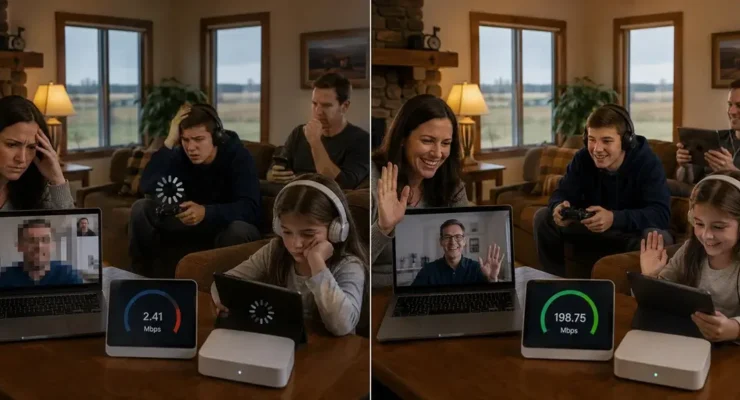
The most critical technical requirement for rural seniors is low latency for video calls. Video calls with family and telehealth appointments are the two highest-value internet applications for most rural seniors — and both require latency under 150 ms to work properly. This is the reason that HughesNet and Viasat (600–800 ms latency) are poor fits for the senior use case despite their lower price points and simple professional installation. A rural senior whose Zoom call with a grandchild is constantly delayed and choppy will quickly give up on video calling altogether — exactly the outcome that worsens social isolation.
Best Internet Options for Rural Seniors in 2026
1. Starlink — Best Overall Performance, Moderate Complexity
Starlink provides the speed, latency, and reliability that enables all the applications rural seniors need — video calls, telehealth, streaming TV, and online services. At $120/month, it is the most expensive option, but the performance gap over legacy satellite is significant for the video call use cases that matter most. The main challenge for older adults: Starlink requires DIY installation or help from a family member or handyman. Once installed, day-to-day use is simple — it just provides internet like any other service.
2. T-Mobile or Verizon Home Internet — Simplest Setup, Lower Cost
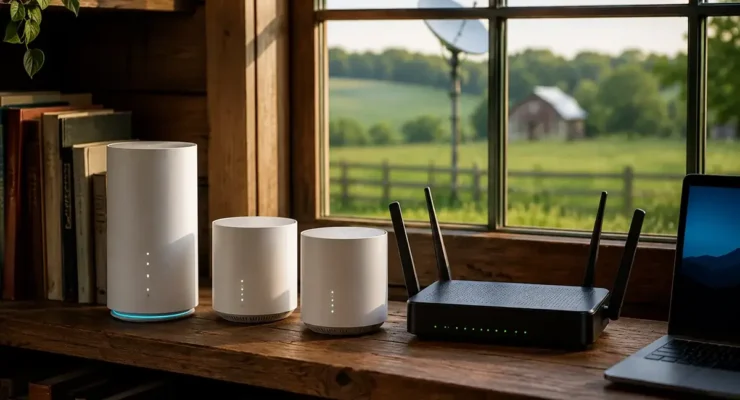
At $25–$50/month with plug-in setup requiring no outdoor installation, cellular home internet is the most accessible option for rural seniors — particularly for older adults who live alone without technical family support nearby. The plug-in gateway arrives in the mail, is placed near a window by the senior themselves, and requires no more technical capability than plugging in a lamp. If it performs adequately at the rural address (25+ Mbps, low latency), it is the easiest and most cost-effective path to meeting rural senior connectivity needs. Check Verizon first (particularly if already a Verizon wireless customer for the $25/month rate), then T-Mobile.
3. Local Fixed Wireless WISP — Best Value When Available
If a local WISP serves the area, it often provides the best balance of cost ($40–$80/month), performance (25–100 Mbps, low latency), and local support (real local humans who can be reached by phone and will often make house calls for installation issues). For rural seniors who need the reassurance of local technical support, a local WISP with responsive customer service may be more valuable than the technically superior Starlink with its entirely app-based support model.
4. HughesNet or Viasat — Last Resort for Seniors
If no other option exists, legacy satellite provides basic internet. However, the high latency fundamentally prevents the video calling that is the most important connectivity application for rural senior quality of life. A rural senior on HughesNet who cannot comfortably video call family is experiencing a preventable social isolation problem. If Starlink installation is at all possible (with family or community help), the investment is justified by the quality-of-life improvement.

Telehealth and Rural Senior Internet
Telehealth has become a cornerstone of rural senior healthcare delivery. For older adults in rural areas who may live hours from the nearest specialist, telehealth video appointments eliminate travel barriers that previously made specialty care practically inaccessible. A rural senior with a cardiologist 200 miles away can now attend a follow-up appointment via video without requiring a full day of travel — provided their internet connection supports it.
The minimum internet requirements for Medicare-covered telehealth video visits vary by platform but generally require 3–5 Mbps download and upload with under 150 ms latency. Major telehealth platforms used in rural Medicare settings include Teladoc, MDLive, and health system-specific portals.
For rural seniors on HughesNet or Viasat (600–800 ms latency), telehealth video appointments are technically possible but practically degraded — the call lag creates an unnatural conversation rhythm that is particularly difficult for older adults with hearing loss or cognitive changes who already find rapid conversation challenging. Switching to Starlink or a low-latency cellular option transforms the telehealth experience from frustrating to functional.
The Health Resources and Services Administration (HRSA) administers several programs specifically focused on telehealth access in rural communities, including grant programs to rural healthcare providers for telehealth infrastructure and patient connectivity support. Rural seniors experiencing difficulty with telehealth connectivity should ask their healthcare provider whether these programs apply to their situation.
Assistance Programs to Reduce Rural Senior Internet Costs
Several programs specifically or disproportionately benefit rural seniors seeking affordable internet:
FCC Lifeline Program: Provides a $9.25/month discount on internet (or phone) service for qualifying households at or below 135% of the federal poverty line, or receiving Medicaid, SSI, or certain other federal benefits. Many rural senior households qualify. Apply through your internet service provider or at fcc.gov/lifeline-consumers. The discount applies to Starlink and other satellite providers as well as cellular carriers.
Low Income Home Energy Assistance Program (LIHEAP): While primarily an energy assistance program, some states have expanded LIHEAP to include internet costs for qualifying low-income households. Check with your state’s human services department for current program scope.
State Senior Connectivity Programs: Several states have established connectivity programs specifically targeting rural senior populations using American Rescue Plan funds. Programs vary significantly by state — check with your state’s Area Agency on Aging for current offerings.
Internet Service Provider Senior Discounts: Some ISPs offer senior-specific discounted plans. T-Mobile does not currently have a specific senior Home Internet discount, but the $25/month bundled rate for existing Verizon wireless customers is accessible to seniors already on Verizon mobile plans.

Ease of Use Comparison for Rural Seniors
| Provider | Installation Complexity | Day-to-Day Use | Technical Support Access | Senior Friendliness |
|---|---|---|---|---|
| T-Mobile / Verizon Home Internet | Very Easy — plug in device | Simple — just works | Phone/chat support | ★★★★★ |
| Local WISP | Easy — technician installs | Simple — just works | Local phone support, often house calls | ★★★★★ |
| Starlink | Moderate — DIY or family help | Simple — app-based monitoring | App/ticket support only — no phone | ★★★☆☆ (with family help) |
| HughesNet | Easy — professional installer | Simple — frustrating performance | Phone support | ★★★☆☆ (performance issues) |
| Viasat | Easy — professional installer | Simple — frustrating performance | Phone support | ★★★☆☆ (performance issues) |
The support model is particularly important for rural seniors. Starlink’s support is entirely app and ticket-based — there is no phone number to call for help. For older adults who are less comfortable with app-based interfaces, this support model can be frustrating when issues arise. Local WISPs, by contrast, typically have a local phone number and staff who can visit in person — a support model that works better for seniors who benefit from direct human assistance.
Frequently Asked Questions
Can I use Starlink to FaceTime my grandchildren?
Yes. Starlink’s 20–60 ms latency makes FaceTime, Zoom, and video calls with family work as naturally as if you were on cable internet. The conversation feels real-time without the half-second delay that plagued HughesNet and Viasat users. For rural seniors, this is one of Starlink’s most meaningful benefits — regular, comfortable video calls with family significantly reduce the social isolation that rural elderly populations disproportionately experience.
Is there a simple internet option for rural seniors who aren’t tech-savvy?
T-Mobile or Verizon Home Internet is the simplest option where available — the gateway device is literally plug-in, and once connected there is nothing to manage day to day. If cellular home internet isn’t available at your rural address, Starlink with installation help from a family member or local handyman provides excellent performance with simple day-to-day operation. After installation, Starlink just works like any internet service.
Does Medicare cover telehealth for rural seniors?
Medicare covers telehealth services for rural beneficiaries under several conditions established during and after the COVID-19 pandemic. Coverage for rural telehealth has been significantly expanded and is expected to continue, though specific covered services and originating site requirements should be verified with Medicare directly. The internet connection required for telehealth is not covered by Medicare, but Lifeline program discounts can reduce the cost of maintaining a qualifying broadband connection for low-income rural seniors.


Leave a Reply