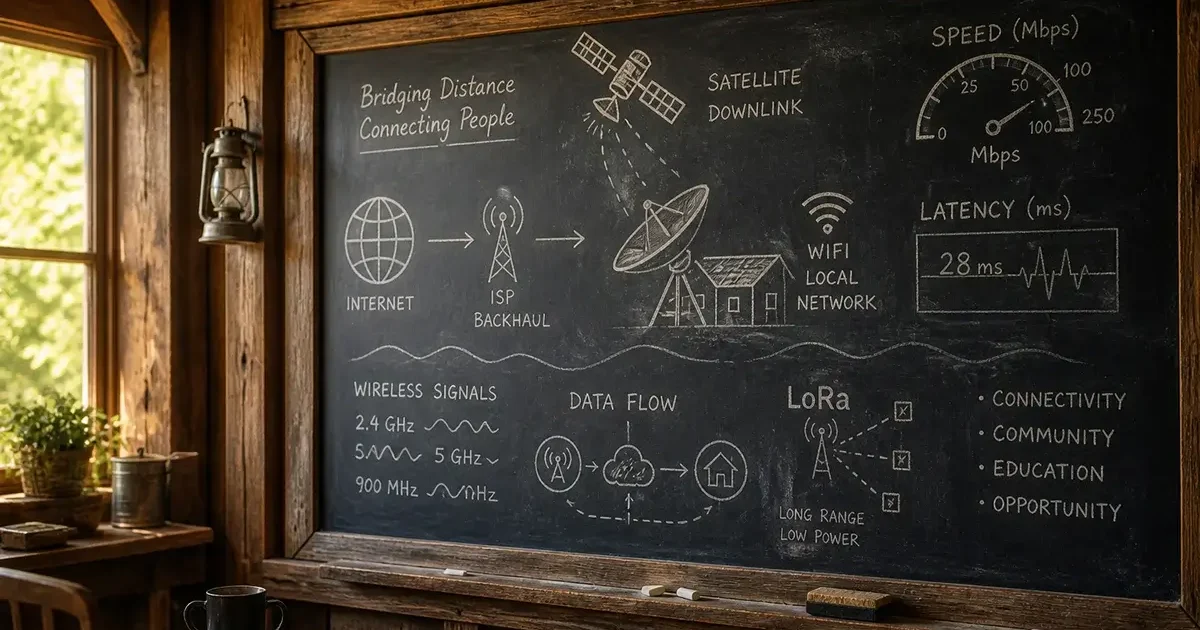
Rural internet discussions are full of technical terms, acronyms, and jargon that can make it difficult for everyday rural residents to understand what their ISP is telling them, evaluate competing options, or effectively advocate for better service. This comprehensive rural internet glossary explains every term you’re likely to encounter — from the basics of bandwidth and latency to the regulatory acronyms of BEAD and RDOF, the technical specifications of satellite constellation systems, and the networking concepts that affect your daily internet experience. No engineering background required.
In This Guide
- Speed and Performance Terms
- Technology and Infrastructure Terms
- Satellite Internet Specific Terms
- Cellular and 5G Terms
- Networking and Home Setup Terms
- Regulatory and Government Program Terms
- Provider and Plan Terms
- Signal Quality Terms
Speed and Performance Terms
Bandwidth: The maximum capacity of your internet connection — how much data can flow through it simultaneously. Often used interchangeably with “speed” but technically distinct. A wider pipe (more bandwidth) allows more data to flow, but doesn’t necessarily mean individual tasks complete faster.
Mbps (Megabits per second): The standard unit for measuring internet speed. Note: 1 Megabyte = 8 Megabits. A 100 Mbps connection can download approximately 12.5 Megabytes per second — so a 1,000 MB (1 GB) file takes about 80 seconds to download.
Gbps (Gigabits per second): 1,000 Mbps. Used to describe fiber internet connections. A 1 Gbps (gigabit) fiber connection can theoretically download 125 Megabytes per second.
Download speed: How quickly data transfers from the internet to your device. Determines how fast web pages load, how smoothly video streams, and how quickly files download. Most ISP marketing focuses on download speed.
Upload speed: How quickly data transfers from your device to the internet. Determines video call quality (your outgoing camera), cloud backup speed, and file sharing performance. Rural internet services typically have much slower upload than download (asymmetric connections).
Latency (Ping): The round-trip time for data to travel from your device to a server and back, measured in milliseconds (ms). Critical for real-time applications. Low latency = responsive, natural-feeling internet. High latency = delayed, sluggish interactions.
Jitter: The variation in latency — how consistently your ping time stays at its average. High jitter causes choppy video calls and audio even when average latency seems acceptable.
Packet loss: The percentage of data packets that fail to reach their destination. Even 1% packet loss significantly degrades video call quality and causes streaming buffering. Should be 0% on a healthy connection.
Bufferbloat: A network quality problem where latency spikes dramatically during high-throughput periods (like downloading a large file), causing video calls to become choppy even though download speeds appear adequate. Test for bufferbloat at waveform.com/tools/bufferbloat.
Throughput: The actual data transfer rate achieved in practice, as opposed to the theoretical maximum (bandwidth). Real-world throughput is always lower than rated bandwidth due to protocol overhead, network congestion, and signal quality factors.
Technology and Infrastructure Terms
Fiber optic / FTTH: Fiber To The Home. Internet delivered via glass fiber cables that carry data as pulses of light. Delivers the fastest, most reliable, and lowest-latency internet available. Symmetric speeds (equal upload and download) at 100 Mbps to 10 Gbps.
DSL (Digital Subscriber Line): Internet delivered over existing copper telephone wires. Speed depends heavily on distance from the telephone company’s equipment — closer means faster. Rural DSL typically delivers 1–25 Mbps, with speeds dropping to 1–5 Mbps on long copper runs common in remote rural areas.
Cable internet: Internet delivered over coaxial cable (the same cable as cable TV). Generally faster than DSL — 100 Mbps to 1 Gbps download — but asymmetric, with upload speeds much lower than download. Limited to areas with cable TV infrastructure, which excludes most rural areas.
Fixed Wireless Access (FWA): Internet delivered via radio signals between a tower and a fixed receiver on your home. Used by both local WISPs (Wireless Internet Service Providers) and major carriers (T-Mobile Home Internet, Verizon Home Internet). Performance ranges from 10–1,000 Mbps depending on technology generation and distance from tower.
WISP (Wireless Internet Service Provider): A small or regional company that builds its own towers and delivers fixed wireless internet to nearby rural homes and businesses. Often the best rural internet option where they operate — faster, cheaper, and lower latency than satellite.
LEO (Low Earth Orbit): The orbital altitude used by Starlink satellites — 340–570 km above Earth. Dramatically lower than geostationary satellites (35,786 km), enabling the low latency that makes Starlink suitable for real-time applications.
GEO (Geostationary orbit): The orbital altitude used by HughesNet and Viasat satellites — approximately 35,786 km. Appears stationary from Earth. The extreme distance creates unavoidable high latency (600–800 ms) that limits usability for real-time applications.
PoE (Power over Ethernet): Technology that delivers electrical power through an Ethernet cable, eliminating the need for a separate power outlet at the device being powered. Used by Starlink (the router powers the dish via the proprietary cable) and by outdoor Wi-Fi access points.
Satellite Internet Specific Terms
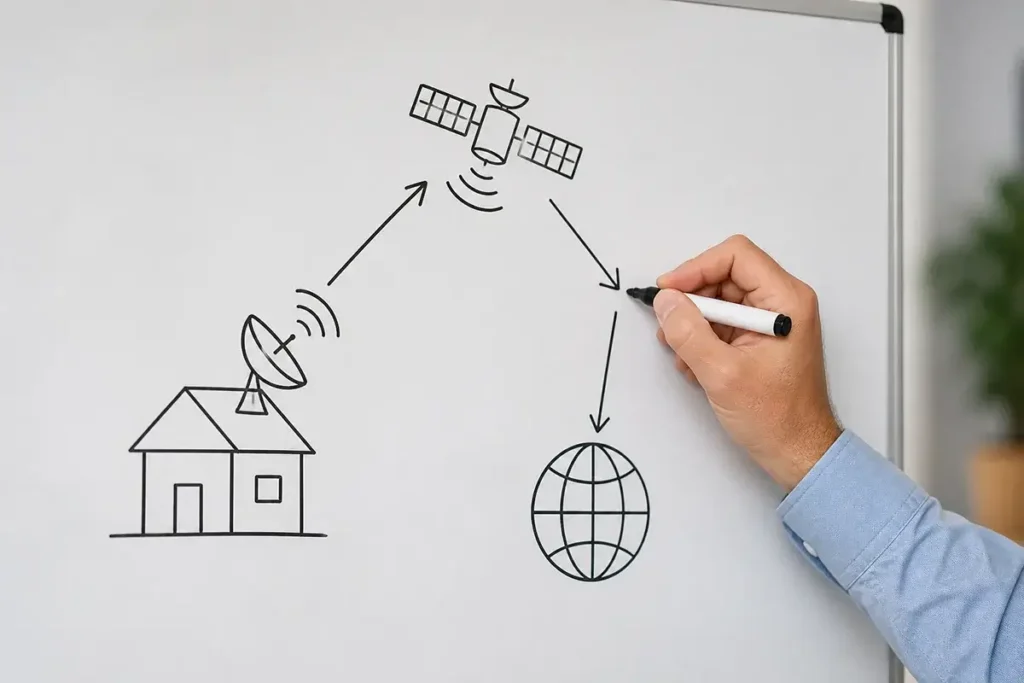
Phased array antenna: The technology inside the Starlink dish. An electronically steered antenna that can aim its beam at different satellites without any mechanical movement — unlike older satellite dishes that must physically point at a fixed satellite. Enables Starlink to track moving LEO satellites seamlessly.
Satellite handoff: The moment when a Starlink dish transitions from communicating with one passing satellite to the next one coming into view. Brief (milliseconds) but can cause momentary connection interruptions if the handoff is imperfect. Responsible for occasional brief Starlink disconnection events.
Rain fade: Signal attenuation caused by precipitation between the satellite and dish. More pronounced with geostationary satellite services (HughesNet, Viasat) due to the longer signal path through the atmosphere. Less common with Starlink’s LEO constellation but can still occur during very heavy precipitation events directly overhead.
Constellation: The complete network of satellites operated by a satellite internet provider. Starlink’s constellation has over 6,500 operational satellites in LEO as of 2026. Amazon’s Project Kuiper is another LEO constellation in development.
Ground station: A terrestrial facility where satellite signals are received and connected to the global internet backbone. Starlink has ground stations strategically placed globally. Your dish communicates with satellites, which relay data to/from the nearest ground station.
Priority data: Data that receives guaranteed network resources and isn’t subject to deprioritization during congestion. Starlink Standard provides 1 TB of priority data per month; after this threshold, data is still available but may be slower during network congestion periods.
Obstruction: Any physical object that blocks the line of sight between the Starlink dish and the sky in the required satellite cone. Trees, buildings, chimneys, hills, and eaves are common rural Starlink obstructions that cause brief disconnection events when the satellite path crosses the blocked area.
Cellular and 5G Terms
Band / Frequency band: The radio frequency range a cellular network uses. Different bands have different range and capacity characteristics. Low-band (600–900 MHz) travels far but is slower. Mid-band (2.5–6 GHz) is faster but has shorter range. High-band/mmWave (24+ GHz) is fastest but travels only hundreds of meters.
LTE (Long-Term Evolution): The 4G cellular standard. Most rural cellular coverage in the US is LTE, typically delivering 10–75 Mbps depending on signal strength and tower capacity.
5G NR (New Radio): The 5G cellular standard. In rural areas, most 5G is low-band 5G NR using 600 MHz spectrum — similar range to LTE but with improved efficiency. True high-speed 5G requires mid-band or mmWave deployment.
Band 71: T-Mobile’s 600 MHz low-band 5G spectrum. Travels 15–30 miles from a tower, making it the primary band for T-Mobile’s rural coverage. Delivers 20–80 Mbps speeds at rural distances.
C-Band: 3.7–3.98 GHz mid-band 5G spectrum acquired by major carriers at FCC auction. Verizon’s primary 5G investment. Delivers 100–400 Mbps speeds but limited to 2–5 mile range from a tower — being deployed to rural areas along major corridors.
CBRS (Citizens Broadband Radio Service): 3.5 GHz spectrum available for licensed commercial use. Being used by rural WISPs and smaller carriers for high-capacity fixed wireless broadband. Delivers mid-band 5G class performance (100–500 Mbps) with 5–10 mile coverage range.
MIMO (Multiple Input Multiple Output): Antenna technology that uses multiple antennas simultaneously to improve speed and signal quality. Modern cellular devices and routers use 2×2 or 4×4 MIMO — important for rural antenna optimization setups.
Carrier aggregation: Technology that combines multiple frequency bands simultaneously to boost total bandwidth. A device using carrier aggregation on LTE might combine Band 13 + Band 5 + Band 66 for higher total speeds than any single band provides.
FirstNet: A nationwide broadband network built on AT&T’s infrastructure specifically for emergency responders and public safety communications. FirstNet tower deployments in rural areas have improved AT&T coverage as a side effect of the emergency responder mandate.
Networking and Home Setup Terms
Router: The device that manages your home network, distributes internet to multiple devices, and provides Wi-Fi. Separate from the modem (which connects to the internet service) — though many ISPs provide combination modem/router units.
Modem: The device that connects your home network to your internet service. For Starlink, the router contains the modem function. For cellular home internet, the gateway device is a combined modem/router.
Wi-Fi 6 (802.11ax): The current standard Wi-Fi specification, introduced in 2019. Supports faster speeds (up to 9.6 Gbps theoretical), better performance in congested environments (multiple devices), and improved efficiency. The right minimum specification for any new router purchase in 2026.
Wi-Fi 6E: Extension of Wi-Fi 6 that adds the 6 GHz frequency band, providing dramatically less interference and faster speeds for compatible devices. Future-proof choice for new router purchases where multiple devices compete for bandwidth.
Mesh Wi-Fi: A system using multiple router nodes placed throughout a home to create a seamless, single-network Wi-Fi environment. The best solution for large rural homes where a single router cannot cover all areas effectively.
Ethernet: Wired network connection using Cat5e/Cat6/Cat6A cables. Always faster, more reliable, and lower latency than Wi-Fi. Recommended for devices where performance matters — desktop computers, gaming consoles, smart TVs, NAS devices.
QoS (Quality of Service): Router functionality that prioritizes specific types of traffic or specific devices over others. Configured to ensure video call traffic (Zoom, Teams) gets bandwidth priority over background downloads or streaming when multiple activities compete for available bandwidth.
SSID (Service Set Identifier): Your Wi-Fi network’s name — what you see when looking for networks to connect to. Each mesh node or access point broadcasts the same SSID so devices connect seamlessly as you move through your home.
NAT (Network Address Translation): Technology that allows multiple devices in your home to share a single public IP address from your ISP. All home routers perform NAT by default.
Bypass Mode / Bridge Mode: Router configuration that disables the Starlink (or ISP) router’s NAT and DHCP functions, passing the public IP directly to a third-party router. Used when replacing the ISP-provided router with a preferred third-party router.
Dual-WAN: Router capability to connect two separate internet sources (e.g., Starlink + cellular hotspot) and manage traffic across both connections, including automatic failover when one connection fails.
VPN (Virtual Private Network): Encrypted tunnel between your device and a remote server or your employer’s network. Adds overhead to your connection — increases effective latency by 10–30 ms. Important for security on rural remote work connections and for accessing corporate resources.
Regulatory and Government Program Terms
BEAD Program: Broadband Equity, Access, and Deployment Program. The $42.45 billion federal broadband infrastructure investment administered by NTIA (National Telecommunications and Information Administration). The largest single federal broadband investment in US history, allocated to states for rural broadband deployment.
NTIA: National Telecommunications and Information Administration. Federal agency within the Department of Commerce that administers BEAD and other broadband programs.
FCC: Federal Communications Commission. Independent regulatory agency that oversees telecommunications including internet service providers, maintains the National Broadband Map, administers Lifeline and E-Rate programs, and enforces broadband-related regulations.
USDA ReConnect: USDA Rural Utilities Service’s grant and loan program for rural broadband infrastructure deployment. Multiple funding rounds have invested over $5 billion in rural broadband infrastructure nationally.
RDOF (Rural Digital Opportunity Fund): FCC program that allocated $20.4 billion through Universal Service Fund mechanisms for rural broadband deployment. Some RDOF auction winners have faced compliance challenges in delivering on their build-out commitments.
FCC Broadband Map: The FCC’s address-level database of broadband internet availability across the United States, available at broadbandmap.fcc.gov. Determines which locations are eligible for BEAD and other federal broadband funding.
Unserved: FCC classification for locations with no broadband access at 25/3 Mbps or higher. Highest priority for BEAD funding.
Underserved: FCC classification for locations with broadband at 25/3–100/20 Mbps. Second highest BEAD priority after unserved locations.
E-Rate: FCC program that provides discounted broadband to schools and libraries, with rural institutions receiving higher discount rates than urban ones.
Lifeline Program: FCC program providing $9.25/month discounts on phone or internet service for qualifying low-income households.
MVNO (Mobile Virtual Network Operator): A company that offers cellular service using another carrier’s network infrastructure. Examples: Visible (uses Verizon’s network), Mint Mobile (uses T-Mobile’s network). Often offer lower prices than the underlying carrier at the cost of lower network priority.
Signal Quality Terms
dBm (decibels relative to one milliwatt): Unit for measuring signal strength. Values are negative — closer to zero means stronger signal. -70 dBm is excellent; -90 dBm is weak but usable; -110 dBm or below is very weak and unreliable.
RSRP (Reference Signal Received Power): The primary LTE/5G signal strength measurement shown in cellular device engineering modes. The equivalent of dBm for cellular specifically. -80 dBm RSRP is excellent; -100 dBm is marginal; -120 dBm is very weak.
SINR (Signal to Interference and Noise Ratio): Measures signal quality relative to interference and background noise. Higher values are better. SINR above 15 dB is excellent; below 0 dB means interference is overwhelming the signal.
Gain (dB — decibels): The amplification factor of a signal booster or antenna. 3 dB of gain doubles the signal power. 10 dB of gain is a 10x increase in signal power. Rural signal boosters typically offer 65–72 dB of gain.
Yagi antenna: A directional antenna type commonly used for rural cellular signal optimization and fixed wireless point-to-point links. Named after its Japanese inventors. Focuses all gain in one direction — must be aimed at the target (tower or access point). High gain in the aimed direction at the cost of coverage in other directions.
MIMO panel antenna: A directional antenna supporting Multiple Input Multiple Output technology. Used with cellular hotspot devices and cellular routers for rural signal optimization. Includes separate antenna elements for different frequency bands and MIMO streams.


Leave a Reply