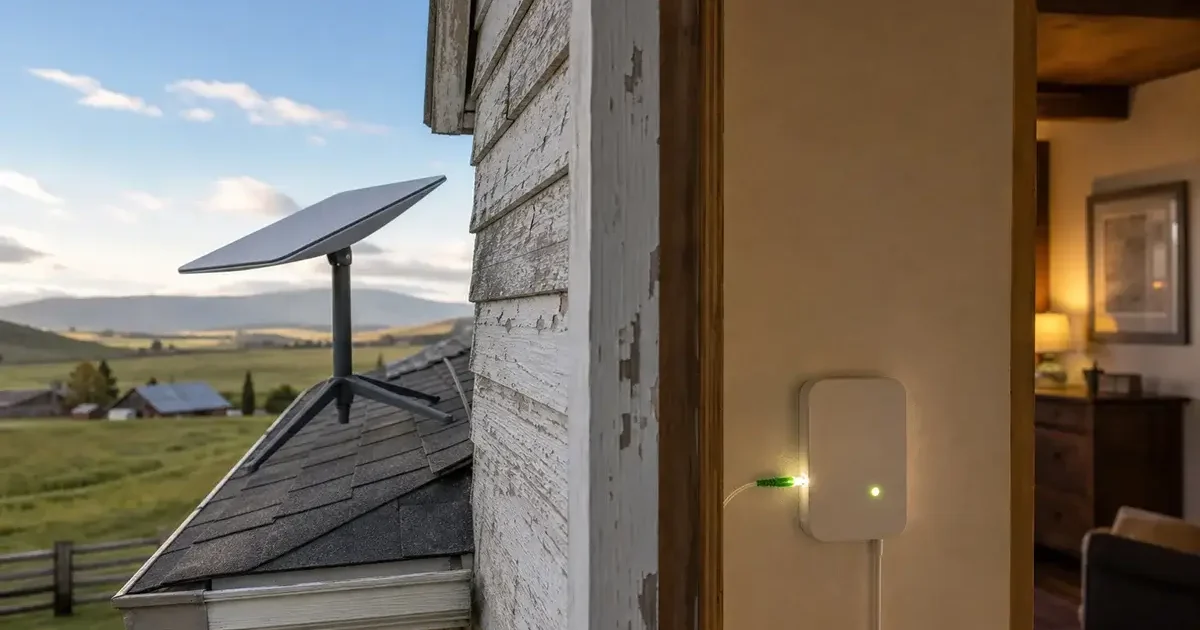
You’ve been on Starlink for two years. The connection has been transformative — you can video call clients, your kids can attend online school, you can manage your farm from the kitchen table. And now you’ve received a notice that a fiber internet provider is coming to your rural road. Should you switch? Keep both? Stick with Starlink? The Starlink vs fiber decision is one that increasing numbers of rural Americans are facing as BEAD Program investments and electric cooperative fiber programs reach communities that have relied on satellite for years. This comprehensive guide helps you make the right decision for your specific situation.
In This Guide
- When Fiber Comes to Rural America
- Performance: Fiber vs Starlink Head-to-Head
- Total Cost Comparison
- Reliability and Uptime Compared
- When Fiber Is the Clear Winner
- When to Keep Starlink Alongside Fiber
- How to Transition from Starlink to Fiber
- Questions to Ask Your Fiber Provider Before Switching
- Running Both: The Dual-WAN Strategy
- Frequently Asked Questions
When Fiber Comes to Rural America
The wave of BEAD Program-funded and electric cooperative fiber deployments rolling across rural America is bringing a genuine infrastructure upgrade to communities that have relied on satellite for years. For most rural households, fiber internet will represent the best broadband they have ever had access to — symmetric gigabit speeds, sub-10 ms latency, and reliability that satellite connections cannot match.
But the transition from Starlink to fiber is not always immediate, automatic, or without tradeoffs. Understanding the full picture — performance differences, cost structures, installation timelines, and contract commitments — helps you make the right decision rather than switching on enthusiasm alone or staying on Starlink out of habit when fiber would serve you better.
Performance: Fiber vs Starlink Head-to-Head
| Metric | Rural FTTH Fiber | Starlink Standard | Starlink Priority |
|---|---|---|---|
| Download Speed | 100 Mbps – 1 Gbps | 25–100 Mbps | 40–220 Mbps |
| Upload Speed | 100 Mbps – 1 Gbps (symmetric) | 8–18 Mbps | 15–35 Mbps |
| Latency | 2–8 ms | 20–60 ms | 20–50 ms |
| Jitter | Under 1 ms | 5–20 ms | 3–15 ms |
| Data Cap | Typically unlimited | 1 TB priority | Unlimited priority |
| Weather Impact | None | Brief heavy precipitation events | Brief heavy precipitation events |
| Reliability | 99.9%+ (with adequate infrastructure) | 99%+ (with brief outages) | 99%+ (with brief outages) |
Fiber’s performance advantage over Starlink is significant and real, particularly in two areas: upload speed and latency. Symmetric fiber gigabit connections deliver 1,000 Mbps upload — versus Starlink Standard’s 8–18 Mbps. This difference is transformative for content creators, video producers, large file senders, remote desktop users, and any business that regularly uploads substantial data. The latency difference (2–8 ms fiber vs 20–60 ms Starlink) is less impactful for most use cases since Starlink’s latency already supports all common applications including gaming and video calls — but competitive gamers, professional traders, and latency-sensitive business applications will notice the difference.

Total Cost Comparison
| Factor | Rural Fiber (Typical) | Starlink Standard |
|---|---|---|
| Monthly Service | $50–$100/mo for gigabit | $120/mo |
| Installation Cost | $0–$500 (often subsidized) | $349 hardware (already paid) |
| Equipment | Router provided or $0 | Router owned ($349 already paid) |
| Contract | Varies (often month-to-month from cooperatives) | None |
| Annual Cost | $600–$1,200 | $1,440 |
| 5-Year Total Cost | $3,000–$6,000 | $7,200 (service only) |
From a pure cost perspective, rural fiber from electric cooperatives is typically less expensive than Starlink when service becomes available. Cooperative fiber gigabit at $50–$80/month represents $480–$960 in annual savings versus Starlink Standard’s $1,440/year. Over five years, that difference compounds to $2,400–$4,800 in savings — significant real money for rural households.
However, cost comparisons require understanding the complete picture. Many BEAD-funded fiber deployments have installation fees of $300–$500 per household if the connection requires running fiber from the road to your home (called the “drop”). If your home is far from the road, this installation cost may be higher. Ask specifically about drop construction costs before assuming the fiber connection is free to activate.
When Fiber Is the Clear Winner — Switch Immediately
Make the switch to fiber without hesitation if these conditions apply:
- You regularly upload large files (video producers, drone operators, cloud backup of large datasets). Fiber’s symmetric gigabit upload eliminates the upload bottleneck that constrains every satellite service.
- You run a home-based business with high monthly data consumption that regularly approaches or exceeds Starlink’s 1 TB priority threshold. Unlimited fiber eliminates data management stress.
- You want the absolute lowest latency for competitive gaming, professional trading, or latency-sensitive business applications. Fiber’s 2–5 ms latency is a meaningful improvement over Starlink’s 20–60 ms.
- The fiber monthly cost is significantly lower than Starlink (most cooperative fiber at $50–$80/month vs Starlink’s $120/month). The performance is better AND the price is lower — this is an easy decision.
- You’ve experienced repeated Starlink outages during severe weather and reliability is critical for your business or telehealth needs. Fiber is inherently more weather-resilient than satellite.
When to Keep Starlink as Backup (Even After Getting Fiber)
Even after fiber arrives, there are compelling reasons to maintain Starlink service — at least for a transition period and potentially permanently if your internet is business-critical:
- Fiber infrastructure is new and still being proved. A newly installed rural fiber network will experience occasional outages during its first year as infrastructure is tested and stabilized. During any fiber outage, Starlink provides instant backup connectivity.
- Power outages affect fiber but not necessarily Starlink. When power fails at the fiber provider’s headend, the fiber service fails with it. Starlink on a UPS (uninterruptible power supply) continues operating through brief power events. This matters for farms, businesses, and rural properties with critical monitoring needs.
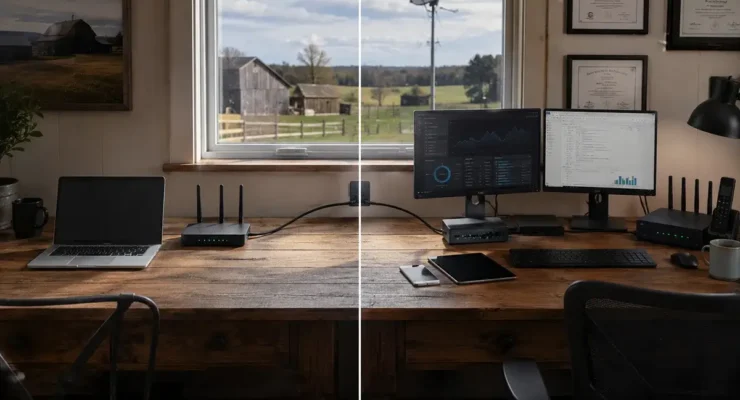
- Business operations requiring 100% uptime justify the combined monthly cost of fiber + Starlink as a backup. A Peplink or dual-WAN router automatically switches between connections — invisible to users and applications.
How to Transition from Starlink to Fiber
The transition process from Starlink to fiber as your primary connection:
- Don’t cancel Starlink until fiber is installed and verified working. Wait until the fiber connection is active and you’ve tested its performance for at least a week before canceling or pausing Starlink service.
- Reconfigure your router. Your existing home network infrastructure (router, switches, Wi-Fi access points) can remain entirely unchanged. Simply change the WAN source from the Starlink Ethernet Adapter to the fiber provider’s modem/ONT (Optical Network Terminal). If you were using Starlink’s router in Bypass Mode, plug your existing router into the fiber ONT instead.
- Pause rather than cancel Starlink initially. The Starlink Roam plan can be paused for up to 12 months. If you’re on a Residential plan, pausing requires canceling and re-subscribing — but re-subscribing is quick if you need to restore service. Keep the hardware securely stored as a backup option.
- Update your network documentation. Note your fiber ONT’s model, your WAN IP configuration, and any port forwarding or static IP arrangements you had configured on Starlink that need to be replicated on the fiber connection.
Questions to Ask Your Fiber Provider Before Switching
Before committing to a switch, get clear answers to these questions from your fiber provider:
- What is the installation cost for my specific address, including the drop from the road to my home?
- What is the monthly service price and is it guaranteed not to increase for a period?
- Is there a term commitment (contract) and what are the cancellation terms?
- What is the average uptime/reliability guarantee (SLA)?
- What support is available when the fiber service goes down — is there 24/7 support and what is the typical repair response time?
- Can I get a static IP address for my home business if needed?
- Is the service symmetric (same upload and download speed)?

Frequently Asked Questions
Can I sell my Starlink dish after switching to fiber?
Yes. Starlink dishes can be sold through Starlink’s own resale platform, eBay, Facebook Marketplace, or local classified listings. The hardware remains active on whatever account it was registered to — a buyer would need to establish their own Starlink service account. As of 2026, Starlink Gen 3 dishes resell for approximately $150–$250 depending on condition and market demand. The router and accessories have lower resale value but can also be sold separately or bundled.
Is fiber always better than Starlink for rural areas?
For performance and long-term cost, fiber is better than Starlink when it’s available at a competitive price from a reliable provider. The key qualifiers: the fiber must actually be installed and operational (not just announced), the price must be reasonable (some BEAD-funded fiber deployments have had higher-than-expected monthly costs), and the provider must be financially stable and offer adequate customer support. Starlink from a proven provider with years of rural service track record is preferable to a new, underfinanced fiber startup deploying its first infrastructure. Evaluate the specific fiber offer at your address, not just the technology type.
Will Starlink lower its price when fiber competition arrives?
Starlink has shown willingness to adjust pricing in competitive markets — the service has both increased and decreased prices in various markets as competitive dynamics change. In areas where fiber becomes widely available at $50–$60/month, market pressure may eventually lead to Starlink price adjustments. However, Starlink’s primary rural market — properties where fiber will never economically reach — provides a captive demand base that reduces competitive pressure in most rural settings. Don’t make financial decisions based on expected Starlink price changes; evaluate the current offerings available to you today.
Does fiber internet require a long-term contract?
It depends on the provider. Electric cooperative fiber programs frequently offer month-to-month service with no long-term contract — reflecting the cooperative model’s member-first orientation. Commercial BEAD-funded ISPs may require 12–24 month contracts. Ask specifically about contract terms before signing up, and compare the contract commitment to Starlink’s no-contract flexibility when evaluating the full picture of switching.
What Makes Electric Cooperative Fiber Different
Not all rural fiber is created equal. When evaluating the “switch from Starlink to fiber” decision, understanding who is providing the fiber and under what business model matters significantly for long-term reliability and customer experience.
Electric cooperative fiber is typically the best rural fiber option when available. Cooperatives are member-owned, not profit-driven — they exist to serve their members rather than maximize shareholder returns. This model produces several advantages: pricing is typically set to cover costs rather than maximize margin (resulting in lower prices than commercial competitors), service areas are defined by membership boundaries rather than commercial profitability (so they serve even the most remote members), and customer service is provided by local staff who know the territory and the members personally.
BEAD-funded commercial ISP fiber may have different characteristics. While BEAD Program terms include affordability requirements, commercial ISPs have profit motivations that can result in higher prices than cooperatives, narrower customer service availability, and potentially less local accountability. Research the specific ISP deploying in your area before committing — community Facebook groups, county extension offices, and local news sources often have early experiences from neighbors who received the service first.
The NTIA’s BEAD Program resources include information about funded projects by state, which can help you identify which ISP is deploying in your area and research their track record in other communities they serve.
What to Do with Your Starlink Equipment After Switching to Fiber
After successfully transitioning to fiber as your primary connection, several options exist for your Starlink hardware:
- Keep as emergency backup: Store the dish and router safely, maintain the Roam plan at $150/month during active natural disaster seasons (hurricane season in the South, severe winter storm season in the North), and pause during lower-risk periods. The dish reactivates in minutes when needed.
- Use at a second property: If you own a vacation cabin, hunting property, or second home without broadband, the dish can be used there under the Roam or Portability plan while fiber covers your primary residence.
- Sell the hardware: Starlink dishes have resale value ($150–$250 for Gen 3 equipment in good condition) through Starlink’s own resale platform, eBay, or Facebook Marketplace. Selling is worth considering if you have no secondary use case and want to recover some hardware cost.
- Donate to a rural community organization: Some rural nonprofits, churches, and community centers in areas without broadband can benefit from a donated Starlink dish and a subsidized Roam service arrangement. Contact local community organizations about this option.

Leave a Reply