
The phrase “5G home internet” appears in marketing for T-Mobile, Verizon, and AT&T home internet products — but the 5G experience that rural Americans actually get is fundamentally different from the gigabit 5G service that gets headlines in urban tech coverage. Understanding what 5G actually means in a rural context, how the different types of 5G perform in real rural environments, and what to realistically expect from 5G home internet in your specific rural area is essential before making any purchasing decisions. This comprehensive guide separates the 5G marketing from the rural 5G reality in 2026.
In This Guide
- The Three Types of 5G: Not All 5G Is Equal
- 5G in Rural Areas: What You Actually Get
- Carrier 5G Rural Coverage Compared
- T-Mobile 5G Extended Range in Rural Areas
- Verizon 5G Rural Coverage
- AT&T 5G Rural Presence
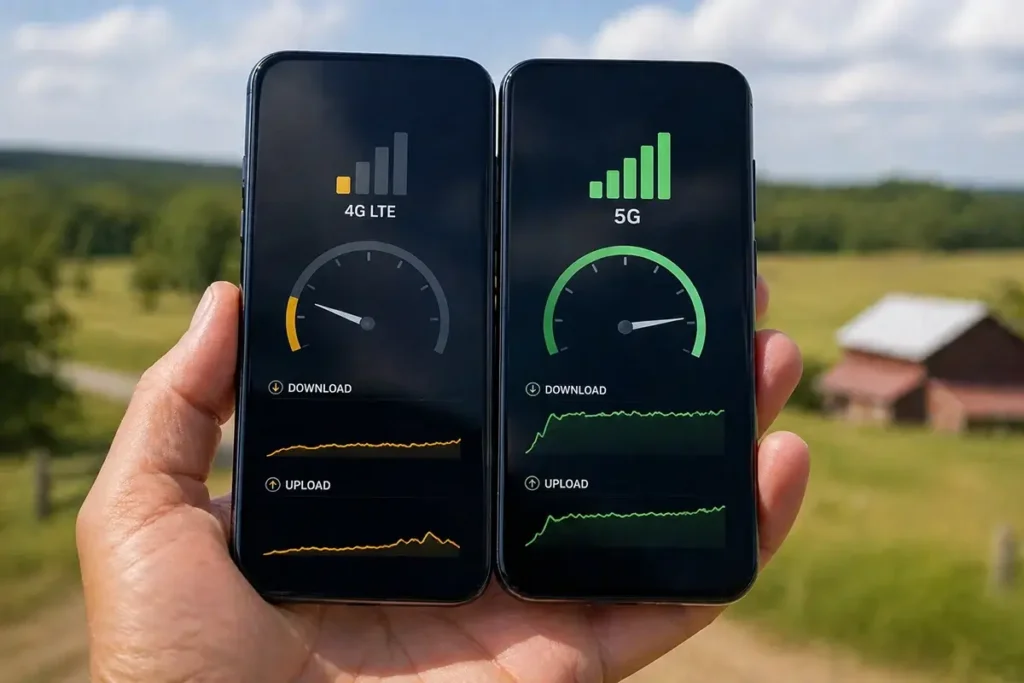
- 5G vs LTE: Real-World Rural Performance Difference
- When 5G Actually Helps in Rural Areas
- 5G Home Internet vs Starlink for Rural
- The Future of Rural 5G Deployment
- FAQs
The Three Types of 5G: Not All 5G Is Equal
The term “5G” covers three distinct radio technologies with dramatically different performance characteristics. Understanding which type of 5G operates in your rural area determines whether you can realistically expect a meaningful upgrade from what you have today:
1. mmWave 5G (millimeter wave, 24–47 GHz)
The “true” 5G that delivers multi-gigabit speeds — 1,000–5,000 Mbps with latency under 5 ms. The headlines about 5G’s transformative potential refer to this technology. mmWave signals travel only a few hundred meters from a tower, cannot penetrate walls or foliage, and require extremely dense tower deployments (every city block in urban settings). mmWave 5G exists only in dense urban cores. It is completely irrelevant to rural internet discussions — it will never reach rural America at any foreseeable future investment level. This is the type of 5G you see on Verizon’s “5G Ultra Wideband” and AT&T’s “5G+” labels in city centers.
2. Mid-Band 5G (2.5–6 GHz, including C-Band and CBRS)
The “goldilocks” 5G — significantly faster than 4G LTE (typically 100–400 Mbps), with improved latency (10–30 ms), and a useful coverage radius of 1–5 miles from a tower. Mid-band 5G is the backbone of T-Mobile’s 5G Ultra Capacity network and Verizon’s expanding C-Band 5G deployment. This type of 5G is reaching rural areas along major highway corridors and in rural communities within range of upgraded towers. It’s the 5G that actually matters for rural fixed wireless access. T-Mobile Home Internet users in areas with mid-band 5G coverage report speeds of 100–400 Mbps — genuinely transformative performance.
3. Low-Band 5G (600–900 MHz, including Band 71 and Band 12)
The “coverage” 5G that travels long distances (10–30+ miles from a tower) and penetrates buildings well — similar to 4G LTE in range and penetration — but delivers only modest speed improvements over 4G LTE (typically 30–100 Mbps). This is what T-Mobile calls “5G Extended Range” (using Band 71 at 600 MHz) and what covers the majority of rural America that T-Mobile has designated as “5G.” The 5G label is technically accurate (it uses 5G air interface protocols) but the performance resembles advanced 4G LTE rather than the futuristic gigabit speeds 5G is associated with in the public imagination.
5G in Rural Areas: What You Actually Get
For rural Americans considering a 5G home internet product, the realistic expectation based on where you actually live:
| Your Location | 5G Type You Likely Have | Realistic Home Internet Speed | Latency |
|---|---|---|---|
| Within 3 miles of a major T-Mobile tower (5G UC) | Mid-band 5G | 100–400 Mbps | 20–35 ms |
| Rural area within T-Mobile Extended Range coverage | Low-band 5G | 20–80 Mbps | 35–60 ms |
| Rural Verizon 5G (C-Band) coverage area | Mid-band 5G | 80–300 Mbps | 25–45 ms |
| Rural area with only Verizon 4G LTE | 4G LTE (no 5G) | 15–60 Mbps | 40–80 ms |
| Remote rural (minimal cellular coverage) | Weak LTE or no service | Under 15 Mbps or unusable | Highly variable |
For most rural Americans, the 5G on their T-Mobile home internet device is low-band 5G delivering 20–80 Mbps — a meaningful upgrade over older LTE home internet in some markets, but not the gigabit revolution the marketing implies. The small percentage of rural users within range of a mid-band 5G tower experience genuinely fast performance that rivals or exceeds Starlink at a lower monthly cost.
T-Mobile 5G Extended Range in Rural America
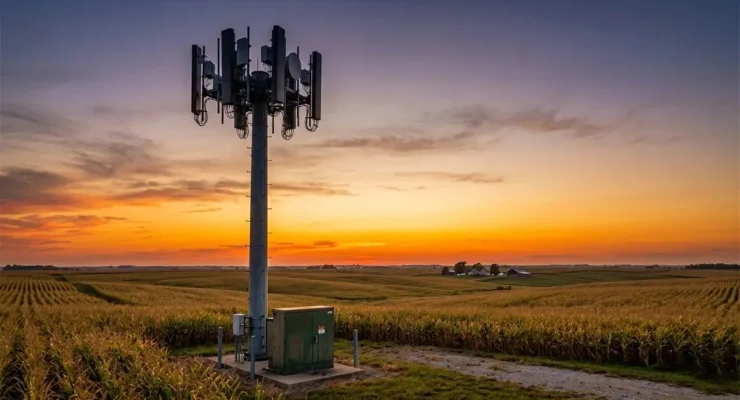
T-Mobile’s rural 5G story is primarily about its 600 MHz Band 71 low-band 5G, marketed as “5G Extended Range.” Band 71 has exceptional range — tower signals cover 15–30 miles in open terrain — making it well-suited for wide-area rural coverage with relatively few tower sites. T-Mobile has deployed Band 71 at thousands of existing rural tower sites, and its coverage maps show 5G blanketing most of rural America in this band.
Real-world T-Mobile Extended Range 5G performance for rural home internet customers:
- Close to a Band 71 tower (within 5 miles, good signal): 40–100 Mbps download, 10–25 Mbps upload, 35–50 ms latency
- Mid-range from tower (5–15 miles, moderate signal): 15–45 Mbps download, 5–15 Mbps upload, 40–70 ms latency
- Edge of coverage (15–25 miles, weak signal): 5–20 Mbps download, 2–8 Mbps upload, 50–100 ms latency
These speeds are adequate for streaming, video calls, and remote work in the middle range scenarios — though significantly below what mid-band 5G or Starlink delivers. The key practical question is not whether “5G” is available in your area, but which specific band your nearest tower broadcasts and what actual signal strength your home receives.
AT&T 5G Rural Presence
AT&T’s rural 5G story is closely tied to FirstNet — the dedicated public safety broadband network built on AT&T’s infrastructure. FirstNet has funded tower construction and equipment upgrades at rural sites specifically to provide emergency responder coverage, and those infrastructure improvements also extend AT&T’s 5G coverage footprint to rural areas that wouldn’t be commercially justified by consumer demand alone.
AT&T rural 5G operates primarily in the 700 MHz (Band 12/14) and 850 MHz (Band 5) low-band ranges, providing similar coverage characteristics to T-Mobile’s Band 71. Download speeds of 20–60 Mbps are typical in rural AT&T 5G coverage areas — adequate for most household applications but not the gigabit performance associated with urban 5G marketing. AT&T’s mid-band C-Band 5G deployment is progressing in rural areas along major highway corridors, potentially bringing 100–300 Mbps service to rural communities near those corridors.
AT&T does not currently market a residential home internet product equivalent to T-Mobile Home Internet at the national level, though AT&T Internet Air has expanded in select markets. For rural AT&T users, the practical 5G benefit is primarily in improved mobile hotspot performance and better support for AT&T’s fixed wireless offerings in areas where the company has made investments.
When 5G Actually Makes a Difference for Rural Users
Despite the nuance around 5G types, there are specific scenarios where 5G genuinely improves the rural internet experience compared to 4G LTE:
Better congestion handling: 5G air interface protocols (NR — New Radio) handle simultaneous users more efficiently than 4G LTE. In rural areas where a tower serves many home internet customers, 5G NR allows the tower to accommodate more users at consistent speeds — reducing the peak-hour performance degradation that LTE home internet users often experience.
Improved upload speeds: 5G NR’s improved uplink efficiency benefits users with video call and cloud upload needs — the use cases where upload speed is the constraining factor. Rural T-Mobile users on 5G Extended Range often report 2–3x upload speed improvements over LTE-only connections, which meaningfully impacts work-from-home and telehealth use cases.
Lower latency: 5G NR introduces new low-latency features (like Transmission Time Intervals of 0.5 ms vs 1 ms in LTE) that reduce baseline latency. In practice, rural 5G users typically see latency of 35–50 ms vs 45–70 ms on LTE — a modest but measurable improvement for real-time applications.
Network slicing for home internet: Carriers deploying 5G network slicing can allocate dedicated spectrum capacity to home internet customers, protecting their service quality from mobile phone traffic congestion during peak periods. This feature is being progressively deployed by T-Mobile and Verizon in 2025–2026 and will improve the consistency of rural 5G home internet performance as it rolls out.
5G Home Internet vs Starlink for Rural Areas
The 5G vs Starlink comparison comes down to availability and cost versus performance ceiling:
| Scenario | Best Choice | Reasoning |
|---|---|---|
| Mid-band 5G available, strong signal | T-Mobile or Verizon 5G Home Internet | 100–400 Mbps at $50/month beats Starlink on price and matches on speed |
| Low-band 5G only, close to tower | Either — T-Mobile may be better value | 50–80 Mbps at $50 vs $120; test T-Mobile first |
| Low-band 5G, edge of coverage | Starlink | 15–30 Mbps unreliable cellular vs 70–115 Mbps consistent Starlink |
| No 5G, only LTE | Starlink | Starlink dramatically outperforms rural LTE-only connections |
| No cellular coverage at all | Starlink (only viable option) | Satellite covers where cellular doesn’t reach |
The Future of Rural 5G: What’s Coming
The rural 5G landscape is evolving rapidly. Several developments will meaningfully improve rural 5G performance in the 2026–2030 timeframe:
CBRS (Citizens Broadband Radio Service) expansion: The 3.5 GHz CBRS band is increasingly being deployed by rural WISPs and smaller carriers for fixed wireless access. CBRS delivers mid-band 5G performance (100–500 Mbps) over distances up to 5–10 miles — a middle ground between low-band 5G’s wide range and mmWave’s high speed over short range. BEAD Program funding is supporting many rural CBRS deployments.
T-Mobile mid-band rural expansion: T-Mobile continues deploying its 2.5 GHz Band 41 mid-band 5G spectrum to rural tower sites, bringing 100–300 Mbps performance to rural corridors previously served only by Band 71 low-band 5G. Rural T-Mobile Home Internet performance will continue improving as more rural towers receive mid-band upgrades.
According to the FCC’s Mobile Broadband Reports, rural 5G deployment has accelerated substantially and is projected to reach more than 90% of rural US addresses with some 5G coverage by 2028 — though the critical question of what type of 5G and what actual performance levels will be delivered varies enormously by geography and carrier investment.
FAQs
Does my area have real 5G or just “5G” marketing?
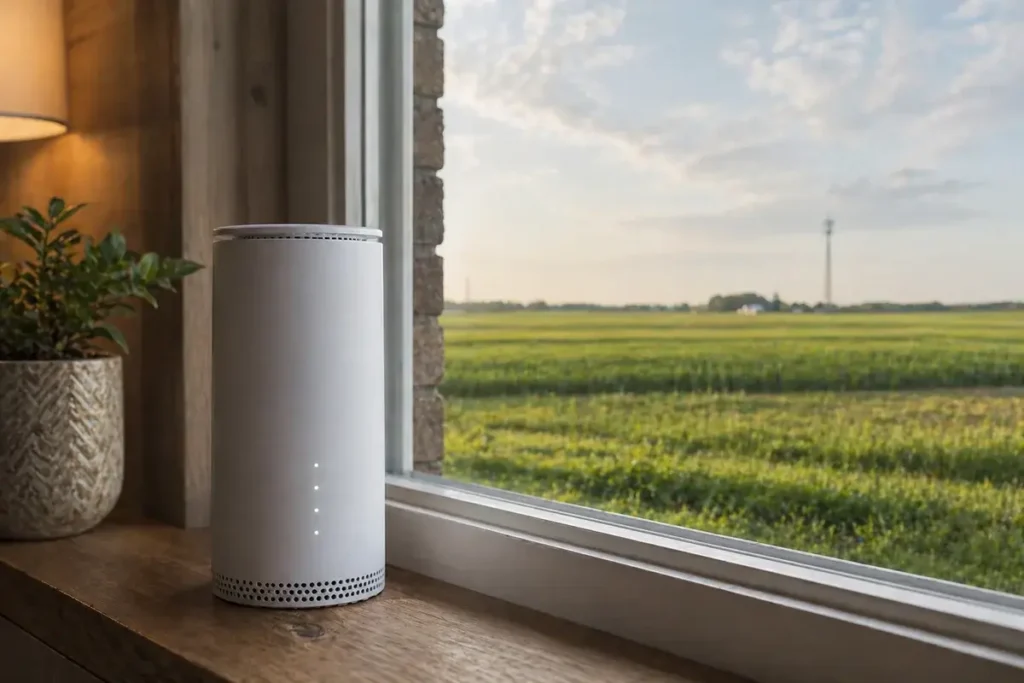
The most reliable way to determine what type of 5G serves your location is to check carrier-specific coverage maps and look for the specific speed tier (T-Mobile’s maps distinguish between “5G Extended Range” and “5G Ultra Capacity”). For actual in-home performance, the only definitive test is to get a T-Mobile or Verizon Home Internet gateway, place it optimally in your home, and run speed tests at different times of day. Marketing coverage maps are aspirational; real-world performance data from your own device is definitive.
Should I wait for better 5G before getting Starlink?
No. If you currently lack adequate broadband, don’t wait for rural 5G improvements that may be 2–5 years away from reaching your specific location. Starlink is available now and provides reliable broadband-class internet at $120/month. The cost of waiting — in lost remote work opportunities, inadequate telehealth access, and children unable to participate fully in online education — far exceeds the modest savings of potentially switching to a cheaper 5G option years in the future when (and if) adequate mid-band 5G reaches your area.
How do I know if I have 5G or 4G LTE at my rural home?
For T-Mobile Home Internet, the gateway device’s admin page and the T-Mobile Home Internet app both show the current connection type (5G NR SA, 5G NSA, or LTE) and the specific band in use. For Verizon Home Internet, the My Verizon app provides connection band information. You can also use a third-party network analyzer app on your smartphone (Network Cell Info Lite on Android, or similar iOS apps) to see exactly which band and generation your phone is connected to at any location — a useful proxy for what the home internet gateway would receive in the same location. The specific band number tells you more than the “5G” label: Band 71, Band 12, or Band 14 are low-band options; Band 41, n41, Band 66, or C-Band (n77/n78) are mid-band options with meaningfully better performance.
Should I get 5G Home Internet or a 5G hotspot plan for my rural property?
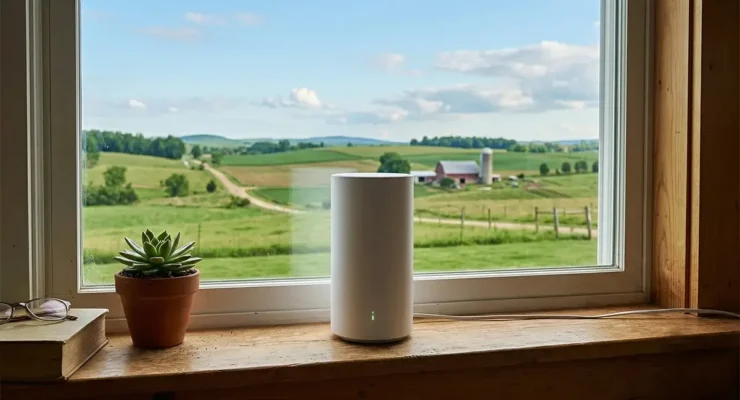
If T-Mobile or Verizon offers Home Internet at your address, that is the better choice over a hotspot plan for primary internet — the gateway device is optimized for stationary home use, often performs better than a portable hotspot in the same location, and the pricing is typically more favorable. A 5G hotspot plan ($30–$80/month) is better suited for mobile use and backup connectivity rather than as a primary residential connection. The combination of a 5G Home Internet gateway as primary plus a hotspot as a backup for outages covers both use cases at a combined cost typically $30–$50/month less than Starlink alone.

Leave a Reply