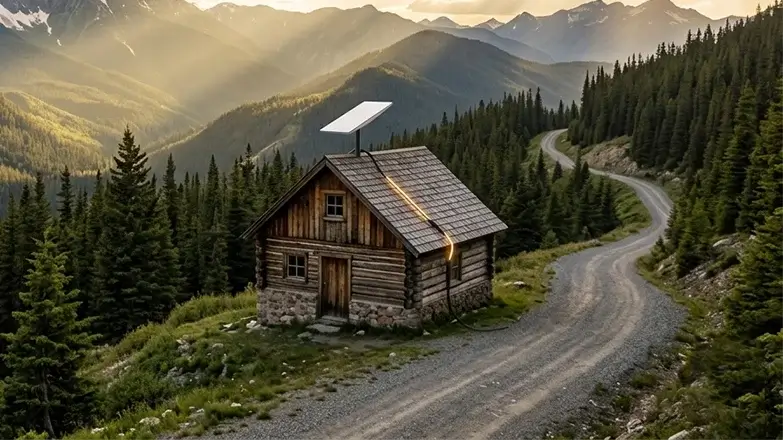
You bought the property. Maybe it’s a dream homestead, an inherited family farm, or a remote retreat far from the suburbs. And then you discovered the problem that millions of rural Americans face every day: there is no internet service, and seemingly no way to get it. No cable, no DSL, no fiber, no cellular signal. The nearest tower is 30 miles away and the geography makes traditional service providers throw up their hands. So what do you actually do?
This guide is for the most challenging end of rural connectivity: properties with little or no existing service. We will walk through every viable option in order of practicality, including technologies you may not have considered, government programs that may fund infrastructure for your area, and creative solutions that rural residents across America have successfully deployed.
In This Guide
- Step 1: Assess What You Actually Have
- Option 1: Starlink Satellite (Recommended First Step)
- Option 2: Cellular Boosters and Hotspots
- Option 3: Long-Range Wi-Fi Bridging
- Option 4: Contact Local WISPs
- Option 5: DSL Through Phone Lines
- Option 6: Government-Funded Infrastructure
- Option 7: Connection Bonding
- Option 8: Community Broadband Cooperatives
- FAQs
Step 1: Assess What You Actually Have
Before spending money on any solution, spend an afternoon assessing your actual situation. What looks like “no service” is often “weak service that the right equipment can work with.” Take these steps first:
- Drive to the nearest hilltop or high point on your property and check your smartphone’s cellular signal. How many bars do you get? Which carriers show any signal at all? Note this.
- Use the FCC National Broadband Map at broadbandmap.fcc.gov to see which providers have self-reported coverage at your address. Look for: fixed wireless ISPs you may not know about, DSL providers on existing phone lines, and cellular carriers.
- Ask your neighbors. Other rural residents within 5–10 miles of you have faced the same problem. What have they found? Local Facebook groups and Nextdoor communities are invaluable here.
- Download the Starlink app and use its sky obstruction scanner to evaluate whether your property has a clear enough sky view for satellite. Most properties outside dense forest do.
- Check your property for a telephone landline. Many rural properties have legacy telephone infrastructure from the era of rural telephone cooperatives. If you have a phone line, you may be able to get DSL service even if the provider doesn’t advertise in your area.
Option 1: Starlink Satellite Internet — Recommended First Step
For the vast majority of rural Americans with no other broadband option, Starlink is the most practical and immediate solution available in 2026. Unlike all the other options in this guide, Starlink requires no local infrastructure, no line-of-sight to a ground-based tower, and no negotiation with a local ISP. If you have a reasonably clear view of the sky, you can have broadband-class internet within a week of placing your order.
Starlink’s standard residential service costs $120/month with a $349 one-time hardware purchase. For many rural households that have been surviving with no internet or a mobile hotspot paying $100+/month for a few gigabytes of data, this is a life-changing upgrade at a competitive total cost. Download speeds of 50–120 Mbps and latency of 20–60 ms make Starlink suitable for remote work, video calls, streaming, online learning, and all other modern internet applications.
The only properties where Starlink is a poor fit are those with very heavy tree cover that blocks the northern sky and cannot be resolved with a taller mount. For those situations, read on — other options exist.
To verify Starlink availability at your address, visit Starlink.com. Service is now available across all of the continental United States with no waitlist in most areas.
Option 2: Cellular Boosters and Hotspots
If there is any cellular signal within range of your property — even a weak signal only visible from your roof or a nearby hilltop — a cellular signal booster combined with a high-gain outdoor antenna can often extract usable internet from that weak signal.
A signal booster system (outdoor Yagi antenna + amplifier + indoor antenna) can amplify signals that are too weak to reach inside your home and rebroadcast them at usable strength. For data use, pair this with a cellular hotspot device or a 4G/5G home router placed near the boosted signal source.
For properties where cellular signal is genuinely weak but present, a setup combining a weBoost Home Complete ($649) with a cellular hotspot can provide 5–30 Mbps of internet for approximately $150–$200 in monthly service costs. This is not ideal, but it is often achievable where nothing else is.
For truly isolated properties, a long-range directional cellular antenna pointed at the most distant visible tower can sometimes pick up signal from towers 30–50 miles away under the right atmospheric and terrain conditions. This requires professional-grade antenna equipment and a suitable elevation advantage.
Option 3: Long-Range Wi-Fi Bridging
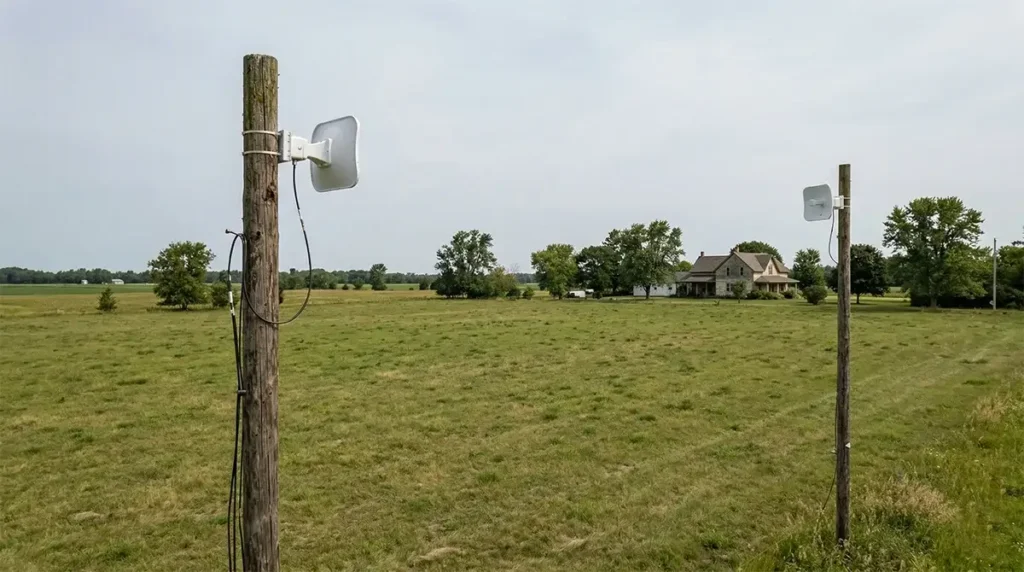
If a neighbor, farm cooperative, or rural business within line-of-sight distance (typically 1–10 miles) has a broadband connection and is willing to share it, a long-range Wi-Fi bridge can extend that connection to your property. Using directional point-to-point Wi-Fi equipment from manufacturers like Ubiquiti (their AirMAX line), Cambium, and MikroTik, it’s possible to bridge broadband connections across several miles with relatively modest equipment costs ($100–$400 per end).
The requirements: clear or near-clear line of sight between the two antenna locations, a willing partner with a broadband connection to share, and the technical willingness to configure the equipment. Many rural communities have built small informal networks this way. A grain elevator with a fiber connection, a rural church, or a neighbor with Starlink can become an internet hub for an entire neighborhood if the terrain and relationships allow.
Option 4: Contact Local Fixed Wireless ISPs (WISPs)
Local Wireless Internet Service Providers (WISPs) operate in many rural areas without advertising their services prominently. They build towers specifically to serve rural communities and can be the best solution when available — often $40–$70/month for 25–100 Mbps with low latency. The challenge is finding them.
To find WISPs in your area: search “[your county name] wireless internet provider” and “[your state] WISP rural internet.” The WISPA (Wireless Internet Service Providers Association) maintains a member directory. Your county extension office, local hardware store, and rural neighbors are also good sources. Many WISPs expand their tower coverage on request — if enough households in your area want service, a WISP may extend coverage to reach you, sometimes with cost-sharing agreements for tower construction.
Option 5: DSL Through Existing Phone Lines
If your property has a copper telephone landline — many rural properties do, even if they’re not actively used — DSL internet service may be available. DSL uses existing telephone copper wire infrastructure to deliver internet without requiring a separate cable installation. Speeds range from a meager 1–3 Mbps on the oldest infrastructure to 15–25 Mbps on newer VDSL2 equipment, depending on the distance from the nearest telephone switching equipment.
Rural DSL is provided by regional telephone companies and rural telephone cooperatives. Contact the company that provides your landline phone service and ask specifically about DSL availability at your address, even if their website doesn’t show it. Many rural telephone cooperatives maintain DSL infrastructure not listed in national ISP databases.
Option 6: Government-Funded Infrastructure Programs
If your area has no viable internet option, you are not alone — and the federal and state governments are currently deploying the largest rural broadband investment in history to address exactly this situation.
The BEAD Program (Broadband Equity, Access, and Deployment), administered by the NTIA, allocated $42.45 billion to states for broadband infrastructure expansion with a specific mandate to prioritize unserved locations first — meaning properties with no broadband access at all. States are currently in various stages of deploying these funds through ISPs that will be required to serve currently unserved areas.
The USDA ReConnect Program has similarly funded hundreds of rural broadband infrastructure projects specifically in areas with no existing high-speed service. You can check the ReConnect grant map on the USDA website to see if your area is included in a funded project.
What you can do: Contact your county commissioner, state broadband office, and local representatives to make sure your address is correctly flagged as “unserved” in federal databases. If your area is incorrectly mapped as served, you can file a formal challenge with the FCC through the National Broadband Map, which directly influences where BEAD funds flow. Collective action — organizing neighbors to all challenge the same incorrect coverage mapping — is particularly effective.

Option 7: Connection Bonding
In some rural situations, no single connection provides adequate bandwidth, but combining multiple weak connections through a technology called bonding or load balancing can create a usable aggregate connection. For example, combining two cellular carrier hotspots (AT&T and Verizon on separate bands) with a DSL connection through a multi-WAN router can aggregate 15–40 Mbps total bandwidth from connections that individually deliver 5–15 Mbps each.
SD-WAN routers from companies like Peplink are popular for rural bonding setups. A Peplink Balance 20X (~$500) can bond up to 5 connections simultaneously and includes smart failover so that if one connection drops, traffic automatically routes through the remaining connections. This approach is particularly useful as a backup to Starlink during weather outages.
Option 8: Rural Broadband Cooperatives
In some rural areas, residents and landowners have solved the connectivity problem by forming or joining rural broadband cooperatives — community-owned organizations that build and operate their own local broadband infrastructure. Rural electric cooperatives in particular have expanded into broadband in many states, leveraging their existing right-of-way infrastructure and member-governance model to bring fiber or fixed wireless to areas commercial ISPs have never served.
Frequently Asked Questions
What is the best internet option for a rural property with no service?
For most rural properties with no existing service and a reasonably clear sky view, Starlink satellite internet is the fastest and most practical solution available in 2026. It requires no local infrastructure and delivers 50–120 Mbps from virtually any location in the US.
Can I use satellite internet for remote work with no other options?
Yes. Starlink is well-suited to remote work including video conferencing, VPN access, cloud applications, and large file transfers. Many thousands of rural remote workers rely on Starlink as their primary business internet connection.
How do I find out what internet providers serve my exact address?
Start with the FCC National Broadband Map, which aggregates ISP-reported coverage data. Be aware that this map overestimates coverage significantly in many rural areas. Follow up by calling local telephone companies and asking neighbors about their experience.
Are there government programs that will bring internet to my property for free?
Programs like BEAD and USDA ReConnect fund ISPs to build infrastructure in unserved areas — the service built is then available to residents at market rates, not free. However, some states and local programs offer subsidized connections for low-income households. Check with your state broadband office for current programs in your area.

Leave a Reply