
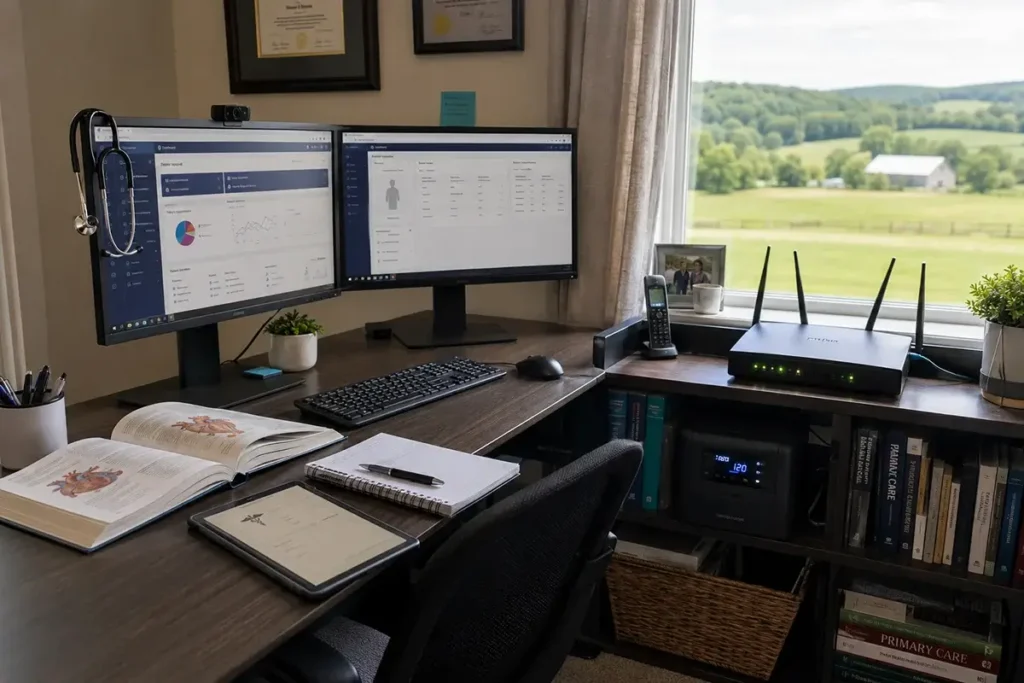
The expansion of telehealth, remote patient monitoring, and virtual care platforms has created a new category of rural remote worker: the healthcare professional who works from home in a rural area. Rural nurses, nurse practitioners, physicians, therapists, social workers, and healthcare administrators are increasingly conducting clinical work, telehealth patient visits, care coordination, and administrative tasks from rural homes — bringing their professional services to rural communities while personally living the rural lifestyle. This creates specific internet requirements that are more demanding than typical office remote work, with HIPAA security obligations layered on top of the performance requirements of healthcare platforms. This comprehensive guide covers everything rural healthcare professionals working from home need to know about internet connectivity in 2026.
In This Guide
- The Rural Healthcare Remote Work Landscape
- Clinical Application Bandwidth Requirements
- HIPAA Compliance on Rural Internet
- Best Internet for Rural Healthcare Workers
- Starlink for Clinical Telehealth Work
- VPN Requirements for Rural Healthcare
- Home Network Security for Clinical Work
- Backup Connectivity for Critical Clinical Work
- Working with Your Healthcare Employer
- Frequently Asked Questions
The Rural Healthcare Remote Work Landscape
Remote healthcare work has expanded dramatically since 2020, and rural areas have disproportionately benefited from this expansion — both as sources of healthcare workers who can now work from rural home addresses and as recipients of telehealth services that previously required travel to distant facilities. The rural healthcare remote worker landscape in 2026 includes:
Telehealth providers: Physicians, nurse practitioners, physician assistants, and other licensed clinicians conducting patient video visits from home-based offices, working for telehealth companies, hospital systems, and health systems with telehealth programs.
Remote clinical nurses (RN, LPN): Nurses doing telephonic triage, remote patient monitoring review, care management coordination, and health coaching from rural home offices — roles that have expanded substantially as health systems have adopted virtual nursing models.
Mental health therapists (LCSW, LPC, psychologists): Mental health professionals conducting teletherapy sessions from rural home offices, serving both rural and urban patient populations via telehealth platforms.
Healthcare administrators: Medical coders, clinical documentation specialists, prior authorization nurses, utilization management reviewers, and quality assurance professionals doing entirely administrative healthcare work from rural homes.
Each of these roles has specific internet requirements — and specific HIPAA considerations — that differ from the general remote work connectivity guidance applicable to other industries.
Clinical Application Bandwidth Requirements
| Clinical Application | Download | Upload | Latency | HIPAA Data Type |
|---|---|---|---|---|
| Patient video visit (standard HD) | 5 Mbps | 5 Mbps | Under 150 ms | PHI — encrypted video |
| Patient video visit (high-definition clinical) | 10+ Mbps | 10+ Mbps | Under 100 ms | PHI — encrypted video |
| EHR system access (Epic, Cerner, Meditech) | 5–15 Mbps | 2–5 Mbps | Under 150 ms | PHI — encrypted browser/VPN |
| Remote desktop to hospital workstation | 5–15 Mbps | 2–5 Mbps | Under 100 ms | PHI — encrypted RDP/Citrix |
| Telephonic triage (VoIP) | 1 Mbps | 1 Mbps | Under 150 ms | PHI — encrypted VoIP |
| Remote patient monitoring dashboard | 5–10 Mbps | 2–5 Mbps | Under 200 ms | PHI — encrypted browser |
| Medical imaging review (radiology) | 25–100 Mbps | 5 Mbps | Under 200 ms | PHI — large file download |
| Administrative EHR coding/documentation | 5–10 Mbps | 2–5 Mbps | Low | PHI — encrypted browser/VPN |
The most demanding rural healthcare remote work application is high-definition patient video visits for clinical specialties where visual assessment is clinically important — dermatology, wound care, ophthalmology, and any specialty requiring clear visualization of physical findings. These applications require upload speeds of 10+ Mbps with consistent latency under 100 ms — requirements that Starlink Priority or local fiber typically meet but that Starlink Standard with marginal upload performance may occasionally struggle with during peak congestion periods.
HIPAA Compliance on Rural Internet Connections
HIPAA (Health Insurance Portability and Accountability Act) does not prohibit healthcare work over satellite internet, cellular internet, or any specific internet technology. What HIPAA requires is that Protected Health Information (PHI) is transmitted and stored securely — using encryption and access controls that protect patient privacy. The internet connection type is less important than how data is handled on and through that connection.
Key HIPAA requirements for rural home-based clinical work:
Encryption in transit: All PHI transmitted over your internet connection must be encrypted. Healthcare applications (Epic, Teladoc, Doxy.me, Zoom for Healthcare) use TLS/SSL encryption that protects data regardless of the internet connection type. VPN connections add an additional encryption layer. Both Starlink and cellular internet are compatible with all standard clinical application encryption.
Secure home network: Your home Wi-Fi network must use WPA3 (or minimum WPA2) encryption with a strong password. The clinical work should be conducted on a separate VLAN or network segment from household IoT devices, guest devices, and personal computing — preventing household device traffic from potentially intercepting clinical data.
Physical workspace privacy: HIPAA requires that patient conversations and PHI on screen are not viewable or audible to household members or visitors. This requires a dedicated workspace (ideally a room with a closable door) for clinical work — a workspace arrangement question rather than an internet technology question.
Business Associate Agreement (BAA): Your internet service provider (Starlink, T-Mobile, Verizon) is not a Business Associate under HIPAA for providing standard internet transit service — they don’t have meaningful access to the encrypted clinical data flowing through their networks. However, any cloud storage service where you store PHI (even temporarily) must have a BAA with your organization. Your employer’s IT or compliance department can clarify which third-party services require BAAs in your specific workflow.
Best Internet for Rural Healthcare Workers
1. Electric Cooperative or WISP Fiber/Fixed Wireless: The best option for any rural healthcare professional working from home is local fiber or high-quality fixed wireless from a local WISP. Low latency (2–30 ms), high symmetric speeds, and local customer support make this the most professional-grade rural broadband for clinical work. Check availability first — if available at your rural address, prioritize this over satellite.
2. Starlink Priority ($250/month): For rural healthcare professionals without fiber or fixed wireless, Starlink Priority’s 15–35 Mbps upload speeds and 20–50 ms latency support all clinical telehealth applications, EHR access, and remote desktop connections adequately. The unlimited priority data eliminates data management concerns during busy clinical shifts. For rural physicians and nurse practitioners conducting patient video visits from home, Starlink Priority is the minimum recommended configuration — the upload speed headroom is important when your video quality directly affects your clinical assessment capability.
3. T-Mobile or Verizon Home Internet (where available): Cellular home internet at $25–$50/month delivers latency and speeds adequate for clinical telehealth if the cellular signal at your address is strong. The cost advantage over Starlink is significant. Verify consistent performance during your typical clinical hours — not just off-peak — before relying on cellular home internet for patient care work.
VPN Requirements for Rural Healthcare Workers
Most healthcare employers require VPN access for remote clinical work — both for security and for access to systems hosted on the hospital or health system network. Healthcare VPN performance on rural Starlink requires specific optimization:
Work with your employer’s IT department on VPN configuration: Request split tunneling if not already enabled — routing only the specific clinical system traffic through the VPN rather than all internet traffic. This dramatically improves effective performance by eliminating the VPN overhead from your general browsing, video calls on VPN-external platforms, and other non-clinical traffic.
Clinical VPN protocols: Most healthcare employers use Cisco AnyConnect, Palo Alto GlobalProtect, Fortinet VPN, or Pulse Secure. All of these support IKEv2/IPSec or SSL VPN protocols that work on Starlink’s 20–60 ms connection. The VPN will add 10–25 ms of additional latency — taking Starlink’s typical 35 ms base latency to approximately 45–60 ms total during VPN sessions, well within the under-150 ms threshold required for clinical video visits.
Home Network Security for Clinical Work
Rural healthcare workers need home network security configurations that exceed typical household internet security requirements:
- Separate clinical VLAN: Configure your router to create a dedicated network VLAN for your work computer and any clinical devices. This prevents household IoT devices (smart TVs, speakers, thermostats) from communicating with your clinical devices and provides network isolation required by many healthcare employer remote work policies.
- WPA3 Wi-Fi encryption on all networks: Ensure your home router is configured for WPA3 security — the current strongest Wi-Fi encryption standard. WPA2 is acceptable if your router doesn’t support WPA3, but WPA or WEP are completely inadequate for clinical data environments.
- Router firmware up to date: Keep your home router’s firmware updated — most clinical work security breaches that originate from home networks involve routers with unpatched vulnerabilities. Set automatic firmware updates if your router supports them.
- Physical device security: Clinical laptops and devices should be password-locked when unattended, encrypted (BitLocker, FileVault), and not shared with household members. Healthcare employer policies typically explicitly prohibit sharing clinical devices with family members.
Backup Connectivity for Rural Clinical Work
Rural healthcare professionals face a specific professional obligation that justifies backup connectivity beyond what most remote workers need: when your internet fails during a patient video visit, a care coordination call, or a clinical review session, patient safety and professional liability are implicated in ways that don’t apply to most other remote work roles.
The recommended rural healthcare backup configuration: Starlink Priority as primary + dedicated Verizon cellular backup on a dual-WAN router (Peplink Surf SOHO or similar) with automatic failover. When Starlink drops during a patient visit — due to weather, equipment issue, or power fluctuation — the cellular backup activates within 2–3 seconds. Most clinical video platforms (Zoom for Healthcare, Teams, Doxy.me) have auto-reconnect capability that restores the patient connection without requiring a full call restart after the brief failover transition.
A UPS (uninterruptible power supply) on all network equipment is equally important — a power fluctuation that reboots your router mid-patient-visit is avoidable with a $120–$150 APC unit that provides 20–30 minutes of clean power through any brief outage.
Frequently Asked Questions
Is Starlink HIPAA compliant for telehealth work?
Starlink internet service itself is not a HIPAA Business Associate and does not require a BAA for transit services — this is consistent with how all internet service providers (cable, DSL, fiber) are treated under HIPAA. What must be HIPAA compliant is how PHI is handled on and through your internet connection — using encrypted clinical platforms, VPN access to hospital systems, and secure home network configuration. A rural nurse conducting telehealth via Zoom for Healthcare (a HIPAA-compliant platform with appropriate BAA) over a Starlink connection is fully HIPAA compliant if the other required security and privacy controls are in place.
What internet speed do I need for telehealth patient visits from a rural home?
For standard HD video patient visits (the majority of telehealth clinical work), minimum requirements are 5 Mbps upload and download with under 150 ms latency. Starlink Standard at 8–18 Mbps upload and 20–60 ms latency meets this minimum. For clinical specialties requiring higher video quality (dermatology, wound care), 10+ Mbps upload is recommended. Starlink Priority’s 15–35 Mbps upload comfortably serves all clinical telehealth applications. According to the Health Resources and Services Administration, reliable broadband enabling telehealth is one of the most critical healthcare infrastructure investments for rural communities — making rural healthcare workers’ home internet not just a personal necessity but a community healthcare access resource.
Can I use T-Mobile Home Internet for clinical telehealth work?
Yes, if T-Mobile Home Internet at your specific address delivers adequate and consistent performance during your clinical hours. T-Mobile’s 30–60 ms latency and 5–25 Mbps upload (where 5G mid-band is available) meets clinical telehealth requirements. The concern is consistency — rural tower congestion during business hours can reduce T-Mobile performance below adequate levels at some addresses. Test T-Mobile performance specifically during your clinical shift hours (not just evenings or early mornings) before relying on it for patient care work. The 15-day return window allows a genuine trial before committing.
Rural Healthcare Workforce and Remote Work Opportunity
The rural healthcare workforce shortage is one of the most consequential public health challenges in the United States. According to the Health Resources and Services Administration, rural Americans have access to fewer physicians per capita than urban Americans in virtually every specialty, with mental health providers, specialists, and advanced practice providers being particularly scarce in rural communities. Remote work for healthcare professionals offers a partial solution to this shortage in two directions simultaneously: it allows rural residents with healthcare credentials to maintain careers without leaving their communities, and it allows urban-based clinicians to provide care to rural patients via telehealth without relocating.
For rural healthcare professionals who might otherwise feel compelled to relocate to urban centers for employment opportunities, reliable rural broadband is the enabling infrastructure that keeps clinical talent in rural communities. A nurse practitioner living on a rural property who can conduct telehealth visits from a home office, remotely manage chronic disease patients for a large health system, and participate in virtual interdisciplinary care teams — all from her rural home — represents both a better quality of life for the clinician and a community asset retained in the rural area rather than lost to urban migration.
Healthcare employers increasingly recognize the rural healthcare worker retention value of supporting rural remote work. Several major health systems — including Sanford Health, Avera, and regional health systems serving rural areas — have specifically designed remote clinical positions that accommodate rural-based providers, recognizing that the ability to work from a rural home is a meaningful benefit that helps recruit and retain clinicians who value the rural lifestyle. For rural healthcare workers, this employer recognition of rural remote work as a benefit creates leverage for requesting the connectivity support (stipends, hardware allowances, VPN configuration assistance) that enables professional-grade clinical work from rural locations.




Leave a Reply