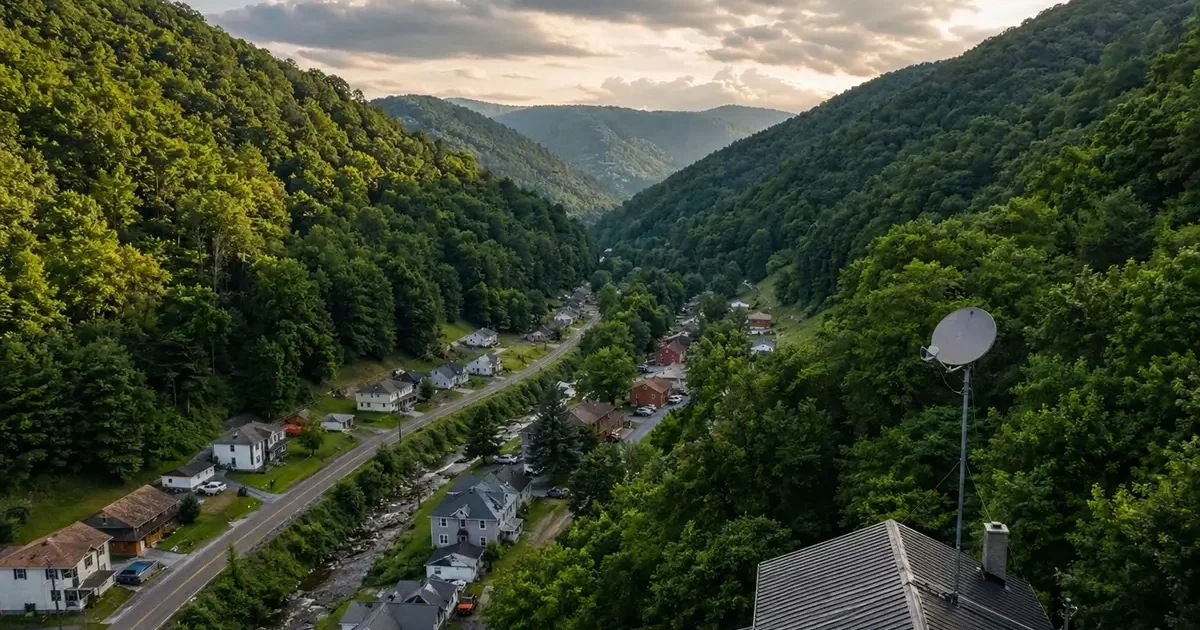
Virginia’s rural broadband situation is one of the most politically and geographically complex in the nation. The state combines some of the most well-connected suburban communities in America — the Northern Virginia suburbs of Washington, D.C., bristle with fiber and high-speed cable — with some of the most persistently disconnected rural communities anywhere east of the Mississippi. Southwest Virginia’s coalfield counties, the rural Piedmont, the Northern Neck peninsula, and the remote reaches of the Alleghany Highlands are home to tens of thousands of Virginians for whom reliable broadband has never been a realistic daily reality. In 2026, Virginia’s aggressive state broadband investment program, combined with Starlink’s universal coverage and federal BEAD Program funding, is beginning to close this gap — but the work is far from finished. This complete guide covers every rural internet option available across Virginia’s diverse regions.
In This Guide
- Virginia Rural Broadband Overview
- Best Internet by Virginia Region
- Starlink in Virginia
- Cellular Home Internet in Rural Virginia
- Virginia Electric Cooperatives and Broadband
- Virginia State Broadband Programs
- BEAD Program Investment in Virginia
- Southwest Virginia: A Region in Focus
- Practical Tips for Rural Virginia Residents
- Frequently Asked Questions
Virginia Rural Broadband Overview
Virginia is a state of extraordinary contrasts in connectivity. Fairfax County in Northern Virginia has near-universal gigabit fiber access; Buchanan County in Southwest Virginia has some of the worst broadband access rates of any county east of the Rocky Mountains. This disparity is not accidental — it reflects decades of telecommunications investment that followed population density and economic activity, leaving rural Virginia’s mountains, valleys, and agricultural communities systematically behind.
According to the FCC National Broadband Map, Virginia has a substantial number of unserved and underserved rural addresses concentrated in the southwestern mountain counties, the rural Piedmont, the Northern Neck and Middle Peninsula, and the rural portions of the Shenandoah Valley. The state’s 2024 broadband investment reports identified over 200,000 Virginia addresses lacking adequate broadband service — a figure that drove significant state and federal investment in closing the gap.
Virginia has responded to this challenge more aggressively than many states. The Virginia Telecommunications Initiative (VATI) — the state’s primary rural broadband grant program — has invested hundreds of millions of dollars in rural broadband infrastructure since 2017, making Virginia one of the most active states in the country for state-level broadband investment. Combined with federal BEAD Program funding and ongoing electric cooperative broadband programs, Virginia’s rural connectivity trajectory is meaningfully improving.
Best Internet by Virginia Region
Southwest Virginia Coalfields (Buchanan, Dickenson, Russell, Tazewell, Wise Counties)
Southwest Virginia’s former coal counties represent the state’s most severe broadband gap — a connectivity deficit that compounds the economic challenges already facing communities transitioning away from coal employment. Buchanan and Dickenson counties have among the lowest broadband access rates of any Virginia counties, with many communities in narrow mountain hollows that both block wireless signal paths and make fiber deployment extremely expensive per household. Starlink is available statewide and is the most immediately accessible broadband solution for most Southwest Virginia properties with adequate sky clearance. VATI and BEAD funding have specifically prioritized Southwest Virginia as the state’s most urgent broadband investment zone.
Shenandoah Valley Rural (Augusta, Rockbridge, Bath, Highland Counties)
The rural portions of the Shenandoah Valley and the Alleghany Highlands to the west represent a second major Virginia broadband gap. Bath and Highland counties — among the most sparsely populated counties east of the Mississippi — have minimal telecommunications infrastructure outside of the small resort communities of Hot Springs and Monterey. The Valley’s broader agricultural communities in Augusta, Rockbridge, and Botetourt counties have telephone cooperative DSL in some corridors and expanding electric cooperative fiber programs. Starlink performs excellently across the Valley’s open landscape where sky views are generally unobstructed. T-Mobile Home Internet availability is better in the populated Valley floor communities than in the more remote mountain areas.
Northern Neck and Middle Peninsula (Lancaster, Northumberland, Essex, Middlesex Counties)
Virginia’s tidewater peninsulas between the Potomac, Rappahannock, and York Rivers represent a distinct connectivity challenge — low population density, waterfront geography that limits infrastructure routing, and communities that are geographically close to Washington and Richmond but functionally isolated from their broadband infrastructure. The Northern Neck has been a specific focus of VATI investment, and several electric cooperative broadband programs serve portions of this region. Starlink’s flat tidewater terrain makes for excellent installation conditions with minimal obstruction concerns.
Rural Piedmont (Lunenburg, Brunswick, Mecklenburg, Charlotte Counties)
Southern Virginia’s rural Piedmont counties — tobacco and timber country stretching along the North Carolina border — have significant broadband gaps in agricultural communities away from the US-58 corridor. Several VATI-funded projects are actively deploying fiber in this region. Mecklenburg Electric Cooperative and other rural cooperatives serve parts of this region with expanding broadband programs. Starlink provides immediate broadband access across the entire Piedmont region.
Starlink in Virginia
Starlink is available statewide in Virginia with no waitlist. Performance across the state’s diverse geography reflects Virginia’s terrain variety. The Shenandoah Valley and rural Piedmont deliver consistently strong Starlink performance in lower-density coverage cells — users routinely report 80–130 Mbps download speeds. Southwest Virginia’s mountain terrain creates more sky obstruction challenges, particularly in narrow coal-hollow communities where ridge walls may limit the northern sky view. The general rule applies: ridge-top and slope properties have excellent Starlink conditions while deep valley bottom properties may need mast installation to achieve adequate sky clearance.
Virginia’s moderate mid-Atlantic climate creates fewer weather-related Starlink performance concerns than northern states. Ice storms — which occur periodically across Virginia’s mountain regions — are the primary weather risk for Starlink performance, as ice accumulation can overwhelm the dish heater’s capacity and temporarily interrupt service. Properties in the Alleghany Highlands and Blue Ridge areas should be aware of this seasonal risk and consider mounting the dish at an angle that facilitates ice shedding.
Virginia Electric Cooperatives and Broadband
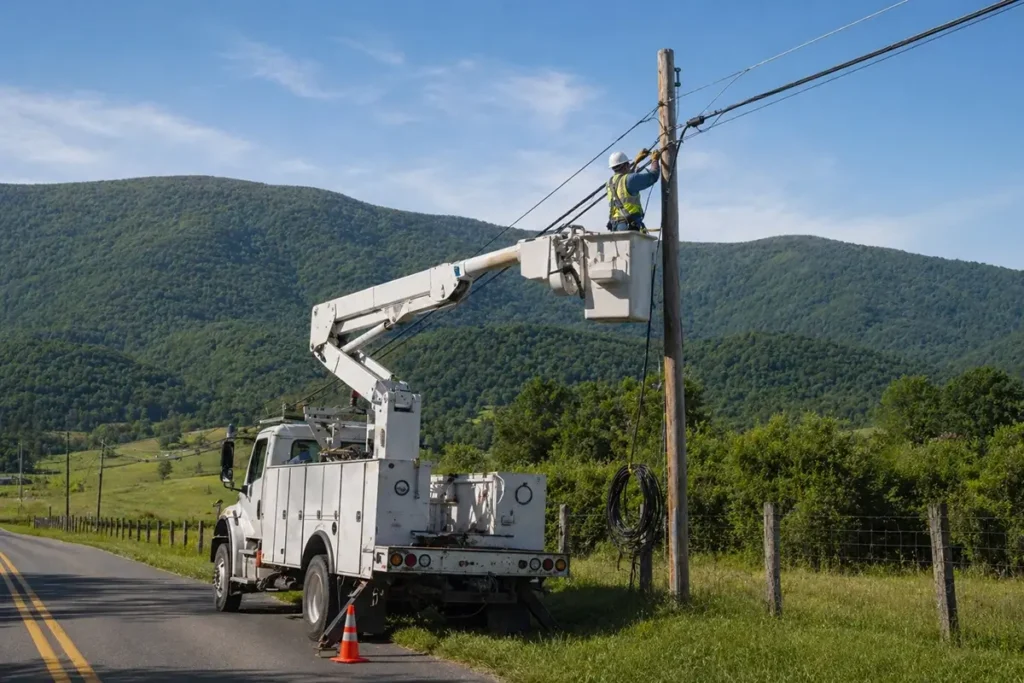
Virginia’s electric cooperatives have been among the most active in the Southeast in pursuing rural broadband deployment for their members. Key programs include:
- Central Virginia Electric Cooperative (CVEC): Serving rural members across Albemarle, Buckingham, Fluvanna, Greene, Louisa, Nelson, and Orange counties with an active fiber broadband program — one of Virginia’s most comprehensive electric cooperative broadband deployments.
- Rappahannock Electric Cooperative: One of the largest Virginia cooperatives, serving members across 22 counties from the Northern Neck to Southwest Virginia with expanding broadband programs.
- Appalachian Power / American Electric Power: Serving Southwest Virginia with utility infrastructure that has been increasingly leveraged for broadband deployment partnerships.
- Northern Neck Electric Cooperative: Serving the Northern Neck peninsula with active broadband deployment using VATI funding.
- Mecklenburg Electric Cooperative: Serving southern Piedmont members with broadband expansion using VATI and BEAD funding.
Virginia cooperative members should contact their cooperative directly about broadband availability and upcoming deployment timelines — programs have been expanding rapidly.
Virginia State Broadband Programs
Virginia’s Virginia Telecommunications Initiative (VATI), administered by the Department of Housing and Community Development, has been one of the nation’s most effective state rural broadband grant programs. VATI has awarded hundreds of millions of dollars across multiple funding rounds since 2017, funding fiber and fixed wireless deployments across the state’s most underserved rural communities. The program specifically requires funded projects to serve previously unserved or underserved addresses, ensuring that investment reaches the communities with the greatest need rather than simply extending service at the urban fringe.
Virginia also operates the Virginia Broadband Availability Map, which aggregates state and federal coverage data and serves as the planning basis for VATI and BEAD investments. Rural Virginians can challenge inaccurate coverage claims on this map — just as on the FCC National Broadband Map — to ensure their communities are correctly identified as needing investment. The Virginia Department of Housing and Community Development’s broadband office maintains current program information at dhcd.virginia.gov/broadband.
BEAD Program Investment in Virginia
Virginia received approximately $1.49 billion in BEAD Program federal funding — one of the larger Mid-Atlantic state allocations, reflecting both the scale of Virginia’s rural broadband gap and the state’s track record of effective broadband program administration. Virginia’s BEAD implementation plan prioritizes unserved locations in the state’s most severely disconnected regions — Southwest Virginia, the Northern Neck, the rural Piedmont, and the Alleghany Highlands — for first-round infrastructure deployment.
The state has set an ambitious target of connecting all unserved Virginia households to broadband service by 2028 using the combination of BEAD funding, VATI grants, and electric cooperative investments. Whether this timeline is achievable depends significantly on the construction challenges in Southwest Virginia’s mountain terrain, where per-household fiber costs can exceed $5,000–$10,000 in the most difficult topography.
Southwest Virginia: A Region Deserving Special Attention
Southwest Virginia’s connectivity challenge is inseparable from its broader economic transition. The region’s coal economy has declined by over 80% since its peak, and economic development advocates uniformly identify broadband connectivity as a prerequisite for the technology-sector jobs, remote work opportunities, and entrepreneurship that could replace lost coal employment. Organizations including the Appalachian Regional Commission (ARC), the LENOWISCO Planning District Commission, and Virginia Coalfield Economic Development Authority (VCEDA) have all identified broadband as their top infrastructure investment priority for Southwest Virginia’s economic future.
Several VATI and ReConnect-funded fiber projects are actively under construction in Buchanan, Dickenson, and Wise counties in 2026. For Southwest Virginia residents who have waited years for connectivity, these deployments represent genuine near-term progress. For those who cannot wait — particularly remote workers, students, and telehealth-dependent patients — Starlink provides broadband-quality connectivity today regardless of the mountainous terrain, provided an adequate sky view can be achieved from the installation site.
Practical Tips for Rural Virginia Residents
- Southwest Virginia residents: The Starlink app’s sky obstruction scanner is essential pre-purchase due diligence in coal-hollow terrain. If your hollow-bottom property has limited northern sky access, a 20–40 foot mast typically clears most Virginia mountain obstruction situations. Many Southwest Virginia users report that a mast plus Starlink has been transformative after years of inadequate DSL service.
- Contact your electric cooperative immediately. Virginia’s electric cooperatives are among the most broadband-active in the Mid-Atlantic. CVEC, Rappahannock Electric, and others have active fiber programs — if you’re a cooperative member, check your cooperative’s website or call member services about current broadband availability and upcoming deployment timelines for your road.
- Check VATI funded projects. The Virginia DHCD broadband office publishes maps of VATI-funded projects, including service areas and expected completion dates. If your area is within a funded project boundary, contact the funded ISP directly about when service will be available at your address.
- Northern Neck and Tidewater residents: Your flat tidewater terrain makes Starlink installation extremely straightforward. Check T-Mobile Home Internet eligibility first at $50/month — the Northern Neck’s proximity to I-95 and Richmond corridors means T-Mobile coverage is sometimes better than expected in these areas.
Frequently Asked Questions
What is the best internet option for rural Southwest Virginia in 2026?
Starlink is the most immediately available broadband solution for the vast majority of rural Southwest Virginia properties. Check for sky clearance using the Starlink app — most ridge-top and slope properties have excellent conditions. For hollow-bottom properties, a 20–40 foot mast typically resolves obstruction issues. VATI and BEAD-funded fiber projects are actively deploying in several Southwest Virginia counties in 2026–2027, so check your specific county’s project status with the Virginia DHCD broadband office for upcoming wired options.
Does Virginia have any state assistance programs for rural internet costs?
The FCC Lifeline Program ($9.25/month discount) applies to qualifying Virginia low-income households for internet service. Virginia does not currently have a state-specific internet cost subsidy program for households, though BEAD implementation requirements include affordability provisions requiring funded ISPs to offer low-cost plans to qualifying households in their service areas. Contact Virginia’s Department of Housing and Community Development broadband office for current program availability.
When will CVEC’s fiber reach my rural address?
Central Virginia Electric Cooperative’s fiber broadband deployment is ongoing across its service territory. CVEC publishes deployment maps on its website showing current service areas and planned expansion zones. Members within planned deployment areas can pre-register for service notification. For members in areas not yet on the deployment map, expressing interest through CVEC’s member engagement channels influences cooperative leadership’s expansion priority decisions.



Leave a Reply