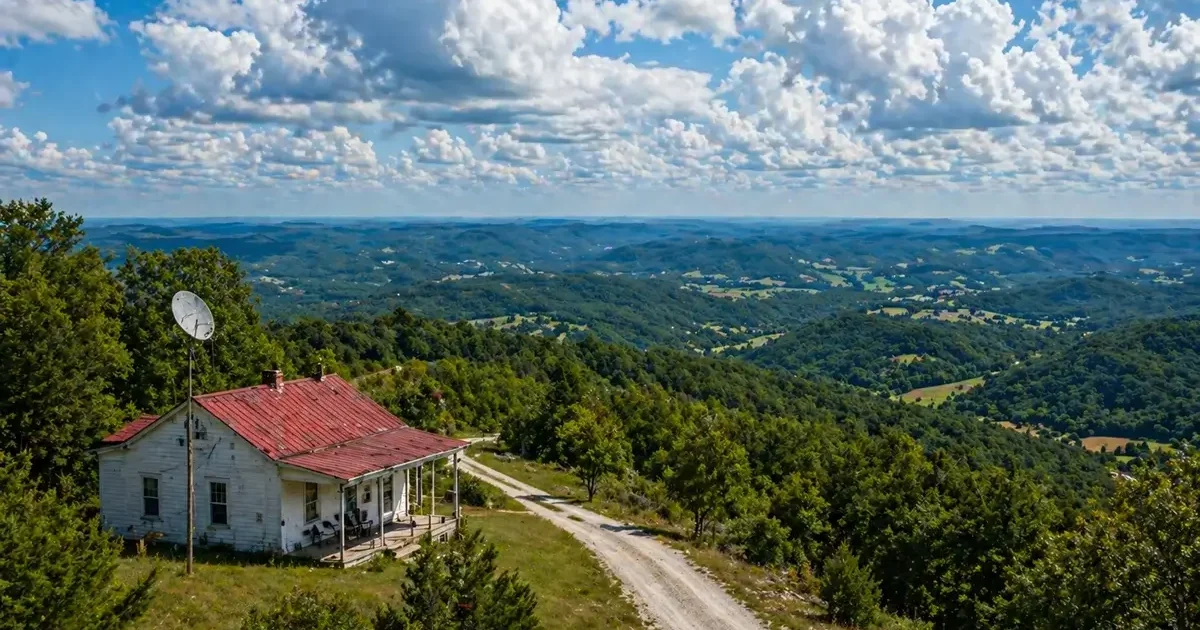
Arkansas is a state where the rural broadband divide runs deep and wide. Nearly 45% of Arkansas’s population lives in rural areas — communities spread across the Ozark Plateau, the Arkansas River Valley, the Delta flatlands, and the Ouachita Mountains. These geographically diverse regions share a common challenge: decades of limited telecommunications investment have left hundreds of thousands of Arkansas residents without reliable broadband, constraining economic development, educational access, and quality of life across the Natural State’s rural communities. In 2026, Arkansas is experiencing a period of unprecedented broadband investment driven by BEAD Program funding, active electric cooperative programs, and the universal availability of Starlink satellite internet. This comprehensive guide covers every rural internet option across Arkansas’s distinct geographic regions.
In This Guide
- Arkansas Rural Broadband Overview
- Internet Options by Arkansas Region
- Starlink in Arkansas
- Cellular Options in Rural Arkansas
- Arkansas Electric Cooperatives and Broadband
- Arkansas State Broadband Programs
- The Arkansas Delta: Special Focus
- Ozarks Connectivity
- Practical Tips for Rural Arkansas Residents
- Frequently Asked Questions
Arkansas Rural Broadband Overview
Arkansas’s broadband gap reflects the state’s geography and economic history. The Arkansas Delta — the flat alluvial plain along the Mississippi River — shares the connectivity challenges of neighboring Mississippi and Tennessee Delta communities, with very low population density, limited historic ISP investment, and communities where economic barriers compound geographic isolation. The Ozark and Ouachita mountain regions create terrain-based infrastructure challenges that drive up the per-household cost of wired broadband deployment. The Arkansas River Valley corridor between these mountain ranges has better connectivity than either flanking region, but still has significant rural gaps away from the main river corridor cities.
According to the FCC National Broadband Map, Arkansas ranks in the bottom quartile of states for rural broadband access, with counties including Phillips, Lee, Monroe, and Prairie in the Delta region and several Ozark and Ouachita mountain counties showing particularly severe connectivity deficits. The state’s African American rural population, concentrated in Delta counties, has been disproportionately affected by both the connectivity gap and the economic barriers to adoption that prevent eligible households from subscribing even when service technically exists.
Internet Options by Arkansas Region
Northwest Arkansas (Benton, Washington, Carroll, Madison Counties)
Northwest Arkansas — anchored by the Bentonville-Fayetteville-Rogers corridor and home to Walmart’s global headquarters and a thriving technology and logistics sector — has the best broadband infrastructure in the state. Urban and suburban communities in this region have fiber and cable service. Rural communities in Carroll and Madison counties adjacent to the urban corridor have better options than most of rural Arkansas, including some WISP coverage and T-Mobile Home Internet eligibility in tower-dense areas. Rural properties at the edges of the Ozark Plateau in this region use Starlink as their primary option where wired broadband doesn’t reach.
Arkansas Ozarks (Newton, Boone, Searcy, Stone, Izard, Fulton Counties)
The Arkansas Ozarks — the state’s most rugged and isolated mountain region — presents connectivity challenges comparable to the Appalachian communities of neighboring states. Newton County, which contains the Buffalo National River and much of the Upper Buffalo watershed, has some of the most remote communities in the state. Terrain-related wireless coverage limitations are significant throughout the Ozark Plateau’s dissected landscape of ridges, hollows, and river valleys. Starlink is the most universally available broadband for Ozark communities, with performance that varies significantly based on sky access from individual property locations. Several small WISPs operate in specific Ozark corridors, and telephone cooperative DSL serves some communities at marginal speeds.
Arkansas River Valley (Pope, Yell, Logan, Scott, Sebastian Counties)
The Arkansas River Valley corridor has moderate connectivity compared to the mountain regions flanking it. Fort Smith and Russellville anchor the corridor with cable and some fiber service that extends partially into surrounding rural areas. Rural communities along US-64, US-22, and adjacent routes have better telephone cooperative DSL than the mountains to the north and south. T-Mobile Home Internet eligibility is moderate in the River Valley where tower density along the major corridor is higher. Starlink serves the entire River Valley region effectively.
Ouachita Mountains (Montgomery, Polk, Scott, Howard Counties)
The Ouachita Mountains in southwest Arkansas — home to Ouachita National Forest and the state’s most rugged southwest terrain — have connectivity challenges similar to the Ozarks but with slightly different geography. The east-west trending ridges create predictable signal-blocking patterns for wireless technologies. Some communities along US-270 have telephone cooperative service. Starlink covers the entire Ouachita region; the forested mountain terrain provides adequate northern sky views from most ridge and slope properties.
Arkansas Delta (Phillips, Lee, Monroe, Prairie, Desha, Chicot Counties)
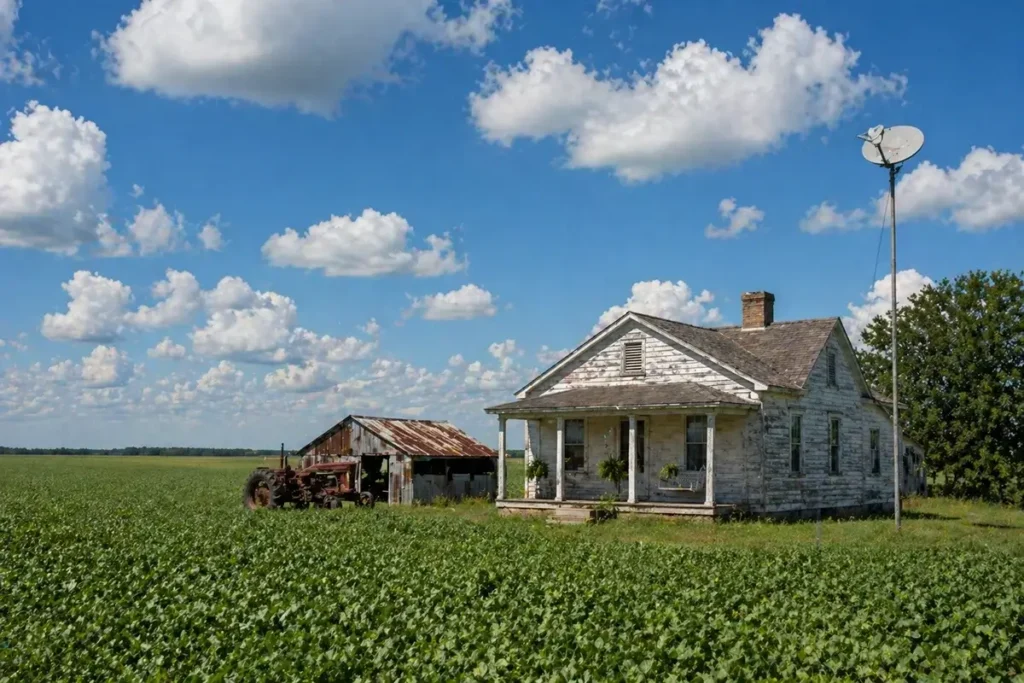
The Arkansas Delta — the flat alluvial plain between the Arkansas and Mississippi Rivers — has some of the state’s most severe broadband access deficits. The combination of very low population density, minimal historic ISP investment, and deep rural poverty creates a connectivity crisis particularly acute in communities like Helena-West Helena, Marianna, and Dumas. The flat Delta terrain is ideal for Starlink installation — no obstruction concerns anywhere in the region — and the low user density in Delta coverage cells delivers some of the fastest Starlink performance in the state. The primary barrier is economic, not geographic.
Arkansas Electric Cooperatives and Broadband
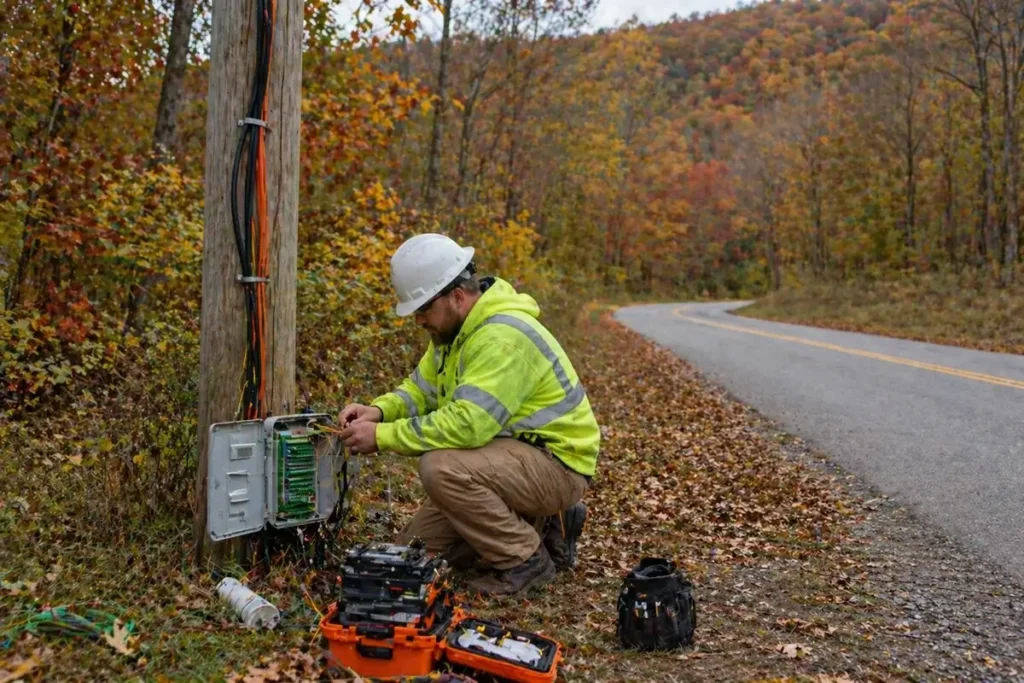
Arkansas has 17 electric cooperatives serving rural members across the state. Several have become active broadband deployers:
- Carroll Electric Cooperative: Serving northwest Arkansas members in Carroll, Benton, Boone, and Marion counties with expanding fiber broadband — one of Arkansas’s most active cooperative broadband programs.
- South Central Arkansas Electric Cooperative: Serving members in south-central Arkansas with broadband development plans using BEAD funding.
- Mississippi County Electric Cooperative: Serving northeast Arkansas Delta members with broadband expansion.
- Ouachita Electric Cooperative: Serving members in south-central Ouachita country with broadband program development.
Arkansas electric cooperative members should contact their cooperative directly about broadband availability — many programs have expanded rapidly with BEAD and ReConnect funding becoming available.
Arkansas State Broadband Programs
Arkansas’s broadband programs are coordinated by the Arkansas Department of Commerce’s Division of Science and Technology, which administers state broadband programs and oversees Arkansas’s BEAD Program implementation. Arkansas received approximately $1.0 billion in BEAD Program federal funding — a substantial allocation reflecting the state’s significant rural broadband deficit.
Arkansas has also been an active participant in the USDA ReConnect Program across multiple funding rounds, with several Arkansas electric cooperatives and telephone companies receiving ReConnect grants for rural broadband infrastructure. The Arkansas Rural Connect grant program — a state-funded complement to federal programs — has provided additional investment in rural broadband infrastructure in communities not covered by federal programs. For current program information, visit the Arkansas broadband office website.
The Arkansas Delta: Special Focus
Like the Mississippi Delta it borders, the Arkansas Delta represents a community where connectivity is simultaneously most needed and most difficult to deliver through market mechanisms alone. The region’s combination of severe poverty, declining population, and limited private ISP investment incentive means that government-funded deployment is essentially the only path to broadband for Delta communities.
Arkansas Delta communities have been specifically targeted in the state’s BEAD implementation plan for first-priority deployment. Electric cooperatives serving the Delta — including Mississippi County Electric and Delta Electric Power — are pursuing fiber deployment using BEAD grants specifically because no commercial ISP has viable economics for Delta deployment without substantial subsidy.
For Delta residents who cannot wait for infrastructure deployment, Starlink provides an immediately available solution. At $120/month, Starlink is expensive relative to Delta household incomes — the FCC Lifeline Program’s $9.25/month discount provides some relief for qualifying low-income households, reducing the effective cost to approximately $110.75/month. Community organizations, churches, and local governments in Delta communities are increasingly exploring community broadband models that aggregate demand and share infrastructure costs across multiple households.
Ozarks Connectivity: The Mountain Challenge
The Arkansas Ozarks present the state’s most challenging terrain for broadband infrastructure. Newton County — with no traffic lights, fewer than 8,000 residents, and communities accessible only by winding mountain roads — represents an extreme case of rural infrastructure economics: the cost of reaching each household is so high, and the density of potential subscribers so low, that no commercial ISP can deploy without substantial per-household government subsidy.
For Ozark residents, Starlink is often the first broadband-quality internet they have ever had access to. The performance improvement over the marginal telephone DSL that many Ozark communities have relied on — moving from 1–5 Mbps with frequent outages to 80–120 Mbps with 25 ms latency — is genuinely transformative. Communities in Newton County, Searcy County, and similar isolated Ozark areas report Starlink as a life-changing service for remote work, telehealth, and family communication.
Sky access in the Ozarks varies significantly by location. Properties on ridge tops and south-facing slopes generally have excellent northern sky clearance. Properties in narrow north-south hollows may need mast installation. The Starlink app’s augmented reality scanner is essential due diligence for any Ozark property purchase — checking Starlink viability before purchasing remote mountain property is as important as checking water well quality.
Practical Tips for Rural Arkansas Residents
- Northwest Arkansas residents in rural Carroll and Madison counties: Carroll Electric Cooperative’s fiber program is one of the state’s most active — check Carroll Electric’s broadband service map for your address before investing in satellite.
- Delta residents: Your flat terrain makes Starlink installation effortless and performance excellent. Check FCC Lifeline eligibility to reduce service costs. Also verify whether your county has an active BEAD-funded project with a realistic near-term deployment timeline before committing to satellite long-term.
- Ozark mountain residents: Use the Starlink app obstruction scanner before ordering. Most ridge and slope properties in the Arkansas Ozarks have excellent sky access. For hollow-bottom properties, a 20–30 foot mast resolves most obstruction challenges at relatively low cost.
- Challenge FCC broadband map inaccuracies. Arkansas has documented overclaiming by telephone companies reporting DSL coverage at theoretical rather than actual speeds. Filing an accurate challenge at broadbandmap.fcc.gov for your address improves your county’s BEAD eligibility and ensures funding flows where it’s genuinely needed.
Frequently Asked Questions
What is the best internet option for rural Arkansas in 2026?
For most rural Arkansas properties, the evaluation order is: (1) check Carroll Electric or your electric cooperative for fiber broadband; (2) check T-Mobile Home Internet eligibility — best value at $50/month if available; (3) Starlink as the universal fallback that works at virtually any property with sky clearance. For Delta communities and Ozark mountain properties without WISP or cooperative service, Starlink is typically the only viable broadband option available today.
Is Starlink available in the Buffalo National River area of Arkansas?
Yes. Starlink is available statewide in Arkansas with no waitlist. Properties along the Buffalo River corridor — including communities in Newton, Searcy, and Marion counties — can order and install Starlink at any property with adequate northern sky clearance. The rugged Ozark terrain means sky obstruction assessment is important for any hollow-bottom property, but ridge-top and slope properties throughout the Buffalo River watershed typically have excellent Starlink conditions.
When will fiber internet reach rural Arkansas communities?
Timeline varies significantly by county and ISP. Carroll Electric’s active fiber deployment in northwest Arkansas is the most advanced in the state. BEAD-funded deployments in priority unserved communities are expected to begin construction in late 2026 and continue through 2029–2031. Delta communities prioritized in the first round of BEAD deployment may see service beginning 2027–2028. In the interim, Starlink provides the only broadband-quality service available at most rural Arkansas addresses today.
Rural Schools and Broadband in Arkansas
Arkansas’s rural school districts face a homework gap that mirrors the state’s broader connectivity crisis. Many rural Arkansas students who have access to technology at school — through E-Rate funded school broadband programs — return home to properties with no viable broadband or only legacy satellite with inadequate performance for online homework platforms. The Arkansas Division of Elementary and Secondary Education has documented that rural-urban educational outcome gaps correlate strongly with home broadband access rates in Arkansas counties.
Several Arkansas rural school districts have implemented hotspot lending programs for students without home broadband — providing cellular hotspot devices for checkout similar to library books. Contact your child’s school district technology coordinator about hotspot lending availability. The Arkansas State Library System and Arkansas county public libraries also maintain E-Rate funded broadband available to library card holders — a meaningful community resource for students needing internet access for schoolwork in underserved communities.
Telehealth and Rural Arkansas Healthcare
Arkansas has some of the worst rural health outcomes in the nation — high rates of chronic disease, extensive healthcare deserts, and communities where the nearest specialist is more than an hour’s drive. Telehealth has been identified by the Arkansas Center for Health Improvement and the Arkansas Rural Health Partnership as among the highest-priority interventions for improving rural health access — but only when the underlying internet connectivity supports it.
Starlink’s rural Arkansas deployment has enabled telehealth access for patients who previously could not participate in video health appointments due to HughesNet and Viasat’s 600 ms latency making video calls functionally inadequate for clinical use. Rural Arkansas clinics and critical access hospitals including those in the Arkansas Rural Hospital Program have expanded telehealth offerings specifically as Starlink has made patient-side connectivity viable in remote communities. For rural Arkansas patients who still rely on geostationary satellite, upgrading to Starlink is a genuine healthcare access investment that can change access to specialist care for chronic condition management, mental health services, and preventive care. For more on this topic, see our complete guide to rural internet for telehealth.

Leave a Reply