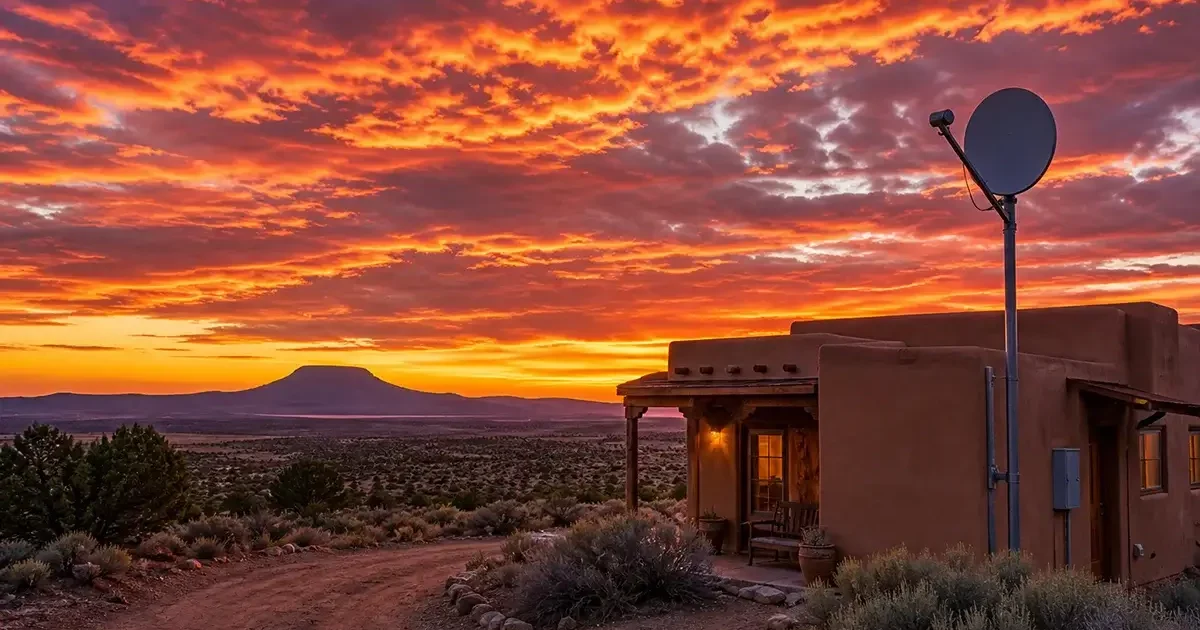
New Mexico presents one of the most challenging rural broadband environments in the United States. With the fifth-largest land area of any US state, a population of only 2.1 million people — making it one of the least densely populated states — and geography ranging from high desert plateaus to the Rocky Mountain spine to the Chihuahuan Desert, New Mexico’s rural connectivity challenges are as vast and varied as its landscape. The state’s significant Native American population, living on reservation lands that span roughly 9 million acres of the state’s territory, faces compounding barriers of geographic isolation, limited economic resources, and historical infrastructure underinvestment that make the connectivity gap an issue of justice as much as economics. This comprehensive guide covers every rural internet option across New Mexico’s diverse regions in 2026.
In This Guide
- New Mexico Rural Broadband Overview
- Best Internet by New Mexico Region
- Starlink in New Mexico
- Connectivity on New Mexico Tribal Lands
- Cellular Coverage in Rural New Mexico
- Local and Regional ISPs
- New Mexico State Broadband Programs
- BEAD Program Investment in New Mexico
- Practical Tips for Rural New Mexico Residents
- Frequently Asked Questions
New Mexico Rural Broadband Overview
New Mexico’s broadband gap is among the most severe of any western state. According to the FCC National Broadband Map, a substantial percentage of New Mexico’s rural addresses lack access to fixed broadband at modern speed standards. The state’s combination of vast distances, sparse population, rugged terrain, and significant economically disadvantaged rural populations — both Hispanic/Latino agricultural communities in the Rio Grande valley’s rural reaches and the state’s 23 federally recognized Native American nations — creates a connectivity crisis that is simultaneously geographic, economic, and historical.
The Rio Grande and its tributaries define New Mexico’s most productive agricultural land and many of its oldest communities — acequias (irrigation ditch communities) and historic Spanish colonial settlements that predate the United States itself. These communities have rich cultural heritage but limited telecommunications infrastructure. The state’s eastern llano (high plains) in the Portales, Roswell, and Carlsbad areas has better agricultural connectivity than the mountain communities but still has significant gaps in remote ranching country. The Navajo Nation, Pueblo communities, and other tribal nations occupying substantial portions of western and northern New Mexico have some of the state’s worst connectivity statistics.
Best Internet by New Mexico Region
Northern New Mexico / Rio Grande Valley (Rio Arriba, Taos, Mora, Colfax Counties)
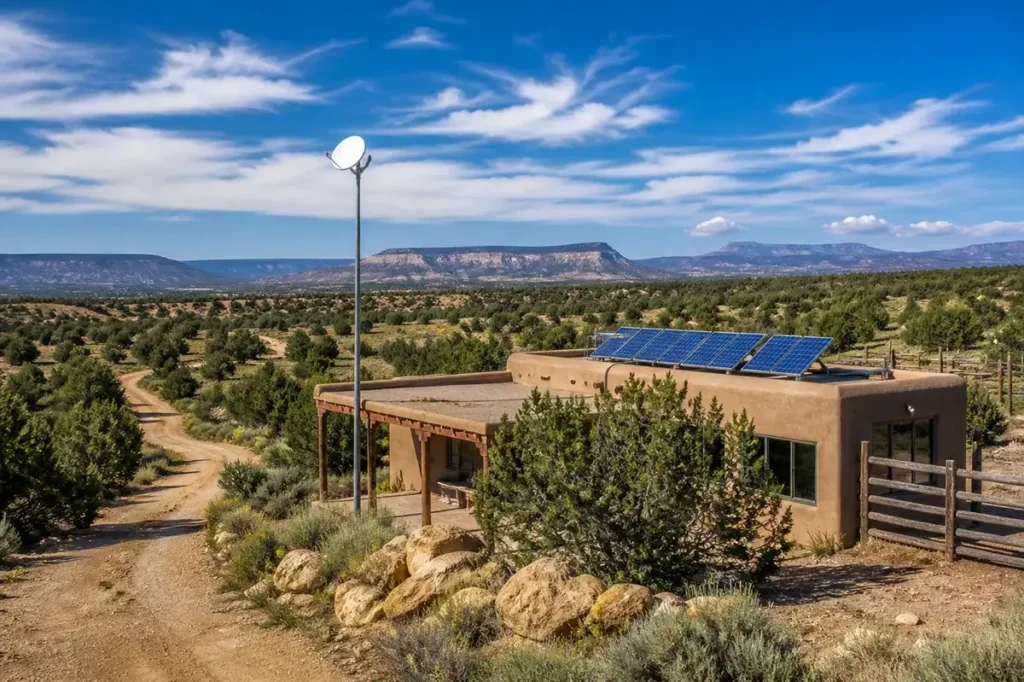
Northern New Mexico’s high mountain and Rio Grande valley communities have a mix of telephone cooperative DSL, some WISP coverage in specific corridors, and Starlink as the universal fallback for remote properties. Communities in the Española Valley, Taos Plateau, and Mora Valley have legacy telephone infrastructure from Citizens Telephone Company and Consolidated Communications that provides varying quality DSL. The scenic but remote communities of the Sangre de Cristo Mountains and Jemez Mountains rely almost exclusively on Starlink. T-Mobile’s rural northern NM coverage is limited. Tribal communities in this region — including multiple Pueblos — have been targeted by tribal broadband funding programs.
Central New Mexico (Socorro, Valencia, Torrance, Lincoln Counties)
Central New Mexico’s vast middle reaches — from the Rio Grande valley eastward across the mountains to the Estancia Basin and Lincoln County ranching country — have spotty connectivity dominated by telephone DSL in communities along US-60, US-380, and US-285 corridors. Rural properties far from these corridors have minimal options beyond satellite. Catron County — the largest county in New Mexico by area and one of the least populated counties in the US — has essentially no fixed broadband outside the small town of Reserve and relies almost entirely on Starlink for any connectivity. The flat high plains of the Estancia Valley are ideal for Starlink installation.
Eastern New Mexico (Chavez, Eddy, Lea, Roosevelt, Curry Counties)
Eastern New Mexico’s high plains and Pecos River valley communities have somewhat better connectivity than the western and mountain regions — driven by the petroleum and natural gas industry’s infrastructure investment in the Permian Basin’s eastern extent (Lea and Eddy counties) and by proximity to the Texas Panhandle’s telecommunications infrastructure. Roswell, Hobbs, Carlsbad, and Clovis have cable or fiber service. Rural agricultural and ranching communities between these towns have telephone cooperative DSL and Starlink. The flat terrain of the eastern llano makes Starlink installation completely straightforward.
Western New Mexico (Grant, Catron, Hidalgo, Luna, Sierra Counties)
Western New Mexico’s mountain and high desert communities — including the Gila Wilderness area, the Bootheel, and the Black Range — represent some of the state’s most isolated territory. Grant County’s mining community history has left some infrastructure; surrounding counties are among the most remote and least-connected in the state. Truth or Consequences and Silver City have basic cable/fiber in town limits; rural areas beyond depend entirely on Starlink and marginal cellular coverage. Hidalgo County in the far southwest corner of New Mexico has some of the sparsest population and worst connectivity of any US county east of California.
Connectivity on New Mexico Tribal Lands
New Mexico has 23 federally recognized Native American nations — 19 Pueblos, the Navajo Nation (extending into New Mexico from Arizona and Utah), and portions of two Apache tribes — occupying roughly 9 million acres of the state’s territory. Tribal communities face compounding connectivity barriers:
- Remote geography that makes infrastructure deployment expensive
- Tribal sovereignty requirements that add regulatory complexity to ISP deployments on tribal land
- Historical telecommunications underinvestment on tribal lands driven by racism and neglect
- Economic barriers to adoption even when service technically exists
Several New Mexico tribal nations have pursued broadband independently using tribal economic resources and federal tribal broadband funding. The Navajo Nation Tribal Utility Authority (NTUA) has deployed fiber and wireless broadband across portions of the Navajo Nation in New Mexico. The Eight Northern Pueblos have collaborated on broadband planning across their member communities. The All Pueblo Council of Governors has advocated collectively for broadband investment in Pueblo communities. Tribal members on New Mexico reservation lands should contact their tribal government’s utility or economic development office for information about tribal broadband programs in their specific community.
Cellular Coverage in Rural New Mexico
Rural New Mexico cellular coverage is significantly more limited than in most eastern states. The state’s vast distances and sparse population make tower deployment economics challenging for all carriers. Verizon has the strongest rural New Mexico cellular network, with coverage along major highway corridors (I-25, I-40, US-54, US-285) and in communities near those corridors. T-Mobile’s rural NM coverage is less comprehensive than in most states — T-Mobile Home Internet eligibility in rural New Mexico is limited to communities near significant population centers and major highway corridors. AT&T FirstNet has improved rural NM coverage through emergency responder network investment in some areas.
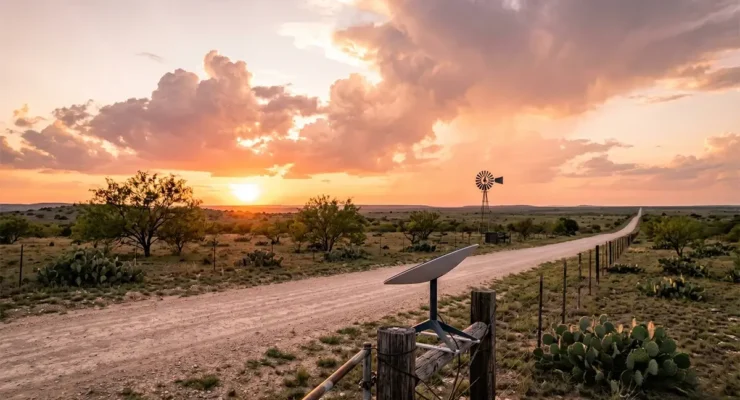
For truly remote New Mexico rural properties — the kind of place where there’s no cell signal from any carrier — Starlink is not just the best option, it is the only option. And the state’s famously clear skies and open terrain make Starlink installation conditions excellent across virtually all of New Mexico’s rural landscape.
New Mexico State Broadband Programs
New Mexico’s broadband programs are coordinated by the New Mexico Department of Information Technology (DoIT) through its Broadband Program. New Mexico received approximately $641 million in BEAD Program federal funding — a significant allocation reflecting the state’s profound broadband gap relative to its population and geographic size.
New Mexico has a specific structural challenge in BEAD implementation: the state has a high percentage of tribal lands where BEAD deployment requires coordination with tribal governments that have their own sovereignty, regulatory requirements, and infrastructure plans. The state has worked to develop tribal engagement protocols that respect tribal sovereignty while facilitating BEAD-funded deployment in tribal communities that want it. For current program information and maps of funded projects, visit the New Mexico DoIT broadband program website.
Practical Tips for Rural New Mexico Residents
- New Mexico’s clear skies are Starlink’s ideal environment. The state’s low humidity, minimal tree cover outside the mountains, and open terrain create some of the best Starlink installation conditions in the country. Mountain communities should use the app’s sky scanner, but most of the state’s rural territory has essentially unrestricted sky access from ground level.
- Tribal members: contact your tribal government about broadband programs before ordering Starlink. Several tribal nations have active programs that may provide subsidized or free connectivity to qualifying members.
- Eastern NM residents in the Permian Basin: Check Verizon Home Internet eligibility — the oilfield industry’s infrastructure investment has improved Verizon coverage in parts of Lea and Eddy counties that may qualify for Home Internet service at the $25/month bundled rate.
- Remote property owners: New Mexico’s remote rural properties — guest ranches, hunting camps, off-grid homesteads — are ideal Starlink candidates. The portable/roam plan allows seasonal use; the standard plan covers permanent off-grid installations. Many remote NM property owners report Starlink as the most transformative change to rural life since rural electrification.
Frequently Asked Questions
Is Starlink available in the Navajo Nation areas of New Mexico?
Yes. Starlink is available across all of New Mexico including Navajo Nation territory with no waitlist. The Navajo Nation’s high desert terrain provides excellent sky views and minimal obstruction for Starlink installation. The primary barrier is economic — the $349 hardware and $120/month service cost represents a significant percentage of household income in many Navajo communities. Tribal broadband subsidy programs and FCC Lifeline discounts can help address cost barriers for qualifying households.
What is the best internet for rural ranching operations in New Mexico?
For remote New Mexico ranches without cellular or wired broadband coverage, Starlink is the only viable broadband solution. The Standard plan ($120/month) covers typical ranch office operations; the Business plan ($250/month) provides better performance for operations with multiple employees or high data usage. For emergency communication independent of internet (essential for remote New Mexico properties), a Garmin inReach or SPOT satellite communicator is strongly recommended alongside any internet solution.
Does New Mexico have any rural internet subsidies for low-income households?
The FCC Lifeline Program provides $9.25/month discounts for qualifying low-income rural New Mexico households. The New Mexico Human Services Department’s Low Income Home Energy Assistance Program (LIHEAP) has explored internet cost inclusion in some program iterations. Tribal members may qualify for tribal broadband assistance programs administered by their specific nation. Check with the New Mexico DoIT broadband program and your county’s community action agency for current state and local assistance programs.
Remote Work and Rural New Mexico
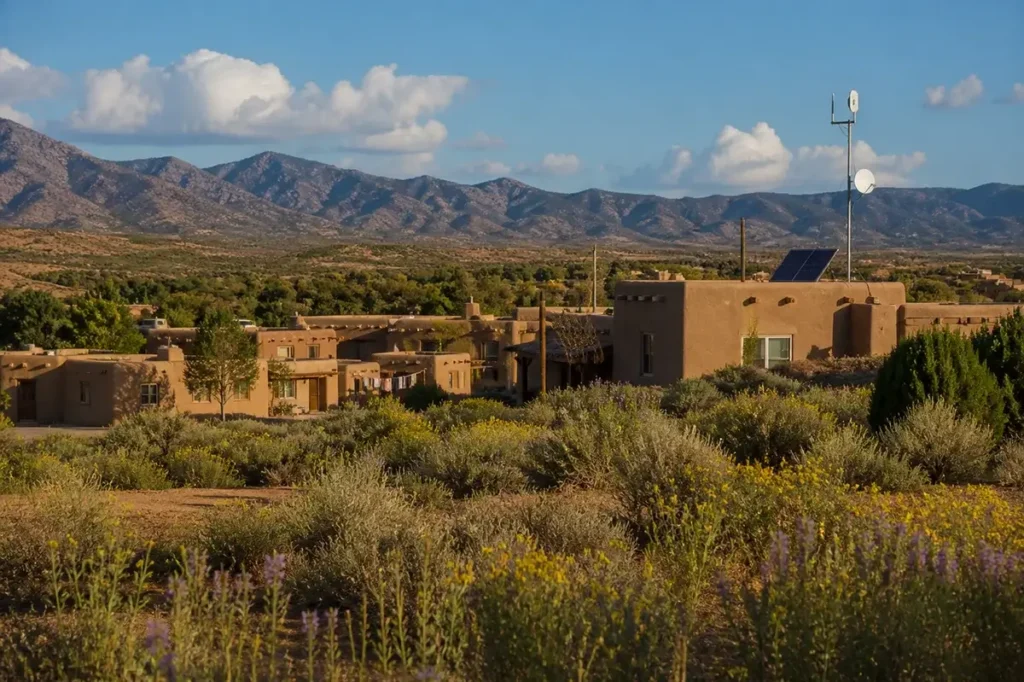
New Mexico has emerged as an increasingly attractive destination for remote workers fleeing high-cost Pacific Coast and Colorado Front Range markets. Santa Fe, Taos, and the communities of the Rio Grande valley offer a combination of cultural richness, natural beauty, and dramatically lower housing costs than California or Colorado — but the internet infrastructure needed to support remote work has lagged far behind the lifestyle draw.
For remote workers who have relocated to rural New Mexico, Starlink has been the enabling infrastructure that makes the lifestyle viable. The combination of Starlink broadband and a properly configured home office network (wired Ethernet, quality router with QoS, UPS for power fluctuation protection) creates a remote work environment that is functionally equivalent to urban broadband in terms of meeting typical professional connectivity requirements. Communities like Abiquiu, Peñasco, and the rural Taos area — previously impractical for remote work due to inadequate internet — now have residents running successful remote careers enabled by Starlink connectivity.
New Mexico’s economic development organizations, including the New Mexico Economic Development Department, have increasingly incorporated broadband connectivity into their rural workforce and business development programs, recognizing that connectivity is a prerequisite for the remote work economy that represents one of the state’s most promising rural economic development opportunities.
Off-Grid Living and Internet in New Mexico
New Mexico has one of the largest off-grid living communities in the United States, concentrated in the Taos area (the Taos “earthship” community), the Galisteo Basin, and throughout the state’s high desert. The state’s 300+ days of sunshine annually makes solar power highly practical, and off-grid solar combined with Starlink has become a powerful combination that enables connected, sustainable rural living without grid infrastructure.
For New Mexico off-grid properties, the solar-powered Starlink setup has become standard practice. A 400–600W solar array with 200–400Ah of lithium iron phosphate battery storage comfortably powers a Starlink Gen 3 dish and router (50–75W combined) alongside typical small-home electrical loads. Many New Mexico off-grid residents report this combination — solar power and Starlink — as enabling a quality of rural life that was previously impossible without grid connection. See our complete off-grid internet guide for detailed setup recommendations applicable to New Mexico’s high-altitude, high-solar-resource environment.


Leave a Reply