If you live in a rural area with spotty or no cell signal inside your home, a cell signal booster could be one of the most cost-effective upgrades you ever make to your rural property. Rather than upgrading your internet plan or switching providers, a signal booster amplifies the existing cellular signal from nearby towers, often transforming a 1-bar, drop-call-prone nightmare into 4–5 bars of consistent service. In this guide, we review the best cell signal boosters for rural homes and properties in 2026, explain how they work, and help you choose the right system for your specific situation.
In This Guide
- How Cell Signal Boosters Work
- What to Look For Before You Buy
- Top Picks: Best Rural Signal Boosters 2026
- 1. weBoost Home MultiRoom
- 2. weBoost Home Complete
- 3. SureCall Fusion5X 2.0
- 4. HiBoost Home 15K Smart Link
- 5. Wilson Pro 70 Plus
- Full Comparison Table
- Installation Tips for Rural Properties
- FAQs
How Cell Signal Boosters Work
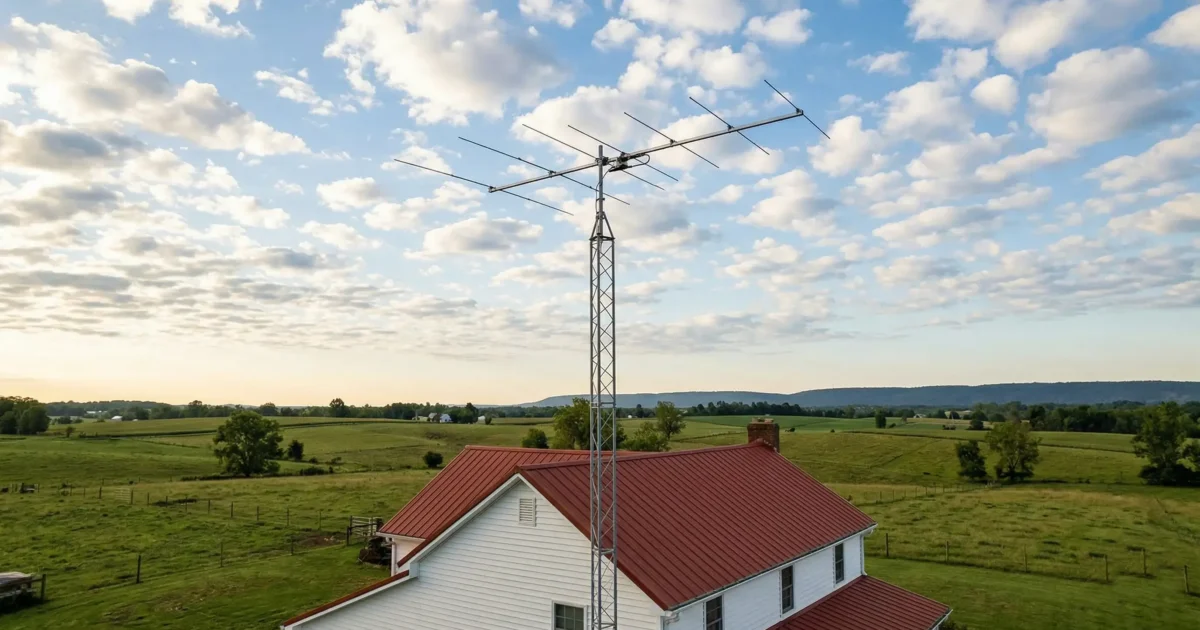
A cell signal booster (also called a cell phone signal amplifier or repeater) is a system with three core components: an outdoor antenna, a signal amplifier, and an indoor antenna. Here is the signal chain:
- The outdoor (donor) antenna is mounted on your roof, a mast, or a pole at the highest practical point. It picks up whatever cellular signal exists in your area, even signals too weak to reach inside your home.
- The amplifier (typically installed in a garage, utility room, or anywhere with power) boosts the signal received by the outdoor antenna by a factor of up to 32x (measured in dB gain).
- The indoor antenna rebroadcasts the boosted signal inside your home, vehicle, or building, covering an area determined by the indoor antenna type and amplifier power.
Cell signal boosters are legal in the United States when using certified equipment. The FCC requires all signal boosters to be registered with your carrier (a simple, free online process), and all major boosters on this list include carrier notification instructions in the box.
Important limitation: a signal booster cannot create signal where there is literally none. If you are completely outside any cellular tower’s reach, no booster will help. The outdoor antenna must be able to pick up at least a minimal signal (-110 dBm or better on a cellular signal analyzer app) to give the amplifier something to work with. For truly no-signal situations, alternatives like Starlink, satellite phones, or SPOT/Garmin communicators are more appropriate.
What to Look For Before You Buy
Not all signal boosters are created equal. For rural properties — where existing signal is weakest and coverage areas are largest — these are the specs that matter most:
- Maximum Gain (dB): Gain measures how much the amplifier amplifies the signal. For rural use, look for boosters with 72 dB gain or higher. The highest-end residential systems offer up to 72–74 dB. More gain = more ability to work with a weak incoming signal.
- Uplink Output Power: Measured in dBm, this determines how far the indoor signal reaches and how clearly your phone can communicate back to the tower. Higher uplink power is especially important in rural areas where towers are distant.
- Coverage Area: Manufacturer-stated coverage areas (typically 3,000–25,000 sq ft) assume ideal conditions. In rural areas with very weak incoming signal, expect real-world coverage of 30–50% of the stated maximum. A booster rated for 7,500 sq ft may cover 3,000–4,000 sq ft in a truly weak signal area.
- Band Support: Confirm the booster supports the frequency bands your carrier uses in your area. All premium boosters on this list support 5G mid-band and all major 4G LTE bands (including Band 12/17, which carriers use specifically for rural coverage due to its long range).
- Outdoor Antenna Type: For rural use, a directional (Yagi) outdoor antenna almost always outperforms an omnidirectional antenna. Yagi antennas focus all their gain in a single direction toward the tower, capturing much weaker signals than an omni can at the cost of needing to be aimed.
Top Picks: Best Rural Cell Signal Boosters 2026
1. weBoost Home MultiRoom — Best Overall for Most Rural Homes
Price: ~$479 | Coverage: Up to 5,000 sq ft | Gain: 65 dB
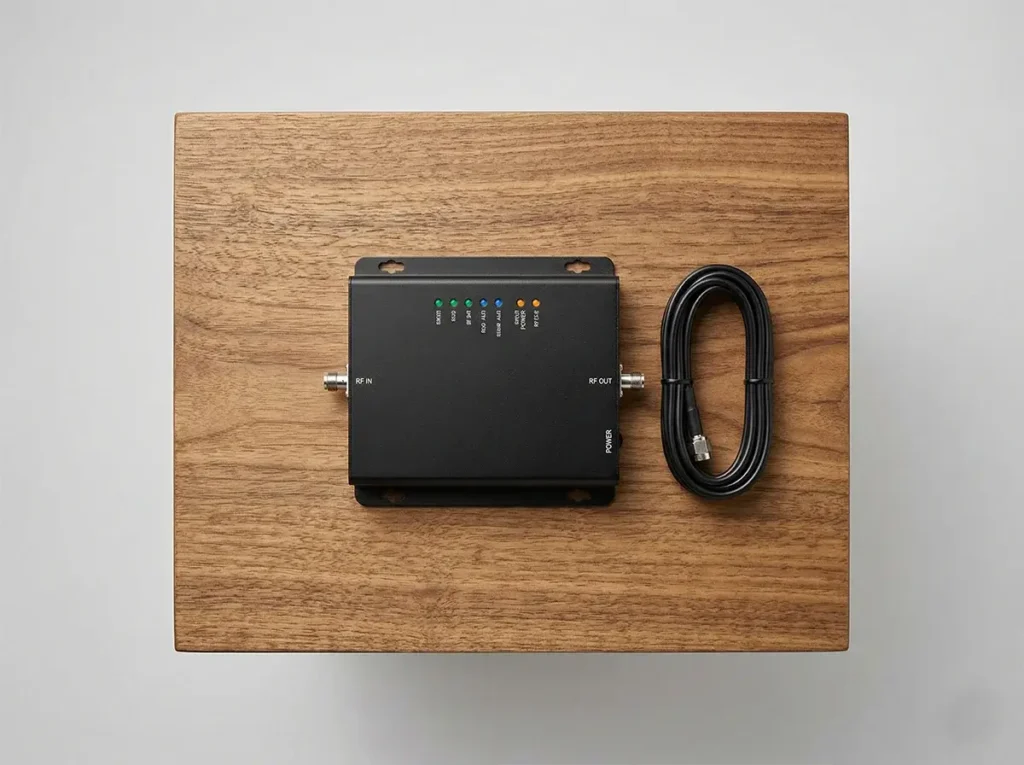
The weBoost Home MultiRoom is the most popular cell signal booster in rural America for good reason: it hits the sweet spot of performance, coverage area, ease of installation, and price. It supports all major US carriers (AT&T, Verizon, T-Mobile, US Cellular) and all current 4G LTE and 5G sub-6GHz frequency bands.
The kit includes a directional Yagi outdoor antenna (the right choice for rural use), a wall-mounted amplifier, an indoor panel antenna, and mounting hardware. Installation is genuinely DIY-friendly — the most technically demanding part is running the included coaxial cable from roof to amplifier, which most handy homeowners can accomplish in half a day.
Real-world performance in a weak signal area (1–2 bars outside): users typically see 3–4 bars of consistent indoor signal, reliable 4G LTE data speeds, and elimination of dropped calls. For a home under 3,000 square feet in a rural setting, this is the booster we recommend most.
Best for: Rural homes under 5,000 sq ft, single-family use, homeowners comfortable with basic DIY installation.
2. weBoost Home Complete — Best for Larger Rural Homes and Farms
Price: ~$649 | Coverage: Up to 7,500 sq ft | Gain: 72 dB
The weBoost Home Complete is the most powerful consumer-grade signal booster weBoost makes for residential use. The extra 7 dB of gain over the MultiRoom may sound modest, but in weak-signal rural environments, every decibel counts — 7 dB represents more than a 5x increase in signal amplification power.
The Home Complete includes the same directional Yagi outdoor antenna as the MultiRoom, but the more powerful amplifier enables it to pull in signals that the MultiRoom would struggle with, and distributes them across a larger indoor area. For rural properties with a large footprint — farmhouses, sprawling older homes, outbuildings — this is often the right step up.
The included outdoor antenna has a 75-foot cable run by default; weBoost sells extension cables for properties that need more distance between the roof mount and the amplifier. For farms where you want to extend coverage to a detached workshop or barn, a second indoor antenna can be wired in parallel for broader distribution.
Best for: Rural homes over 4,000 sq ft, farms, ranches, properties with very weak signal (only 1 bar outside), multi-story homes.
3. SureCall Fusion5X 2.0 — Best Performance, Commercial-Grade
Price: ~$799 | Coverage: Up to 8,000 sq ft | Gain: 72 dB
SureCall’s Fusion5X 2.0 is a step into near-commercial-grade territory without requiring a commercial installation. With 72 dB of maximum gain and a sophisticated automatic gain control system that prevents oscillation (the “feedback loop” that can occur when outdoor and indoor antennas are positioned too close), the Fusion5X is particularly well-suited to challenging rural installations where the outdoor and indoor antenna separation distance is limited.
The system is compatible with all US carriers and all frequency bands including the rural-critical Band 12 and Band 14 used by AT&T and FirstNet for extended-range coverage. SureCall’s monitoring software provides real-time signal strength data, which is invaluable for optimizing outdoor antenna aim after installation.
Best for: Power users, home-based businesses, properties with complex layouts, installations where antenna separation is challenging.
4. HiBoost Home 15K Smart Link — Best Budget Premium Option
Price: ~$399 | Coverage: Up to 6,000 sq ft | Gain: 72 dB
HiBoost entered the US market as a challenger brand and has earned a strong reputation for offering near-premium performance at meaningfully lower prices than weBoost and Wilson. The Home 15K Smart Link’s headline feature is its smartphone app connectivity, which provides real-time signal strength monitoring, band-specific performance data, and remote diagnostics — features that on competing brands require expensive commercial units.
At $399, the Home 15K is approximately $250 less than the weBoost Home Complete with comparable gain specs. The trade-off is build quality that feels slightly less premium, a warranty that is shorter than weBoost’s, and customer support that, while improving, isn’t yet at weBoost’s level. For rural users who are comfortable with technology and want maximum amplification per dollar, the HiBoost is an excellent value.
5. Wilson Pro 70 Plus — Best for Outbuildings and Small Commercial Properties
Price: ~$1,099 | Coverage: Up to 25,000 sq ft | Gain: 72 dB
Wilson Electronics (parent company of weBoost) makes the Wilson Pro 70 Plus for light commercial and large residential applications. At 25,000 square feet of rated coverage, this is the right tool for rural situations that go beyond a single house: a large farmstead with multiple connected outbuildings, a ranch with a main house and guest quarters, or a small rural business with a large floor plan.
The Pro 70 Plus supports multiple indoor antennas distributed across a property, with signal splitting hardware available to extend coverage to separate structures. Professional installation is recommended for multi-antenna deployments, though the system itself is technically accessible for experienced DIYers.
Full Comparison Table
| Booster | Price | Gain | Coverage | Best For |
|---|---|---|---|---|
| weBoost Home MultiRoom | ~$479 | 65 dB | 5,000 sq ft | Most rural homes under 5K sq ft |
| weBoost Home Complete | ~$649 | 72 dB | 7,500 sq ft | Larger homes, very weak signal |
| SureCall Fusion5X 2.0 | ~$799 | 72 dB | 8,000 sq ft | Challenging installs, businesses |
| HiBoost Home 15K | ~$399 | 72 dB | 6,000 sq ft | Best value at this gain level |
| Wilson Pro 70 Plus | ~$1,099 | 72 dB | 25,000 sq ft | Multiple buildings, commercial |
Installation Tips for Rural Properties
Rural installations present specific challenges that differ from suburban signal booster setups. Here are the most important tips from years of rural testing and reader feedback:
- Use a Yagi directional antenna outdoors, always. Rural properties need every dB of gain they can get. An omnidirectional antenna is convenient but captures signal from all directions, diluting the gain. A Yagi antenna focused precisely at the nearest cell tower will consistently outperform omni antennas in weak signal environments.
- Mount the outdoor antenna as high as possible. Elevation is your friend. Every additional meter of height above obstacles (trees, buildings, terrain features) improves your ability to reach distant towers. Roof peaks, chimney mounts, and purpose-built antenna poles all work well.
- Find your strongest signal direction first. Use the free Speedtest app or a cellular signal analyzer app to walk your property and identify where signal is strongest before committing to antenna placement. The direction of strongest signal is the direction to aim your Yagi.
- Use quality low-loss coax cable. The standard RG-6 cable included in most kits is adequate for short runs. For long cable runs (over 50 feet), upgrade to LMR-400 low-loss coaxial cable to preserve signal strength between the outdoor antenna and amplifier.
- Maximize indoor/outdoor antenna separation. Signal boosters are regulated by how much isolation exists between the outdoor and indoor antennas. FCC rules require at least 30 dB of isolation. In practice, you want maximum separation — different floors, opposite ends of the home — to prevent oscillation and allow the system to operate at full legal power.
Frequently Asked Questions
Will a signal booster improve my rural internet speed?
If you use cellular data (mobile hotspot, T-Mobile Home Internet) rather than a separate broadband connection, yes — a stronger cell signal typically delivers faster LTE/5G data speeds and reduced latency. If your internet comes from a separate satellite or fixed wireless connection that does not use the cellular network, a cell booster won’t affect those speeds.
Can I boost signal from all carriers at once?
Yes. All the boosters in this guide are multi-carrier compatible and boost signals from AT&T, Verizon, T-Mobile, and US Cellular simultaneously on all supported frequency bands.
Do I need a permit to install a cell signal booster?
No permit is needed for the booster installation itself. However, FCC regulations require you to notify your carrier that you are operating a signal booster. All certified boosters (look for the “FCC Certified” mark) include easy carrier notification steps, and the process is free and takes about 5 minutes online.
What if I have zero signal outdoors?
A signal booster cannot generate signal where there is literally none. If your outdoor signal is below about -115 dBm (measured with a signal analyzer app), a booster is unlikely to help meaningfully. In truly no-signal areas, consider Starlink satellite internet for data, and a satellite phone or SPOT/Garmin communicator for emergency voice communication. See our guide on how to get internet in a rural area with no service for more options.

Leave a Reply