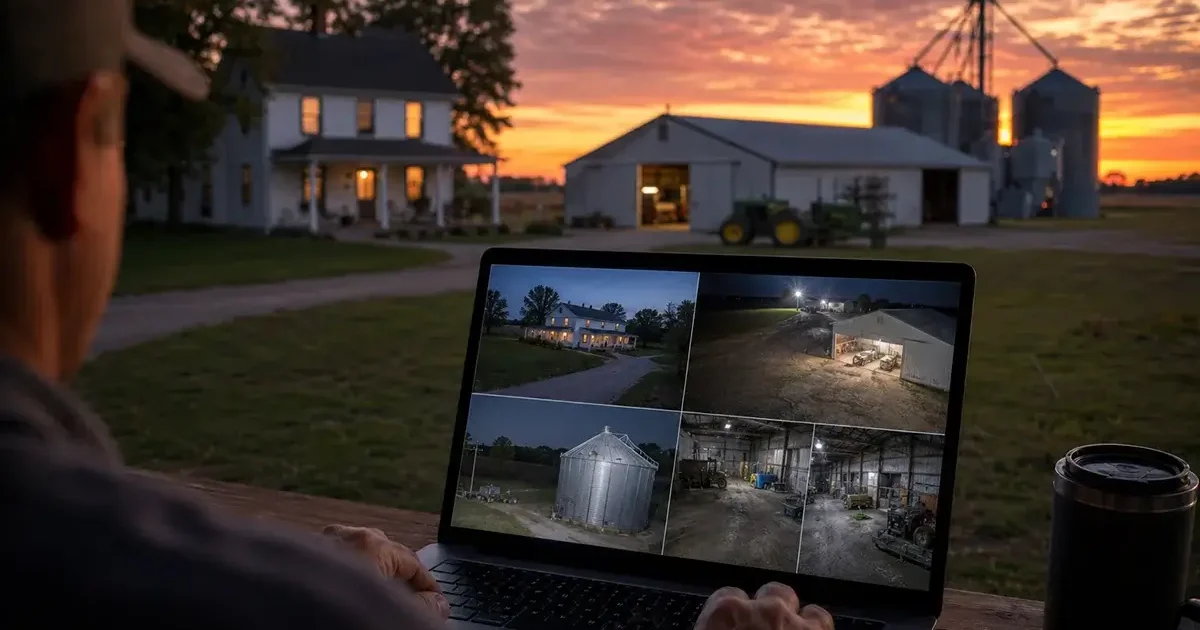
Rural properties face security challenges that suburban and urban homeowners rarely consider. The combination of geographic isolation — properties far from neighbors and emergency services — large acreage that is difficult to monitor physically, valuable agricultural equipment and livestock that represent significant theft targets, and internet connections that were, until recently, too slow to support reliable camera streaming has historically left rural landowners with inadequate security options. In 2026, the combination of affordable high-definition cameras, Starlink and cellular broadband, and increasingly sophisticated cloud security platforms has changed what’s possible for rural property security. This comprehensive guide covers the best security cameras for rural properties in 2026, how to design a system that works with rural internet limitations, and how to build comprehensive monitoring across large rural acreages.
In This Guide
- Unique Security Challenges of Rural Properties
- Types of Rural Security Cameras
- Internet Requirements for Rural Security Cameras
- Top Security Camera Picks for Rural Properties 2026
- Solar-Powered Cameras for Remote Rural Locations
- Cellular-Connected Cameras for Areas Without Wi-Fi
- Coverage Strategy for Large Rural Properties
- Storage: Cloud vs Local NVR for Rural Use
- Cost Analysis by Property Type
- Frequently Asked Questions
Unique Security Challenges of Rural Properties
Rural property security requires thinking differently from suburban home security. The challenges are distinct in scale, type, and the resources available to address them:
Response time reality: In rural areas, law enforcement response times of 30–60 minutes or longer are common. This changes the security objective from “catch criminals in the act” to “deter crime through visible surveillance, document incidents for insurance and law enforcement after the fact, and provide early warning of trespass that allows time to respond.” A rural security camera system designed with these objectives — deterrence and documentation rather than real-time intervention — performs very differently from a suburban system designed for quick police response.
Scale of property: A typical rural property requiring security monitoring may encompass 5–500+ acres with multiple structures — main house, barn, equipment shed, grain storage, guest house, hunting cabin. No single camera covers this scale; comprehensive coverage requires strategic placement of multiple cameras and sometimes multiple networked subsystems.
Target profile: Rural property theft targets differ from urban targets. Farm equipment theft — tractors, combines, ATVs, trailers — represents some of the highest-value rural theft. Livestock theft (cattle, horses, goats) is a significant issue in many rural areas. Copper wire and metal theft from outbuildings is common. Trespassing by hunters, off-road vehicle users, and others on rural land is frequent. A rural security system needs to monitor large open areas, outbuildings, equipment storage, livestock areas, and access roads — not just doors and windows.
Power availability: Many rural camera installation locations don’t have convenient access to electrical outlets — a distant barn, a remote gate, a field corner position. Solar-powered cameras and long-cable PoE (Power over Ethernet) runs are far more relevant in rural security installations than in suburban ones.
Internet connectivity limitations: Until recently, rural internet was often too slow and data-capped to support cloud-connected cameras. HughesNet’s 15–100 GB monthly caps made continuous camera uploads impractical. Starlink and cellular home internet have changed this equation, but data budget management remains relevant for households with many cameras on metered connections.
Types of Rural Security Cameras
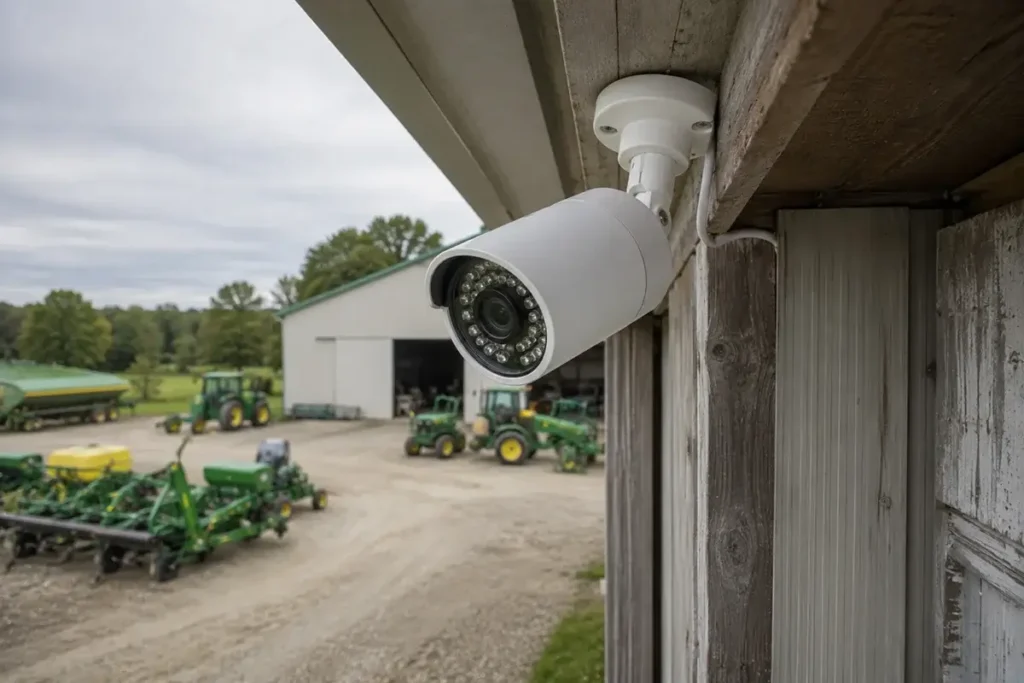
Wired PoE cameras: Power over Ethernet cameras receive both power and data through a single Cat6 cable — eliminating the need for a separate power outlet at each camera location. For cameras within cable-run distance of your router or NVR (typically up to 330 feet / 100 meters), wired PoE cameras are the most reliable option. They don’t depend on Wi-Fi signal strength and have no batteries to replace. The main limitation: running cable to remote rural locations (distant barns, field gates) is expensive and labor-intensive.
Wi-Fi cameras: Wireless cameras connect to your home Wi-Fi network and require only a power source at the installation location. Convenient for locations with power available but without Ethernet cable runs. Performance depends on Wi-Fi signal strength — cameras at the edge of Wi-Fi coverage experience dropouts that affect recording reliability. Wi-Fi camera range limits of 150–300 feet from the nearest access point restricts where they can be placed on large rural properties without Wi-Fi range extension infrastructure.
Solar-powered cellular cameras: The most flexible option for truly remote rural locations — no power outlet required, no Wi-Fi required. These cameras have built-in cellular modems (4G LTE) with their own SIM cards, powered entirely by solar panels with battery backup. They upload motion-triggered clips and provide live view directly over the cellular network. Perfect for remote gates, distant outbuildings, field corners, and hunting property monitoring. Monthly cellular plan costs ($5–$20/camera/month) add to operating cost but eliminate the infrastructure constraint of other camera types.
Trail cameras (wildlife/security): Trail cameras — originally designed for wildlife monitoring by hunters — have evolved into effective rural property security tools. Modern 4G trail cameras send motion-triggered images directly to a smartphone app over cellular networks, require no Wi-Fi or local power, and can run for months on battery sets in remote locations. They are significantly less capable than dedicated security cameras (lower resolution, slower trigger, no continuous recording) but are invaluable for monitoring remote trail access points, field corners, and areas too far from any infrastructure for other camera types.
Internet Requirements for Rural Security Cameras
| Camera Setup | Upload Bandwidth Needed | Monthly Data (per camera) | Works on HughesNet? | Works on Starlink? |
|---|---|---|---|---|
| Continuous cloud recording (1 cam, 1080p) | 2–4 Mbps constant | 200–400 GB | ❌ Data cap issue | ✅ Yes |
| Motion-triggered cloud clips (1 cam) | 0.5–2 Mbps burst | 5–30 GB | ⚠️ Possible on higher plans | ✅ Yes |
| Local NVR + remote access only | 0.5–1 Mbps for remote view | 1–5 GB | ✅ Works | ✅ Yes |
| Cellular camera (own SIM) | Uses own data plan | Billed separately | N/A | N/A |
For rural properties on Starlink, continuous cloud recording of multiple cameras is feasible but requires data budget management — 10 cameras on continuous 1080p recording could consume 2–4 TB per month, exceeding Starlink Standard’s 1 TB priority threshold. The practical solution: use motion-triggered recording (cameras only upload when motion is detected) rather than continuous recording, and use local NVR (Network Video Recorder) storage for continuous recording with cloud backup of important clips only.
Top Security Camera Picks for Rural Properties 2026
1. Reolink RLC-810A (PoE, 4K) — Best Wired Camera for Main Buildings
Price: ~$55/unit | Resolution: 4K (8MP) | Type: Wired PoE
The Reolink RLC-810A delivers 4K resolution, color night vision with a built-in spotlight, and person/vehicle smart detection — all at a price point that makes deploying multiple cameras economically accessible. For main house coverage, barn doors, and equipment yard monitoring where Ethernet cable runs are practical, the RLC-810A provides excellent image quality that clearly captures license plates, faces, and equipment details needed for law enforcement and insurance documentation. The Reolink app provides remote viewing from anywhere with a smartphone.
2. Amcrest UltraHD 5MP PoE Camera — Best Value PoE for Outbuildings
Price: ~$45/unit | Resolution: 5MP | Type: Wired PoE
Amcrest’s outdoor PoE cameras provide dependable performance at a price that enables comprehensive outbuilding coverage without budget strain. IP67 weatherproofing handles rain, dust, and temperature extremes common on rural properties. The wide field of view (90°) covers large open areas effectively. Works with Amcrest’s cloud service or any standard ONVIF NVR — no ongoing subscription required if you use local storage.
3. Reolink Go PT Plus (4G LTE, Solar) — Best Solar/Cellular Camera for Remote Locations
Price: ~$130/unit + $5–$10/month cellular | Resolution: 2K | Type: Solar-powered, cellular
The Reolink Go PT Plus is specifically designed for the rural remote location use case. Solar panel keeps the built-in battery charged indefinitely in locations with adequate sun exposure (most rural outdoor locations). 4G LTE connectivity means no Wi-Fi or cable infrastructure required — the camera uploads motion-triggered clips to the Reolink cloud using its own SIM card. Pan-tilt capability allows remote camera aiming through the smartphone app. Ideal for remote gates, field corners, hunting cabins, and any location where running power and cable is impractical.
4. Stealth Cam DS4K (Trail Camera) — Best for Remote Access Roads
Price: ~$150/unit + $5/month | Resolution: 4K video, 36MP still | Type: Battery, cellular
For remote rural trail access points, hunting property monitoring, and the most distant areas of large rural properties, cellular trail cameras provide practical monitoring without infrastructure. The Stealth Cam DS4K sends images directly to a smartphone app when motion is detected, runs months on battery, and requires no Wi-Fi or power. Image quality and trigger speed are below dedicated security cameras, but for access road monitoring where the primary goal is early warning of trespass or documenting vehicle traffic, cellular trail cameras are the pragmatic solution.
5. Hikvision DS-2CD2347G2-LU (ColorVu) — Best Professional Camera for Critical Areas
Price: ~$80/unit | Resolution: 4MP | Type: Wired PoE, color 24/7
Hikvision’s ColorVu technology provides full-color 24-hour video — even in complete darkness using the camera’s built-in white light illuminator — rather than the standard black-and-white night vision that makes license plate and face identification difficult. For the highest-security monitoring locations (main gate, equipment storage areas containing high-value machinery), Hikvision ColorVu cameras provide the clearest actionable nighttime footage of any cameras in this price range. Requires a compatible NVR for full feature access.
Coverage Strategy for Large Rural Properties
Comprehensive rural property coverage requires a layered approach that matches camera type to location characteristics:
Layer 1 — Main structures (wired PoE cameras): All access points to the main house, barn doors, equipment shed entries, grain storage loading areas, and driveway approaches should use wired PoE cameras connected to a local NVR. This infrastructure provides the highest reliability and best image quality for the most-monitored areas. Budget: 8–12 cameras for a typical rural farmstead main structure area.
Layer 2 — Extended coverage (Wi-Fi cameras + access point extension): Secondary buildings within 500 feet of the main house Wi-Fi network can be covered by outdoor Wi-Fi cameras or wired cameras connected to PoE access points that extend the network. This layer covers guest houses, storage sheds, and the near-property perimeter where cabling is possible but not as convenient as at main structures.
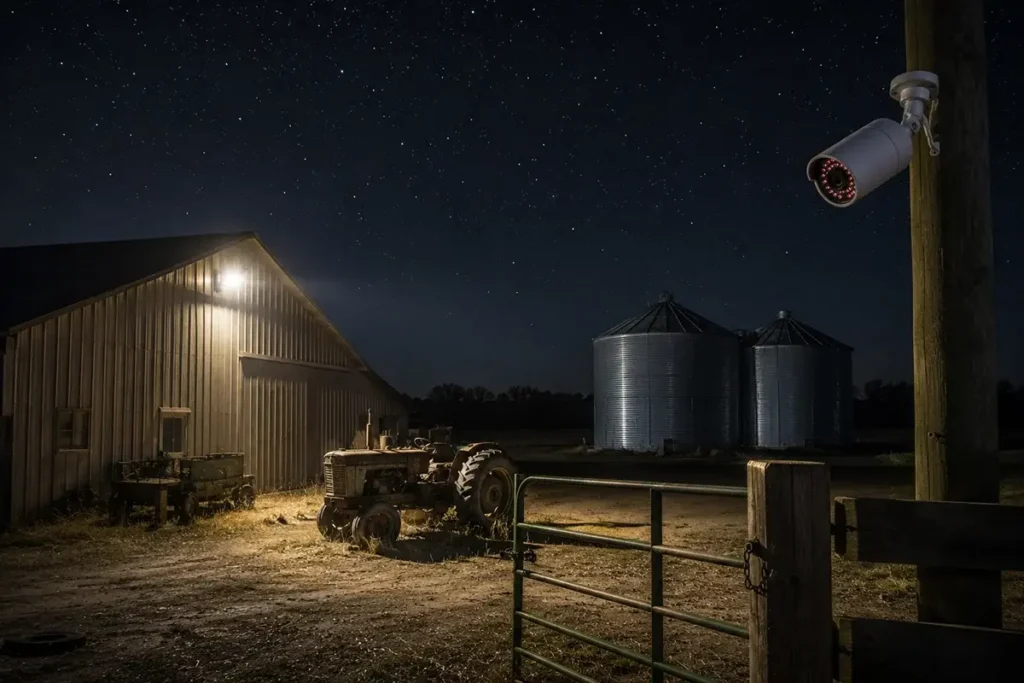
Layer 3 — Remote locations (solar/cellular cameras): Remote gates, field roads, distant outbuildings, hunting camp access, and property boundary points require solar-powered cellular cameras. One cellular camera at each primary access point to the property perimeter provides early warning of trespass and documents vehicle traffic at entry points. Budget: 3–8 cameras depending on property size and number of access points.
Cost Analysis by Rural Property Type
| Property Type | Recommended Setup | Hardware Cost | Monthly Operating Cost | 5-Year Total |
|---|---|---|---|---|
| 50-acre hobby farm | 6 PoE cameras + NVR + 2 solar/cellular | $800–$1,200 | $10–$20 (cellular cams) | $1,400–$2,400 |
| 300-acre cattle ranch | 12 PoE + 6 solar/cellular + outdoor AP extension | $2,500–$4,000 | $30–$60 (cellular cams) | $4,300–$7,600 |
| Remote hunting property (100 acres) | 6 cellular trail cameras | $600–$900 | $30–$60 (cellular plans) | $2,400–$4,500 |
| Rural vacation rental (Airbnb) | 4 outdoor PoE + 1 video doorbell + NVR | $700–$1,000 | $0–$10 (optional cloud) | $700–$1,600 |
Frequently Asked Questions
Can I use security cameras on a HughesNet or Viasat connection?
Yes, with limitations. Motion-triggered clip-based recording (cameras only upload video when motion is detected) is compatible with capped satellite connections — a typical rural property with moderate traffic may generate 5–20 GB of camera uploads per month, within the range of higher-tier HughesNet and Viasat plans. Continuous cloud recording is not practical on capped satellite plans. Using a local NVR for continuous recording and only uploading motion-triggered alerts to the cloud is the recommended approach for any data-capped rural internet connection. See our guide on managing rural internet bandwidth for data-efficient camera setup strategies.
What is the best security camera for a remote rural gate without power or Wi-Fi?
Solar-powered cellular cameras are the definitive solution for remote rural gates without power or Wi-Fi infrastructure. The Reolink Go PT Plus and Blink Outdoor 4G LTE (where available) mount directly to a gate post or nearby fence post, charge from an included or accessory solar panel, and send motion-triggered images to your smartphone over the cellular network with their own SIM card. No power outlet, no Wi-Fi, no cable runs required.
Do rural security cameras work during power outages?
Wired cameras powered by PoE switches lose power during outages unless the PoE switch and NVR are on an uninterruptible power supply (UPS). For rural properties where power outages are more frequent than urban areas, placing your NVR, PoE switch, and core networking equipment on a quality UPS (APC or CyberPower, 1000–1500VA capacity) is strongly recommended. This provides 1–3 hours of continued camera operation through most rural power events. Solar-powered cellular cameras continue operating indefinitely through power outages since they are completely grid-independent — a meaningful advantage for truly remote monitoring needs.
How do I view my rural security cameras remotely?
Most modern security camera systems provide remote viewing through smartphone apps (Reolink, Amcrest, Hikvision) that connect to either a cloud service or directly to your home NVR via your Starlink or cellular home internet connection. For direct NVR access, your home network needs a static or DDNS-tracked public IP address — most Starlink and cellular home internet connections provide dynamic IPs. Setting up a DDNS (Dynamic DNS) service like DuckDNS (free) on your router solves this, providing a consistent address for remote NVR access regardless of how often your public IP changes. According to USDA’s agricultural security resources, remote monitoring capability is one of the most effective farm security improvements rural property owners can make, particularly when combined with visible camera deterrence signage.
Advanced Livestock Monitoring Camera Systems
Modern security camera technology has converged with livestock management software to create purpose-built livestock monitoring systems that go far beyond traditional security cameras. For cattle, dairy, swine, and poultry operations, these integrated systems provide both security monitoring and operational management data from the same camera infrastructure:
Cainthus (now part of Ever.Ag): An AI-powered livestock monitoring system that uses cameras to track individual animal behavior, feeding activity, water consumption, and early health indicators. Designed for dairy and beef operations, Cainthus cameras connect to a cloud analytics platform that alerts farm managers to individual animals showing reduced activity or feeding patterns that may indicate health issues before clinical symptoms develop. At the scale of a 500+ head dairy operation, early illness detection enabled by camera monitoring can prevent significant economic losses from delayed treatment.
Cowlar (cattle wearable + camera integration): Combines wearable neck collar sensors with barn cameras for comprehensive livestock monitoring. The camera component provides visual verification of animals flagged by collar health alerts — allowing farm managers to confirm remotely whether an alerted animal shows visible illness symptoms before making the decision to call a veterinarian.
For poultry operations, environmental monitoring cameras in broiler and layer houses provide continuous visual monitoring of bird behavior, feather condition, and flock distribution patterns that indicate environmental issues (temperature, ventilation, disease) earlier than periodic in-person inspection allows. These agricultural monitoring applications require reliable broadband connectivity — Starlink Business’s unlimited priority data provides the consistent upload bandwidth needed for multiple camera streams.
Legal Considerations for Rural Security Cameras
Rural property surveillance has legal dimensions that vary by state and situation. Key legal considerations for rural camera deployments:
- Public road monitoring: Cameras that capture the public road adjacent to your property generally do not require consent from passing motorists, as roads are public spaces with no reasonable expectation of privacy. However, cameras positioned to capture adjacent private property — a neighbor’s yard or structures — may create legal exposure depending on state law.
- Audio recording: Many cameras include microphones. Several states (California, Illinois, Maryland, Pennsylvania, Washington, and others) require two-party consent for audio recording. In these states, disable audio recording on cameras that may capture conversations between non-consenting parties. Video-only recording is legal in all states for security purposes.
- Posting notice: While not legally required in most jurisdictions, posting visible notices that video surveillance is in use on your property is a best practice that deters trespassers and removes any ambiguity about recording consent for visitors to your property.
- Agricultural trespass and documentation: In many states, documented evidence from security cameras — video and timestamp evidence — significantly strengthens enforcement action for agricultural trespass, crop theft, and equipment vandalism. Consult your county sheriff about the most useful camera placement and video quality standards for evidentiary use in your jurisdiction.

Leave a Reply