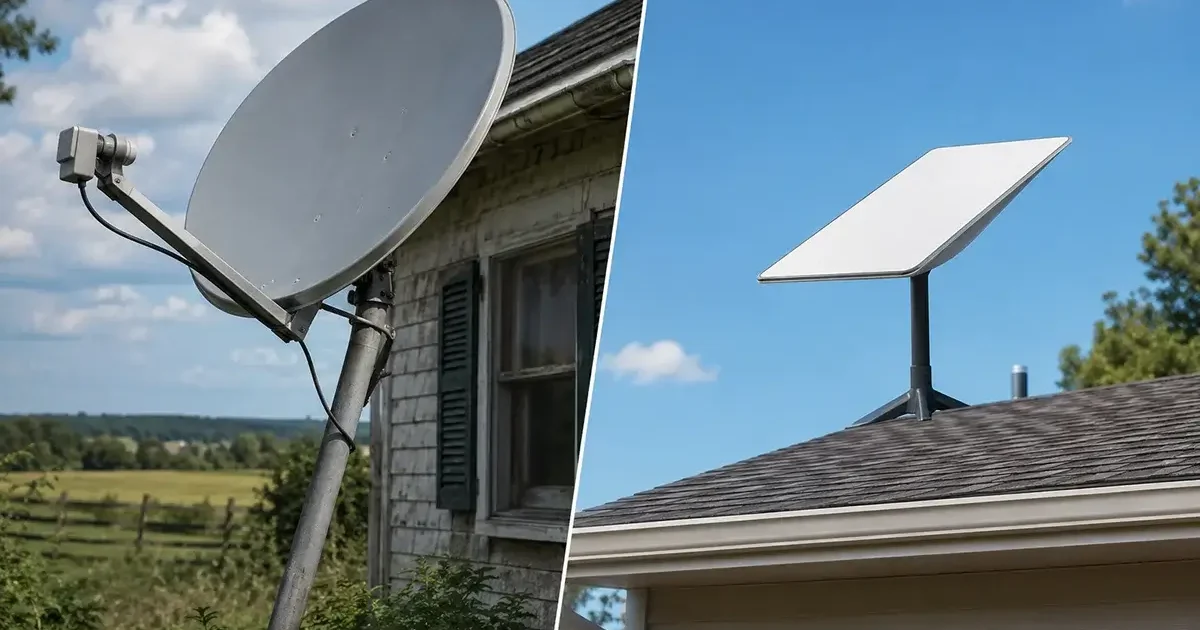
HughesNet has been the default rural internet option for millions of Americans for over two decades. At its peak, HughesNet served as the only viable connection for rural properties without telephone DSL or cable access — a monopoly of necessity rather than preference. In 2026, the satellite internet landscape has been completely transformed by Starlink’s low-Earth orbit service, and HughesNet faces an existential competitive challenge. Yet HughesNet continues to serve millions of rural customers, has launched its Gen 6 satellite system with improved capabilities, and maintains specific scenarios where it remains a reasonable choice. This comprehensive and honest HughesNet review for 2026 covers everything rural Americans need to know — the real download speeds, the latency problem that won’t go away, the data cap situation, the pricing, and the specific remaining scenarios where HughesNet still makes sense despite Starlink’s arrival.
In This Guide
- HughesNet Gen 6: What Changed
- Plans and Pricing 2026
- Real-World Download and Upload Speeds
- The Latency Problem: Why It Won’t Change
- Data Caps Explained
- Installation and Equipment
- What HughesNet Works Well For
- What HughesNet Cannot Do
- HughesNet vs Starlink: Honest Comparison
- Should You Switch from HughesNet to Starlink?
- Frequently Asked Questions
HughesNet Gen 6: What Changed in 2026
HughesNet launched its sixth-generation satellite system (EchoStar 24, also known as Jupiter 3) in 2023 and has been expanding service using its additional capacity throughout 2024–2026. Gen 6 represents a meaningful improvement over the previous HughesNet generation in one specific area: throughput capacity. The Jupiter 3 satellite adds substantial bandwidth compared to earlier HughesNet satellites, allowing HughesNet to offer higher plan speed tiers and reduce the severity of peak-hour speed throttling that has plagued HughesNet customers for years.
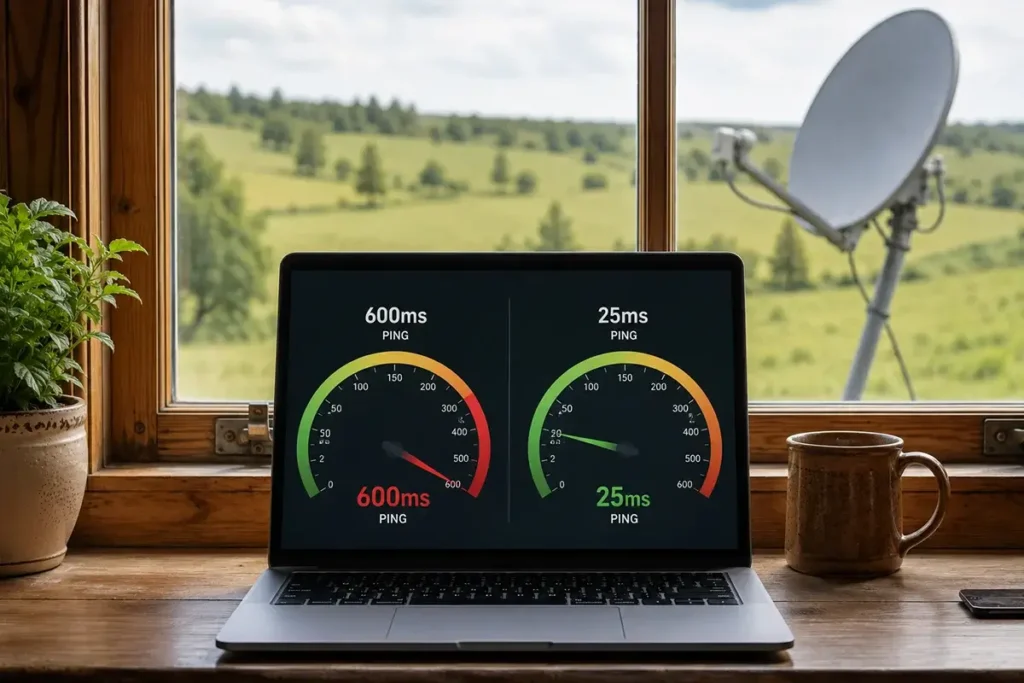
What Gen 6 does NOT change: latency. Jupiter 3 is a geostationary satellite orbiting at 35,786 km above Earth — the same distance as every previous HughesNet satellite. Physics dictates that any signal traveling to this altitude and back takes a minimum of approximately 600 milliseconds round-trip. No upgrade to the satellite hardware, signal processing, or network architecture can change this fundamental physical constraint. HughesNet Gen 6’s latency is identical to HughesNet Gen 5’s latency — approximately 600–700 ms. This is the core reason that HughesNet remains fundamentally unsuitable for video calls, gaming, VoIP, and other real-time applications regardless of generation.

HughesNet Plans and Pricing 2026
| Plan | Monthly Price | Priority Data | After Priority | Download Speed | Upload Speed |
|---|---|---|---|---|---|
| Select 15 GB | $49.99/mo | 15 GB | 1–3 Mbps (throttled) | Up to 25 Mbps | Up to 3 Mbps |
| Select 30 GB | $64.99/mo | 30 GB | 1–3 Mbps (throttled) | Up to 25 Mbps | Up to 3 Mbps |
| Select 100 GB | $89.99/mo | 100 GB | 1–3 Mbps (throttled) | Up to 50 Mbps | Up to 3 Mbps |
| Elite 200 GB | $174.99/mo | 200 GB | 3 Mbps (throttled) | Up to 100 Mbps | Up to 5 Mbps |
All HughesNet plans include a monthly equipment lease fee of approximately $14.99/month — adding $180/year to the effective annual cost beyond the base plan price. The 24-month contract is required for new activations, with early termination fees starting at $400 and decreasing over the contract term. This contract commitment is one of the most important distinctions from Starlink, which has no annual contract and no ETF.
The data cap structure is HughesNet’s most frustrating pricing feature. A household that consumes its 15 GB of priority data in the first week of the billing period (easily possible with just a few HD video streams) spends the remaining three weeks at throttled 1–3 Mbps speeds that are barely functional for web browsing. Even the 100 GB plan can be exhausted in a single day of heavy household use. The Bonus Zone (2 AM–8 AM) provides unlimited data during overnight hours — useful for scheduled downloads but impractical for regular daytime internet use.
Real-World Download and Upload Speeds
HughesNet’s advertised speeds represent maximum capabilities under ideal conditions. Real-world performance for rural customers in 2026:
| Condition | Download Speed | Upload Speed | Latency |
|---|---|---|---|
| Priority data available, off-peak hours | 20–45 Mbps | 2–4 Mbps | 600–700 ms |
| Priority data available, peak hours (7–10 PM) | 8–20 Mbps | 1–2 Mbps | 650–750 ms |
| After priority data exhausted (throttled) | 1–3 Mbps | 0.5–1 Mbps | 600–700 ms |
| During heavy precipitation overhead | 1–10 Mbps or drop | 0.5–2 Mbps | 700–900 ms |
The real-world download speeds — 20–45 Mbps at best, often much lower — are technically adequate for streaming standard definition video and basic web browsing. The upload speed (2–4 Mbps maximum) makes video calls extremely poor quality for the person on the other end of the call. And the latency (600–700 ms) makes every real-time application — video calls, gaming, VoIP, remote desktop — functionally degraded to the point of being either unusable or deeply frustrating.
The Latency Problem: A Physics Issue, Not a Software Fix
HughesNet’s most fundamental limitation — the 600 ms latency — cannot be solved by any upgrade to satellites, modems, or network software. It is a consequence of the laws of physics. Light travels at approximately 186,000 miles per second. A geostationary satellite at 35,786 km (22,236 miles) altitude is approximately 22,000–26,000 miles from any US ground location. The round-trip signal path is 44,000–52,000 miles. Dividing by the speed of light gives a minimum round-trip latency of approximately 476–560 ms purely for the signal travel time — before accounting for any network processing delay, which adds another 100–200 ms.
No amount of technology improvement makes this satellite orbit’s physics better. SpaceX solved this problem by moving the satellites to 340–570 km altitude — 60x closer — which reduces the signal travel time to 4–12 ms and total latency to 20–60 ms. HughesNet’s satellites cannot be moved to a lower orbit; they are geostationary by design, locked in their 35,786 km orbit as required by the geostationary physics.
What HughesNet Still Works Well For in 2026
Despite its significant limitations, HughesNet remains a functional choice for specific use cases where its limitations don’t matter:
- Email-only users: Email requires minimal bandwidth and is completely insensitive to latency — messages are asynchronous, so the 600 ms delay is irrelevant. HughesNet’s 15 GB plan at $49.99/month works well for rural users whose primary internet need is email communication.
- Web browsing and research: Standard web page loading is functional on HughesNet, though noticeably slower than on low-latency connections. Non-time-sensitive research, news reading, and information access work adequately.
- Social media (non-video): Text and photo-based social media browsing works on HughesNet. Video on social media (Instagram Reels, TikTok, YouTube) works during priority data availability but is slow and buffers frequently.
- Standard definition streaming during priority data: Netflix and other streaming services at 480p (standard definition) stream adequately on HughesNet’s 25 Mbps connection when priority data is available. HD streaming at 720p or 1080p works during off-peak hours but consumes priority data quickly.
- Very light rural users on a minimal budget: For rural households with truly minimal internet needs and for whom the $49.99/month Select plan represents a more manageable cost than Starlink’s $120/month, HughesNet provides basic internet functionality at a lower price point — but users must genuinely have minimal real-time communication needs.
HughesNet vs Starlink: Honest Comparison 2026
| Factor | HughesNet Gen 6 | Starlink Standard |
|---|---|---|
| Monthly Price | $49.99–$174.99 + $14.99 equipment | $120 (no equipment fee) |
| Hardware Cost | Leased (included in lease fee) | $349 (purchased, owned) |
| Contract | 24 months required | None |
| ETF if cancelled early | Up to $400 | None |
| Download Speed | 25–100 Mbps (priority data only) | 65–115 Mbps typical |
| Upload Speed | 3–5 Mbps | 8–18 Mbps |
| Latency | 600–700 ms (cannot be reduced) | 20–60 ms |
| Data Cap | 15–200 GB priority (then throttled) | 1 TB priority (then slower, not throttled) |
| Video Calls | Poor — lag is severe | Excellent — feels natural |
| Gaming | Unplayable (online multiplayer) | Fully playable |
| Weather Impact | Significant rain fade | Brief heavy-precipitation events |
| Installation | Professional technician required | DIY, no technician |
Should You Switch From HughesNet to Starlink?
For the overwhelming majority of rural HughesNet customers, switching to Starlink is the right decision. The question is not whether Starlink is better — it is, in every meaningful performance dimension. The questions are about timing and cost:
If you are within 6 months of HughesNet contract expiration: Order Starlink now and run it in parallel. By the time you have tested Starlink for a few weeks and confirmed it meets your needs, you’ll be close enough to contract expiration that waiting out the remaining months is worth the free early termination. Cancel HughesNet exactly at the contract anniversary to avoid any additional charges.
If you have 12+ months remaining on your HughesNet contract: Calculate your ETF. If your ETF is under $200 and Starlink would save you money monthly (HughesNet at $80/month vs Starlink at $120/month — Starlink costs $40 more per month, so ETF payback would take 5 months), the premium for Starlink’s dramatically better performance may not justify immediate ETF payment purely on financial grounds. However, if video calls, telehealth, remote work, or children’s online education are active needs, the performance value of switching immediately typically outweighs the ETF cost.
According to the FCC’s Internet Access Services reports, geostationary satellite internet subscriptions have declined significantly since 2021 as LEO satellite alternatives have become available — a clear market signal of rural users’ preference for Starlink’s superior performance when given a viable alternative.
Frequently Asked Questions
Is HughesNet good enough for working from home?
No, for any job that requires video calls or VPN access. HughesNet’s 600 ms latency makes video calls (Zoom, Teams, Google Meet) feel like a frustrating international call from the 1990s — with half-second delays in every exchange. Most work-from-home roles require video meetings as a standard part of the job; HughesNet makes these meetings sufficiently degraded to create professional friction and often prompts employers to question whether a remote employee’s internet is adequate for the role. For remote workers, Starlink is not a luxury upgrade — it is a professional necessity.
Can HughesNet support Netflix streaming?
Yes, in limited ways. Netflix at standard definition (480p) streams adequately on HughesNet when priority data is available. Netflix at 1080p HD requires sustained 5+ Mbps and works during off-peak periods when priority data is available. The data cap is the main limitation — a single 1080p HD Netflix movie consumes approximately 3 GB of priority data. A household that streams regularly will exhaust its priority data allocation within a week even on the higher-tier plans, spending most of the month at throttled speeds barely adequate for standard definition.
Is HughesNet available everywhere in the US?
HughesNet claims availability throughout the continental United States, Alaska, Puerto Rico, and US territories — wherever you have a clear southern sky view. In practice, very high northern latitudes in Alaska may have limited satellite visibility. HughesNet’s coverage is comparable to Starlink’s in geographic footprint but dramatically different in performance — both cover most of rural America, but only Starlink’s performance is adequate for modern internet applications.
The HughesNet Customer Experience in 2026
Beyond the technical performance specifications, the lived experience of HughesNet customers in 2026 tells a consistent story. Community forums, social media groups for rural internet users, and review sites paint a picture of a service that is functional for minimal use cases but deeply frustrating for modern household internet use — particularly for households that have seen Starlink’s performance by comparison.
The most common customer complaints about HughesNet in 2026 center on three issues: data cap exhaustion happening far faster than the plan’s allocation suggests it should (a function of how much modern web content and background app activity consumes data that users don’t realize is happening), video call quality that is universally described as inadequate for work or family connection purposes, and customer service that has been criticized for difficulty reaching effective resolution for technical and billing issues. HughesNet’s contract structure — 24 months with substantial ETF — compounds these frustrations by creating a financial barrier to switching to a better service.
By contrast, the minority of HughesNet customer reviews that are positive typically describe users with truly minimal internet needs: email, occasional light web browsing, no video calls, and careful data usage discipline that keeps consumption within the plan’s priority threshold. For this user profile — which describes a diminishing minority of actual household internet usage in 2026 — HughesNet’s entry-level pricing and professional installation provide a functional basic internet connection at lower upfront cost than Starlink.
The FCC’s Measuring Broadband America report has consistently found that HughesNet delivers download speeds closer to its advertised rates than most ISPs — but the same reports document the latency figures (600+ ms) that make those download speeds functionally inadequate for the real-time applications that define modern internet use. The technical accuracy of HughesNet’s speed delivery is not in question; the adequacy of those speeds and that latency for real-world rural household needs is what has driven the mass migration of rural internet customers from HughesNet to Starlink since 2022.



Leave a Reply