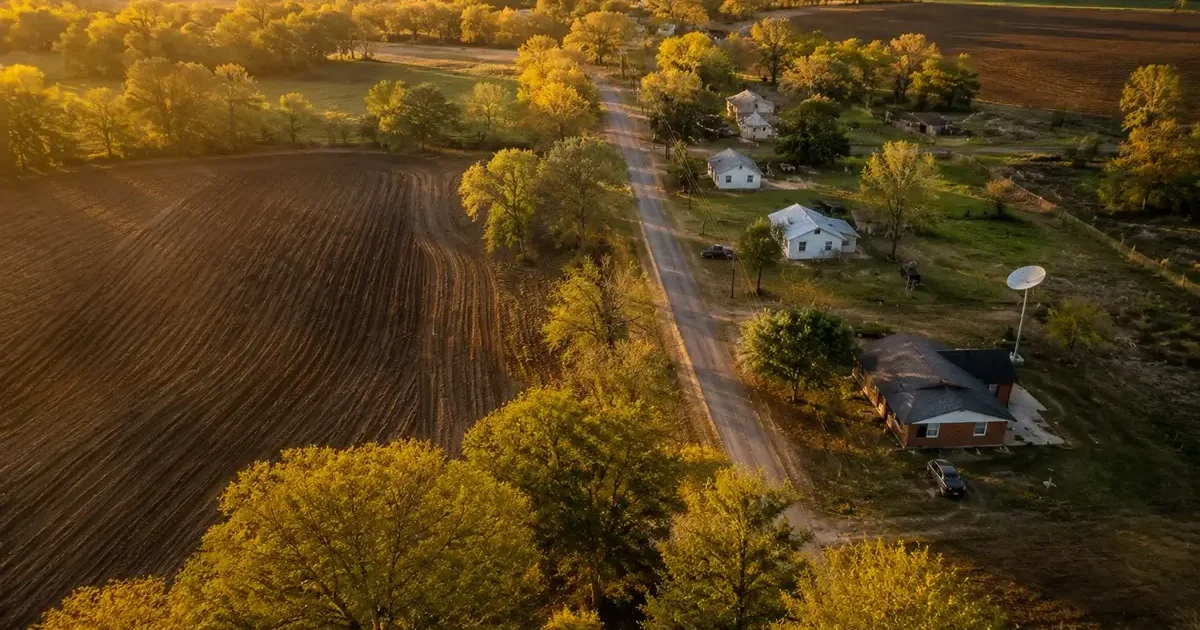
Alabama’s rural broadband situation is a story of dramatic geographic inequality set against a backdrop of accelerating federal investment that is beginning to change the landscape. The state’s urban-rural connectivity divide is among the sharpest in the Southeast — Birmingham, Huntsville, and Mobile have competitive broadband markets with fiber providers and cable internet, while the rural Black Belt counties of central Alabama, the mountainous counties of the northeast, and the agricultural communities of the coastal plain have connectivity deficits that rank among the worst in the nation. In 2026, Starlink’s universal coverage, an increasingly active electric cooperative broadband sector, and Alabama’s BEAD Program investment are creating more options for rural Alabama residents than have ever existed — but navigating those options requires understanding the state’s complex regional landscape. This complete guide covers every rural internet option across Alabama’s diverse geography.
In This Guide
- Alabama Rural Broadband Overview
- Best Internet by Alabama Region
- Starlink in Alabama
- Cellular Home Internet in Rural Alabama
- Alabama Electric Cooperatives and Broadband
- The Alabama Black Belt: A Special Focus
- Alabama State Broadband Programs
- BEAD Program Investment in Alabama
- Alabama Agriculture and Connectivity
- Practical Tips for Rural Alabama Residents
- Frequently Asked Questions
Alabama Rural Broadband Overview
Alabama has approximately 1.8 million rural residents — nearly 37% of the state’s total population — spread across 67 counties with dramatically varying levels of broadband access. The state’s rural broadband gap is both geographic and demographic: rural Alabama communities that are predominantly African American — particularly in the historic Black Belt region — face compounding connectivity deficits that reflect decades of racially inequitable infrastructure investment decisions.
According to the FCC National Broadband Map, Alabama ranks near the bottom of southeastern states in rural broadband access, with substantial concentrations of unserved addresses in the Black Belt counties (Wilcox, Perry, Hale, Greene, Sumter, Choctaw, Clarke, Washington, Marengo), the northeast mountain counties (DeKalb, Cherokee, Cleburne, Randolph), and the rural portions of the coastal plain (Washington, Choctaw, Clarke, Monroe counties).
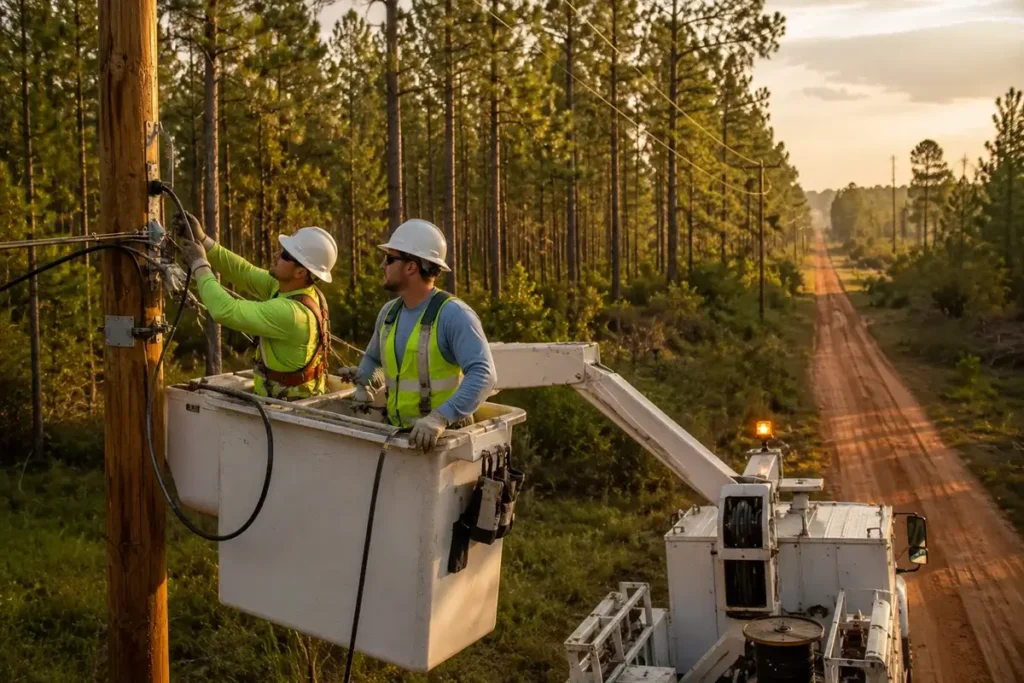
Alabama’s electric cooperative sector — 23 member cooperatives serving rural members across the state — has emerged as the most active rural broadband deployer in the state, with several cooperatives building fiber to members using USDA ReConnect grants and BEAD Program allocations. This cooperative-led approach mirrors what has worked in other southeastern states and represents Alabama’s most promising path to closing its rural connectivity gap.
Best Internet by Alabama Region
Northeast Alabama Mountains (DeKalb, Cherokee, Etowah, Marshall Counties)
Northeast Alabama’s sand mountain communities and Lookout Mountain plateau have connectivity challenges created by the region’s rugged, dissected terrain. Fort Payne and Gadsden anchor this region with cable and some fiber service. Rural communities in the valleys and on the plateau between these anchor cities depend on telephone cooperative DSL (Peoples Telephone of Mcintosh, Northeast Alabama Telephone Company) and Starlink. T-Mobile’s rural northeast Alabama coverage is moderate along US-11 and US-431 corridors. The scenic terrain that makes the region attractive to recreation and retirement communities also makes infrastructure deployment expensive and technically challenging.
Wiregrass Region (Houston, Henry, Barbour, Coffee, Dale Counties)
The Wiregrass region in southeast Alabama — named for the native wiregrass plant that historically covered the longleaf pine forests — has a mix of connectivity options. Dothan anchors the region with cable and fiber service that extends partially into surrounding rural communities. The Wiregrass Electric Cooperative and several telephone companies serve rural corridors. Starlink performs well across the Wiregrass region’s relatively flat terrain. The agricultural communities of peanut, cotton, and poultry production that define this region have increasing precision agriculture connectivity needs that Starlink addresses more effectively than the region’s legacy DSL infrastructure.
North Alabama Tennessee Valley (Limestone, Morgan, Lawrence, Cullman Counties)
North Alabama’s Tennessee Valley region — home to Huntsville’s aerospace and technology industry and Decatur’s manufacturing base — has better broadband infrastructure than most of rural Alabama, driven by the economic activity of the metro corridor. Rural communities in Limestone, Lawrence, and Cullman counties between the urban anchors have moderate connectivity through telephone companies and Comcast cable reaching rural areas. The North Alabama Electric Cooperative has been active in broadband deployment for members in this region. T-Mobile Home Internet eligibility is higher in north Alabama near the Huntsville corridor than elsewhere in the state.
Southwest Alabama (Washington, Choctaw, Clarke, Monroe Counties)
Southwest Alabama’s timber and agricultural communities — sparsely populated counties bordering Mississippi and the Mobile Bay watershed — have some of the state’s worst broadband access. Washington, Choctaw, and Clarke counties in particular have large areas with essentially no fixed broadband options. Starlink is the primary viable broadband for most of this region’s rural properties. The flat-to-rolling timber country provides generally good Starlink sky views with minimal obstruction concerns. South Alabama Electric Cooperative has been one of the state’s most active broadband deployers, with fiber programs covering portions of its service territory in this region.
The Alabama Black Belt: A Special Focus
The Alabama Black Belt — named for the region’s distinctive dark, fertile soil — stretches across the center of the state through counties including Wilcox, Perry, Hale, Greene, Sumter, Marengo, Dallas, Lowndes, Bullock, Macon, Russell, and Barbour. This region has some of the most severe broadband access deficits in the southeastern United States, compounded by the deepest rural poverty rates in the state and historical patterns of racially inequitable infrastructure investment that have left Black Belt communities systematically underserved across multiple infrastructure categories — not just broadband but roads, water, and economic development investment generally.
The consequences of Black Belt connectivity deficits are acute and well-documented. Schools in majority-Black Black Belt counties have some of the lowest home broadband access rates among their students of any rural school districts in the nation — a homework gap that contributes to documented educational outcome disparities. Healthcare deserts in the Black Belt are among the worst in America, and the telehealth that could improve healthcare access is inaccessible to patients on slow or high-latency connections. Remote work opportunities that could provide economic alternatives to the region’s limited local employment base require the connectivity that most Black Belt homes don’t have.
In 2026, Starlink is providing broadband access to Black Belt households that can afford the $120/month service and $349 hardware — but these costs represent significant barriers in a region where median household incomes are among the lowest in the nation. The FCC Lifeline Program’s $9.25/month discount provides some relief. Several Alabama electric cooperatives serving Black Belt members — including Black Warrior EMC and Clarke-Washington EMC — have received USDA ReConnect grants for fiber deployment specifically targeting Black Belt communities. And Alabama’s BEAD Program allocation prioritizes Black Belt addresses in its first-priority unserved deployment phase.
Alabama Electric Cooperatives and Broadband
Alabama’s 23 electric cooperatives collectively serve more than 1 million member accounts across the state’s rural territory — the backbone of rural electricity delivery that is increasingly becoming the backbone of rural broadband as well. Key Alabama EMC broadband programs:
- South Alabama Electric Cooperative: One of Alabama’s most active EMC broadband deployers, serving rural members in Butler, Conecuh, Crenshaw, Covington, and Monroe counties with expanding fiber broadband using USDA ReConnect and BEAD funding.
- Wiregrass Electric Cooperative: Serving Wiregrass region members in Coffee, Covington, and Geneva counties with fiber broadband deployment.
- Black Warrior Electric Membership Corporation: Serving Black Belt and north-central Alabama members with broadband development plans targeting previously unserved members.
- Tombigbee Electric Cooperative: Serving west Alabama members near the Mississippi border with broadband expansion plans.
- Clarke-Washington Electric Membership Corporation: One of the most active southwest Alabama cooperatives in broadband deployment, serving rural members in Clarke, Washington, and Mobile counties.
Alabama EMC members should contact their cooperative directly about broadband availability — programs have been expanding rapidly and availability at specific addresses may have changed in the past six months even if the cooperative’s website hasn’t been updated.
Alabama State Broadband Programs
Alabama’s broadband programs are coordinated by the Alabama Department of Economic and Community Affairs (ADECA) in partnership with the Governor’s office. Alabama received approximately $1.35 billion in BEAD Program federal funding — one of the larger Southeastern allocations reflecting the state’s significant rural broadband deficit.
Alabama has also maintained the Alabama Broadband Accessibility Fund (ABAF), a state-funded grant program that has provided supplemental investment in rural broadband infrastructure since 2018. ABAF-funded projects have deployed broadband infrastructure in rural Alabama communities not covered by federal programs, with electric cooperatives being the primary recipients of ABAF grants. For current program information and funded project maps, check the ADECA broadband program website.
BEAD Program Investment in Alabama
Alabama’s BEAD implementation specifically prioritizes the state’s most severely underserved communities. The state’s implementation plan places the Black Belt counties, southwest Alabama, and the most remote northeast mountain communities in the first-priority deployment cohort — reflecting both the depth of connectivity deficit and the recognition that equity considerations require directing initial investment to communities that have waited longest.
Alabama has worked to ensure that electric cooperatives — which have established trust relationships with rural members and existing infrastructure — are prominent recipients of BEAD-funded deployment grants. This cooperative-centric approach to BEAD implementation is designed to maximize the likelihood that funded infrastructure is actually built in the communities that need it most, rather than in areas that are easier or cheaper to serve.
Alabama Agriculture and Connectivity
Alabama agriculture — poultry (the state is one of the nation’s top broiler chicken producers), cattle, timber, peanuts, cotton, and aquaculture — has connectivity needs that are becoming increasingly central to competitive farm operations. Alabama poultry integrators including Tyson, Wayne Farms, and Koch Foods operate complex contracts with independent grower farms that require real-time data transmission for house monitoring, biosecurity compliance, and production reporting — all of which require reliable broadband at each contract grower’s farm location.
For Alabama contract poultry growers — a significant portion of the state’s rural agricultural economy — the connectivity question is often a business compliance issue as much as a quality-of-life issue. Integrators increasingly require growers to have adequate internet connectivity for biosecurity cameras, environmental control systems, and production data reporting. Growers without adequate broadband face potential contract compliance issues as digital reporting requirements expand. Starlink Business has become the most common solution for Alabama poultry growers beyond EMC fiber coverage.
Practical Tips for Rural Alabama Residents
- Contact your EMC about broadband immediately. Alabama’s electric cooperatives are among the most active broadband deployers in the Southeast. If your EMC hasn’t announced broadband service, call and ask — many programs are in planning stages not yet publicly announced, and member demand signals directly influence deployment priority decisions.
- Black Belt residents: Check FCC Lifeline Program eligibility. At $9.25/month discount on Starlink service, the effective monthly cost drops to approximately $110.75/month for qualifying low-income households. Also verify whether your county is within an active EMC broadband deployment project through the ADECA broadband website.
- Challenge FCC broadband map inaccuracies. Alabama has documented ISP overclaiming, particularly from legacy AT&T DSL infrastructure in the Black Belt and southwest Alabama. Filing an accurate challenge at broadbandmap.fcc.gov improves your county’s BEAD eligibility and helps direct funding where it’s genuinely needed.
- Northeast Alabama mountain residents: Use the Starlink app obstruction scanner before ordering — the sand mountain terrain and plateau edges create sky obstruction challenges for some hollow-bottom properties. Most ridge and plateau properties have excellent Starlink conditions.
Frequently Asked Questions
What is the best internet for the Alabama Black Belt in 2026?
Starlink is the most immediately available broadband solution for Black Belt properties today. The region’s rolling terrain provides generally good sky access with minimal obstruction concerns. Cost assistance through FCC Lifeline ($9.25/month discount) helps reduce barriers for qualifying low-income households. BEAD-funded EMC fiber deployments are underway in several Black Belt counties and expected to provide lower-cost wired alternatives beginning 2027–2029 for many Black Belt communities.
Does Alabama have any rural internet assistance programs?
The FCC Lifeline Program applies nationally including Alabama — qualifying low-income households receive $9.25/month discount on internet service. The Alabama Department of Economic and Community Affairs administers BEAD Program implementation which includes digital equity requirements for affordability. Contact ADECA’s broadband office and your county’s community action agency for current state and local assistance programs.
When will rural Alabama get BEAD-funded broadband?
Alabama’s BEAD implementation is targeting first-priority unserved communities in the Black Belt and southwest Alabama for early deployment rounds. Realistic timelines for service in first-priority communities range from 2027–2028 for active EMC fiber projects already in construction planning, to 2029–2031 for more remote areas requiring new infrastructure from scratch. In the interim, Starlink provides the only reliable broadband-quality option for most rural Alabama properties today.
Remote Work Opportunity in Rural Alabama
Alabama’s rural communities — particularly the Black Belt counties — have historically had limited economic diversity beyond agriculture and manufacturing, both of which have contracted significantly in recent decades. Remote work represents one of the most promising economic development pathways for rural Alabama communities, but only for residents with broadband connectivity that supports professional remote work requirements.
Organizations including the Alabama Rural Action Network, the Black Belt Community Foundation, and the University of Alabama’s rural economic development programs have identified broadband connectivity as the single highest-priority infrastructure investment for rural Alabama’s economic diversification. The specific value is concrete: a rural Black Belt resident with Starlink connectivity can work remotely for an employer in Birmingham, Atlanta, or anywhere else in the country — earning competitive wages while living in a community where housing costs are dramatically lower than in metro areas. This pattern of rural remote work adoption is already transforming smaller communities in states with better broadband access; Alabama’s rural communities stand to benefit from the same dynamic as connectivity improves.
The Alabama Department of Commerce has incorporated rural broadband in its economic development strategy, recognizing that connectivity is prerequisite infrastructure for the remote work economy. For rural Alabamians currently without adequate broadband who want to pursue remote work opportunities, Starlink’s immediate availability at any Alabama property provides the enabling infrastructure today while electric cooperative fiber and BEAD-funded deployments develop the longer-term infrastructure trajectory.
What internet options are available in rural north Alabama mountains?
North Alabama’s DeKalb, Jackson, Etowah, and Cherokee county mountain communities have a mix of options in 2026. Coosa Valley Electric Cooperative and Cherokee Electric have active broadband programs — check your cooperative’s current service availability first. Several regional WISPs serve specific communities in the Fort Payne and Gadsden corridors. Starlink is available statewide with good performance for ridge-top and slope properties; hollow-bottom locations may need mast installation to clear ridge obstructions. T-Mobile and Verizon have moderate rural coverage in the Tennessee Valley corridors; check Home Internet eligibility at your specific address for potential cost savings versus Starlink.
Is there fiber internet available in rural Alabama?
Electric cooperative fiber programs are active in portions of rural Alabama — particularly through Tombigbee Electric Cooperative in the western Black Belt region and several north Alabama cooperatives. These programs are expanding using USDA ReConnect and BEAD Program funding. Outside of cooperative fiber service areas, fiber internet is generally limited to incorporated communities served by municipal utilities or regional telephone companies. Check with your electric cooperative and the Alabama Office of Broadband Development for current fiber availability at your specific address and upcoming deployment timelines.
How much does Starlink cost in Alabama and is it worth it?
Starlink Standard costs $120/month plus a one-time $349 hardware purchase in Alabama. For rural Alabama households currently on HughesNet ($50–$80/month) or Viasat ($70–$150/month), the monthly cost comparison depends on your current plan. The performance improvement — from HughesNet’s 600 ms latency to Starlink’s 25–50 ms latency — enables video calls, telehealth, gaming, and remote work applications that are completely impractical on geostationary satellite. For rural Alabama households where any of these applications matter, Starlink is worth the additional monthly cost. FCC Lifeline-eligible households receive a $9.25/month discount, reducing the effective cost to $110.75/month.
Is there any way to get cheap or free internet in rural Alabama?
The FCC Lifeline Program provides qualifying low-income Alabama households a $9.25/month discount on internet service — applicable to Starlink and cellular providers. Alabama’s public libraries receive E-Rate funded broadband providing free public internet access to library card holders. Several Alabama counties have community Wi-Fi programs at community centers, churches, and schools specifically for residents without home broadband. Contact your county’s community action agency for current local assistance programs. BEAD Program implementation in Alabama will eventually require funded ISPs to offer subsidized plans for qualifying low-income households — timelines to be determined as deployments begin in 2026–2027.
Precision Agriculture and Alabama Farm Connectivity
Alabama’s agricultural economy — ranked among the nation’s leaders in poultry production, with significant cattle, cotton, peanut, and specialty crop operations — depends increasingly on precision agriculture technology that requires reliable broadband. The Alabama Cooperative Extension System has documented that Alabama farmers with broadband connectivity are significantly more likely to adopt precision agriculture technologies including GPS guidance, yield monitoring, variable rate application, and farm management software platforms that improve both profitability and environmental performance.
For Alabama farm operations without access to cooperative fiber or cable, Starlink Business ($250/month) is the recommended connectivity solution. The flat terrain of south Alabama and the Black Belt makes Starlink installation effortless, and the sparse rural coverage cells deliver consistently strong performance. For north Alabama’s more rolling terrain, most farm locations have adequate sky access from elevated farmstead positions. The John Deere Operations Center, Climate FieldView, and similar precision ag platforms all require broadband connectivity for full functionality — connectivity that Starlink delivers reliably regardless of location in Alabama’s agricultural regions.
The Alabama Farmers Federation has advocated for rural broadband as an agricultural productivity issue, recognizing that connectivity is now infrastructure as fundamental to competitive farming as electricity and reliable roads. For Alabama farm operations still on legacy HughesNet or Viasat satellite, switching to Starlink is the most impactful technology upgrade available — the upload speed improvement alone (from HughesNet’s 3 Mbps to Starlink’s 15+ Mbps) dramatically accelerates data sync for connected equipment and drone imagery upload that is routine in modern precision farming operations.
Education and Digital Equity in Rural Alabama
Alabama’s rural school districts — concentrated in the Black Belt and north Alabama mountain counties — face a homework gap that compounds existing educational disadvantage in communities where poverty rates are among the highest in the nation. Students in rural Alabama districts with E-Rate funded school broadband can participate fully in technology-enhanced learning during school hours, but return home to properties where no broadband exists for homework platforms, digital textbooks, and virtual tutoring services. The Alabama State Department of Education has documented that rural-urban educational outcome gaps correlate strongly with home broadband access in Alabama counties. Alabama’s BEAD Program implementation specifically addresses the homework gap through digital equity provisions requiring affordable plans for low-income households in funded service areas. In the interim, the Alabama State Library Service coordinates with county public libraries to provide E-Rate funded broadband access at library locations — a community resource that provides free internet access to rural Alabama students and residents without home broadband in the communities served by public library branches.



Leave a Reply